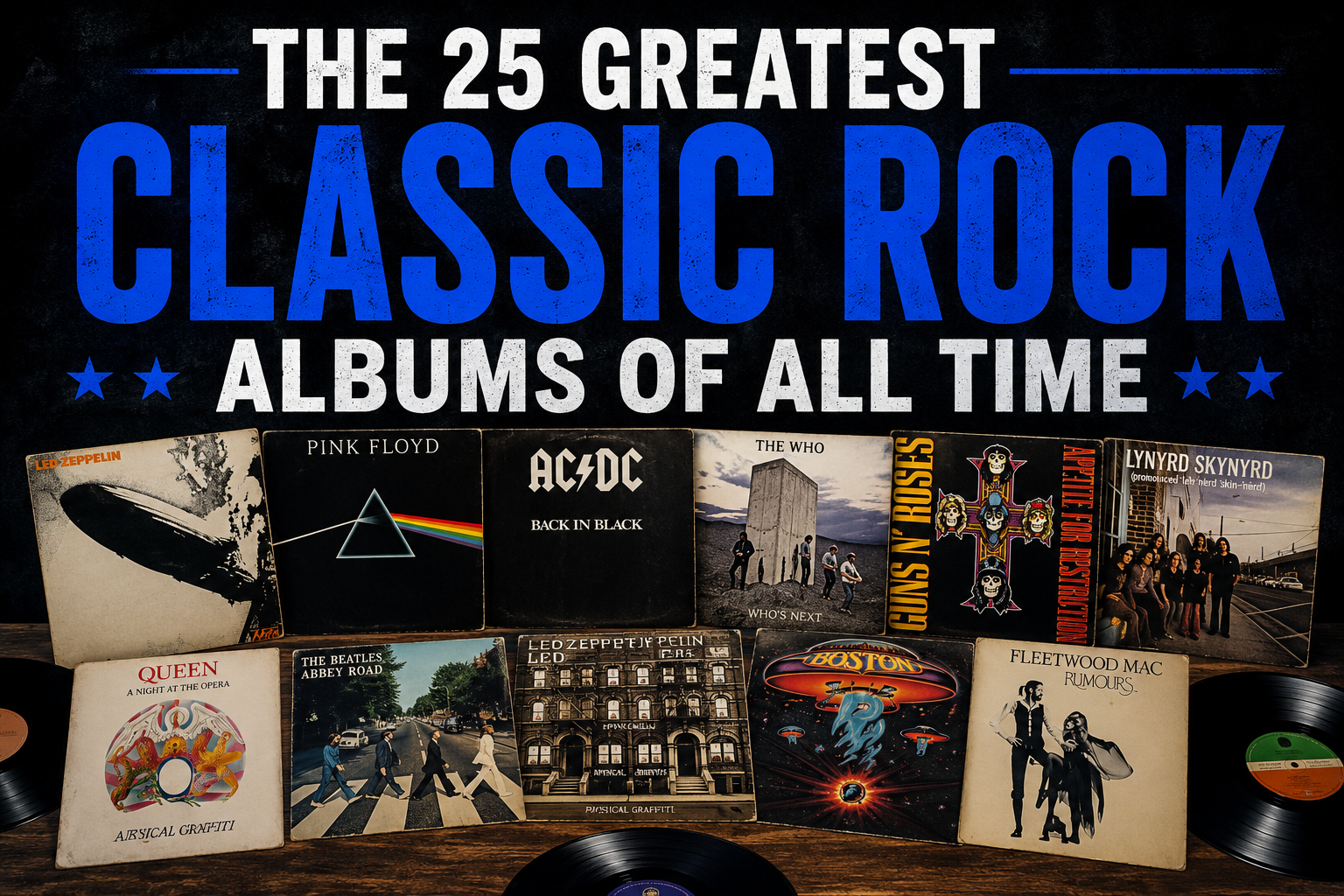
The 25 Greatest Classic Rock Albums of All Time
Classic rock never really disappeared — it just changed generations. These 25 albums didn't just sell millions of copies. They rewrote the rulebook, defined tones, and taught generations of guitarists what rock music could be.
Classic rock has never really disappeared. It has simply changed generations.
Every decade produces new stars, but few albums have managed to transcend time the way the records on this list have. These aren't simply collections of songs — they're cultural landmarks. They influenced countless musicians, changed the direction of guitar playing, sold millions of copies, and continue to inspire everyone from bedroom players to arena headliners.
Creating a definitive list is nearly impossible. Every fan has a favorite left off, every guitarist has a hill they're willing to die on, and every generation hears these records through a different lens. Rather than ranking albums purely by sales or critical acclaim, we've considered influence, songwriting, musicianship, production, longevity, and their impact on the evolution of rock music.
These are the 25 greatest classic rock albums ever recorded.
25. Boston — Boston (1976)
Few debut albums have exploded quite like Boston. Tom Scholz proved that a perfectionist working in a basement studio could out-produce major labels. "More Than a Feeling" remains one of rock's defining guitar songs, while the layered harmonies and soaring lead work helped define arena rock for decades.
Why It Matters: It rewrote what a debut album could sound like — and quietly established the multi-tracked guitar harmony as a rock production standard.
24. Creedence Clearwater Revival — Cosmo's Factory (1970)
John Fogerty somehow blended blues, country, swamp rock, and straight-ahead rock into an unmistakable sound. With "Travelin' Band," "Who'll Stop the Rain," "Run Through the Jungle," and "Lookin' Out My Back Door," it's almost a greatest-hits album disguised as a studio release.
Why It Matters: A masterclass in economy. Every note earns its place, every song lands within four minutes, and every riff sounds like it was carved out of pine.
23. Dire Straits — Brothers in Arms (1985)
Mark Knopfler never needed speed to become one of the greatest guitarists ever. His expressive phrasing on "Money for Nothing" and "Brothers in Arms" demonstrated that feel almost always wins over flash. The pristine production also helped make this one of the defining albums of the CD era.
Why It Matters: Proof that touch and tone can matter more than technique. Knopfler's fingerstyle voice remains one of the most recognizable in rock.
22. The Allman Brothers Band — At Fillmore East (1971)
Perhaps the greatest live rock album ever recorded. Duane Allman's slide guitar remains breathtaking, while Dickey Betts' melodic playing created one of history's greatest twin-guitar combinations. "Whipping Post" still serves as a masterclass in improvisation.
Why It Matters: It set the standard for what a live rock album should sound like — and made the twin-guitar attack a permanent part of the language.
21. Van Halen — 1984 (1984)
By 1984, Eddie Van Halen had already rewritten the guitar rulebook. This album expanded his legacy even further. "Panama," "Hot for Teacher," and "Jump" showcased a guitarist who wasn't afraid to embrace keyboards while remaining one of rock's most explosive players.
Why It Matters: Every guitarist who followed had to reckon with what Eddie made possible on this record.
20. Tom Petty & The Heartbreakers — Damn the Torpedoes (1979)
Tom Petty understood something many rock bands forgot: great songs never go out of style. Every riff serves the melody, every solo serves the song, and the result is an album that still sounds fresh four decades later.
Why It Matters: A songwriting bible for anyone who thinks a guitar's real job is to serve a vocal.
19. Lynyrd Skynyrd — (Pronounced 'Lĕh-'nérd 'Skin-'nérd) (1973)
Southern rock found its definitive statement. "Free Bird" became one of guitar's greatest epics, while "Simple Man" remains among the most emotional ballads ever written. Gary Rossington and Allen Collins crafted guitar harmonies that influenced generations.
Why It Matters: Set the blueprint for triple-guitar Southern rock — and delivered one of the most-requested solos of all time.
18. Fleetwood Mac — Rumours (1977)
Behind the interpersonal drama was one of the finest-produced albums in rock history. Lindsey Buckingham's understated but brilliant guitar work elevated every song, proving that restraint can be just as powerful as technical fireworks.
Why It Matters: The gold standard for pop-rock production and one of the best-selling albums ever. Every note is deliberate.
17. The Police — Synchronicity (1983)
Andy Summers transformed simple chord voicings into atmospheric masterpieces. His use of chorus, delay, and unusual harmonies inspired countless guitarists searching for texture instead of distortion.
Want This Tone?
Tell ToneMD what guitar and gear you own and we’ll show you how to get as close as possible using the equipment you already have — full signal chain, real numbered settings, no guesswork.
Included with The Guitar Plugged Premium
Why It Matters: It made "texture" a legitimate goal for rock guitar — a lesson The Edge, Johnny Marr, and countless others learned by heart.
16. AC/DC — Back in Black (1980)
Following Bon Scott's death, few expected AC/DC to survive. Instead, they produced arguably the greatest hard rock album ever recorded. Malcolm Young's rhythm guitar remains the gold standard, while Angus Young delivered riffs that every guitarist eventually learns.
Why It Matters: The definitive rhythm-guitar record. Every player who wants to know why feel beats flash should study Malcolm's right hand.
15. Eagles — Hotel California (1976)
Don Felder and Joe Walsh closed the album with arguably the greatest dual-guitar solo ever committed to tape. Beyond the title track, the songwriting, production, and musicianship remain nearly flawless.
Why It Matters: Made the two-guitar outro solo a permanent fixture of rock — and set an impossibly high bar for it.
14. Deep Purple — Machine Head (1972)
Every guitarist has played "Smoke on the Water." Yet reducing this album to a single riff ignores "Highway Star," one of the earliest examples of neoclassical guitar playing that influenced Randy Rhoads, Yngwie Malmsteen, and countless metal legends.
Why It Matters: Ritchie Blackmore's playing on this record is the missing link between blues-rock and neoclassical metal.
13. Guns N' Roses — Appetite for Destruction (1987)
Rock had become polished. Guns N' Roses made it dangerous again. Slash's Les Paul through a Marshall became one of the most recognizable tones in history, while songs like "Welcome to the Jungle" and "Sweet Child O' Mine" remain staples worldwide.
Why It Matters: The last great debut of the 20th century — and the record that ended the hair-metal era it was born into.
12. Aerosmith — Rocks (1976)
Ask Slash, Joe Perry, or Kirk Hammett about influential rock albums, and Rocks inevitably enters the conversation. Loose, dirty, bluesy, and unapologetically raw, it helped shape generations of hard rock.
Why It Matters: Half of Appetite-era Guns N' Roses and half of Metallica's early swagger trace directly back to this album.
11. ZZ Top — Eliminator (1983)
Billy Gibbons proved tone comes from the fingers long before the amplifier. By blending Texas blues with synthesizers and MTV-ready hooks, ZZ Top reached an entirely new audience without sacrificing their identity.
Why It Matters: A miracle of reinvention — a Texas blues band conquering MTV without giving up a shred of their sound.
“These albums weren't manufactured to chase trends or algorithms. They were created by musicians obsessed with pushing boundaries, writing unforgettable songs, and discovering new sounds.”
10. Black Sabbath — Paranoid (1970)
Tony Iommi essentially invented heavy metal after adapting his playing style following a factory accident. Every crushing riff on Paranoid laid the groundwork for decades of hard rock and metal to follow.
Why It Matters: The birth certificate of heavy metal. Everything heavy that came after owes it a royalty.
9. Led Zeppelin — Led Zeppelin IV (1971)
There may never be another album that combines acoustic beauty and sheer power so effortlessly. "Black Dog," "Rock and Roll," "Going to California," and "Stairway to Heaven" remain among rock's most iconic recordings.
Why It Matters: The album that turned Zeppelin from a great rock band into a myth.
8. Pink Floyd — The Dark Side of the Moon (1973)
David Gilmour reminds guitarists that every note matters. His bends, sustain, and phrasing continue to be studied by players who understand that emotion often outweighs speed.
Why It Matters: A record so gravitationally important it charted for fifteen straight years. Gilmour's solos are still the reference for expressive rock lead playing.
7. Queen — A Night at the Opera (1975)
Brian May built one of rock's most distinctive guitar voices using homemade equipment and limitless creativity. Combined with Freddie Mercury's songwriting, the result was an album unlike anything before or since.
Why It Matters: Nobody has ever sounded like Brian May — because nobody else built their own guitar, their own amp, and their own vocabulary from scratch.
6. Metallica — Master of Puppets (1986)
Technically, it's metal — but its influence stretches far beyond one genre. James Hetfield's rhythm playing became the benchmark for precision, while Kirk Hammett's melodic leads balanced aggression with memorable hooks.
Why It Matters: The high-water mark of thrash — and the record that dragged aggressive music into the mainstream a full three years before …And Justice for All.
5. The Who — Who's Next (1971)
Pete Townshend's windmill chords and innovative use of synthesizers pushed rock forward. "Baba O'Riley" and "Won't Get Fooled Again" remain stadium anthems decades later.
Why It Matters: Made the electric guitar and the synthesizer coexist without either giving ground. Townshend's power chords remain the most-copied rhythm tool in rock.
4. The Beatles — Abbey Road (1969)
The Beatles closed an era with astonishing maturity. George Harrison's emergence as one of rock's finest songwriters and guitarists is evident throughout, particularly on "Something" and "Here Comes the Sun."
Why It Matters: The band that invented modern rock signed off with a record that predicted the next fifty years of it.
3. Jimi Hendrix — Are You Experienced (1967)
Before Hendrix, the electric guitar had boundaries. After Hendrix, there were none. Feedback, fuzz, wah, controlled chaos, and breathtaking creativity permanently changed rock music forever.
Why It Matters: Every rock guitarist alive owes some fraction of their vocabulary to this album — often without realizing it.
2. The Rolling Stones — Exile on Main St. (1972)
Messy. Gritty. Dangerous. Human. Keith Richards perfected the art of imperfect rhythm guitar, creating grooves that countless musicians have tried — and failed — to duplicate.
Why It Matters: The most human-sounding rock record ever made. Its looseness is its argument.
1. Led Zeppelin — Physical Graffiti (1975)
No album better captures the limitless possibilities of classic rock. Jimmy Page effortlessly moves from crushing riffs to delicate acoustics, blues, folk, progressive rock, and Eastern influences. "Kashmir" alone altered the trajectory of rock guitar, while "Ten Years Gone," "Trampled Under Foot," and "In My Time of Dying" showcase a band operating at the absolute peak of its powers.
Rather than relying on a single signature sound, Physical Graffiti became a showcase for everything Led Zeppelin represented — experimentation, virtuosity, songwriting, and fearless ambition. More than fifty years later, it still feels impossibly modern.
Why It Matters: No other classic rock album covers this much ground this well. It's a double album that never sags — and it's the closest thing rock has to a mission statement.
Gear Inspired by the Legends
You don't need a vintage Marshall stack and a '59 Les Paul to chase these tones. A handful of modern staples get you closer than you'd think.
Final Thoughts
Every classic rock fan would reorder this list. Some will argue for Dark Side of the Moon at number one. Others would place Abbey Road, Back in Black, or Led Zeppelin IV at the summit.
That's the beauty of classic rock.
These albums weren't manufactured to chase trends or algorithms. They were created by musicians obsessed with pushing boundaries, writing unforgettable songs, and discovering new sounds. Long before streaming playlists and social media, these records spread through word of mouth, FM radio, record stores, and generations of guitarists determined to learn every riff by ear.
The greatest compliment you can pay any of these albums is to put them on, turn the volume up, and remember why rock music became timeless in the first place.
Frequently Asked Questions
- What makes an album a 'classic rock' album?
- Classic rock generally refers to guitar-driven rock recorded roughly between the late 1960s and the late 1980s — an era defined by album-oriented FM radio, virtuoso musicianship, and songs built to be played loud through real amplifiers. The best of them still sound modern because they were engineered around performance and songwriting rather than production trends.
- Why is Physical Graffiti ranked above Led Zeppelin IV?
- IV is the tighter, more radio-defining record, but Physical Graffiti covers more ground — crushing riffs, folk, blues, funk, and Eastern-inflected epics like Kashmir — without ever losing focus. It's the fullest expression of what Zeppelin, and by extension classic rock, could do.
- Where are Bruce Springsteen, U2, or Bob Dylan?
- Great artists, but this list is focused on guitar-driven classic rock albums where the guitar is the primary storytelling voice. A similar list for singer-songwriters or roots rock would look very different.
- Which of these albums is the best entry point for a new guitarist?
- Back in Black and Appetite for Destruction are the most direct guitar lessons on this list — every song is a riff clinic. From there, work backwards to Machine Head, Rocks, and Are You Experienced to hear where those bands got their vocabulary.
- What gear will get me close to these classic tones?
- A humbucker-loaded guitar (Les Paul, SG, or Epiphone equivalent), a mid-gain tube or modeling amp like a Marshall DSL40CR or Boss Katana, and a Tube Screamer-style overdrive will cover 80% of the classic rock playbook. Everything else is in your hands.
Related Articles
Experience-driven coverage, not algorithm bait.
- 20+ years of guitar playing experience
- Real-world retail experience at Guitar Center
- Thousands of hours testing guitars, amps, and pedals
- A community of 50,000+ guitar enthusiasts across platforms
- Partnerships with Fender, DistroKid, TrueFire, Card Chords, and Enya
- Editorial standards published openly — see how we test gear
Join The Guitar Plugged Newsletter
Weekly guitar stories, gear recommendations, and deep dives on the albums that shaped rock — straight to your inbox.
Ask GP
3 free questionsQuestions about The 25 Greatest Classic Rock?
Get a straight answer from The Guitar Plugged's knowledge engine.
Discussion (0)
Sign in to join the discussion.
Sign in to commentLoading comments…
Discover another guitar story
Swipe through our latest features, breaking news and iconic solos — one story at a time.
Open Swipe →More in Best Of Lists

The 15 Best '80s Metal Guitarists of All Time
From Eddie Van Halen and Randy Rhoads to George Lynch, Steve Vai and Dimebag Darrell, these are the players who made an entire generation want to turn the gain up.

20 Easy Guitar Riffs That Sound Way Harder Than They Are
Great riffs are not necessarily complicated riffs. Some of rock's most recognisable guitar moments are built from two strings, three chords and a rhythm that refuses to let go. Here are twenty of them — and how to make each one sound like the record.

Top 25 Classic Rock Bands of All Time
From Led Zeppelin and the Rolling Stones to Rush and the Allman Brothers, these are the 25 classic rock bands that shaped everything that followed — ranked on influence, songwriting, musicianship, longevity and legacy.