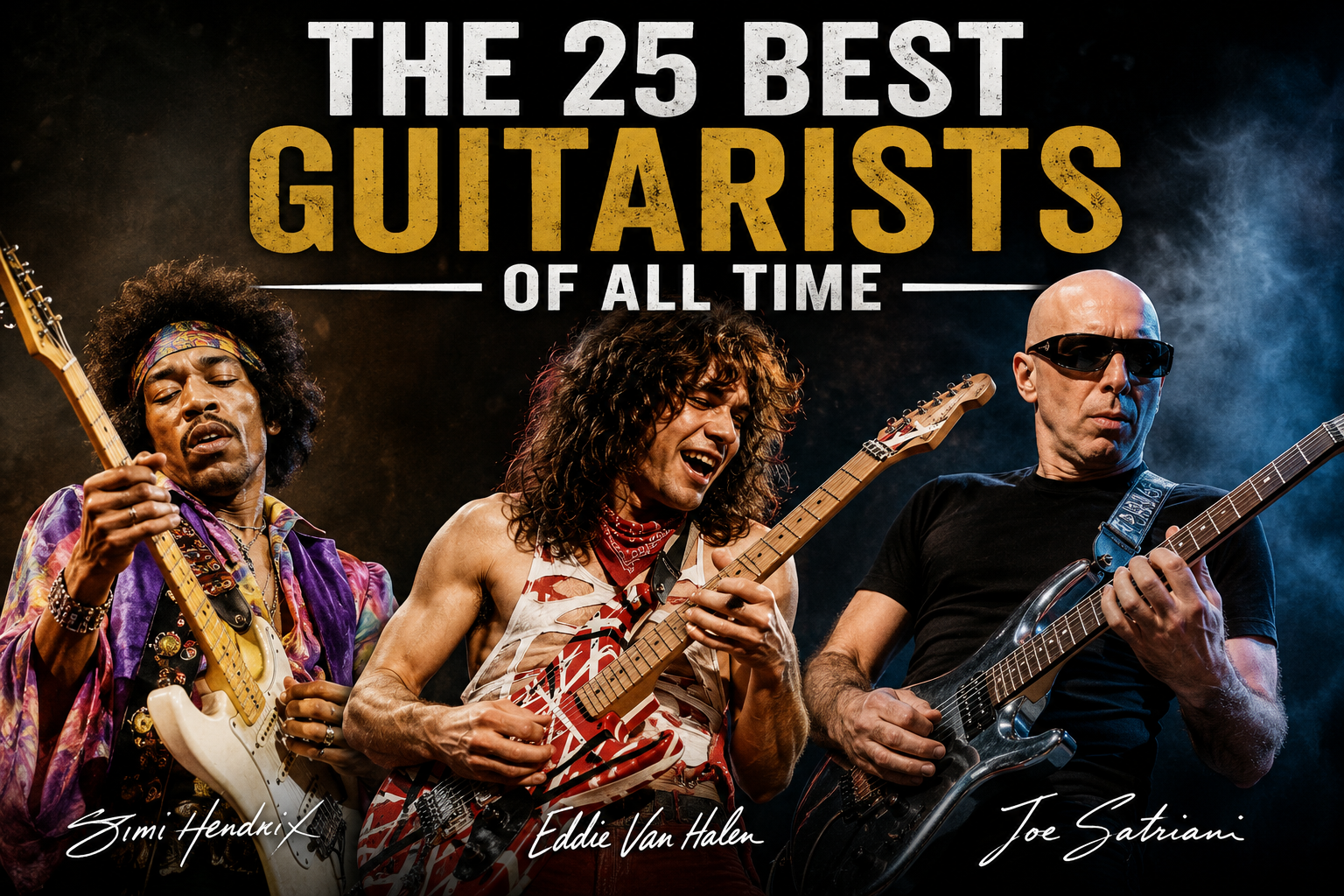
The 25 Most Influential Guitarists of All Time (Ranked)
From the man who invented the solid-body electric to the players who bent it into something new every decade — a definitive, storyteller's ranking of the 25 guitarists who shaped the instrument forever.
Every generation argues about the greatest guitarist of all time. The names shift, the criteria drift, and somebody always storms off when their favorite gets snubbed. That's part of the fun — but it's also why lists like this matter. Guitar didn't evolve in a straight line. It leapt forward in bursts, and almost every leap can be traced back to a single player who heard something nobody else heard yet.
This isn't a ranking of the fastest players, the most technically dazzling, or the ones who sold the most records. It's a ranking of influence — the guitarists who permanently changed how the instrument is built, played, recorded, and heard. Some are pioneers. Some are stylists. A few are simply irreplaceable.
We've drawn on decades of interviews, recordings, and gear archaeology to build this list, and yes, we've argued about it internally more than once. If you disagree with the order, good. Tell us at the bottom. But first, hear us out.
A great guitarist doesn't just play notes. They redraw the map for everyone who comes after.
25. Tom Morello
Tom Morello walked into Rage Against the Machine with a Harvard degree, a Fender Telecaster nicknamed "Sendero Luminoso," and a completely alien approach to the electric guitar. While his peers chased faster picking, Morello turned his instrument into a turntable, a siren, a scratching DJ, a broken transmission. On "Killing in the Name" and "Bulls on Parade," those squeals and stutters aren't effects — they're his hand on the pickup selector and the toggle switch, played in rhythm.
Signature gear: Fender Telecaster, Marshall JCM 800, DigiTech Whammy, Cry Baby wah, Boss DD-3 delay.
Tone: Dry, aggressive, mid-forward, with an almost mechanical bite in the pick attack.
Greatest recordings: Rage Against the Machine (1992), Evil Empire (1996), The Battle of Los Angeles (1999).
Why They Matter: Morello proved that innovation in guitar didn't have to mean more notes. It could mean fewer notes used in ways nobody imagined. Every modern guitarist who's ever exploited a killswitch, a Whammy pedal, or a pickup toggle for rhythmic effect owes him a nod.
24. Randy Rhoads
Randy Rhoads was 25 years old when a Beechcraft Bonanza clipped a tour bus in Florida and killed him. In his brief run with Ozzy Osbourne — barely two studio albums — he permanently changed heavy metal. Rhoads studied classical guitar with the same intensity he brought to arenas, and you can hear it in "Mr. Crowley," "Crazy Train," and the neoclassical fireworks of "Diary of a Madman." He harmonized guitar lines like a composer, not a rock star.
Signature gear: Jackson Rhoads V (custom polka-dot flying V), Karl Sandoval V, Marshall 1959 100-watt heads, MXR Distortion+.
Tone: Bright, articulate, aggressive but never muddy — every note stayed legible even at concert volume.
Greatest recordings: Blizzard of Ozz (1980), Diary of a Madman (1981), Tribute (1987, live).
Why They Matter: Rhoads legitimized classical technique in metal and inspired an entire generation of shredders — Zakk Wylde, Dimebag Darrell, Alexi Laiho, and countless others. If you love the story of Crazy Train, you already know why he's on this list.
23. Brian May
Brian May is a doctor of astrophysics who built his own guitar with his father in a London bedroom in 1963 using an oak fireplace mantel and motorcycle valve springs. That guitar — the Red Special — became Queen's entire orchestral guitar section. May played it with a sixpence coin instead of a pick, ran it through a wall of AC30 amps, and layered harmony parts three, five, sometimes nine deep.
Signature gear: Red Special (self-built), Vox AC30 stack, Dallas Rangemaster treble booster, sixpence coin.
Tone: Vocal, singing, violin-like sustain with unmistakable harmonic bloom.
Greatest recordings: "Bohemian Rhapsody," "Killer Queen," "Brighton Rock," "Fat Bottomed Girls."
Why They Matter: May treated the guitar as an orchestra, not a lead voice. That approach — stacked harmony guitars as compositional architecture — influenced everyone from Boston's Tom Scholz to Iron Maiden's Adrian Smith. Read our full Brian May tone guide for the settings and secrets.
22. Mark Knopfler
Mark Knopfler never used a pick. That single fact reshapes everything about his sound — the round attack, the fingerpicked triplets on "Sultans of Swing," the way his Strat sounds warm and human instead of glassy and thin. Knopfler is a storyteller first and a technician second, and his solos read like short fiction: setup, tension, resolution.
Signature gear: Fender Stratocaster (Schecter Strat-style guitars for most of Dire Straits' peak), Pensa-Suhr MK signature, Soldano SLO-100, various vintage tweed Fenders.
Tone: Round, warm, slightly compressed — the fingerstyle attack softens the Strat's top end into something closer to a jazz box.
Greatest recordings: "Sultans of Swing," "Money for Nothing," "Romeo and Juliet," "Brothers in Arms."
Why They Matter: Knopfler made restraint fashionable in an era of hair-metal excess. Every fingerstyle Strat player from John Mayer to Cory Wong owes him something. Our Sultans of Swing riff breakdown digs into exactly how he did it.
Knopfler proved a guitar solo could tell a story in three phrases and then get out of the way.
21. Dimebag Darrell
Darrell Abbott was the pulse of Pantera. His riffs on "Cowboys From Hell," "Walk," and "Cemetery Gates" essentially defined 1990s American metal, and his squealing pinch harmonics — the "Dime squeals" — became a whole vocabulary. Dimebag played with joy, and it came through the speakers even when the riff was pulverizing.
Signature gear: Dean ML (later the Washburn Dime series), Randall Century 200 solid-state heads, MXR Six Band EQ, Furman parametric EQ.
Tone: Sharp, scooped-mid, deliberately un-Marshall — a solid-state bite that shouldn't have worked and absolutely did.
Greatest recordings: Cowboys From Hell (1990), Vulgar Display of Power (1992), Far Beyond Driven (1994).
Why They Matter: Dimebag legitimized solid-state tone in the metal world when everyone else worshipped tubes, and he proved that groove — real, hip-shaking groove — could live inside genuinely heavy music.
20. David Gilmour
If you want a masterclass in patience, put on "Comfortably Numb" and listen to how long David Gilmour lets a bend hang before resolving it. Gilmour is the guitarist who taught the rock world that space between notes is as important as the notes themselves. His solos are architecture — built, not improvised.
Signature gear: Black Fender Stratocaster (the "Black Strat"), Hiwatt DR103 heads, Big Muff Pi, Colorsound Power Boost, TC 2290 delay.
Tone: Massive, singing, endlessly sustaining — a Strat that sounds like a cathedral organ.
Greatest recordings: The Dark Side of the Moon (1973), Wish You Were Here (1975), The Wall (1979).
Why They Matter: Gilmour turned the electric guitar into a lead vocal. Our full David Gilmour tone guide breaks down every pedal and setting.
19. Carlos Santana
You can identify Carlos Santana's tone in a single note. That's not hyperbole — the sustained, vocal, singing sound of a PRS through a Mesa Boogie has become one of the most instantly recognizable voices in popular music. Santana fused Latin percussion, jazz phrasing, and blues-rock into something completely original at Woodstock in 1969, and he's been refining it ever since.
Signature gear: PRS Santana signature, Dumble Overdrive Reverb, Mesa Boogie Mark I, Boogie Dual Rectifier.
Tone: Warm, thick, endlessly sustaining, with a soft violin-like top end.
Greatest recordings: Abraxas (1970), Caravanserai (1972), Supernatural (1999).
Why They Matter: Santana opened rock guitar to non-Anglo influences and made "world music" a mainstream conversation two decades before the term existed.
18. Chet Atkins
Chet Atkins is the reason country guitar sounds like country guitar. His thumbpick-and-fingers approach — bass line on the low strings, melody and chords on top, all played simultaneously — became known as the "Nashville sound," and it directly shaped everyone from Jerry Reed to Tommy Emmanuel to Mark Knopfler.
Signature gear: Gretsch 6120 Chet Atkins Hollow Body, Gretsch Country Gentleman, Standel amps, later custom Gibson Chet Atkins solidbodies.
Tone: Clean, articulate, chimey — the Gretsch's Filter'Tron humbuckers with just a hint of amp compression.
Greatest recordings: Mister Guitar (1959), Chet Atkins in Three Dimensions (1956), his production work on virtually every Nashville hit of the 1960s.
Why They Matter: As both a player and an RCA producer, Atkins essentially invented modern Nashville. Almost every fingerstyle guitarist on Earth is playing some derivative of his technique.
17. Kirk Hammett
Want This Tone?
Tell ToneMD what guitar and gear you own and we’ll show you how to get as close as possible using the equipment you already have — full signal chain, real numbered settings, no guesswork.
Included with The Guitar Plugged Premium
For a lot of guitarists born after 1975, Kirk Hammett was the first shredder they ever heard. His solos on "Master of Puppets," "One," and "Fade to Black" are among the most transcribed leads in modern metal — melodic, wah-drenched, and structured like little songs inside the bigger song.
Signature gear: ESP KH-2 (based on his "Mummy" Strat), Mesa Boogie Mark IIC+ and Rectifier, Cry Baby wah (rarely off), Tube Screamer.
Tone: Hot, saturated, wah-inflected, with a distinct scoop that cuts over Metallica's rhythm wall.
Greatest recordings: Ride the Lightning (1984), Master of Puppets (1986), …And Justice for All (1988).
Why They Matter: Hammett taught the wah pedal to a whole generation and helped make Metallica the most influential metal band of the last 40 years. More context in our Kirk Hammett guide.
16. John Mayer
John Mayer is the rare pop star who spent his fame becoming a better guitarist. Watch a John Mayer Trio bootleg from 2005, then a Dead & Company show from 2019, and you're watching a player who never stopped improving. His blues language is deep, his phrasing owes debts to Clapton and SRV in equal measure, and his tone chase is legendary.
Signature gear: PRS Silver Sky, Fender John Mayer Stratocasters, Two-Rock Studio Pro 35, Klon Centaur, Ibanez TS10.
Tone: Round, singing, slightly compressed — the polished cousin of SRV's Texas roar.
Greatest recordings: Continuum (2006), Try! (2005, John Mayer Trio), any Dead & Company "Eyes of the World."
Why They Matter: Mayer made blues guitar cool for a generation that came of age in the iPod era. Full argument in our piece on why he's better than you think.
15. George Harrison
George Harrison rarely gets ranked among the technical greats because he rarely tried to be one. Instead, he wrote guitar parts that were compositional, melodic, and unforgettable — the 12-string opening chord of "A Hard Day's Night," the slide work on "My Sweet Lord," the ringing arpeggios of "Something."
Signature gear: Rickenbacker 360/12, Gretsch Duo Jet, Gibson Les Paul "Lucy," Fender Rosewood Telecaster, Vox AC30.
Tone: Chiming, jangly, orchestral — always in service of the song.
Greatest recordings: Revolver (1966), Abbey Road (1969), All Things Must Pass (1970).
Why They Matter: Harrison invented the modern lead-guitar-as-melodic-hook — the reason your favorite indie band still writes solos that people sing along to.
14. Eddie Van Halen
Eddie Van Halen is not #1 on this list, but he might be the single most influential technical guitarist of the modern era. "Eruption," recorded in a single take in 1978, effectively split rock guitar into a before and after. Two-hand tapping, dive-bomb whammy techniques, harmonic squeals, the "Frankenstrat" that spawned the entire superstrat industry — Eddie did all of it first, or at least loudest.
Signature gear: Frankenstrat (later the EVH Wolfgang), 100-watt Marshall Super Lead, Variac (to run his amp at 90V), MXR Phase 90, MXR Flanger.
Tone: The "brown sound" — thick, saturated, chewy, with an unmistakable mid bloom.
Greatest recordings: Van Halen (1978), Van Halen II (1979), 1984 (1984).
Why They Matter: Every shredder from Steve Vai forward is standing on Eddie's shoulders. Read our full complete guide to Eddie Van Halen for the whole story.
Eddie didn't just play the guitar. He rewired its central nervous system.
13. Stevie Ray Vaughan
Stevie Ray Vaughan showed up in 1983 with Texas Flood and reminded America that the blues was still dangerous. He played with a heavier gauge string, a thicker pick, a Number One Strat with the frets worn down to the wood, and he attacked the guitar like it owed him rent. His tone is one of the most imitated — and least attainable — in electric guitar history.
X Concepts Strings • Made in USA
Never Run Out of Strings Again.
Join the X Concepts String Club and get fresh USA-made strings delivered every month—plus Premium membership options for the full Guitar Plugged experience.
Signature gear: "Number One" Fender Stratocaster (1963 body, 1962 neck), Dumble Steel String Singer, Fender Vibroverb, Ibanez Tube Screamer, .013-gauge strings.
Tone: Massive, aggressive, thick, with a stinging top end and an almost horn-like midrange.
Greatest recordings: Texas Flood (1983), Couldn't Stand the Weather (1984), In Step (1989).
Why They Matter: SRV saved electric blues from being relegated to nostalgia acts. Full deep dive in our Stevie Ray Vaughan tone guide.
12. Joe Satriani
Joe Satriani did something almost nobody thought was possible in the late 1980s: he sold millions of records without singing on any of them. Surfing With the Alien went platinum in 1987 and proved instrumental rock guitar could be commercially massive when the melodies were strong enough. Satriani is also the teacher's teacher — he taught Kirk Hammett, Steve Vai, Larry LaLonde, Alex Skolnick, and countless others.
Signature gear: Ibanez JS Series (JS2410 and JS1200 among the classics), Marshall JVM, Peavey JSX, Vox Big Bad Wah.
Tone: Legato-friendly, singing, slightly compressed, with a huge midrange bloom.
Greatest recordings: Surfing With the Alien (1987), Flying in a Blue Dream (1989), The Extremist (1992).
“Speed is a skill. Taste is a discipline. The greatest guitarists understood both.”
Why They Matter: Satch made instrumental guitar radio-friendly and inspired an entire generation to buy an Ibanez. Read our track-by-track on the Surfing With the Alien album.
11. Steve Vai
Steve Vai is what happens when a guitarist studies with Joe Satriani, then transcribes Frank Zappa charts for years, then decides to make guitar records that sound like film scores. His 1990 album Passion and Warfare remains one of the most technically ambitious solo guitar records ever made, and "For the Love of God" is arguably the most emotionally overwhelming shred instrumental ever written.
Signature gear: Ibanez JEM (with the famous "monkey grip"), Ibanez Universe 7-string, Legacy 100-watt heads, Morley Bad Horsie wah.
Tone: Massive, harmonically rich, endlessly sustaining, with cinematic effects on top.
Greatest recordings: Passion and Warfare (1990), Sex & Religion (1993), his work on David Lee Roth's Eat 'Em and Smile.
Why They Matter: Vai (and the Ibanez JEM) invented the modern superstrat as we know it. See our full Steve Vai guide.
10. Tony Iommi
Tony Iommi lost the tips of two fingers in a sheet-metal accident when he was 17. To keep playing, he detuned his guitar to lower string tension and built plastic thimbles for his damaged fingers. The result — heavier strings tuned lower and played with a lighter touch — became the sonic template for heavy metal.
Signature gear: Gibson SG Special (his "Monkey"), Laney LA100BL heads, Tycobrahe Parapedal wah, Rangemaster treble booster.
Tone: Dark, thick, grinding — the primordial soup of every metal tone since 1970.
Greatest recordings: Paranoid (1970), Master of Reality (1971), Vol. 4 (1972).
Why They Matter: Iommi invented heavy metal guitar. Not participated in it — invented it. See our Tony Iommi deep dive.
9. Slash
Slash is the last true guitar hero of the arena-rock era, and he's the reason a whole generation of kids talked their parents into a Les Paul. His solos on "Sweet Child O' Mine," "November Rain," and "Paradise City" are permanent installations in the classic-rock canon — bluesy, melodic, and somehow both effortless and enormous.
Signature gear: Gibson Les Paul Standard (many, but especially the '59 replica), Marshall JCM 800 2203, Cry Baby wah, MXR M234 Analog Chorus.
Tone: Woody, mid-forward, sustaining — the platonic ideal of a Les Paul through a cranked Marshall.
Greatest recordings: Appetite for Destruction (1987), Use Your Illusion I & II (1991), Slash's Snakepit (1995).
Why They Matter: Slash proved that pentatonic phrasing and a Les Paul into a Marshall never actually went out of style. Deep dive: Slash and the Sweet Child O' Mine solo.
8. Jimmy Page
Jimmy Page came up through the London session scene playing on hundreds of records before Led Zeppelin, and it shows — he thinks like a producer as much as a guitarist. The riff to "Whole Lotta Love," the intricate arrangement of "Stairway to Heaven," the mandolin-inflected acoustic work on "The Battle of Evermore" — Page understood that guitar was a studio instrument as much as a live one.
Signature gear: Gibson Les Paul "Number One," Danelectro 3021 (for slide and DADGAD), Fender Telecaster (early Zeppelin), Marshall Super Lead, Sola Sound Tone Bender.
Tone: Grainy, midrange-heavy, atmospheric — a Les Paul that sounds like it was recorded in a haunted stairwell (because sometimes it was).
Greatest recordings: Led Zeppelin II (1969), IV (1971), Physical Graffiti (1975).
Why They Matter: Page invented the modern hard-rock riff and half of modern guitar production. See our Stairway to Heaven breakdown and Whole Lotta Love story.
7. Chuck Berry
Chuck Berry didn't just influence rock guitar. He is rock guitar. That signature double-stop shuffle on "Johnny B. Goode" — the one every guitar player learns at 15 — was already in place by 1955. The duckwalk, the showmanship, the twangy hollowbody through a small combo — every guitar hero who came after him is running one of Chuck Berry's plays.
Signature gear: Gibson ES-350T, Gibson ES-355, Fender Dual Showman, tape-slap delay.
Tone: Twangy, sharp, cutting — meant to slice through a live band without a monitor system.
Greatest recordings: "Johnny B. Goode," "Maybellene," "Roll Over Beethoven," "You Never Can Tell."
Why They Matter: Keith Richards said it himself: "I lifted every lick he ever played." That's not an exaggeration — every player from Richards to Angus Young to Joe Perry is running Chuck Berry's playbook.
Chuck Berry didn't just influence rock guitar. Rock guitar is what Chuck Berry sounded like.
6. Duane Allman
Duane Allman died in a motorcycle accident at 24, and by then he'd already changed slide guitar forever. His slide work on Derek and the Dominos' Layla — recorded when he was 23 — is arguably the most soulful slide playing on any rock record. With the Allman Brothers, he built the twin-guitar improvisational language that essentially birthed Southern rock and jam-band culture.
Signature gear: Gibson Les Paul "Tobacco Burst" and "Cherry Burst," Marshall 50-watt heads, Coricidin medicine bottle (as a slide).
Tone: Warm, singing, midrange-rich — a Les Paul that sounds like it's crying.
Greatest recordings: At Fillmore East (1971), Layla and Other Assorted Love Songs (1970), Eat a Peach (1972).
Why They Matter: Duane invented Southern rock and set the standard for slide guitar. Our Layla riff history tells the story.
5. B.B. King
B.B. King played fewer notes than almost any guitarist on this list, and every one of them was the right one. His vibrato — a rapid butterfly-wing motion with the whole left hand — became a technique named after him. "The Thrill Is Gone," recorded in 1969, is a masterclass in how a single guitar can carry an entire arrangement.
Signature gear: Gibson ES-355 "Lucille," Lab Series L5 solid-state amp, later Fender Twin Reverb.
Tone: Warm, singing, hollow-body sweet — vocal in every sense.
Greatest recordings: Live at the Regal (1965), Completely Well (1969), Riding With the King with Clapton (2000).
Why They Matter: B.B. King is the single most important electric blues guitarist ever recorded. Clapton, Hendrix, SRV, Mayer — they all trace back to B.B.
4. Jeff Beck
Jeff Beck was the guitarist's guitarist. Ask any of the players on this list who they were terrified to play in front of, and half will say "Jeff Beck." He replaced Eric Clapton in the Yardbirds, invented feedback-as-instrument on "Shapes of Things," then spent the next 50 years reinventing his sound every album. By the end, he'd abandoned the pick entirely and was playing with his thumb, whammy bar, and volume knob like a synthesizer.
Signature gear: Fender Stratocaster, Marshall 100-watt heads, later Roland VG-8, DigiTech Whammy, Fernandes Sustainer.
Tone: Constantly evolving — from screaming Yardbirds distortion to whisper-clean fusion.
Greatest recordings: Blow by Blow (1975), Wired (1976), Truth (1968).
Why They Matter: Beck showed that the electric guitar could be a lifelong instrument of reinvention. No other player on this list evolved as radically or as continuously.
3. Eric Clapton
Before Clapton, blues guitar in England was an obscure art form for record collectors. After him, it was the foundation of rock and roll. His work with John Mayall's Bluesbreakers in 1966 — the "Beano album" — is the single record most responsible for the sound of every British rock band that followed. Then he did it again with Cream. And again with Derek and the Dominos.
Signature gear: Gibson Les Paul (Bluesbreakers era), Gibson SG "The Fool" (Cream), Fender Stratocaster "Blackie" and "Brownie" (later career), Marshall 1962 combo, Fender Twin.
Tone: "Woman tone" — thick, singing, midrange-heavy on the SG; later, glassy Strat clarity.
Greatest recordings: John Mayall's Bluesbreakers with Eric Clapton (1966), Disraeli Gears (1967), Layla and Other Assorted Love Songs (1970).
Why They Matter: Clapton is the reason "blues guitarist" became a viable career in rock. See our Sunshine of Your Love riff piece.
2. Jimi Hendrix
Jimi Hendrix had roughly four years as a headlining artist before he died at 27, and in that time he permanently reset what an electric guitar could sound like. "Purple Haze," "Little Wing," "Voodoo Child (Slight Return)," the Star-Spangled Banner at Woodstock — every one of them contains at least one moment nobody had ever coaxed out of six strings before.
Signature gear: Fender Stratocaster (played right-handed and flipped upside down), Marshall Super Lead 100, Fuzz Face, Uni-Vibe, Octavia, Vox wah.
Tone: Wild, feedback-drenched, endlessly expressive — the fuzz-drenched voice of an entire cultural moment.
Greatest recordings: Are You Experienced (1967), Axis: Bold as Love (1967), Electric Ladyland (1968).
Why They Matter: Almost every guitarist on this list has cited Hendrix as the reason they picked up the instrument. Deeper reading: our Purple Haze breakdown and top guitar tones list.
Everyone on this list influenced somebody. Hendrix influenced everyone.
1. Les Paul
There is no electric guitar without Les Paul. Not the instrument, not the recording technique, not the industry. Les Paul designed the first solid-body electric guitar — "The Log" — in 1940, when the entire guitar establishment thought he was insane. He invented multitrack recording, close-mic'ing, tape delay, and the concept of overdubbing. He then went on to have a hit-making career as a player, cutting virtuoso records with his wife Mary Ford in the 1950s that still hold up.
Every other guitarist on this list is playing his instrument, on his invention, using his production techniques. Every guitarist on Earth owes Les Paul a beer.
Signature gear: Gibson "Les Paul" (which he co-designed in 1952), his own "Log" prototype, custom-built amps, tape decks he modified himself.
Tone: Clean, articulate, bell-like — the sound of a solid-body played with jazz-schooled precision.
Greatest recordings: "How High the Moon" (1951), "Vaya Con Dios" (1953), "The World Is Waiting for the Sunrise" (1951).
Why They Matter: Les Paul didn't just influence guitar. He invented modern guitar as a discipline and as an industry. It's not remotely controversial to rank him #1 on any list of influence.
The Rig That Started It All: A Quick Comparison
Because so many players on this list are tied to a specific guitar, we've compressed the greatest hits into one table. Consider it a cheat sheet.
| Guitarist | Signature Guitar | Signature Amp | Iconic Track |
|---|---|---|---|
| Les Paul | Gibson "Les Paul" | Custom-built | "How High the Moon" |
| Jimi Hendrix | Fender Stratocaster | Marshall Super Lead | "Purple Haze" |
| Eric Clapton | Gibson Les Paul / Fender Strat | Marshall 1962 | "Sunshine of Your Love" |
| Jeff Beck | Fender Stratocaster | Marshall 100W | "Cause We've Ended as Lovers" |
| B.B. King | Gibson ES-355 "Lucille" | Lab Series L5 | "The Thrill Is Gone" |
| Jimmy Page | Gibson Les Paul | Marshall Super Lead | "Stairway to Heaven" |
| Slash | Gibson Les Paul Standard | Marshall JCM 800 | "Sweet Child O' Mine" |
| Eddie Van Halen | Frankenstrat / EVH Wolfgang | Marshall Super Lead | "Eruption" |
| Stevie Ray Vaughan | Fender Stratocaster "Number One" | Fender Vibroverb | "Texas Flood" |
| Tony Iommi | Gibson SG Special | Laney LA100BL | "Iron Man" |
| David Gilmour | Fender "Black Strat" | Hiwatt DR103 | "Comfortably Numb" |
| Brian May | Red Special | Vox AC30 stack | "Bohemian Rhapsody" |
| Mark Knopfler | Fender Stratocaster | Soldano SLO-100 | "Sultans of Swing" |
| John Mayer | PRS Silver Sky | Two-Rock Studio Pro | "Gravity" |
| Tom Morello | Fender Telecaster | Marshall JCM 800 | "Killing in the Name" |
Building Your Own Rig Inspired by the Legends
You don't need a $15,000 vintage burst to sound like these players. Half of the tones on this list came from modest gear that has since become collectible precisely because the players used it. If you want to chase these tones without taking out a second mortgage, we've built out a full section on how the modern working rig can get you 90% of the way there.
The other route is digital modeling. A Fractal FM3 or a Line 6 HX Stomp can convincingly emulate almost every amp on the list above, from a Vox AC30 to a JCM 800, and stack them with the pedals these players actually used. If you're chasing multiple tones in one box, that's the shortcut.
Frequently Asked Questions
Frequently Asked Questions
- Why is Les Paul ranked #1 over Jimi Hendrix?
- Because without Les Paul's inventions — the solid-body electric guitar, multitrack recording, tape delay, overdubbing — Hendrix literally has no instrument to play and no way to record what he played. Hendrix's *artistic* influence is arguably unmatched, but Les Paul's *foundational* influence is total. This is an influence ranking, not a coolness ranking.
- Where's Prince? Where's Django Reinhardt? Where's Angus Young?
- On our list of regrets. Any Top 25 leaves out great players — Django, Prince, Angus Young, Frank Zappa, Allan Holdsworth, and Yngwie Malmsteen all have legitimate cases. We chose players whose specific innovations you can trace directly into modern guitar language. That was our tiebreaker.
- What's the single most influential piece of gear on this list?
- The Gibson Les Paul, followed closely by the Fender Stratocaster. Between them, they account for more iconic recorded moments than the rest of the electric guitar world combined.
- Is this list biased toward classic rock?
- Somewhat, and deliberately. The classic-rock era (roughly 1965-1985) is when electric guitar was the dominant lead instrument in popular music. Almost every modern guitarist — regardless of genre — is still working with vocabulary invented during that window.
- How did you decide the ranking order?
- We weighed four criteria: technical innovation, tonal influence, cultural impact, and how directly other guitarists cite them. Players who scored high across all four (Les Paul, Hendrix, Clapton, Beck) ranked higher than players who dominated one category only.
The Verdict
Ranking guitarists is a fool's errand and also completely irresistible. What makes this list stand up is that every player on it changed the language of the instrument in a permanent, traceable way. Take any one of them out and modern guitar sounds different.
That said, no list is ever settled. We left off Robert Fripp. We left off Django Reinhardt (an omission we'll defend and regret in equal measure). We left off Prince, who was arguably one of the most complete guitarists of the last 50 years. We left off Frank Zappa, Allan Holdsworth, Wes Montgomery, Yngwie Malmsteen, Angus Young, and probably your personal favorite.
So — what do you think? Who would make your Top 25? Drop your list in the comments below. Argue with us. Tell us who we snubbed. That's what these lists are for.
For more countdowns and deep dives, check out our Top 25 Guitar Solos, the Top 25 Guitar Riffs, and the Top 10 Guitar Tones of All Time.
- Boss Katana MkII 100W Combo Amplifier$399·Check on Amazon →
- Dunlop PVP101 Variety Pick Pack (12-Pack)$6·Check on Amazon →
- D'Addario EXL110 Nickel Wound Electric Guitar Strings (.010-.046)$8·Check on Amazon →
Some links are affiliate links — we may earn a small commission at no cost to you.
Experience-driven coverage, not algorithm bait.
- 20+ years of guitar playing experience
- Real-world retail experience at Guitar Center
- Thousands of hours testing guitars, amps, and pedals
- A community of 50,000+ guitar enthusiasts across platforms
- Partnerships with Fender, DistroKid, TrueFire, Card Chords, and Enya
- Editorial standards published openly — see how we test gear
Get more deep dives like this in your inbox.
Weekly features on the players, gear, and stories that shaped electric guitar — from The Guitar Plugged editorial team.
Ask GP
3 free questions a dayStill curious? Ask GP about this story.
Your personal classic-rock and guitar guide — ask anything about The 25 Most Influential Guitarists.
Discussion (0)
Sign in to join the discussion.
Sign in to commentLoading comments…
Discover another guitar story
Swipe through our latest features, breaking news and iconic solos — one story at a time.
Open Swipe →More in Best Of Lists
Top 15 Guitar Intros You Know in One Second
Some songs need a chorus to announce themselves. These barely need the guitarist to get started — 15 intros ranked on recognition, personality, and pure gut reaction.
20 Songs That Made an Entire Generation Want to Play Guitar
Every guitarist has one: the song that made a guitar feel less like an object and more like a doorway. These 20 didn't just become classics — they created players.
Top 20 Guitarists Defined by One Solo
One unforgettable guitar moment can turn a great player into a permanent part of rock history. These are the 20 guitarists most defined by a single solo.