
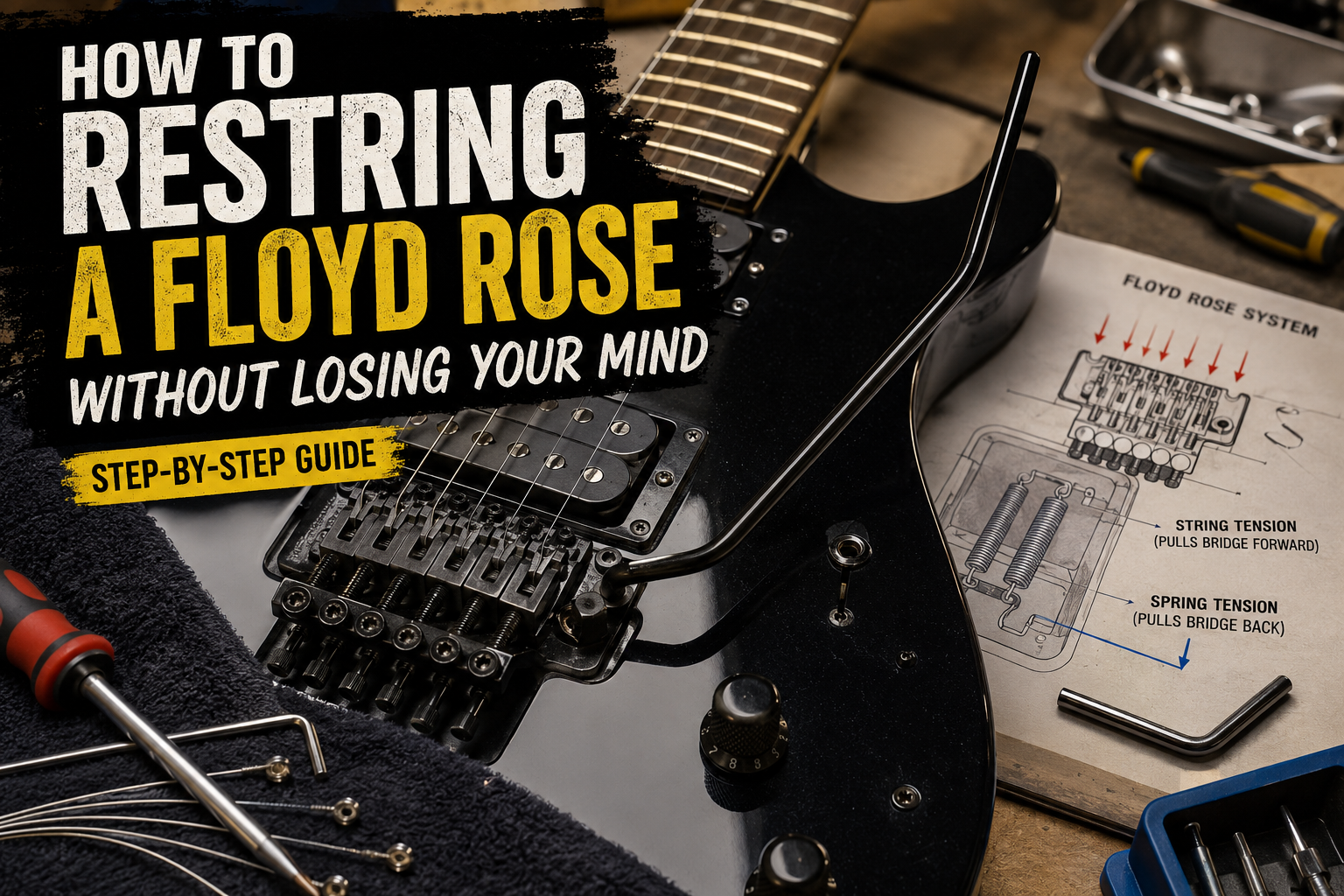
How to Restring a Floyd Rose Without Losing Your Mind
A detailed beginner-friendly guide to restringing a Floyd Rose guitar — bridge blocking, fine tuners, locking nut setup, spring tension, diagrams, and common mistakes.
Some links below may be affiliate links. If you buy through them, The Guitar Plugged may earn a small commission at no extra cost to you. Thanks for keeping the lights on at the Garage.
A Floyd Rose can feel like a cursed puzzle box the first time you restring it. You tune one string, another drops. You tighten the bridge, the whole thing tilts forward. You stretch the strings, everything goes sharp. Then you question every life choice that led you to owning a floating tremolo.
Relax.
A Floyd Rose is not impossible. It just follows a different set of rules. Once you understand the balance between string tension and spring tension, the whole system starts to make sense.
This guide will walk you through the entire process step by step.
What You'll Need
New strings. Wire cutters. A 3mm Allen wrench. A string winder. A tuner. A small cloth or towel. Optionally: a tremolo block, eraser, 9V battery, folded cardboard, or stack of picks for blocking the bridge. Fretboard cleaner and a microfiber cloth are nice to have.
The Big Rule: Change One String at a Time
With a regular hardtail guitar, you can remove all the strings at once. With a Floyd Rose, don't do that — unless you're also cleaning the fretboard, changing gauges, or doing a full setup.
The easiest method: remove one string, replace it, tune it close, then move to the next. This keeps the bridge from collapsing backward into the body.
Diagram 1: How a Floyd Rose Balances
STRING TENSION pulls the bridge forward

E  A  D  G  B  e
|  |  |  |  |  |
v  v  v  v  v  v

        [ FLOYD ROSE BRIDGE ]
              /
             /
            /   <- Bridge tilts forward if string tension wins


SPRING TENSION pulls the bridge backward

Back cavity:
[Spring] [Spring] [Spring]
     \      |      /
      \     |     /
       [ Trem Claw ]
A Floyd Rose floats because two forces are fighting each other: the strings pull the bridge forward, and the springs in the back pull it backward. Your job is to keep the bridge level.
Step 1: Unlock the Nut
At the top of the neck, you'll see three locking clamps. Use the correct Allen wrench and loosen each clamp. You don't need to remove them — just enough so the strings move freely.
[LOCKING NUT]
 +-----+-----+-----+
 | E/A | D/G | B/e |
 +-----+-----+-----+

Loosen these before restringing.
Important: once the nut is unlocked, use the regular tuners on the headstock.
Step 2: Set the Fine Tuners in the Middle
Before removing strings, look at the fine tuners on the bridge. Set each one about halfway — not fully tight, not fully loose. Right in the middle.
Why? Because after you lock the nut later, the fine tuners are what you'll use for small tuning adjustments.
Fine tuner range:

Too loose       Perfect starting point       Too tight
   |-------------------|-------------------|
                       ^
                    Start here
Step 3: Block the Bridge
This is the trick that saves your sanity. Place something soft but firm under the back of the bridge to keep it from sinking when string tension changes.
You can use a trem block, folded cardboard, a stack of picks, a 9V battery wrapped in cloth, or a small eraser. Goal: keep the bridge close to level while restringing. Don't use anything that will scratch the finish.
Side view

Correct floating position:

Body   ----------------------
Bridge ----------------
           ^
      Level with body


Blocked bridge:

Body   ----------------------
Bridge ----------------
        [ BLOCK ]
Step 4: Remove One String
Start with the low E. Loosen the string at the tuner until it has no tension, then go to the bridge saddle and loosen the small string lock screw at the back of the saddle.
Bridge saddle

String enters here
      v
 +--------------+
 |   Saddle     |
 |              |  <- small block clamps string
 +------+-------+
        |
  Lock screw here
Once loose, pull the old string out.
Step 5: Cut the Ball End Off the New String
On most Floyd Rose bridges you don't use the ball end. Cut it off.
Normal string:

Ball end ----===========================


For Floyd Rose:

CUT HERE
   v
 X Ball end ----=========================
You insert the freshly cut end into the bridge saddle.
Step 6: Insert the String Into the Saddle

X Concepts Strings • Made in USA
Never Run Out of Strings Again.
Join the X Concepts String Club and get fresh USA-made strings delivered every month—plus Premium membership options for the full Guitar Plugged experience.
Push the cut end of the string into the saddle. Hold it straight. Tighten the saddle lock screw. Don't Hulk-smash it — snug is enough. Overtightening can strip the screw or crush the string block.
Step 7: Run the String Through the Tuner
Pull the string through the tuning post. Leave just a little slack — most strings only need 1–2 wraps around the post. Thinner strings can take slightly more.
Good wrap:

Tuning post:
   ||
   ||==== string
  /||
 / ||


Bad wrap:

Too many messy wraps = tuning problems
“A Floyd Rose isn't fighting you. That's just physics.”
Tune the string roughly to pitch. Don't obsess yet.
Step 8: Repeat for All Six Strings
Same process for each string: loosen old string, unlock at the saddle, cut the ball end off the new string, clamp it into the saddle, run it through the tuner, tune close, move on. Recommended order: low E → A → D → G → B → high E.
Step 9: Stretch the Strings
Once all six are installed, stretch them gently. Grab each string around the 12th fret and pull upward slightly. Don't yank like you're starting a lawn mower. Stretch, retune, stretch again.
String stretching:

Nut ---------------- 12th fret ---------------- Bridge
                         ^
                    gently pull here
This helps the strings settle before you lock the nut.
Step 10: Tune in Small Passes
This is where people lose their minds. Don't fully tune one string and expect the rest to stay perfect. Tune in passes: low E close, A close, D close, G close, B close, high E close — then repeat the entire process.
Each time you tune one string the bridge moves slightly, which affects the others. That's normal.
Step 11: Check the Bridge Angle
Look at the side of the bridge. The baseplate should be roughly parallel with the guitar body.
Correct:

Body    ---------------------
Bridge  ---------------------


Bridge tilted forward:

Body    ---------------------
Bridge        /--------------


Bridge tilted backward:

Body    ---------------------
Bridge  ---------------\
Level? You're good. Tilted forward? The strings are pulling too hard. Tilted backward? The springs are pulling too hard.
Step 12: Adjust the Spring Claw If Needed
Flip the guitar over and open the back cavity. You'll see springs connected to a claw with two screws.
Back cavity

   Spring    Spring    Spring
     \         |         /
      \        |        /
       +--------------+
       |  Trem Claw   |
       +---+------+---+
           |      |
        Screw   Screw
If the bridge tilts forward, tighten the claw screws slightly (about a quarter turn clockwise each). If it tilts backward, loosen them slightly (a quarter turn counterclockwise). Always adjust both screws evenly, then retune. This may take a few rounds.
Step 13: Remove the Bridge Block
Once the guitar is close to pitch and the bridge is level, gently remove the block. The bridge may move a little — that's normal. Retune again.
Step 14: Lock the Nut
Once tuning is stable, lock the nut clamps back down. Snug, not crushed. After locking the nut, your headstock tuners are basically out of the equation — from here, use the fine tuners on the bridge.
Step 15: Final Tune With Fine Tuners
Use the bridge fine tuners to dial everything in. If you set them halfway earlier, you'll have plenty of room to adjust sharp or flat.
Common Floyd Rose Mistakes
Taking all strings off at once can collapse the bridge backward and turn a simple restring into a full setup. Forgetting to unlock the nut means cranking the tuners does nothing good. Not centering the fine tuners leaves you no adjustment room later. Changing string gauge without adjusting springs — going from 9s to 10s adds tension, going from 10s to 9s reduces it; either way the bridge needs adjustment. Overtightening the saddle blocks strips hardware. And expecting it to tune like a hardtail — a Floyd needs several tuning passes because the whole system floats.
What String Gauge Should You Use?
For standard tuning: 9–42 gives easy bends, classic shred feel, less tension. 10–46 is balanced, stronger rhythm tone, slightly more stable. 9–46 is a hybrid set — easy leads with tighter low strings. 10–52 suits drop tunings, heavier rhythm playing, and modern rock. For most Floyd Rose guitars, 9–42 or 10–46 is the safest starting point.
The Guitar Plugged's Favorite String Brands
Easy go-to choices: Ernie Ball Regular Slinky 10–46, Ernie Ball Super Slinky 9–42, D'Addario XL 10–46, D'Addario XL 9–42, Elixir Nanoweb 10–46, Stringjoy Custom Sets, and DR Strings Tite-Fit. For Floyd Rose guitars, consistency matters — if your guitar is set up for 9s, stay with 9s unless you're ready to adjust spring tension.
Quick Floyd Rose Restring Checklist
[ ] Unlock nut
[ ] Set fine tuners halfway
[ ] Block bridge
[ ] Change one string at a time
[ ] Cut ball ends off strings
[ ] Clamp strings at saddles
[ ] Tune close
[ ] Stretch strings
[ ] Tune in repeated passes
[ ] Check bridge angle
[ ] Adjust spring claw if needed
[ ] Remove block
[ ] Final tune
[ ] Lock nut
[ ] Fine tune at bridge
Final Thoughts
A Floyd Rose is not hard once you stop treating it like a normal bridge. The secret is balance. The strings pull one way. The springs pull the other. Your job is to keep the bridge level while bringing everything up to pitch.
Once you get the process down, restringing a Floyd Rose goes from nightmare fuel to just another part of owning a serious rock machine. Take your time, change one string at a time, block the bridge, and don't panic when the tuning moves around at first. That's not the guitar fighting you. That's just physics.
Block the bridge. Center the fine tuners. Change one string at a time. Tune in passes. Lock the nut last. Do those five things and the Floyd Rose stops being scary forever.
- Ernie Ball Regular Slinky 10–46$7·Check on Amazon →
- Ernie Ball Super Slinky 9–42$7·Check on Amazon →
- D'Addario XL Nickel Wound 10–46$8·Check on Amazon →
- D'Addario XL Nickel Wound 9–42$8·Check on Amazon →
- DR Strings Tite-Fit$9·Check on Amazon →
- Stringjoy Electric Guitar Strings$11·Check on Amazon →
Some links are affiliate links — we may earn a small commission at no cost to you.
Experience-driven coverage, not algorithm bait.
- 20+ years of guitar playing experience
- Real-world retail experience at Guitar Center
- Thousands of hours testing guitars, amps, and pedals
- A community of 50,000+ guitar enthusiasts across platforms
- Partnerships with Fender, DistroKid, TrueFire, Card Chords, and Enya
- Editorial standards published openly — see how we test gear
The Modern Guitar Magazine. Delivered to your inbox.
No spam. No gimmicks. Just great guitar content — stories, tones, iconic solos, and honest gear takes. Every week.
Ask GP
3 free questions a dayStill curious? Ask GP about this story.
Your personal classic-rock and guitar guide — ask anything about How to Restring a Floyd.
Discussion (0)
Sign in to join the discussion.
Sign in to commentLoading comments…
Discover another guitar story
Swipe through our latest features, breaking news and iconic solos — one story at a time.
Open Swipe →More in Guitar Garage
10 Things Every Gigging Guitarist Needs (And the One Thing They Always Forget)
Every guitarist obsesses over amps and pedals, but smooth gigs come down to preparation. Here are 10 essentials every gigging guitarist needs — plus the one thing almost everyone forgets.
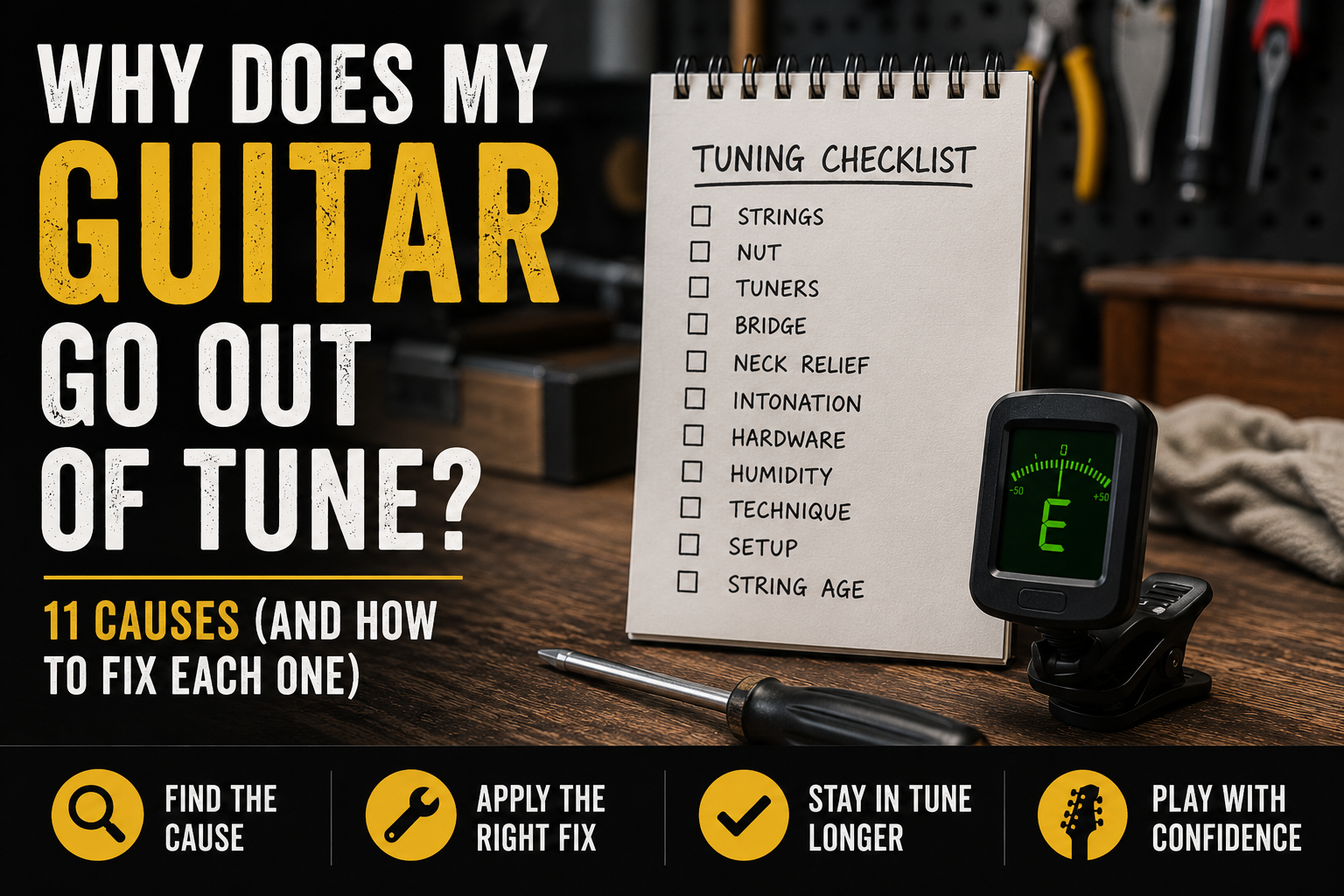
Why Does My Guitar Go Out of Tune? 11 Causes (And How to Fix Each One)
Discover the 11 most common reasons guitars go out of tune and learn practical fixes to keep your instrument stable and sounding its best.

How to Record Guitar at Home (And Actually Get a Professional Sound)
From your very first riff to a polished recording — everything you need to know without wasting money on gear you don't need.