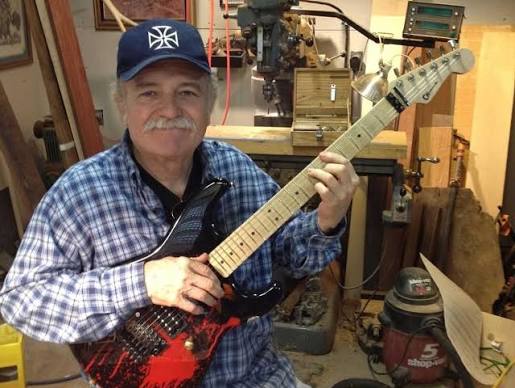
Wayne Charvel: The Man Who Helped Reinvent the Electric Guitar
Before the high-performance electric guitar became a product category, players and builders were quietly inventing it in Southern California repair shops. Wayne Charvel was standing at the center of that shift.
In the early 1970s, Southern California was quietly becoming one of the most important places in the world for the electric guitar — and almost nobody outside the local scene realized it yet.
Guitarists were beginning to ask more of their instruments than the major manufacturers were willing to build.
They wanted hotter pickups. Faster necks. Bright, aggressive finishes that looked nothing like a 1959 sunburst. Rewired electronics. Replacement bodies. Tremolos that could take a beating. Instruments tuned around the increasingly aggressive style of hard rock that was taking shape on the same freeways where custom cars had been trading paint for two decades.
The Fender and Gibson catalogs of the period were not designed around any of that.
So a small handful of builders and modifiers stepped into the gap.
One of them was Wayne Charvel.
Long before Charvel became a globally recognized brand associated with pointy headstocks, neon graphics and 1980s virtuosos, it was a repair shop with a hand-painted sign and a stack of guitars in various states of surgery. Before the high-performance electric guitar was a product category, it was a philosophy being worked out in a small shop in Azusa, California.
This is the story of the man who helped shape that philosophy — and of how a single Southern California repair bench quietly redirected the future of the electric guitar.
What to Remember
- ▸Wayne Charvel opened Charvel's Guitar Repair in Azusa, California in 1974, building a business around repair, refinishing and aftermarket parts.
- ▸His shop became part of the Southern California ecosystem that surrounded a young Eddie Van Halen and the early hot-rodded guitar scene.
- ▸Wayne sold his interest in the Charvel business to Grover Jackson in 1978 — most famous production-era Charvel guitars were developed after his departure.
- ▸The Superstrat, as we know it, grew out of the customization philosophy Wayne helped establish, not from a single guitar he personally built.
- ▸After leaving Charvel, Wayne kept building under his own name, including Wayne Guitars, staying committed to player-focused American-made instruments.
Before Charvel Was a Guitar Brand
Wayne Charvel did not arrive at guitar building through a music school or a factory apprenticeship. He arrived through paint.
His early trade was sign painting and spray finishing — a background that would matter more than it might sound. Refinishing an electric guitar to a professional standard is not something a hobbyist stumbles into. It requires an understanding of prep work, grain filling, color matching, spray technique and how lacquer behaves as it cures. Wayne had that vocabulary before he ever became a name in guitar circles.
In the early 1970s, that skill set found its way to Fender.
According to Wayne Charvel's own recollections in interviews over the years, he spent a period doing out-of-warranty refinishing work associated with Fender instruments — the kind of jobs a factory did not particularly want to handle in-house. It was steady, technical work, and it put him in close contact with real players' guitars: what they were doing to them, what they were breaking, what they wished they could change.
That was the education.
By the time he was ready to open his own doors, he already understood what most working guitarists wanted. Not another catalog instrument. Something closer to what was in their heads.
Charvel's Guitar Repair Opens
In 1974, Wayne Charvel opened Charvel's Guitar Repair in Azusa, a small town tucked against the foothills east of Los Angeles.
On paper, it was a repair shop. In practice, it was something more.
Charvel's Guitar Repair handled the ordinary things — fret jobs, setups, refinishes, rewires, broken headstocks glued back together for local players who could not afford to replace a guitar. But it also traded in what would eventually become an entire industry: aftermarket bodies, aftermarket necks, replacement pickups, hardware upgrades and one-off custom finishes for players who wanted something a factory would never build.
That mattered enormously in the 1970s.
Guitarists were no longer content to accept whatever came in a Fender or Gibson case. They wanted to modify. To personalize. To turn a stock instrument into something built around a specific sound and a specific pair of hands. If you can imagine a small shop where a Stratocaster body sits on a workbench next to a routed humbucker cavity, a can of custom paint and a stack of unbranded necks waiting for a fret job, you have a fair picture of where guitar culture was heading and who was helping it get there.
That was Charvel's Guitar Repair.
The shop became a hub — a place where working players, session guys and local rock musicians dropped off instruments and picked up something better than what they left behind.
The Guitar Plugged may earn a commission from qualifying purchases made through affiliate links in this article, at no additional cost to you.
When Guitars Became Hot Rods
It is not a coincidence that this happened in Southern California.
The region already had a mature hot-rod culture. Since the 1940s, Californians had been taking mass-produced Fords and Chevys apart and reassembling them into something faster, meaner and more personal. Bigger engines. Different carburetors. Lowered stances. Custom paint. It was not about rejecting the original car — it was about refusing to leave it alone.
The electric guitar was heading toward exactly the same idea.
By the mid-1970s, a Stratocaster in the hands of a serious rock player often looked nothing like the one on the wall at a music store. Pickups had been swapped for hotter units. Selector switches had been rewired. Tremolo systems had been reworked or replaced entirely. The finish, in many cases, was no longer the finish that had left the factory. Some guitars had been stripped, sanded, refinished, re-fretted and re-electronic'd so many times that only the neck plate remembered where they started.
Wayne Charvel's background as a painter was almost tailor-made for this moment.
He could make a guitar look like nothing else in the room. Bold colors. Graphics. Custom finishes that would have been unthinkable coming out of a big American factory. That visual language — a Strat body sprayed in a color that belonged on a car cowl — became part of the identity of what would eventually be called the high-performance rock guitar.
The hot-rodded electric guitar was not born in a boardroom.
It was worked out in shops like his, one modification at a time.
The Eddie Van Halen Connection

X Concepts Strings • Made in USA
Never Run Out of Strings Again.
Join the X Concepts String Club and get fresh USA-made strings delivered every month—plus Premium membership options for the full Guitar Plugged experience.
You cannot tell this story without talking about Eddie Van Halen. But you also have to tell it carefully.
By the late 1970s, Eddie was doing what other Southern California guitarists were doing, only more radically. He was building his own instruments from parts. Bolting a humbucker into a Stratocaster-style body. Wiring a single volume knob. Painting the whole thing himself with masking tape and rattle cans. The instrument that would eventually be known as the Frankenstein is often cited as the visual and sonic beginning of the modern hot-rodded electric guitar.
The Charvel shop existed inside that same ecosystem.
Wayne Charvel has recalled, in various interviews over the years, providing Eddie with guitar parts — the kind of bodies, necks and pieces a young player would need to keep building and rebuilding instruments to his own specifications. The exact details vary between sources, and the folklore around Eddie's early gear is famously tangled. What is clear is that the Charvel shop was one of the local stops in a scene where an entire wave of players was starting to reject factory guitars in favor of something they built themselves.
“Before the high-performance electric guitar was a product category, it was a philosophy being worked out in a small shop in Azusa, California.”
It is worth being precise here. Wayne Charvel did not personally build the Frankenstein. That guitar was Eddie's own project, assembled from parts sourced from multiple places, and Eddie has always described it as his creation. The relationship between Wayne's shop and Eddie's early instruments is real, but it is a relationship of parts, atmosphere and shared philosophy — not a single mythic assembly.
What matters historically is bigger than any one guitar.
By the late 1970s, players like Eddie were no longer waiting for a major manufacturer to give them their ideal instrument. They were assembling those instruments themselves, with the help of shops like Wayne Charvel's. That shift — the shift from consumer to co-designer — is one of the most important developments in the history of the electric guitar. For a deeper look at how Eddie shaped the sound that grew out of these instruments, see our ultimate guide to Eddie Van Halen and the "Eruption" deep dive.
The Sale to Grover Jackson
In 1978, Wayne Charvel sold his interest in the Charvel business to Grover Jackson.
It is one of the most important dates in this whole story, and one of the most misunderstood.
The Charvel brand that most guitarists picture — the pointy headstocks, the bright graphic finishes, the artist relationships that turned the name into a symbol of 1980s rock — was largely developed after Wayne's departure, under Grover Jackson and his team. That version of Charvel, along with the Jackson brand that would soon spin out of the same workshop, took the customization philosophy Wayne had helped establish and turned it into complete guitars sold under their own names.
It is important to separate the two.
Wayne Charvel personally sold the business in 1978. The mass-produced, artist-driven Charvel and Jackson instruments that became iconic across the 1980s were designed and built under Grover Jackson's ownership, using ideas that had continued to evolve after Wayne stepped away.
Put simply: Wayne created the workshop culture. Grover built the brand that the culture eventually became.
Both parts of that story matter. Neither is complete without the other.
The Rise of the Superstrat
By the middle of the 1980s, guitar players had a new word for what all of these modifications had become: the Superstrat.
The Superstrat took the familiar double-cutaway Stratocaster shape and pushed almost every specification in a more aggressive direction. Humbucker pickups replaced single coils, often loaded hot for maximum output. Necks became thinner, faster and often ended in a pointy headstock. Rosewood or ebony fingerboards carried 22 or 24 frets instead of the traditional 21. Locking tremolo systems — most famously the Floyd Rose — allowed players to dive-bomb, pull chords sharp and abuse the whammy bar in ways that would have destroyed a vintage Fender in minutes. Finishes were louder, sharper, more graphic.
This was the guitar equivalent of a factory-built hot rod.
Charvel, under Grover Jackson's ownership, became one of the defining names in that movement. So did Jackson itself, along with a handful of other American and Japanese builders operating in the same space. But the philosophy powering all of it — take the familiar instrument and hot-rod it for the modern rock player — was the exact philosophy that Wayne Charvel's Azusa shop had been quietly practicing since 1974.
Many of the artists most closely associated with the classic Charvel and Jackson era became famous after Grover Jackson took ownership. That is where the timeline distinction matters: the early Charvel shop under Wayne shaped the culture; the later Charvel brand under Grover shaped the roster.
For a broader look at where these instruments still sit in the modern gear landscape, see our roundup of the best metal guitars of 2026, which shows just how much of today's high-performance market still traces back to these ideas.
Wayne Charvel After Charvel
It would be easy to assume that Wayne Charvel's story ended when the ink dried on the sale in 1978.
It did not.
In the years that followed, Wayne kept working in guitar design and building. He continued to draw on the same skills that had defined the Azusa shop: hands-on knowledge of guitar construction, an obsession with finish and detail, and a preference for building instruments around the needs of individual players rather than the needs of a factory production line.
One of the projects most associated with his post-Charvel career is Wayne Guitars, a builder that continued the tradition of American-made, player-focused electric instruments. The specific catalog changed over the years, but the philosophy did not. Custom-built. Hands-on. Player-first.
That continuity is easy to miss if you only know the mass-market Charvel story. But it is central to who Wayne Charvel actually was as a builder. He did not simply lend his surname to a brand and disappear. He kept building.
The Legacy
Step back and look at what a modern guitarist takes for granted.
High-output humbuckers dropped into a Strat-style body. Compound-radius necks that feel fast under the fingers. Floyd Rose tremolos and locking nuts. Custom finishes in every color imaginable, on every shape imaginable. Rewired electronics, coil splits, kill switches, brass nuts, graphite saddles, roller string trees. Instruments personalized down to the pickup screws.
None of that was normal in 1974.
Every one of those ideas had to be argued into existence, one modification at a time, in shops where players and builders were quietly rejecting the idea that a factory specification was the final word on what an electric guitar should be.
Wayne Charvel's importance is not simply that his surname eventually became a globally recognized guitar brand. It is that his shop — and the culture around it — helped establish the deeper idea underneath all of it: an electric guitar can, and perhaps should, be modified around the individual player.
That belief is now so widely held that guitarists barely notice it.
It is why parts sites, aftermarket pickup makers, tremolo companies, boutique refinishers and custom builders exist at the scale they do today. It is why Superstrats are still one of the most important categories of rock instrument on the market. It is why every serious rock and metal player treats their instrument as something to be dialed in, not simply accepted.
The through-line is easy to lose in the branding.
But if you follow it backward — past the neon graphics, past the artist endorsements, past the factory production lines — you eventually arrive at a small Southern California guitar shop where the sign said Charvel and the man behind the counter had come up through paint booths, not music schools.
The high-performance electric guitar is not a product that Fender or Gibson invented and then handed to the world.
It is a culture that players and builders created for themselves, in shops where nobody was willing to leave well enough alone.
Wayne Charvel was one of the people at the center of that.
The instruments guitarists play today still carry his fingerprints — even the ones that no longer bear his name.
Some links are affiliate links — we may earn a small commission at no cost to you.
Explore Hot-Rodded Guitar Gear
Some links may be affiliate links. We may earn a small commission at no cost to you.
Experience-driven coverage, not algorithm bait.
- 20+ years of guitar playing experience
- Real-world retail experience at Guitar Center
- Thousands of hours testing guitars, amps, and pedals
- A community of 50,000+ guitar enthusiasts across platforms
- Partnerships with Fender, DistroKid, TrueFire, Card Chords, and Enya
- Editorial standards published openly — see how we test gear
Get More Guitar History Deep Dives
Long-form features on the builders, players and instruments that shaped modern guitar — delivered straight to your inbox.
Ask GP
3 free questions a dayStill curious? Ask GP about this story.
Your personal classic-rock and guitar guide — ask anything about Wayne Charvel.
Discussion (0)
Sign in to join the discussion.
Sign in to commentLoading comments…
Discover another guitar story
Swipe through our latest features, breaking news and iconic solos — one story at a time.
Open Swipe →More in Guitar Talk
Happy Birthday, Joe Perry: The Riff Machine Who Gave Aerosmith Its Swagger
Joe Perry turns 76 today. From the swampy grind of “Sweet Emotion” to the reunion that saved a band, this is the career of the guitarist who taught American hard rock how to strut.
History of the Riff: How Joe Satriani Made “Flying in a Blue Dream” Feel Weightless
An acoustic guitar in an unusual tuning, a stray broadcast and a melody that seems to hang in the air: inside the construction of Satriani’s 1989 masterpiece.
Tony Iommi Opens Up About His Final Conversation With Ozzy Osbourne: “I Still Can't Get It in My Head”
The Black Sabbath guitarist says Ozzy was exhausted after the band's emotional farewell — but determined to give fans one final show.