
The Electric Dawn
THE GUITAR PLUGGED
Fullerton's New Contour: Fender Unveils the Stratocaster
Leo Fender's small California shop introduces a sleeker, three-pickup solidbody with a built-in vibrato, a sharp departure from the utilitarian Telecaster.
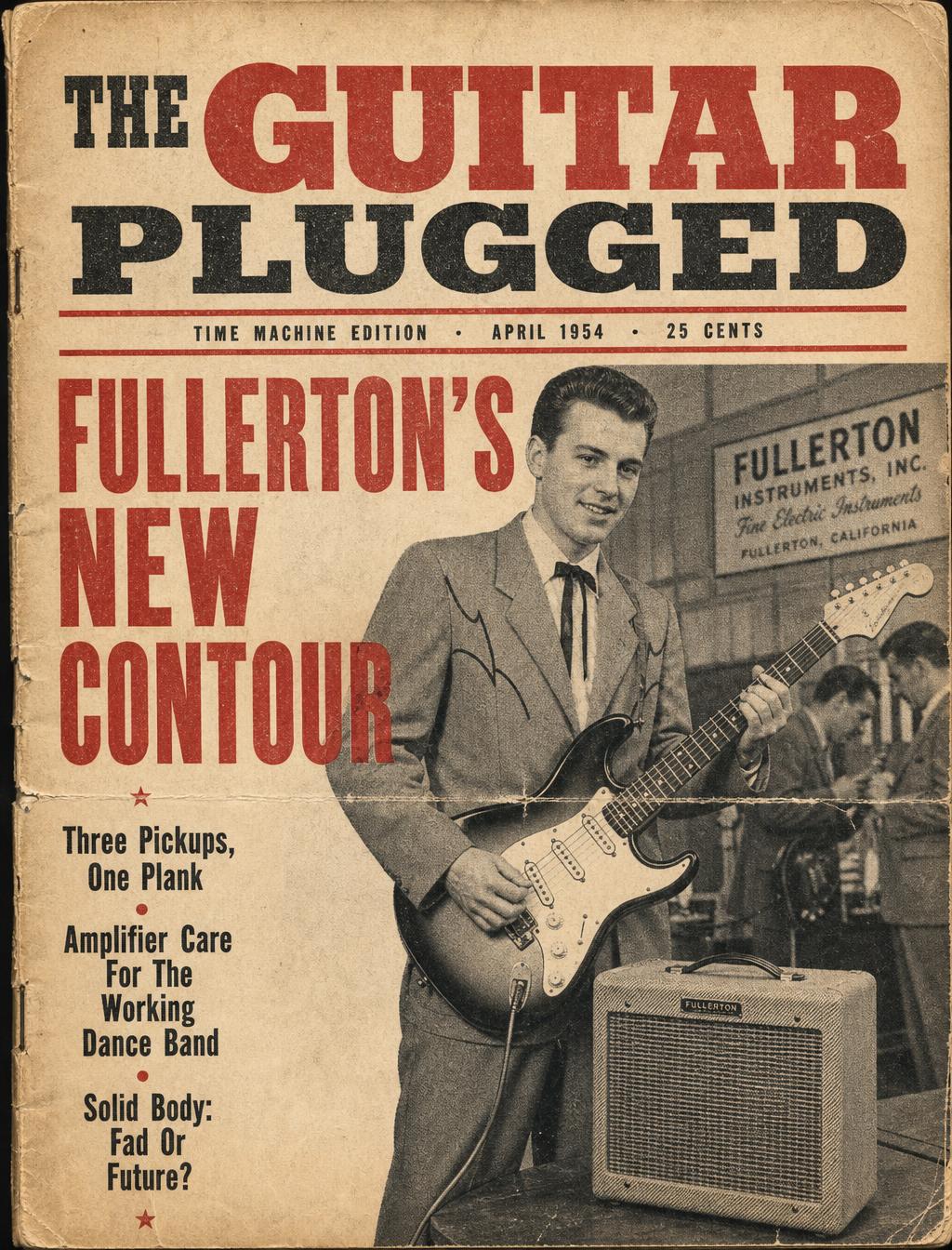
Fender's Fullerton, California operation has never been shy about function over flash. The Telecaster, now four years into production, proved that a slab of ash with two pickups and a bolt-on neck could hold its own on any bandstand. But this spring, Leo Fender's company is shipping a new instrument that looks like nothing else on a music store wall: the Stratocaster.
A Body That Fits the Player
The most immediate difference between the new guitar and the Telecaster is the wood itself. Where the Tele is a flat slab, the Stratocaster's ash (and increasingly, alder) body has been contoured on the back and the forearm bevel on the front, shaping it to sit against the player's ribs and forearm rather than dig into them. Freddie Tavares, who worked alongside Leo Fender on the design, is credited with much of the final body shape, drawing it out on paper before it went to the pattern shop. The double cutaway also gives players real access to the upper frets, something the single-cutaway Telecaster does not offer.
Three Pickups and a Floating Bridge
Where the Telecaster carries two single-coil pickups, the Stratocaster adds a third in the middle position, wired through a three-way selector switch that lets a player choose neck, middle, or bridge pickup. Guitarists are already finding that jamming the switch between detented positions coaxes an out-of-phase quack the factory never advertised, though Fender's official literature only describes the three standard settings.
The bridge is the real engineering centerpiece: a synchronized tremolo unit that lets the entire bridge plate rock on a knife-edge pivot, with six adjustable saddles feeding into a block routed into the body and pulled against a set of springs in a rear cavity. Players can dip a note or shimmer a chord and, in principle, return to pitch, a feature the hardtail Telecaster and most Gibson archtops simply don't offer.
Priced Against Gibson's Archtop World
Gibson's electric line still leans on carved, arched tops and hollow construction, instruments built by luthiers trained in the archtop tradition. Fender's approach is closer to a factory production line: bolt-on necks, bodies routed on pattern-following machinery, and pickups wound in-house. The Stratocaster lists at a premium over the Telecaster, but it undercuts Gibson's higher-end electrics while offering features, the vibrato and triple pickup array chief among them, that no Gibson model currently matches.
What Players Are Saying
Word from Southern California session players and touring country and western sidemen circulating around Fullerton is that the new guitar sits better on the body during long dance-hall sets, and that the tremolo, once you get the springs and saddle heights dialed in, actually holds tune well enough for stage use. It's early yet, and Fender is still working out kinks in the vibrato hardware for reliability, but retailers taking on the Stratocaster describe steady, curious interest from working guitarists who want something that looks and feels different from anything on the rack.
A Different Kind of Guitar Company
What's clear even now is that Fender is building instruments the way it builds amplifiers: standardized parts, replaceable necks, a small design team iterating quickly rather than a shop of individual luthiers each hand-carving a top. Whether the Stratocaster becomes as ubiquitous as the Telecaster remains to be seen, but Fullerton has clearly decided the electric guitar is not finished evolving.
The Contour Body's Origins
Leo Fender and his small design team reportedly arrive at the contoured shape partly through direct feedback from working musicians who complained about the Telecaster's sharp edges digging into their ribs and forearms during long sets, a practical grievance rather than an aesthetic one. George Fullerton, another key figure in the shop alongside Freddie Tavares, is credited with refining early design mockups, and the resulting shape, with its offset waist and dual cutaways, sets a template that all subsequent Fender solidbody guitars would echo in one form or another.
Pickups Wound In-House
Fender winds its own pickups on-site in Fullerton, and the Stratocaster's three single-coils, staggered in height to compensate for the different output levels of the wound strings, are tuned to give a brighter, glassier voice than the Telecaster's bridge pickup, particularly in the middle and neck positions. That brighter voicing, paired with the guitar's contoured shape, positions it as an instrument suited as much to clean, articulate playing as to the more raw, cutting tones the Telecaster had made its reputation on.
Solving the Tuning Problem
Vibrato units on electric guitars before this point have a poor reputation among working musicians, prone to knocking instruments out of tune after even light use, and Fender's synchronized tremolo design is aimed squarely at solving that complaint through its pivoting bridge plate and coordinated saddle movement. Early units still need careful setup, spring tension and saddle height both affecting how reliably the guitar returns to pitch, and some retailers report spending extra time at the counter walking new buyers through adjustments before letting the guitar leave the shop.
A Small Company With Big Ambitions
Fender remains, in early 1954, a modest operation compared to the entrenched instrument makers back east, but the company's approach, standardized parts, bolt-on necks that can be swapped rather than reglued, and pickups and hardware built to consistent specifications, points toward a manufacturing philosophy that values repeatability over individual craftsmanship. Whether that philosophy proves it can compete with Gibson's carved-top reputation in the eyes of professional musicians remains an open question this spring, but the Stratocaster gives Fender its most ambitious answer yet.
Why it matters now
The Stratocaster would become the most copied electric guitar body shape in history, the instrument most associated with Buddy Holly, Jimi Hendrix, Eric Clapton, Stevie Ray Vaughan, and generations of players who never touched a Telecaster. Its synchronized tremolo, contoured body, and three-pickup layout set the template that countless other manufacturers would chase for the rest of the twentieth century and beyond. What looked in 1954 like a curious variation on Fender's existing line turned out to be the guitar that defined rock and roll's visual and sonic identity for decades to come.
Sources
- Fender company history archives — model introduction and design credit to Freddie Tavares
- Guitar Player magazine retrospectives on the Stratocaster's 1954 debut