
The Electric Dawn
THE GUITAR PLUGGED
Chess Records Cuts Chuck Berry's "Johnny B. Goode"
Chuck Berry's Chicago single, built on a double-stop intro he traces to Louis Jordan guitarist Carl Hogan, arrives as a defining statement of guitar-driven rock and roll.
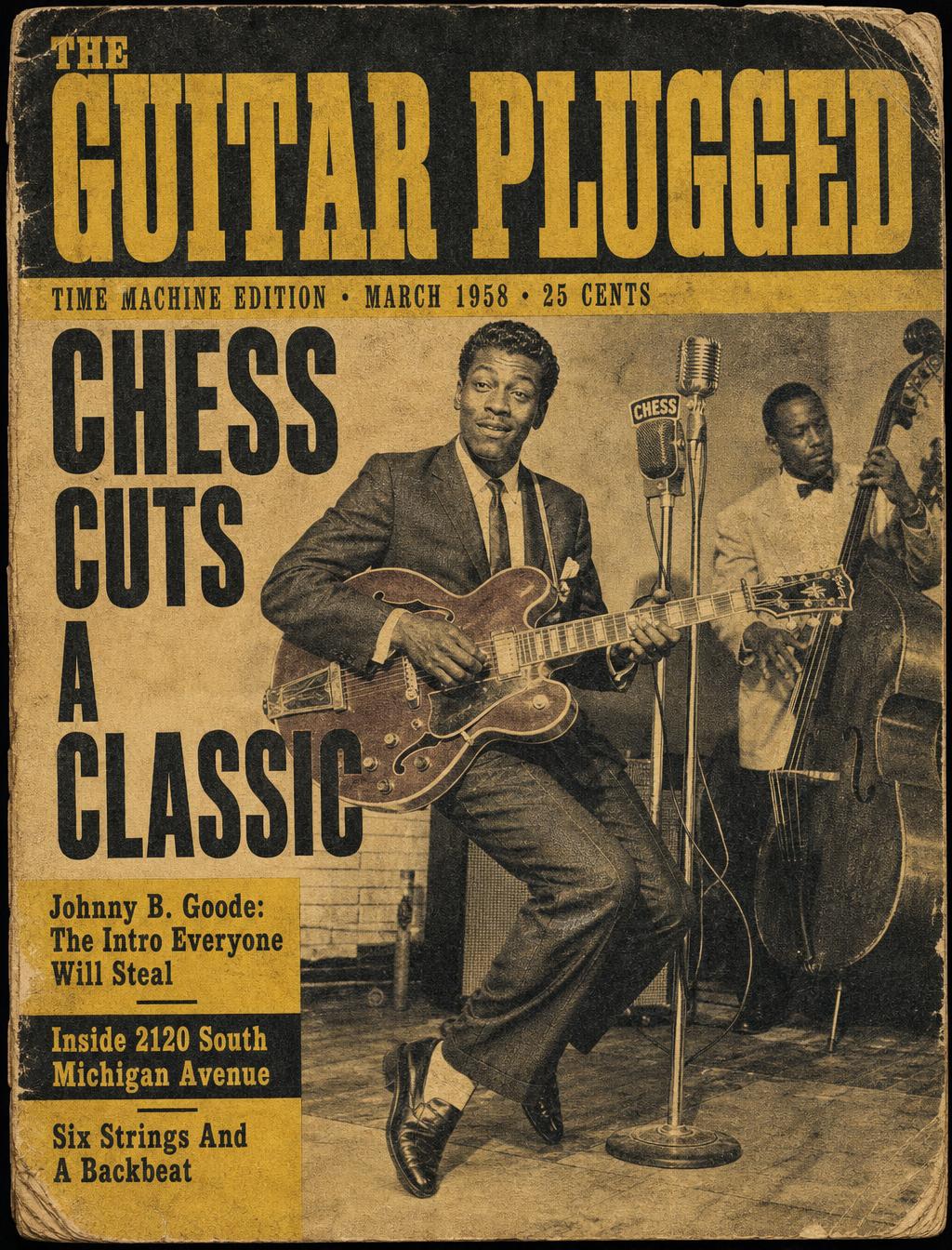
Chess Records has released Chuck Berry's latest single, "Johnny B. Goode," and it opens with a guitar figure that guitarists across the country are already trying to work out by ear off their turntables. The intro, a ringing, doubled-string run climbing up the neck, has become the calling card of the record before the first verse even starts.
A Debt to Carl Hogan
Berry has spoken about drawing the shape of that opening lick from Carl Hogan, the guitarist in Louis Jordan's Tympany Five, whose playing on Jordan's small-group jump blues sides Berry studied closely coming up in St. Louis. The lineage matters: Berry isn't inventing a guitar vocabulary from nothing, he's taking the swinging, horn-influenced phrasing of jump blues guitar and running it through an electric solidbody at rock and roll tempo and volume.
The Gibson ES-350T
Berry's main instrument on record and on stage through this period is a Gibson ES-350T, a thinline hollow-body electric with dual pickups, an instrument built more for jazz and dance-band guitarists than for the raw tone Berry gets out of it. He drives the amp hard enough that the guitar's clean, articulate voice takes on a cutting edge, letting the double-stops ring out over the rhythm section without getting buried.
Cut in Chicago
The session took place at Chess Records' studio on the South Side of Chicago, the same room that has been turning out Muddy Waters and Howlin' Wolf sides for the label. Chess's setup favors a tight, close-mic'd sound that puts Berry's guitar and vocal right up front, with Johnnie Johnson's piano rolling underneath, an arrangement that owes as much to Johnson's boogie-woogie right hand as it does to Berry's guitar lines. Johnson, Berry's longtime bandleader and writing partner from St. Louis, has been central to the sound of these Chess sides even though the singles carry Berry's name alone.
A Song About a Guitar Player
The lyric itself, about a country boy who can play a guitar just like ringing a bell, reads almost as a statement of purpose for what Berry is doing on the record. It's a rock and roll single that is explicitly about the electric guitar as an instrument of transformation, sung by a guitarist demonstrating exactly that transformation in real time.
What Guitarists Are Taking From It
For working guitarists, the record is a short course in how much rhythmic drive a single guitar can generate. Berry's phrasing sits right on top of the beat, and the solo sections lean on bent double-stops and quick position shifts rather than single-note runs up and down the scale. It's a vocabulary built for guitarists without formal jazz training who nonetheless want to solo with confidence over a shuffle.
Leonard Chess and the Session Setup
Leonard Chess, who runs the label with his brother Phil out of the storefront studio at 2120 South Michigan Avenue, has built Chess Records' reputation on blues sides that favor directness over polish, and the "Johnny B. Goode" session follows the same working method the label uses for Muddy Waters and Howlin' Wolf: cut the band together in a single room, keep the takes moving, and trust the players to know the material cold before the tape starts rolling. Berry, backed by Johnnie Johnson on piano, Willie Dixon on bass, and Fred Below on drums, reportedly needed only a handful of takes to nail the arrangement, a testament to how thoroughly worked out the song already was after months of playing it live around St. Louis.
An Autobiographical Lyric
Berry has described the song's country boy who "could play a guitar just like ringing a bell" as a version of his own story, growing up not far from New Orleans in the lyric's telling, though Berry himself is from St. Louis, a detail he has said he changed to make the narrative feel more like a folk tale than a memoir. The lyric's undisguised pride in the electric guitar as a route out of a hard upbringing gives the record a self-mythologizing quality that few rock and roll singles before it have attempted so directly.
Amplification Kept Simple
Berry's amplifier setup on these Chess dates is unglamorous by design: a single combo amp driven hard enough to add grit to the ES-350T's naturally clean voice, without the layers of pedals or outboard effects that later guitarists will reach for to get a comparable edge. The distortion here comes almost entirely from pushing tube headroom past its comfortable limit, a technique blues guitarists on Chess's roster have already been using for years, and Berry's application of the same idea to an uptempo, backbeat-driven song is a big part of what makes the record feel new rather than derivative of the blues sides surrounding it in the Chess catalog.
Radio and the Color Line
"Johnny B. Goode" arrives at a moment when Berry's records are being played on pop stations as well as the rhythm and blues outlets that have long supported him, part of a broader, uneven breakdown of radio's racial segregation of playlists. Berry's clean diction, storytelling lyrics, and guitar-forward arrangements have made him one of the few Black rock and roll artists whose singles cross over reliably to white teenage audiences, a crossover that record executives are watching closely as they decide who else on their rosters might follow a similar path.
Why it matters now
"Johnny B. Goode" became one of the most widely learned guitar intros in popular music, a rite of passage for beginning rock guitarists for decades after its release. Berry's synthesis of jump blues phrasing, jangling double-stops, and driving rhythm guitar became foundational vocabulary for rock and roll and, later, rock guitar broadly, echoed by everyone from the British Invasion bands to Chuck Berry's own descendants in blues-rock. The record's later inclusion aboard the Voyager Golden Record and its continued ubiquity on classic rock radio only underline how thoroughly this single Chess session shaped what a guitar solo could sound like.
Sources
- Chess Records session documentation — recording location and personnel
- Chuck Berry's autobiography — Carl Hogan influence and Gibson ES-350T usage