
The Unplugged Correction
THE GUITAR PLUGGED
Nirvana's Nevermind Trades Guitar Heroics for Loud-Quiet-Loud
Recorded with Butch Vig at Sound City and mixed by Andy Wallace, the Seattle trio's second album swaps shred for a left-handed Fender and a Boss distortion pedal.
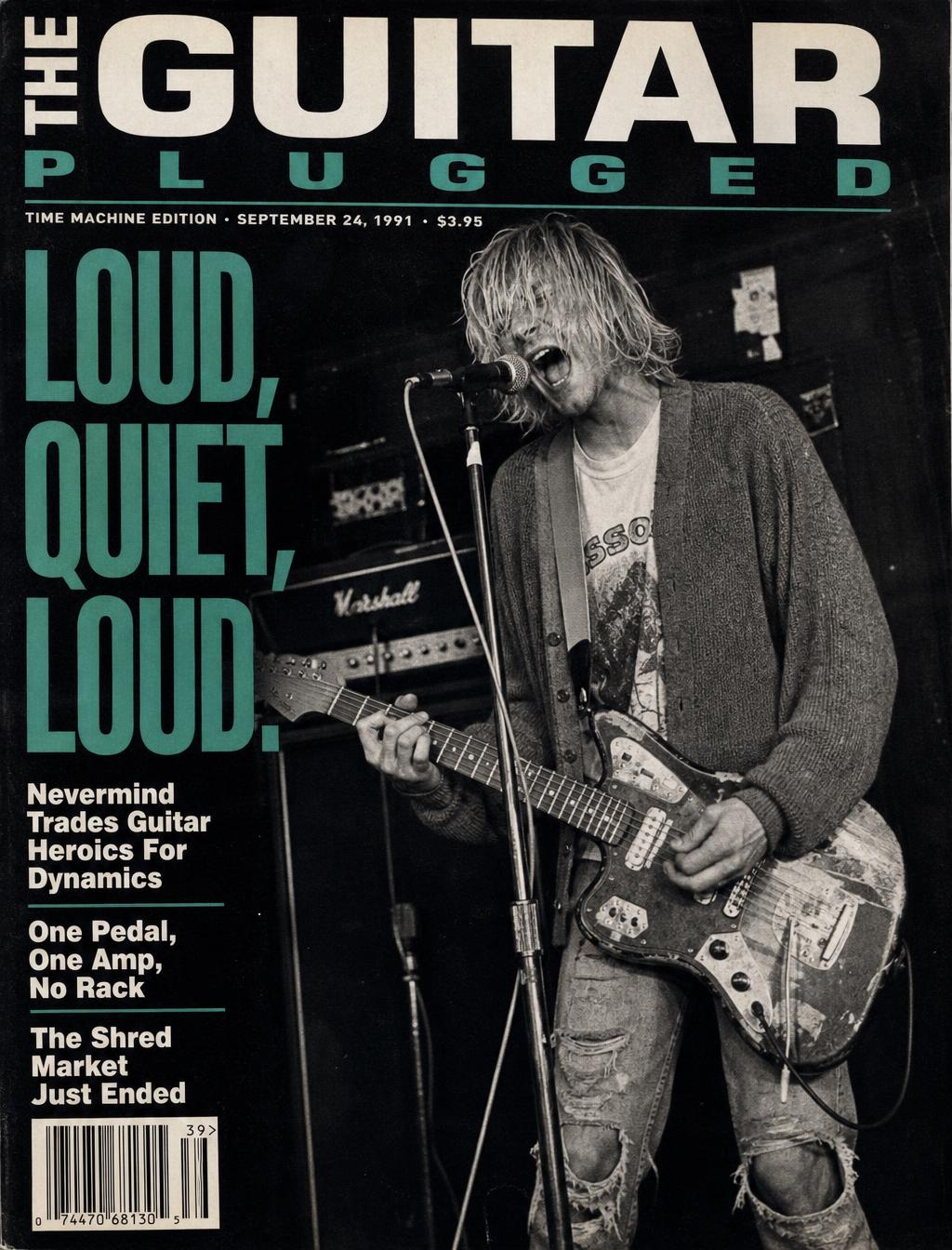
Nirvana's second album, Nevermind, is out this week, and it doesn't sound like it's trying to compete with the technical guitar playing dominating hard rock radio right now. There's no tapping, no whammy-bar dive bombs, no extended solo built to show off. Instead there's a trio from Aberdeen and Olympia, Washington, making a record out of blunt dynamics: quiet, tense verses that explode into loud, distorted choruses, over and over, until the contrast itself becomes the hook.
Sound City and Butch Vig
The album was tracked at Sound City Studios in Van Nuys with producer Butch Vig, who came up recording Midwest underground bands before this session. Vig's approach reportedly kept the takes relatively lean and the arrangements tight, resisting the temptation to over-polish material that had already been road-tested in clubs. Andy Wallace, known for mix work on records with considerably more technical firepower, handled the final mix, giving the album a wide, radio-ready presence without sanding down the rawness of the performances underneath.
A Left-Handed Guitar and a Cheap Pedal
Kurt Cobain plays left-handed, and his main guitars on the record are a Fender Mustang and a Fender Jaguar, both flipped for his left-handed playing and both considered budget or specialty instruments by the standards of the guitar magazines that fill their pages with superstrat endorsements. His distortion comes largely from a Boss DS-1, a simple orange stompbox with none of the switching complexity of the rack-mounted rigs favored by more technically minded players. On "Come as You Are," the wobbling, underwater quality of the main riff comes from an Electro-Harmonix Small Clone chorus pedal, its modulation set deep enough to blur the pitch of the notes rather than just widen them.
Loud, Quiet, Loud
The dynamic swings that define songs like "Smells Like Teen Spirit" aren't a production trick so much as a songwriting habit, verses stripped down to a spare riff and vocal, choruses slamming back in with the full band at volume. It's a structure Cobain has talked about admiring in the Pixies, and it stands in sharp contrast to the more evenly loud, technically dense arrangements common on rock radio at the moment, where guitar solos are expected to be a showcase rather than a passing texture.
Unpolished Gear for an Unpolished Sound
None of Cobain's gear choices look like an attempt to chase tone in the way most guitar magazines currently define it. The Mustang and Jaguar are inexpensive, somewhat maligned instruments among collectors, prone to going out of tune and lacking the sustain of a Les Paul or a superstrat. In Cobain's hands, that instability becomes part of the sound rather than a liability, feeding into an album that feels deliberately unglamorous next to the guitar-hero records still selling heavily this year.
From Wisconsin Basement to Major Label Budget
Butch Vig had already worked with the band once before, producing early sessions for what became the songs on Nevermind at his Smart Studios in Madison, Wisconsin, on a fraction of the budget Geffen Records eventually put behind the finished album. The move to Sound City in Van Nuys, a studio prized for the natural sound of its live room and its vintage Neve console, gave the band considerably more time and technical resources than they'd had on any previous recording, though by most accounts the sessions themselves stayed efficient, tracked over roughly a month rather than drawn out.
Doubled Guitars, Not Multiplied Solos
Cobain's guitar parts on the record are frequently doubled, recorded twice and panned to widen the rhythm sound rather than layered into the dense, orchestral stacks favored by more technically minded contemporaries. The approach reinforces the songs' blunt riffs without adding the harmonic complexity a multi-guitar arrangement built around lead lines would introduce, keeping the emphasis on the songs' structure rather than on displaying instrumental range. Where solos do appear, on "Lithium" and elsewhere, they tend to restate the vocal melody rather than depart from it into extended improvisation.
Krist Novoselic's Anchor
Bassist Krist Novoselic's playing, often overlooked next to discussion of Cobain's guitar and Dave Grohl's arrival as the band's new drummer, does much of the work of holding the loud sections together, doubling Cobain's riffs an octave down through a rig built around a Rickenbacker-style bass into an Ampeg amplifier, giving the choruses a low-end weight that lets the guitar tone stay comparatively thin and biting rather than needing to carry the bottom end itself.
A Deliberate Break From the Sunset Strip Sound
The album's guitar sound reads, deliberately or not, as a rebuke to the glossy, guitar-hero-driven hard rock that has dominated MTV and rock radio through the second half of the 1980s, records built around superstrat guitars, extended whammy-bar solos, and painstakingly layered studio guitar work. Nevermind's rawer, more compressed guitar tones and its refusal to feature an extended solo anywhere on the record are already being discussed by critics as a statement in themselves, whether or not the band intended it that way, and Geffen's marketing has so far made no attempt to sell the record on musicianship in the way labels typically pitch a new hard rock act.
Why it matters now
Nevermind went on to sell enormously and is now widely credited with shifting mainstream rock away from the technical guitar-hero era and toward the alternative and grunge sounds that dominated the following years. Cobain's use of unfashionable Fender guitars like the Mustang and Jaguar helped revive interest in those models, which had been overlooked by collectors for years, and Fender later issued signature versions modeled directly on his instruments. The Boss DS-1 and Electro-Harmonix Small Clone both became indelibly linked to Cobain's sound, turning inexpensive, unglamorous pedals into some of the most sought-after stompboxes in guitar shops for decades afterward.
Sources
- Michael Azerrad — Come as You Are: The Story of Nirvana
- Sound on Sound — Nevermind recording retrospective with Butch Vig
- Guitar World — Kurt Cobain gear features on Fender Mustang, Jaguar and pedal use