
The Unplugged Correction
THE GUITAR PLUGGED
Steve Vai Turns the Guitar Solo Into a Full Album with Passion and Warfare
The former Zappa sideman and David Lee Roth foil steps out alone with a whammy-heavy, multitracked record built around his green Ibanez JEM.
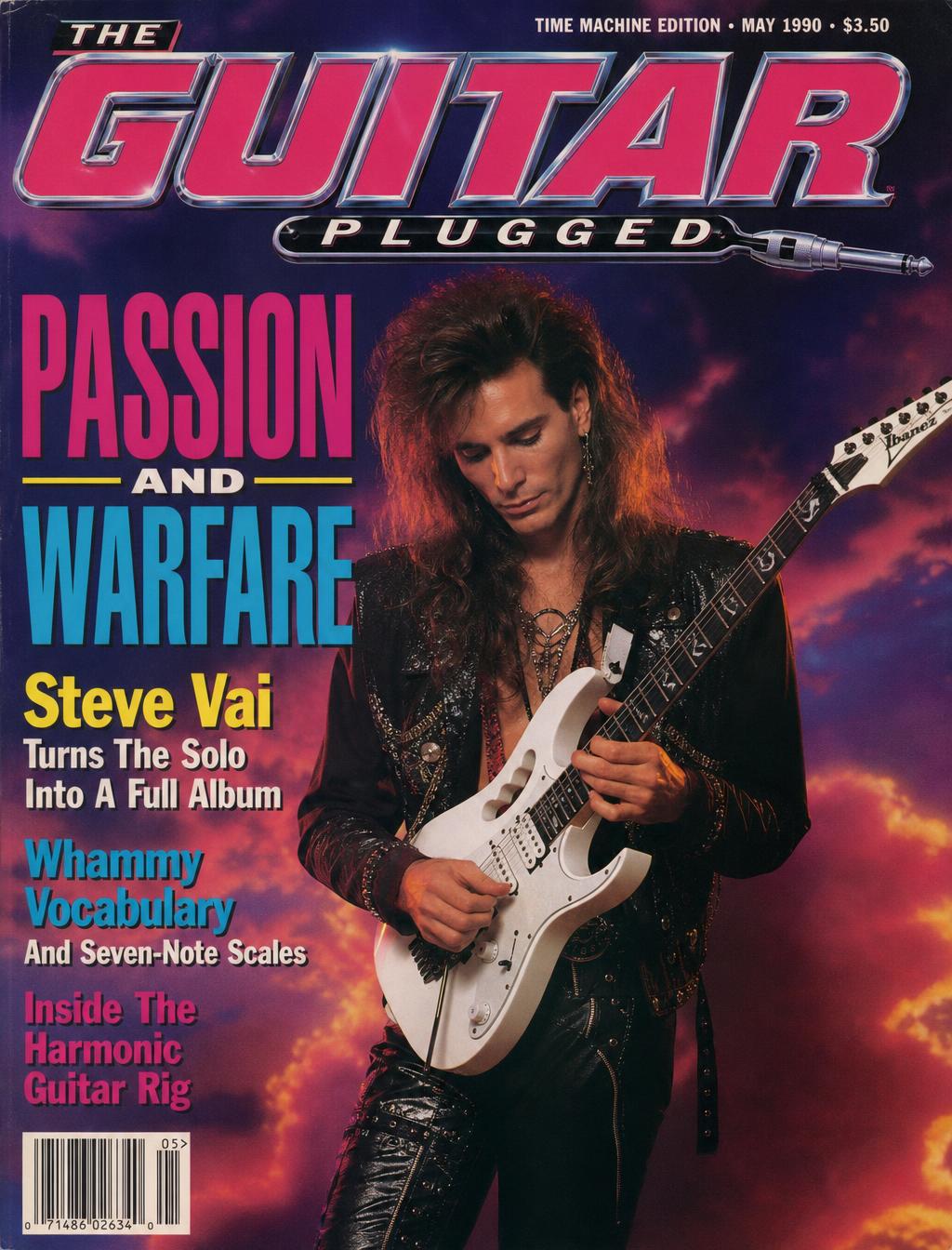
Steve Vai has spent most of the last decade as somebody else's guitarist — first surviving the notoriously difficult transcription work of playing in Frank Zappa's band, then stepping into the spotlight-hungry role of lead guitarist for David Lee Roth after Roth left Van Halen. Passion and Warfare, his new solo album, is the first record built entirely around his own vision, and it sounds like someone who has spent years storing up ideas he wasn't allowed to fully unleash in someone else's band.
The Guitar with the Grip
Vai's main instrument throughout the record is his Ibanez JEM, the signature model built to his specifications and instantly recognizable for the sculpted handle carved into the upper bout of the body — the monkey grip that lets him hoist the guitar overhead without losing his hold on it. The JEM's Floyd Rose locking tremolo system is central to his vocabulary here: entire passages are built around extreme pitch-bending, dive bombs and harmonic squeals that would detune a guitar with a standard bridge within a few takes.
A Solo Record, Track by Track
“For the Love of God” is the album's emotional centerpiece, a slow, vocal-like instrumental built on long sustained notes and expressive whammy-bar vibrato rather than speed. It stands in deliberate contrast to the record's more technical showcases, and it's already being singled out by other guitarists as proof that Vai's outrageous technique serves melody rather than just spectacle. Elsewhere on the record, Vai layers guitar parts heavily, building dense, orchestral-sounding arrangements almost entirely out of multitracked guitar rather than keyboards or strings.
Sound Shaped by Years on the Road
Vai's tone on Passion and Warfare carries the polish of someone who spent the last several years in front of arena crowds with David Lee Roth, refining a rig built for consistency night after night. The record's sound leans on high-gain amplification pushed to sustain notes indefinitely, a necessity for the kind of legato, whammy-driven phrasing that defines his playing — lines that swoop, cry and squeal in ways that owe as much to a synthesizer's pitch-bend wheel as to a conventional rock guitar solo.
From Sideman to Solo Artist
What makes Passion and Warfare notable beyond its guitar pyrotechnics is that it's an entirely instrumental statement from a player best known, up to now, for supporting other people's songs. Vai wrote, performed and produced the record largely on his own terms, and the result plays less like a collection of guitar exercises than like a composer working in a language where the guitar happens to be doing all the talking.
Written While Still on Someone Else's Payroll
Vai has said much of the material on Passion and Warfare was composed years earlier, some of it while he was still touring behind Zappa and during the Roth years, sketched onto cassette in hotel rooms and dressing rooms between other people's gigs. Signing to Relativity Records finally gave him a vehicle to record the backlog on his own terms, without a bandleader's songs to serve or a producer pushing for radio-friendly verses. The album's density, some tracks stacking a dozen or more guitar overdubs, reflects years of accumulated ideas rather than a burst of studio-bound inspiration.
The JEM's Specifications
The Ibanez JEM Vai plays throughout the record was developed directly with Ibanez's design team to his specifications: a thin, fast neck, a compound-radius fingerboard that flattens out toward the higher frets for easier bending, and the now-famous Lion's Claw routing around the Floyd Rose that lets him pull the bar up sharply as well as dive it down, rather than just slacking the strings. The DiMarzio pickups fitted to the guitar, developed in tandem with Vai, are voiced to stay articulate at the high-gain levels his rig runs at, a design consideration aimed squarely at keeping legato runs and pinch harmonics from collapsing into mush.
Effects and Signal Chain
Vai's rig behind the album leans on rack-mounted processing rather than a pedalboard, a setup built for the consistency of night-after-night arena work with Roth that he carried over into the studio: compression and noise gating to keep the sustained, high-gain tone clean between notes, along with delay and modulation effects used compositionally rather than as mere color, most audibly on the multitracked, almost choral guitar harmonies that stack up on several of the record's more orchestral passages. It's a heavily engineered sound, but one built to serve extended, singing sustain rather than raw aggression.
Beyond the Technique
What separates Passion and Warfare from the glut of shred records competing for guitar magazine covers this year is the range Vai insists on covering within a single album: alongside the whammy-driven pyrotechnics of "Juice" and "The Animal" sits the aching restraint of "For the Love of God," and the record's sequencing makes clear Vai wants the two treated as equally serious statements. Reviewers who came in expecting a pure technical showcase are finding a more considered, occasionally strange record, one that treats the guitar less as a vehicle for speed than as a full compositional instrument capable of its own emotional register.
Why it matters now
Passion and Warfare became one of the best-selling instrumental guitar albums of all time and is widely regarded as Vai's definitive artistic statement, cementing his reputation independent of his sideman work with Zappa and Roth. "For the Love of God" in particular became a modern guitar standard, taught and covered by generations of players as a benchmark for expressive whammy-bar vibrato and legato phrasing. The Ibanez JEM line launched alongside Vai's rising profile remains in continuous production decades later, and the monkey-grip handle became one of the most recognizable design details in signature-guitar history.
Sources
- Guitar World — Steve Vai interviews on Passion and Warfare and the Ibanez JEM
- Guitar Player magazine — Vai gear and technique features circa 1990
- Ibanez artist archives — JEM model development history