Best Guitars Under $1,000 in 2026: The Ultimate Buyer's Guide
If you've got $1,000 to spend on an electric guitar in 2026, you're in one of the sweetest spots in the market. Here are the five we'd actually buy — plus the used picks that punch way above their weight.
If you've got $1,000 to spend on an electric guitar in 2026, you're in one of the sweetest spots in the market. Build quality has never been better, competition between manufacturers is fierce, and it's entirely possible to walk away with a guitar that will serve you for decades without feeling like you compromised.
At The Guitar Plugged, we looked at playability, reliability, versatility, resale value, community reputation, and overall bang for your buck. Whether you're a weekend player or a gigging musician, these are the guitars we'd confidently recommend in 2026.
The 2026 Comparison Table
Here's the short version. We'll break each guitar down in detail below.
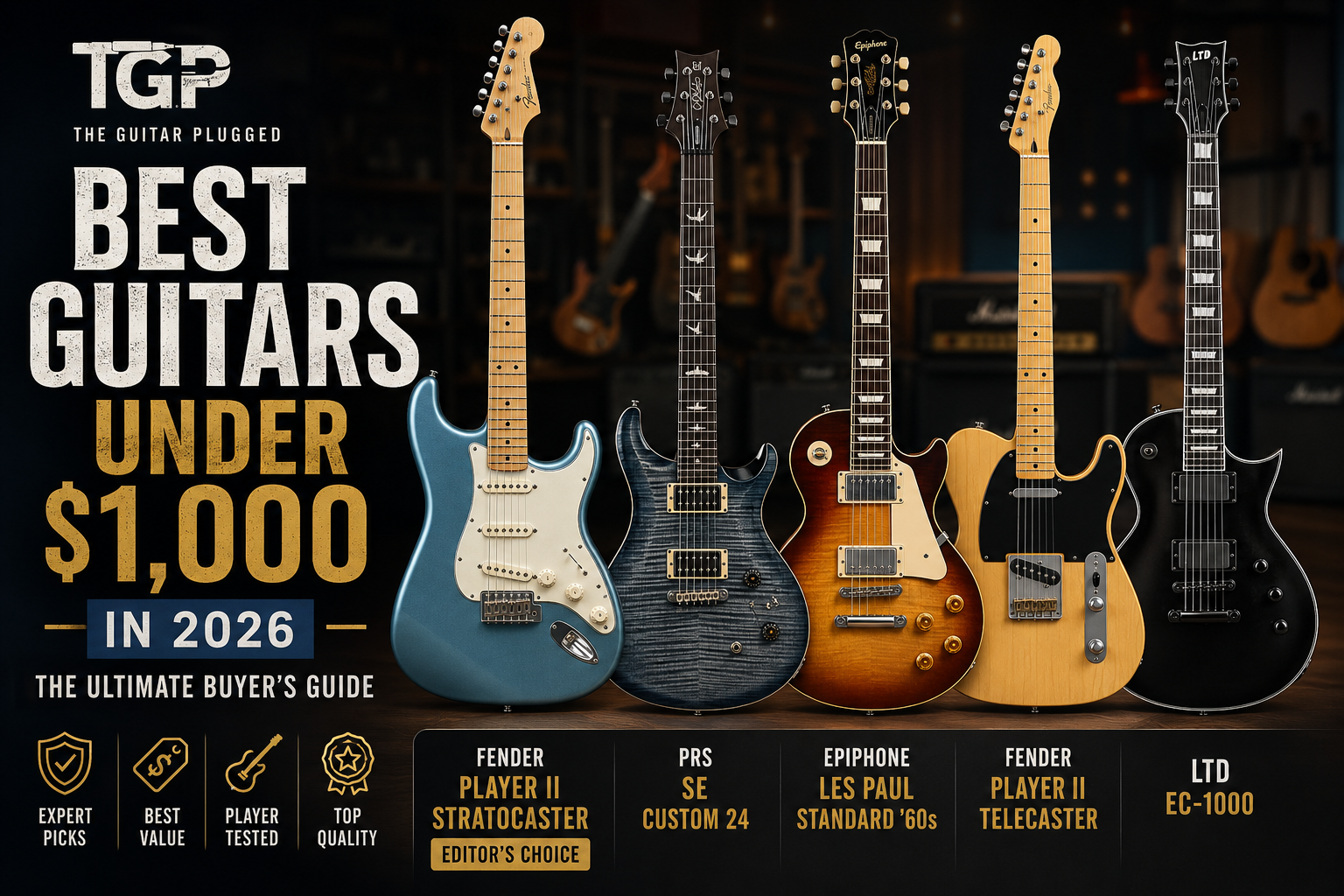
| Guitar | Approx Price | Pickups | Best For | TGP Rating |
|---|---|---|---|---|
| Fender Player II Stratocaster ⭐ | $899 | 3× Single-Coil | Blues, Rock, Pop, Country, Funk | 9.6 / 10 |
| PRS SE Custom 24 | $949 | 2× Humbucker (Split) | Rock, Fusion, Worship, Studio | 9.5 / 10 |
| Epiphone Les Paul Standard '60s | $699 | 2× Humbucker | Classic Rock, Blues, Hard Rock | 9.3 / 10 |
| Fender Player II Telecaster | $899 | 2× Single-Coil | Country, Indie, Rock, Alternative | 9.4 / 10 |
| LTD EC-1000 (used) | $850–$1000 | 2× Humbucker | Metal, Hard Rock, Modern Rock | 9.5 / 10 |
1. Fender Player II Stratocaster — Editor's Choice ⭐
If we could only recommend one guitar under $1,000 in 2026, this is it.
The Fender Player II Stratocaster delivers everything players have loved about Strats for generations while offering modern reliability and consistency. It's comfortable, versatile, and holds its value exceptionally well — a guitar you can buy today and still love a decade from now.
★★★★★ — 9.6 / 10
Best For: Blues, rock, pop, country, funk, worship, session work.
Legendary Strat tone with modern consistency.
Extremely comfortable Modern C neck.
Excellent resale value.
Massive aftermarket support — pickups, hardware, mods.
Works in almost every genre out of the box.
Single-coil hum in high-gain situations.
Some players want a chunkier neck.
Stock pickups are good, not boutique.
Body: Alder. Neck: Maple, Modern C. Fingerboard: Maple or Rosewood. Pickups: Three Player II Single-Coils. Bridge: 2-Point Tremolo. Scale: 25.5".
Tone Overview: Glassy cleans, quacky in-between positions, and that singing midrange bridge tone that defined modern guitar music. Roll back the volume for warm jazz-tinged cleans, push it through a cranked tube amp for the bluesy bark Hendrix, Gilmour, and Mayer made famous.
Playability: The Modern C neck and rolled fingerboard edges feel broken-in from day one. Bends feel effortless, and the contoured body sits perfectly against you whether you're standing or sitting for long sessions.
Build Quality: Fender's Ensenada factory has hit a new stride with the Player II line. Fret ends are clean, finishes are consistent, and setups are usable straight from the box — closer to USA-made quality than ever before.
Value for Money: Outstanding. The Player II represents one of the strongest price-to-quality ratios Fender has ever offered.
Who Should Buy It: First serious guitar players, gigging musicians who need a do-it-all instrument, and anyone who wants Fender heritage without spending American Pro money.
Final Verdict: The safest, smartest $1,000 you can spend on an electric guitar in 2026.
2. PRS SE Custom 24 — Best Overall Modern Guitar
The PRS SE Custom 24 continues to punch well above its price tag in 2026.
With excellent craftsmanship, coil-splitting capability, and one of the most comfortable neck profiles available at any price, it's one of the easiest guitars to recommend to anyone who plays modern rock, fusion, or worship.
★★★★★ — 9.5 / 10
Best For: Rock, fusion, modern worship, studio recording, progressive styles.
Incredible versatility from coil-splitting humbuckers.
Excellent quality control across every unit.
Fast, comfortable Wide Thin neck.
Beautiful flame-maple finishes.
24 frets and full-scale playability for lead players.
Wide Thin neck isn't for everyone.
Stock TCI pickups can feel slightly polite for high-gain metal.
Less vintage character than a Strat or Les Paul.
Body: Mahogany with Flame Maple Veneer. Neck: Maple, Wide Thin. Fingerboard: Rosewood. Pickups: PRS 85/15 'S' Humbuckers (coil-split). Bridge: PRS Tremolo. Scale: 25".
Tone Overview: Tight, articulate humbucker tone with a usable, twangy split mode that genuinely covers single-coil territory. The 25" scale length splits the difference between Fender's 25.5" tightness and Gibson's 24.75" warmth.
Playability: PRS's Wide Thin neck profile is one of the fastest, most consistent neck shapes in this price range. Lead players, in particular, often pick one up and never want to put it down.
Build Quality: Indonesian PRS SE production has steadily climbed for years and is now arguably the most consistent factory output in the sub-$1,000 market.
Value for Money: Excellent. You get genuine PRS design DNA — including coil-splitting — at a fraction of a Core PRS price.
Who Should Buy It: Modern players who need one guitar that covers cleans, crunch, and high-gain leads convincingly.
Final Verdict: The most versatile guitar on this list and a future modern classic.
3. Epiphone Les Paul Standard '60s — Best Classic Rock Machine
If thick sustain and classic humbucker tones are what you're after, this is one of the easiest recommendations of 2026.
Modern Epiphone quality has improved dramatically over the past few years, making these guitars serious performers for players who want iconic Les Paul feel and tone without Gibson pricing.
★★★★★ — 9.3 / 10
Best For: Classic rock, blues, hard rock, southern rock.
Outstanding value — punches well above its price.
Rich, sustaining ProBucker humbucker tone.
Beautiful classic finishes (Iced Tea, Bourbon Burst).
Familiar Les Paul feel and balance.
Excellent platform for upgrades.
Heavy — can be a lot on a strap for a 3-hour set.
Stock electronics are functional but begging for a wiring upgrade.
Neck dive on some examples.
Body: Mahogany with Maple Top. Neck: Mahogany, Rounded '60s. Fingerboard: Indian Laurel. Pickups: ProBucker 2 / ProBucker 3. Bridge: LockTone Tune-O-Matic. Scale: 24.75".
Tone Overview: Thick, midrange-forward and saturated. The ProBuckers are unfussy, vintage-voiced humbuckers that respond beautifully to gain and pick attack — exactly what you want for Slash, Page, or Joe Perry territory.
Playability: The Rounded '60s neck is slimmer than the chunkier '50s profile and suits players who do a lot of lead and chord work alike.
Build Quality: Modern Epiphone QC is a different conversation than it was even five years ago — fret work, finish quality, and consistency are now genuinely impressive.
Value for Money: Among the best on this entire list. Often the cheapest 'real' guitar on the page.
Who Should Buy It: Anyone who's ever wanted a Les Paul but couldn't justify Gibson money.
Final Verdict: The classic-rock dream guitar at a fraction of the cost.
4. Fender Player II Telecaster — Best Tele Under $1,000
Every guitarist should play a Telecaster at least once. The Player II Tele is the easiest way to find out why.
Simple, reliable, and absolutely packed with personality, the Player II Tele delivers everything from country twang to gritty rock tones with effortless authority.
★★★★★ — 9.4 / 10
Best For: Country, blues, indie, rock, alternative.
Incredible reliability — the workhorse of working musicians.
Signature Tele bite and twang.
Excellent resale value.
Minimal maintenance.
Timeless, polarizing-in-a-good-way design.
Only two pickup positions some players want more.
Bridge can feel sharp without rolling the saddle edges.
Less shred-friendly geometry than a Strat or PRS.
Body: Alder. Neck: Maple, Modern C. Fingerboard: Maple or Rosewood. Pickups: Two Player II Single-Coils. Bridge: 3-Saddle Tele with Compensated Brass Saddles. Scale: 25.5".
Tone Overview: Bright, snappy bridge tone with bite for days. The neck pickup is warmer than most players expect and excellent for jazzy chord-melody and indie tones.
“Build quality has never been better. A thousand dollars in 2026 buys you a guitar you can keep for decades.”
Playability: The Modern C neck is identical to the Strat version — fast, comfortable, and forgiving.
Build Quality: Same Ensenada quality jump as the Player II Strat. Setups out of the box are noticeably better than the Player I generation.
Value for Money: Outstanding. Teles age beautifully and retain value year after year.
Who Should Buy It: Players who value tone character over tonal breadth.
Final Verdict: The most expressive simple guitar money can buy under $1,000.
5. LTD EC-1000 — Best Used Buy Under $1,000
Shopping used can unlock some incredible value in 2026, and the LTD EC-1000 remains one of our favorite recommendations at this price point.
Known for outstanding playability and premium appointments, it's a guitar that genuinely feels and sounds significantly more expensive than its used asking price.
★★★★★ — 9.5 / 10
Best For: Metal, hard rock, modern rock, recording, live performance.
Premium hardware — Floyd Rose, EMG, or Fishman options depending on year.
Outstanding neck feel — thin-U profile loved by lead players.
Excellent sustain.
Professional-level fit and finish.
Fantastic used market value.
Heavy body.
Active EMG models require battery maintenance.
More one-trick than a PRS for versatile players.
Body: Mahogany. Neck: 3-Piece Mahogany, Thin U. Fingerboard: Ebony. Pickups: EMG 81 / 60 (or Fishman Fluence depending on year). Bridge: TonePros locking or Floyd Rose. Scale: 24.75".
Tone Overview: Tight, aggressive, surgical. Built for high-gain modern playing but cleans up better than most people expect.
Playability: One of the fastest, most comfortable necks under $1,500 — the EC-1000's thin profile and ebony board are made for shredding and modern rhythm work.
Build Quality: ESP's LTD line continues to be one of the most consistently well-built guitars in the import market.
Value for Money: Exceptional on the used market. New, these often push $1,200+; used, you can routinely find them in the $850–$1,000 range.
Who Should Buy It: Modern rock and metal players who want a workhorse second guitar — or a primary that takes a beating.
Final Verdict: The smart-money pick if you're comfortable buying used.
Honorable Mentions
Five guitars couldn't possibly cover the whole sub-$1,000 universe. These six all came close to making the main list and are absolutely worth a look depending on your style.
PRS SE McCarty 594 — vintage-voiced PRS with a 24.594" scale and incredible cleans.
Ibanez RG550 — reissue of the legendary shred machine, lightning-fast neck.
Sire Larry Carlton S7 — boutique-feeling S-style at a stupidly low price.
Sterling by Music Man Cutlass — overlooked alternative to a Strat with brilliant fretwork.
Gretsch Electromatic Series — for anyone who wants the jangle and twang of a real Gretsch.
Schecter C-1 Platinum — modern metal player's dream for under a grand.
Why We Recommend Shopping Used
Here's where we think a lot of players leave money on the table.
For the same $1,000 budget, the used market can often put you into an instrument that originally retailed for significantly more. Buying used through reputable marketplaces lets you stretch your budget, access discontinued favorites, find premium finishes, get better specifications for your money, and dodge the biggest depreciation hit a guitar will ever take.
How to Inspect a Used Guitar
Before pulling the trigger on any used purchase, check seller ratings carefully, review every photo (especially the headstock, neck heel, and bridge), read descriptions completely, compare multiple listings for the same model, and ask questions before purchasing. A good seller will happily provide extra photos or video.
Specifically inspect: neck relief, fret wear, headstock breaks, electronics noise, hardware corrosion, and finish checking. Anything dishonestly hidden in stock photos is a red flag.
Buying Guide: New vs Used
New guitars give you a warranty, a fresh setup, and the satisfaction of being the first owner. Used guitars give you more guitar for the same money, no depreciation hit, and access to discontinued models that often outclass current production. Neither is wrong — the right answer depends on your tolerance for risk and your patience.
Buying Guide: Bolt-On vs Set-Neck
Bolt-on necks (Strat, Tele) are easier to replace, tend to sound snappier, and transmit more attack. Set-neck designs (Les Paul, PRS, LTD EC) generally feel more resonant and produce longer sustain. Neither is objectively better — they're tools for different jobs.
Buying Guide: Humbuckers vs Single Coils
Single coils sound bright, articulate, and dynamic but are prone to 60-cycle hum. Humbuckers sound thicker, hotter, and quieter and are the standard for rock and metal. Coil-splitting (like on the PRS SE) gives you both in one guitar.
Buying Guide: Scale Length
Fender's 25.5" scale produces a tighter, brighter string tension that's great for clean tones and bends. Gibson's 24.75" scale feels slinkier and produces a warmer, fatter midrange. PRS splits the difference at 25".
Buying Guide: Neck Profiles
Modern C (Fender Player II) is the universal Goldilocks shape. Wide Thin (PRS) is fast and flat — loved by lead players. Rounded '60s (Epiphone) is slim but with more meat in the back. Thin U (LTD) is shred-territory thin. Try before you buy whenever possible.
Which Guitar Holds Value Best?
Fender Player II Stratocasters and Telecasters depreciate the least, period. PRS SE Custom 24 and LTD EC-1000 hold value remarkably well thanks to consistently strong used demand. Epiphone Les Pauls hold value steadily and are nearly impossible to lose money on if you buy used to start with.
Which Guitar Is Best For Beginners?
The Fender Player II Stratocaster and the Epiphone Les Paul Standard '60s are both excellent first 'serious' guitars. They're comfortable, forgiving, easy to set up, and inspiring to play — without locking you into one genre.
Which Guitar Is Best For Gigging?
The PRS SE Custom 24 and the LTD EC-1000 are the workhorses on this list — built for the road, stable in tune, and tonally flexible enough to cover most setlists without an instrument change.
Frequently Asked Questions
- What is the best electric guitar under $1,000 in 2026?
- Our Editor's Choice is the Fender Player II Stratocaster. It nails the classic Strat tone, plays effortlessly, holds resale value, and works across nearly every genre — from blues and pop to country, funk, and worship.
- Should I buy a new or used guitar under $1,000?
- For the same $1,000 budget, the used market can often put you into an instrument that originally retailed for significantly more. If you can inspect the guitar carefully or buy from a reputable seller, used is almost always the better value.
- What is the best guitar under $1,000 for beginners?
- The Fender Player II Stratocaster and the Epiphone Les Paul Standard '60s are both excellent first 'serious' guitars — comfortable necks, forgiving tone, strong resale value, and easy to grow into.
- What is the best guitar under $1,000 for gigging?
- The PRS SE Custom 24 and the LTD EC-1000 are workhorses built for stage life — stable tuning, reliable hardware, and tonal range that covers most setlists without swapping instruments.
- Are Epiphone Les Pauls as good as Gibson Les Pauls?
- Modern Epiphone quality has improved dramatically. A Gibson still feels and sounds like a Gibson, but a well-set-up Epiphone Les Paul Standard '60s gets you 80–90% of the experience at a fraction of the price.
- Which guitar under $1,000 holds its value best?
- Fender Player II Stratocasters and Telecasters depreciate the least over time, followed closely by PRS SE Custom 24 and LTD EC-1000. All four have strong used demand on platforms like Reverb.
The Guitar Plugged Final Verdict
Fender Player II Stratocaster — the safest, smartest, most versatile $1,000 in 2026.
PRS SE Custom 24 — the most genres covered by a single instrument on this list.
Epiphone Les Paul Standard '60s — classic-rock heaven for the price.
Fender Player II Telecaster — the working musician's secret weapon.
LTD EC-1000 — boutique feel and tone for sub-$1,000 used money.
No matter which guitar you choose from this list, you're getting an instrument capable of professional performance, studio recording, and years of reliable playing. And if you're looking to maximize your budget, don't forget to check the used market first — you might be surprised what your money can buy.
Experience-driven coverage, not algorithm bait.
- 20+ years of guitar playing experience
- Real-world retail experience at Guitar Center
- Thousands of hours testing guitars, amps, and pedals
- A community of 50,000+ guitar enthusiasts across platforms
- Partnerships with Fender, DistroKid, TrueFire, Card Chords, and Enya
- Editorial standards published openly — see how we test gear
The Modern Guitar Magazine. Delivered to your inbox.
No spam. No gimmicks. Just great guitar content — stories, tones, iconic solos, and honest gear takes. Every week.
Discussion (0)
Sign in to join the discussion.
Sign in to commentLoading comments…
Discover another guitar story
Swipe through our latest features, breaking news and iconic solos — one story at a time.
Open Swipe →More in Best Of Lists

20 Easy Guitar Riffs That Sound Way Harder Than They Are
Great riffs are not necessarily complicated riffs. Some of rock's most recognisable guitar moments are built from two strings, three chords and a rhythm that refuses to let go. Here are twenty of them — and how to make each one sound like the record.

Top 25 Classic Rock Bands of All Time
From Led Zeppelin and the Rolling Stones to Rush and the Allman Brothers, these are the 25 classic rock bands that shaped everything that followed — ranked on influence, songwriting, musicianship, longevity and legacy.
Happy Birthday, Slash: 10 Guitar Solos That Defined a Rock Guitar Hero
Top hat, Les Paul, cigarette, Marshall stack — the image is instantly recognizable. But it's the playing that made Slash a rock guitar hero. Ten solos that explain why.