Happy Birthday, Slash: 10 Guitar Solos That Defined a Rock Guitar Hero
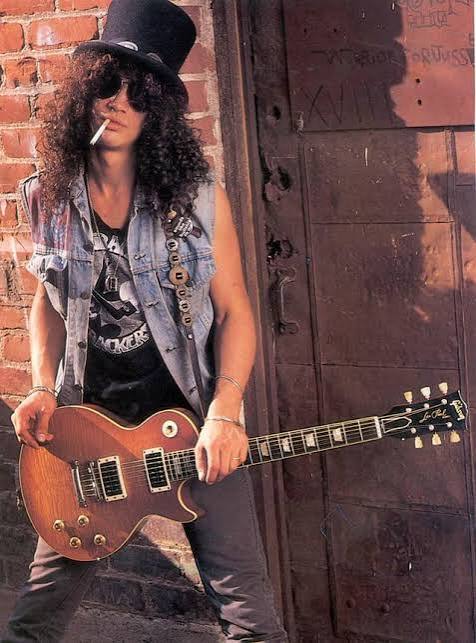
Top hat, Les Paul, cigarette, Marshall stack — the image is instantly recognizable. But it's the playing that made Slash a rock guitar hero. Ten solos that explain why.
Happy birthday, Slash. Born Saul Hudson on July 23, 1965, he has spent nearly four decades doing something that sounds simple until you try it: making a Les Paul plugged into a Marshall feel like a signature. The top hat, the curls, the cigarette, the low-slung guitar and the endless cascade of bluesy vibrato became one of the most recognizable images in rock history. None of that would have lasted without the notes.
Slash emerged in the mid-1980s, when technical guitar playing was everywhere. Yngwie Malmsteen had rewritten the ceiling for speed. Steve Vai and Joe Satriani were treating the instrument as a laboratory. Eddie Van Halen's tapping had already reshaped the vocabulary. Into that world walked a kid from a Guns N' Roses lineup who wasn't trying to out-shred anyone. He wanted to write guitar parts you could sing back the next morning.
That is exactly what he did. His greatest solos are not collections of licks — they are compositions with beginnings, middles and endings. They breathe. They build. They resolve. And, crucially, ordinary listeners remember them, which almost no shredder of the era can claim to the same extent.
To celebrate his birthday, The Guitar Plugged is counting down ten Slash solos that explain, in his own hands, why he became one of the defining rock guitarists of his generation.
[TOC]
• Slash helped restore a raw, blues-driven guitar voice to mainstream hard rock at a moment when the genre was drifting toward pure technique.
• His greatest solos function as memorable compositions within the songs, not just extended lead breaks.
• The Les Paul, top hat and Marshall stack became instantly recognizable — but it's his phrasing that has kept the image relevant.
• Decades into his career, Slash still sounds like Slash after two notes, because his identity lives in feel and melody as much as in vocabulary.
#10 — "Slither" — Velvet Revolver (2004)
When Guns N' Roses fractured and the Chinese Democracy years began stretching into a decade-long silence, Slash needed a home for the songs and the tone in his hands. Velvet Revolver — with former GN'R bandmates Duff McKagan and Matt Sorum, Stone Temple Pilots frontman Scott Weiland, and guitarist Dave Kushner — gave him one.
"Slither," the lead single from Contraband, opens with a mean, downtuned riff that has more in common with post-grunge hard rock than 1987 Sunset Strip. And that is the point. The solo doesn't try to teleport listeners back to Appetite for Destruction. It sits inside a heavier, more modern arrangement and pushes against it with wide, insistent bends and the kind of vibrato that could only belong to one player.
For guitarists, "Slither" is a lesson in adaptation. The vocabulary is the same — pentatonics, blues bends, that signature slow finger vibrato — but the pocket is different. Slash is playing on top of the riff, not around it, and the energy of the track dictates the pacing. The solo is proof that his identity was never dependent on a specific band or era. Put him in a new room and he sounds like himself in the new room.
#9 — "Anastasia" — Slash featuring Myles Kennedy and The Conspirators (2012)
"Anastasia," from the 2012 album Apocalyptic Love, is the record that shut down a specific lazy argument — the one that says Slash's greatest playing lives entirely inside the Guns N' Roses catalog. It does not.
The song opens with a classically flavored acoustic figure that quickly explodes into a heavy electric riff, and the lead work is some of the most technically adventurous of his career. The picking is faster than the GN'R records ever asked him to play. The phrasing runs through arpeggios and chromatic passing tones alongside his usual blues vocabulary. And yet nothing about it sounds like a player trying to prove something.
This is Slash at 47, several decades into the job, still finding new corners of the instrument to explore. The main riff has become a modern guitar-store staple for good reason: it is genuinely fun to play, it sits perfectly under the fingers, and it demonstrates that his composition instincts had, if anything, sharpened with age. If you only know Slash from Appetite, "Anastasia" is required listening. It rewires the argument.
Guitarists chasing that fuller solo-era sustain often reach for a Gibson Les Paul Standard 60s or the more accessible Epiphone Slash Les Paul Standard — both are natural fits for the humbucker-driven voice on this record.
#8 — "Knockin' on Heaven's Door" — Guns N' Roses (1991)
Yes, it is a Bob Dylan song. Dylan wrote it for the Pat Garrett and Billy the Kid soundtrack in 1973. Guns N' Roses did not invent it. What they did — and what Slash in particular did — was rebuild it into something that lives comfortably next to their own material on Use Your Illusion II.
Slash's lead work on "Knockin' on Heaven's Door" is a masterclass in restraint. The chord progression is famously spartan: G, D, Am, C, over and over. There is nowhere to hide behind harmonic movement. Every phrase has to justify itself with note choice, phrasing and dynamics alone.
Listen to how he opens: single notes, wide bends, plenty of space, no rush to fill every bar. When the intensity does rise, it rises through vibrato and sustain, not through faster picking. The final solo section climbs by inches rather than leaps, and that patience is exactly what makes it feel earned when it finally opens up. It is a Dylan song rearranged into a guitar showcase without ever losing the shape of the original.
#7 — "Welcome to the Jungle" — Guns N' Roses (1987)
The opening seconds — that high, delay-drenched, harmonic-heavy intro — are one of the most recognizable calling cards in rock. The riff underneath is menacing without being aggressive; it swaggers.
The solo, when it arrives, is short by Appetite for Destruction standards, which is exactly what the song wants. "Welcome to the Jungle" is a track built on tension: Axl Rose's serpentine vocal, Duff McKagan's pushing bass, Steven Adler's shuffle-tinged backbeat and Slash's biting lead all conspire to keep the listener on edge. A long, meandering solo would deflate that tension. A tight, hard-hitting one keeps the fuse lit.
What is worth studying is the intro itself. Whether or not you count it as a "solo," it is one of the most quoted lead-guitar passages of the 1980s, and it demonstrates the young Slash's compositional instinct. The opening isn't a lick — it's a hook. It sets the mood of an entire album in a handful of bars.
#6 — "Paradise City" — Guns N' Roses (1987)
For most of its running time, "Paradise City" is a swinging, mid-tempo hard rock anthem. Then, in the final third, the tempo doubles and the whole thing turns into a runaway train. That is where Slash's most frenetic playing on the entire Appetite for Destruction album lives.
The famous mid-song solo — the melodic, singable one — is a fantastic bit of writing. It is the part every guitar teacher points at when explaining how to build a memorable lead line. But it is the second half, the sprint to the finish, that shows the other side of him. When the song demands aggression, he uncorks it. Rapid-fire runs, choked bends, controlled chaos.
The contrast is the lesson. Slash is often (correctly) praised as a melodic player, but he was never only a melodic player. "Paradise City" is Exhibit A: the same guitarist who can write the hook can also turn around and burn the roof off the arena when the arrangement calls for it.
Get Slash’s “Sweet Child o' Mine” Tone
Tell ToneMD what guitar and gear you own and we’ll show you how to get as close as possible using the equipment you already have — full signal chain, real numbered settings, no guesswork.
Included with The Guitar Plugged Premium
#5 — "Don't Cry" — Guns N' Roses (1991)
If you want to understand why Slash's phrasing is so widely imitated and so rarely convincingly duplicated, spend an afternoon with the "Don't Cry" solos.
The song, from Use Your Illusion I, is a power ballad in the classic mold, but the lead guitar work refuses to fall back on cliché. Slash plays like a singer. Notes are chosen, not stumbled into. Bends land on target pitches and are held for exactly the right length. Vibrato arrives at the end of the note as decoration, not as a nervous habit. There is space between phrases — sometimes more space than lick.
This is the Slash performance to hand to a young guitarist convinced that a great solo means more notes. "Don't Cry" demonstrates the opposite. Every emotional peak is built out of pacing and dynamics, not virtuosity. The result is a solo that sounds like an actual voice with something to say.
#4 — "Civil War" — Guns N' Roses (1991)
"Civil War," also from Use Your Illusion II, is one of the most ambitious songs in the Guns N' Roses catalog. It opens with a spoken sample, moves through folk-flavored acoustic passages, then explodes into a full-band hard rock track before winding back down. Slash's guitar work has to carry a track with genuine thematic weight, and it does.
His playing here is dramatic without being melodramatic. The main solo is patient and vocal, with the kind of long, singing sustained notes that only really work through a well-driven tube amp on the edge of feedback. The tone — thick, midrange-forward, gloriously overdriven — matches the seriousness of the subject matter.
"Civil War" is Slash proving that his voice on the guitar has range. He can play a party anthem. He can play a ballad. He can also play a state-of-the-union address.
#3 — "Estranged" — Guns N' Roses (1991)
Ask a casual Guns N' Roses fan to name their favorite Slash solo and they will almost always reach for "November Rain" or "Sweet Child O' Mine." Ask a serious Slash devotee and "Estranged" is nearly always in the top two or three.
The reason is simple: no other Guns N' Roses song gives him more room to breathe. "Estranged" runs nearly ten minutes on Use Your Illusion II, and Slash's guitar functions as a second voice throughout, in genuine conversation with Axl Rose's lead vocal. There are multiple lead sections, each with its own melodic identity, and by the time the final solo arrives the song has earned a payoff.
What is remarkable about the final solo is the sense of arrival. Slash doesn't start at ten. He starts with a simple, sustained figure and slowly climbs, using recurring melodic ideas as anchors. When the peak finally comes, it is because everything before it made it inevitable. This is composition on the level of a film score.
For guitarists who want to understand what "melodic development" actually means in a rock context, "Estranged" is one of the best lessons available. It is not the flashiest thing he ever played. It might be the most musical.
X Concepts Strings • Made in USA
Never Run Out of Strings Again.
Join the X Concepts String Club and get fresh USA-made strings delivered every month—plus Premium membership options for the full Guitar Plugged experience.
#2 — "Sweet Child O' Mine" — Guns N' Roses (1987)
The opening riff is one of the most famous single-guitar figures in rock history. Slash has said in interviews over the years that it started as a warm-up exercise, a string-skipping arpeggio pattern he tossed off during rehearsal. Which is a good reminder that some of the best guitar parts were never meant to be guitar parts at all.
But this list is about solos, so let's stay on the solo.
The lead break in "Sweet Child O' Mine" is a small architectural marvel. It begins in the minor pentatonic box every guitarist learns first, restates a memorable melodic phrase, and then — during the outro's dramatic key shift into E — climbs into a passage that feels like it's building toward something bigger than itself. That is exactly what it's doing. The final section, over the chant of "Where do we go now?", is where Slash lets loose. Fast runs sit on top of held notes. Bends stack into each other. The tension is released rather than dissolved.
Wah pedal use has always been part of Slash's live vocabulary, and "Sweet Child O' Mine" is one of the songs where it shines. If you want to explore that texture at home, a classic Dunlop Cry Baby wah is the natural starting point.
“Slash arrived in an era of shredders and outplayed most of them by refusing to shred. His solos sound like songs inside songs — and that is why we still hum them decades later.”
This is a solo you can hum. It is also a solo where every phrase is doing work. Both statements are true, which is basically the entire Slash thesis in a single track.
#1 — "November Rain" — Guns N' Roses (1991)
There was really only one candidate.
"November Rain," the nearly-nine-minute centerpiece of Use Your Illusion I, is the moment where every strength Slash has as a lead guitarist arrives inside the same song. The composition is orchestral in scale. The arrangement moves through multiple sections. And in every one of them, the guitar has a job — a specific melodic role that could not be replaced without the piece losing something.
There are, of course, multiple lead moments across the track. But it is the final solo that has become part of popular culture in a way almost no other rock guitar solo has managed in the last forty years.
Consider how it is built. Slash does not start hot. He opens with a long, sustained held note, then eases into a melodic figure that develops over the chord changes. Each subsequent phrase pushes a little harder, climbs a little further, holds a little longer. Bends bloom into vibrato. Notes ring out into the mix. The build is deliberate and unhurried, the way a great singer paces a final chorus.
The music video — the one where he steps out of the church and plays the solo in a Nevada desert in front of Axl Rose's grand piano — has become part of the song's identity. It's worth noting that the video imagery and the recorded performance are two separate artifacts; the studio take was tracked in a studio, not in a desert. But the visual has stayed welded to the audio in the cultural memory, and that combination is a huge part of why "November Rain" is one of the few rock guitar solos your non-guitar-playing friends can name.
It is a solo that works as pure music. It is also a solo that has become a cultural symbol. That combination — memorability, composition, tone, phrasing, emotional payoff, cultural impact and, above all, a distinct guitarist's identity fully on display — is what earns it the #1 spot. "November Rain" is Slash writing his own guitar legacy in real time, and the ink dried a long time ago.
If "November Rain" made you fall in love with the album it lives on, an original pressing of Use Your Illusion I on vinyl is still the definitive way to hear it.
[MEMBERS_CTA]
Why Slash Still Sounds Like Slash
Peel back the songs and the ingredients of his lead voice are not exotic. He is a blues-based rock player who leans on the minor pentatonic scale, adds the natural minor and blues-scale color notes, phrases in ways he learned from listening to Jimmy Page, Jeff Beck, Joe Perry, Angus Young and countless blues records, and adds his own instincts on top.
So why does he sound like him and not like them?
Phrasing. Slash tends to play his phrases behind the beat, giving each line a slight lag that makes it feel conversational rather than rehearsed. He also breathes between phrases in a way that borrows more from a vocalist than from another lead guitarist. Space is part of the vocabulary, not the absence of it.
Bends. His bends are wide, deliberate, and almost always resolved. He doesn't just bend to a note — he bends to a note and stays there long enough for the pitch to be unambiguous. The tension of the bend and the release of the resolution are treated as separate expressive events.
Vibrato. His signature slow, wide vibrato is possibly the single most identifiable element of his sound. It arrives at the tail of a note, not the middle, and it stays even. It is the vocal equivalent of a singer holding a long note with unmistakable body in the tone.
Note choice inside familiar boxes. Countless guitarists know the minor pentatonic. Slash's genius is not scale knowledge; it's knowing which notes inside a familiar scale carry the most weight against the underlying chord.
Dynamics and buildup. He rarely starts a solo at full intensity. His best performances climb. That trajectory, more than any single lick, is what makes his solos feel like miniature songs.
You can learn every note he ever recorded and still not sound like him. That gap is where his identity lives.
The Les Paul and Marshall Connection
No discussion of Slash's tone is complete without addressing the Gibson Les Paul and the Marshall amplifier — but the history is more interesting than the shorthand.
During the recording of Appetite for Destruction in 1986–87, Slash's most famous studio guitar was not, in fact, a production Gibson Les Paul at all. It was a Les Paul-style replica built by luthier Kris Derrig, based on a 1959 Les Paul Standard, that producer Mike Clink brought into the sessions. That instrument — the "Appetite Les Paul" — is now one of the most storied guitars in rock history. Slash has spoken about it many times, and Gibson has since released authorized replicas of it in various forms.
In the years since, Slash has become one of the most public and enduring Gibson Les Paul artists on the planet. His signature relationship with Gibson has produced multiple official artist models, and Epiphone has offered accessible versions at more affordable price points. Today, walking into a guitar shop and seeing a Les Paul next to a top hat and a poster of Slash is very nearly a genre-defining image. The current Epiphone Slash Signature Les Paul puts that visual identity within reach of most players.
On the amplifier side, Slash's long association with British-style overdrive is well documented. Marshall amps — and, over the years, various Marshall-adjacent tube heads including his own signature Marshall AFD100 — have been core to his live rigs. On specific individual recordings, gear historians have argued for years about which exact heads and cabinets were captured on tape. Rather than pretend certainty here, it is more useful to describe the tonal identity: humbucker warmth, midrange presence, generous sustain, British-style overdrive that reacts to the picking hand, and enough dynamic range that rolling the guitar volume down cleans things up meaningfully.
That combination — warm humbuckers into a driven British-voiced tube head — is one of the most persistent tonal recipes in rock, and Slash's version of it has become the benchmark.
How to Approach a Slash-Inspired Tone
You do not need a vintage 1959 Les Paul and a wall of Marshalls to get into this neighborhood. You need the right ingredients and, more importantly, the right hands.
Start with a dual-humbucker guitar. A Les Paul-style solid body is the natural fit, and options span a wide range of budgets — from an Epiphone Les Paul Standard 60s through the Epiphone signature Slash models all the way up to Gibson Custom Shop Slash releases. Use the bridge pickup for aggressive rhythm and lead cutting, and the neck pickup or a blend for smoother, more vocal ballad tones.
For amplification, aim for British-voiced tube tone with moderate-to-high gain — enough breakup to sustain notes and let bends bloom, not so much that the transients disappear into a wall of saturation. Focus on midrange presence and controlled bass. If a full Marshall stack is impractical, a modeler, a smaller tube combo or a British-voiced pedal into a clean amp can get you into the neighborhood.
Add a good wah — the Dunlop Cry Baby is the classic starting point and remains the pedal most closely associated with Slash's live vocabulary. A short delay adds space around sustained lead notes without turning the tone into a wash.
Then — and this is the important part — put the equipment down and work on your hands. Slow, controlled bends that hit their target pitch. Even vibrato that arrives at the end of the note. Space between phrases. Dynamics that build across a solo rather than sitting at one volume. A guitarist with a modest rig and excellent phrasing will capture more of Slash's character than a player with an expensive signature setup and no touch.
Reader Debate: What Is Slash's Greatest Guitar Solo?
This is the fun part. Every Slash fan has their pick, and no ranking survives contact with a comments section. So: what's yours?
Is it "November Rain," the orchestral centerpiece where every strength arrives inside one arrangement? "Sweet Child O' Mine," the anthem that made his phrasing part of the vocabulary of an entire generation of guitarists? "Estranged," the deep cut that Slash-heads always defend as his most musical performance? "Anastasia," the post-GN'R statement that his best playing was not stuck in the 1980s? Or another performance entirely — a live take, a Velvet Revolver track, a solo career deep cut, something he played as a guest on someone else's record?
What is Slash's greatest guitar solo?
Tap your pick. One vote per reader.
The Guitar Plugged Verdict
Guitar trends have changed dramatically since Appetite for Destruction landed in 1987. Modeling rigs have replaced amp stacks for many players. The pop charts have moved on from guitar-driven hard rock several times over. The technical ceiling of the instrument has been pushed further in every direction.
And yet: a Les Paul feeding a roaring rock tone, followed by one perfectly placed slow bend and a wide, expressive vibrato — that combination is still recognized in a heartbeat as Slash. Not as a genre. As a specific human being.
That is what a signature sounds like. That is what a rock guitar hero does.
Happy birthday, Slash. From all of us at The Guitar Plugged — thanks for the solos. We'll be arguing about which ones are the best for the rest of our lives, and that is exactly the way it should be.
Keep Reading on The Guitar Plugged
What to Remember
- ▸Slash's greatest solos are compositions inside songs — with beginnings, middles, ends and memorable melodic hooks.
- ▸His identity lives in phrasing, bends and vibrato more than in scales or speed.
- ▸The Appetite for Destruction lead tone came largely from a Kris Derrig Les Paul-style replica, not a stock production Gibson.
- ▸His long association with Les Paul-style guitars and British-voiced Marshall amplification became one of rock's defining artist-and-instrument relationships.
- ▸"November Rain" is our #1 pick — a rare rock guitar solo that works as pure music and as a cultural symbol at the same time.
Chase the Slash Sound
Some links may be affiliate links. We may earn a small commission at no cost to you.
Experience-driven coverage, not algorithm bait.
- 20+ years of guitar playing experience
- Real-world retail experience at Guitar Center
- Thousands of hours testing guitars, amps, and pedals
- A community of 50,000+ guitar enthusiasts across platforms
- Partnerships with Fender, DistroKid, TrueFire, Card Chords, and Enya
- Editorial standards published openly — see how we test gear
The Modern Guitar Magazine. Delivered to your inbox.
No spam. No gimmicks. Just great guitar content — stories, tones, iconic solos, and honest gear takes. Every week.
Ask GP
3 free questions a dayStill curious? Ask GP about this story.
Your personal classic-rock and guitar guide — ask anything about Happy Birthday, Slash.
Discussion (0)
Sign in to join the discussion.
Sign in to commentLoading comments…
Discover another guitar story
Swipe through our latest features, breaking news and iconic solos — one story at a time.
Open Swipe →More in Best Of Lists
Top 15 Guitar Intros You Know in One Second
Some songs need a chorus to announce themselves. These barely need the guitarist to get started — 15 intros ranked on recognition, personality, and pure gut reaction.
20 Songs That Made an Entire Generation Want to Play Guitar
Every guitarist has one: the song that made a guitar feel less like an object and more like a doorway. These 20 didn't just become classics — they created players.
Top 20 Guitarists Defined by One Solo
One unforgettable guitar moment can turn a great player into a permanent part of rock history. These are the 20 guitarists most defined by a single solo.