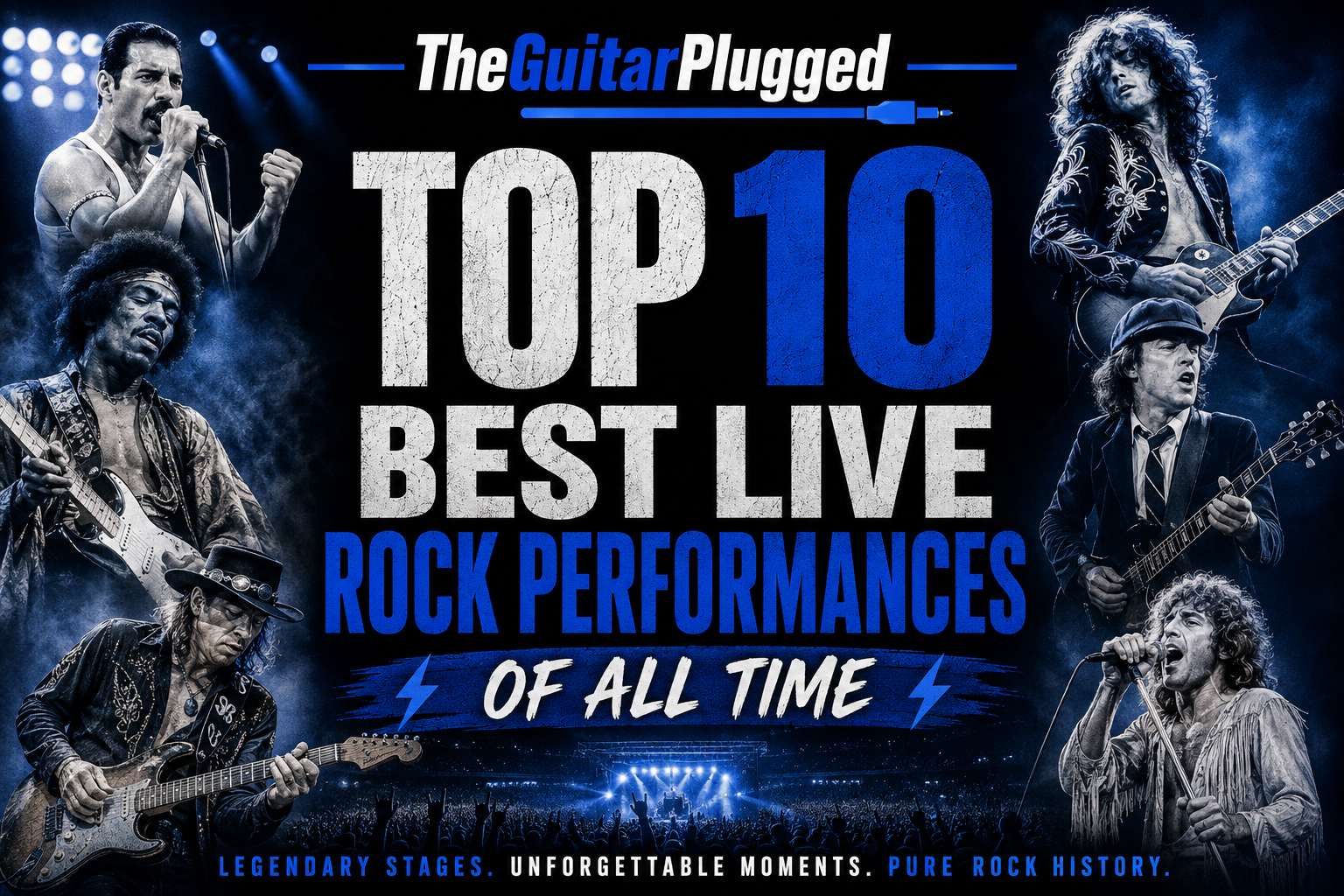
The 10 Best Live Rock Performances of All Time
From Queen owning Wembley in 20 minutes to Jimi Hendrix redefining the electric guitar at Woodstock, these are the performances that showed what rock music can become when the stage, the songs and the moment collide.
There are great concerts, and then there are performances that become part of rock history.
The distinction matters. A technically flawless show isn't necessarily a legendary one. Some of the greatest live performances ever captured contain mistakes, rough edges, questionable notes and moments that would probably get cleaned up in a modern production. What separates them is something much harder to manufacture: the feeling that something important is happening in real time.
That's what we're ranking here. This isn't simply a list of the best-selling concert films or the most famous tours. We looked at the performance itself, the musicianship, the historical significance, the atmosphere surrounding it and — perhaps most importantly — whether the footage still makes you want to turn the volume up decades later.
Some were enormous stadium events. One took place inside an ancient Roman amphitheater without an audience. Another happened early in the morning in front of what remained of a mud-soaked festival crowd. They couldn't be more different. But every performance on this list captured a band or guitarist at a moment when everything seemed to click.
Here are The Guitar Plugged's 10 Best Live Rock Performances of All Time.
10. Pink Floyd — Live at Pompeii (1971)
There may not be another concert film quite like Pink Floyd: Live at Pompeii. Mostly because it isn't really a concert in the conventional sense.
Pink Floyd performed inside the ancient Roman amphitheater at Pompeii with essentially no traditional audience at all. Instead of thousands of screaming fans, the band was surrounded by stone, empty seats and the remains of a civilization buried by Mount Vesuvius nearly two thousand years earlier. And somehow, that makes the performance feel even bigger.
The setting perfectly matched what Pink Floyd was becoming in the early 1970s. This was before The Dark Side of the Moon transformed them into one of the biggest bands on Earth. They were still experimental, strange, psychedelic and willing to let songs breathe for enormous stretches of time.
“Echoes” is the centerpiece. David Gilmour's guitar doesn't dominate through sheer speed or aggression. It hangs in the air. Notes bend, sustain and decay into the natural atmosphere surrounding the band. The performance demonstrates something that would become central to Gilmour's reputation: space can be as important as notes.
Nick Mason's drumming, Roger Waters' bass and Richard Wright's keyboards create a constantly shifting foundation underneath him. There's no crowd reaction telling you when something important happened. No massive light show. No sea of phones. Just Pink Floyd making enormous, strange music in an ancient amphitheater. More than five decades later, it still looks like transmission footage from another planet.
9. The Who — Live at Leeds (1970)
If you want to understand why The Who developed a reputation as one of the most dangerous live bands of their generation, Live at Leeds is Exhibit A.
The studio versions of The Who's songs could be controlled. Onstage, they became something else entirely. Pete Townshend's guitar playing was violent and rhythmic. John Entwistle's bass frequently behaved like a lead instrument. Keith Moon seemed permanently seconds away from destroying the entire arrangement, while Roger Daltrey stood in the middle of it all trying to command the chaos.
Yet somehow it worked. That's what makes Live at Leeds so remarkable. The band sounds enormous.
Townshend is particularly fascinating from a guitarist's perspective because his role demonstrates that rhythm guitar doesn't have to mean “background guitar.” His massive chords, aggressive strumming and explosive dynamics effectively become part of the percussion section. The guitar isn't simply accompanying the song. It's pushing it forward.
There are heavier bands. There are more technically sophisticated bands. But very few groups have ever sounded as physically alive as The Who did around this period.
8. Metallica — Seattle '89 (1989)
Metallica in 1989 was terrifying. And that's meant as a compliment.
The Damaged Justice tour caught the band after ...And Justice for All had elevated them from thrash-metal heroes into something approaching arena-level dominance. Seattle is one of the definitive documents of that era.
James Hetfield's right hand sounds like industrial machinery. Kirk Hammett attacks his leads. Lars Ulrich drives the band forward with youthful aggression. Jason Newsted — still relatively new to the group — looks like he's trying to physically launch himself through the stage.
The setlist doesn't hurt either. Kill 'Em All, Ride the Lightning, Master of Puppets and ...And Justice for All all existed simultaneously in 1989. The performances of “Creeping Death,” “Master of Puppets” and “Battery” capture Metallica before decades of stadium dominance changed the scale of the operation. They were already huge. But they still played like they had something to prove.
For guitarists, Seattle '89 is also one of the greatest demonstrations of Hetfield's rhythm playing ever captured. The precision is ridiculous — but it's the combination of precision and aggression that makes it special. Plenty of guitarists can play fast. Far fewer can make a riff sound like it's coming through the wall.
7. Pearl Jam — Live on Two Legs (1998)
Get Stevie Ray Vaughan’s “Live at El Mocambo (1983)” Tone
Tell ToneMD what guitar and gear you own and we’ll show you how to get as close as possible using the equipment you already have — full signal chain, real numbered settings, no guesswork.
Included with The Guitar Plugged Premium
Pearl Jam's place on this list isn't built around pyro, elaborate staging or one massive historic event. It's here because Pearl Jam became one of rock's great live bands.
By the late 1990s, the group had moved beyond the enormous cultural explosion surrounding Ten and established something much more sustainable: a reputation for delivering concerts that could change dramatically from night to night. Live on Two Legs captured performances from their 1998 North American tour and showed a band completely comfortable with its own identity.
Eddie Vedder had become an exceptional frontman. Mike McCready remained one of the most expressive lead guitarists to emerge from the 1990s. Stone Gossard's rhythm work continued to provide much of the band's underlying muscle. And the group had learned how to stretch songs without turning everything into self-indulgent improvisation.
There's an important lesson in Pearl Jam's longevity. Great live bands don't simply reproduce albums. They allow songs to evolve. A familiar song can feel different depending on the room, the tempo, the solo or the energy of the audience. Pearl Jam embraced that philosophy more aggressively than most bands of their generation.
6. The Rolling Stones — Havana Moon (2016)
By 2016, The Rolling Stones had absolutely nothing left to prove. Which makes Havana Moon even more impressive.
The band's historic free concert in Havana, Cuba drew an enormous crowd and represented something larger than another stop on another Stones tour. And then the band actually delivered. Mick Jagger was in his seventies and still moving around a massive stage with the energy of performers half his age. Keith Richards remained unmistakably Keith Richards.
That's important because Richards has never been about technical perfection. His brilliance is feel. Timing. Space. Attitude. Those slightly loose rhythmic pockets that somehow become tighter because Charlie Watts is underneath them.
The Stones have always understood something about rock music that can get lost in conversations about technique: the groove is the song. You could teach someone every note Richards plays and still not necessarily teach them to sound like Keith Richards. That's why seeing the Stones perform decades into their career remained compelling. They weren't trying to compete with younger bands. They were demonstrating the language those bands inherited.
5. AC/DC — Live at Donington (1991)
Sometimes rock music doesn't need to be complicated. Sometimes you need Angus Young, a Gibson SG, a Marshall stack and a riff.
AC/DC's 1991 performance at Donington is one of the greatest examples of a massive rock show built around incredibly direct musical ideas. The stage is enormous. The audience is enormous. The production is enormous. Yet underneath all of it sits Malcolm Young's rhythm guitar. That's the secret.
Angus gets the spotlight — and deservedly so — but Malcolm was the engine. Listen to the space between the chords. Listen to the way the guitars lock with the drums. Listen to how little unnecessary information exists in an AC/DC arrangement. Every part has a job.
Angus then gets to explode over the top. His playing at Donington contains everything that makes him one of rock's most identifiable guitarists: blues vocabulary, enormous bends, frantic vibrato, pentatonic runs and seemingly limitless physical energy. The performance of “Thunderstruck” alone would justify the concert's reputation. But Donington works because AC/DC manages to make a gigantic festival crowd feel like it's standing inside a sweaty club. That's much harder than it looks.
4. Led Zeppelin — Madison Square Garden / The Song Remains the Same (1973)
Led Zeppelin in 1973 had reached an extraordinary position. They weren't simply successful. They were becoming mythological.
“Queen didn't merely play Live Aid. For twenty minutes, Queen owned it.”
The Madison Square Garden performances captured for The Song Remains the Same show Zeppelin operating at a scale few rock bands had previously experienced. Robert Plant had the voice. John Bonham had perhaps the most recognizable drum feel in hard rock. John Paul Jones quietly held together arrangements that were often far more sophisticated than they initially appeared. And Jimmy Page had become the archetype of the guitar hero.
Page's live playing has always generated debate because he wasn't interested in reproducing every studio part with clinical accuracy. That's precisely why the best Zeppelin performances feel dangerous. Songs stretch. Tempos move. Solos wander into unexpected places. Arrangements threaten to come apart before suddenly snapping back together.
Page wasn't performing music like a technician demonstrating a finished product. He was exploring it. At their best, Zeppelin could move from almost complete silence to overwhelming volume within seconds. Few bands have ever understood dynamics better.
3. Stevie Ray Vaughan — Live at El Mocambo (1983)
There are guitar performances. And then there is Stevie Ray Vaughan at El Mocambo. For guitar players, this footage can almost feel unfair.
Vaughan was still early in his mainstream career when he walked onto the stage of Toronto's El Mocambo in 1983. But he already sounded completely formed. The Stratocaster tone. The enormous strings. The aggressive pick attack. The left-hand strength. The Texas shuffle. The Hendrix influence. The Albert King bends. It was all there.
Yet none of it sounded like imitation. SRV had absorbed generations of blues guitar and somehow turned them into a language that immediately sounded like Stevie Ray Vaughan. That's the difference between influence and identity.
Watch his hands during this performance. The physicality is remarkable. Vaughan attacks the guitar hard enough that it occasionally looks like he's fighting it. But underneath the aggression is extraordinary control. His bends land. His vibrato speaks. His rhythm playing swings. And his dynamics constantly shift.
This wasn't guitar playing designed to impress guitar players. It was emotional communication through an electric guitar. That's why El Mocambo remains essential viewing. Thousands of technically extraordinary guitar performances have appeared since. Very few feel this alive.
2. Jimi Hendrix — Woodstock (1969)
Jimi Hendrix's Woodstock performance has become so deeply embedded in popular culture that it's easy to forget how bizarre the circumstances actually were. Hendrix didn't perform at the height of the festival. He effectively played after Woodstock was already ending.
By Monday morning, much of the enormous crowd had left. The festival grounds were devastated. People were exhausted. The cultural event of a generation was stumbling toward its conclusion. Then Hendrix played “The Star-Spangled Banner” — and created one of the defining moments in electric-guitar history.
The performance is frequently described as a protest, although Hendrix himself resisted simplistic interpretations of it. What matters musically is what he did with the instrument. Hendrix transformed the guitar into sound design. Feedback became vocabulary. Whammy-bar dives became explosions. Sustained notes became sirens. Noise became music.
The Stratocaster wasn't simply playing the melody of the American national anthem. It was commenting on it. That's an enormous distinction. Before Hendrix, distortion and feedback were often things engineers and guitarists tried to control. Hendrix understood they could become compositional tools.
Modern guitarists live in the world he helped create: high-gain amplifiers, fuzz, wah, extreme effects, controlled feedback, studio experimentation, noise as texture. None of those ideas belong exclusively to Hendrix, but few musicians accelerated their acceptance more dramatically. A white Stratocaster. A headband. A wall of amplifiers. And a guitarist making sounds that seemed impossible. More than half a century later, it still feels radical.
1. Queen — Live Aid (1985)
Twenty-one minutes. That's approximately how long Queen needed to create arguably the greatest live rock performance ever captured. And the circumstances make it even better.
Queen wasn't necessarily the band everyone expected to dominate Live Aid. The event featured an absurd collection of major artists — U2, David Bowie, The Who, Elton John, Paul McCartney, Dire Straits, Sting and many more. Queen walked onto the Wembley Stadium stage and essentially turned the entire event into a Queen concert.
Freddie Mercury sat at the piano. Played the opening notes of “Bohemian Rhapsody.” And Wembley erupted. What followed has become rock mythology: “Bohemian Rhapsody,” “Radio Ga Ga,” “Hammer to Fall,” “Crazy Little Thing Called Love,” “We Will Rock You” and “We Are the Champions.”
But the setlist alone doesn't explain it. The performance is No. 1 because of command. Mercury understood the crowd at a level very few performers ever have. The famous “Ay-Oh” call-and-response sequence is almost absurd when you watch it closely. One person sings a phrase. Tens of thousands of people immediately sing it back. Mercury changes the phrase. They follow him again. It's less like watching a singer perform and more like watching someone physically conduct a stadium.
Brian May is equally important. His Red Special tone cuts through everything without becoming harsh, and his guitar work demonstrates why Queen arrangements were so effective. May rarely plays simply to fill space. His parts function like orchestrations — chord inversions, melodic fills, harmonized lines and carefully voiced lead parts give Queen a musical sophistication that could easily disappear beneath Mercury's showmanship. It doesn't. Instead, the two complement each other.
And then there's the sheer efficiency of the performance. No wasted movement. No extended speech. No unnecessary jam. Queen understood exactly what Live Aid required. They weren't playing a Queen concert. They were walking onto a global stage filled with other legendary artists with approximately twenty minutes to make everyone remember them. They did.
Nearly every discussion about the greatest live rock performance eventually circles back to Wembley. There's a reason. Queen didn't merely play Live Aid. For twenty minutes, Queen owned it.
The Final Ranking
1. Queen — Live Aid (1985)
2. Jimi Hendrix — Woodstock (1969)
3. Stevie Ray Vaughan — Live at El Mocambo (1983)
4. Led Zeppelin — Madison Square Garden / The Song Remains the Same (1973)
5. AC/DC — Live at Donington (1991)
6. The Rolling Stones — Havana Moon (2016)
7. Pearl Jam — Live on Two Legs (1998)
8. Metallica — Seattle '89 (1989)
9. The Who — Live at Leeds (1970)
10. Pink Floyd — Live at Pompeii (1971)
What Did We Get Wrong?
That's the fun part. A list like this is impossible to make without leaving something painful out. Where's Van Halen? Where's Prince? Where's Rush? Where's David Bowie? Where's Dire Straits? Where's Black Sabbath? Where's Cream? Where's Rory Gallagher? Where's Thin Lizzy?
Depending on what era of rock you grew up with, you could probably replace half this list before breakfast. But that's exactly why these rankings are worth arguing about. Rock history isn't a spreadsheet. It's personal. The concert that changed one person's life might mean absolutely nothing to someone else.
So now it's your turn: what's the greatest live rock performance you've ever seen — either in person or on video? And more importantly: who did we leave out? Drop your pick in the comments.
Experience-driven coverage, not algorithm bait.
- 20+ years of guitar playing experience
- Real-world retail experience at Guitar Center
- Thousands of hours testing guitars, amps, and pedals
- A community of 50,000+ guitar enthusiasts across platforms
- Partnerships with Fender, DistroKid, TrueFire, Card Chords, and Enya
- Editorial standards published openly — see how we test gear
The Modern Guitar Magazine. Delivered to your inbox.
No spam. No gimmicks. Just great guitar content — stories, tones, iconic solos, and honest gear takes. Every week.
Discussion (0)
Sign in to join the discussion.
Sign in to commentLoading comments…
Discover another guitar story
Swipe through our latest features, breaking news and iconic solos — one story at a time.
Open Swipe →More in Guitar Talk
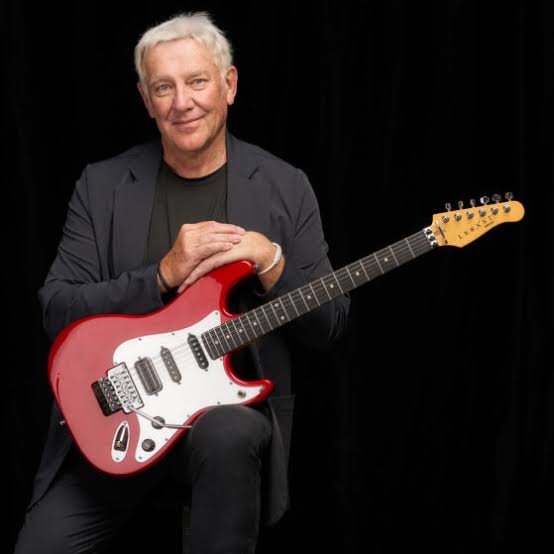
History of the Riff: How Alex Lifeson Made “The Spirit of Radio” Sound Like Electricity
Rush's 1980 masterpiece opens with rock guitar's most recognizable burst of controlled chaos — a modified Strat, a flanged Marshall and a riff built to sound like radio waves.
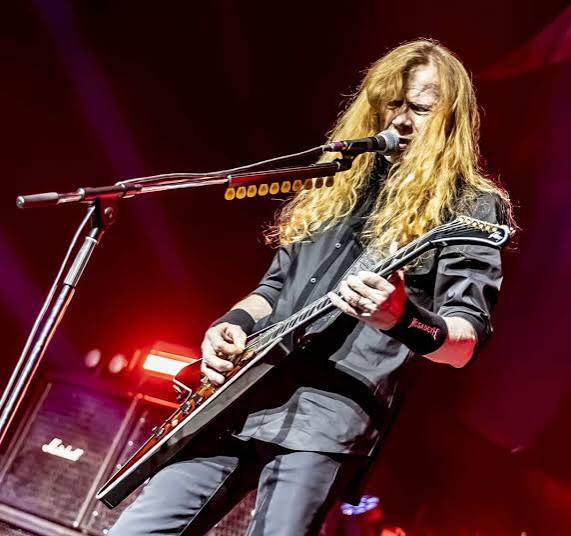
History of the Riff: Megadeth's "Tornado of Souls" — The Perfect Storm That Changed Metal Guitar
How Dave Mustaine built one of thrash metal's most relentless riffs — and how Marty Friedman walked into Megadeth and turned the song into guitar history.
Slash Says Young Guitar Players Are ‘Blowing My Mind’ — Maybe Guitar Isn’t Dying After All
For years we’ve been told the guitar is losing its place in popular music. Slash appears to be seeing something very different.