
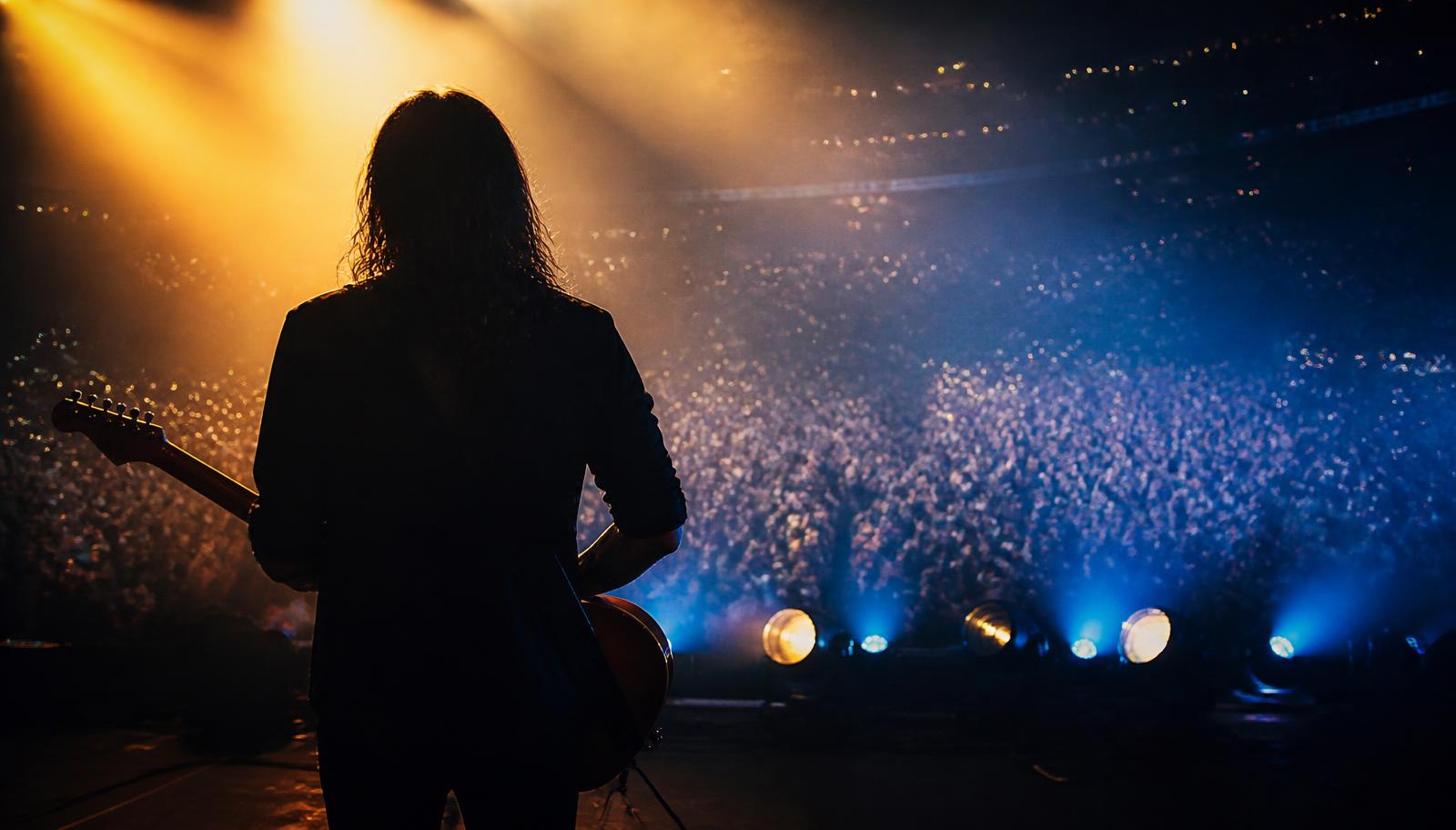
Some players have performed the same 24 bars more than three thousand times. Boredom is the obvious assumption — and, according to the guitarists who actually do it for a living, mostly the wrong one.
Do the math on a hit song and the number gets absurd fast. A working arena guitarist plays roughly ninety shows in a heavy touring year. Sustain that for thirty years and the signature solo — the one printed on the T-shirts, the one the crowd films — has been performed something in the region of two and a half to three thousand times. Add soundchecks, rehearsals, television slots, radio sessions and the awards-show medleys, and you are comfortably past four thousand.
Four thousand repetitions of the same twenty-four bars. It is a number that provokes an immediate, obvious question, and one that fans ask guitarists constantly in meet-and-greet lines: doesn't it get boring?
The honest answer, drawn from decades of interviews, memoirs and the behaviour of the players themselves, is more interesting than a simple yes or no. Some guitarists genuinely resent their biggest song. A few have retired one outright. But the large majority — including nearly everyone who has managed a forty-year career — describe something closer to the opposite: a nightly ritual they have learned to protect, because it is the one moment in the set where the audience does the heavy lifting.
The number that changes everything
There is a threshold most touring musicians describe in some form. Somewhere between the two-hundredth and the five-hundredth performance, a song stops being a piece of music the guitarist is playing and becomes a piece of choreography the guitarist is executing. The fingers no longer read the notes. They read the room.
That transition is what separates the players who burn out on a hit from the ones who don't. Once the physical execution is automatic, the guitarist's attention has to land somewhere else, and where it lands determines how the next two thousand performances feel. Players who put their attention on the notes — on whether tonight's bend was as good as last night's — describe grinding fatigue. Players who put their attention on the audience describe the opposite.
Ask any veteran sideman when a song became automatic and you tend to get the same shrug: somewhere in the first year of hard touring. After that, the challenge is no longer can I play it but where am I looking while I play it.
Why the famous solos don't change
Here is the detail that tells you most about how professionals think about this. If boredom were the dominant force, you would expect the famous solos to drift — for guitarists to improvise their way out of the tedium. Overwhelmingly, they do not.
Listen to bootlegs of the Eagles playing "Hotel California" across five decades and the harmonised outro is essentially identical every night, because Don Felder and Joe Walsh treat it as a composed part rather than a solo. The same is true of Queen's "Bohemian Rhapsody" guitar section, of the melodic centre of "Comfortably Numb," of the twin harmony in "Hotel California" and of the entire architecture of "Sultans of Swing." These are not improvisations that happened to be recorded. They are melodies, and audiences hear a wrong note in a famous solo the way they would hear a wrong lyric.
That is a form of discipline, not boredom management. Felder has spoken and written at length about the pressure of delivering that outro exactly as recorded — the awareness that a stadium is singing the guitar line back and will notice any deviation. It is closer to the mindset of an orchestral musician than a jam-band player.
Want This Tone?
Tell ToneMD what guitar and gear you own and we’ll show you how to get as close as possible using the equipment you already have — full signal chain, real numbered settings, no guesswork.
Included with The Guitar Plugged Premium
The guitarists who do change things tend to change the container rather than the contents. Jimmy Page famously used the free sections of Led Zeppelin's live sets — the extended passages in "Dazed and Confused" or "No Quarter" — as the release valve, precisely so that the composed moments could stay composed. Kirk Hammett has reworked Metallica solos live for decades, but the recognisable hooks survive; it is the connective tissue that moves.
What to Remember
- ▸A signature solo from a forty-year career has typically been performed 2,500–4,000 times, including soundchecks and TV.
- ▸Famous solos stay note-for-note because audiences hear them as melodies — a wrong note lands like a wrong lyric.
- ▸Documented hit fatigue (Plant, Radiohead) is almost always about what the song did to the artist's identity, not the playing.
- ▸Long-career sidemen consistently describe the hit as the ritual that sustains the tour, not the thing that drains it.
- ▸The practical fixes are the same at any level: raise your own standard, change the gear, keep one section improvised.
The players who really did get sick of it
The resentment is real in a minority of cases, and it is usually about something other than the music.
Robert Plant's long, public discomfort with "Stairway to Heaven" is the most cited example in rock. Across interviews stretching from the 1980s onward, he has made clear he has little appetite for singing it nightly, and he has spent his solo career conspicuously avoiding it. Notably, Jimmy Page has never expressed anything comparable about playing the guitar part. The friction was with what the song came to represent — an anthem that flattened everything else Led Zeppelin did — rather than with the notes themselves.

X Concepts Strings • Made in USA
Never Run Out of Strings Again.
Join the X Concepts String Club and get fresh USA-made strings delivered every month—plus Premium membership options for the full Guitar Plugged experience.
Radiohead's relationship with "Creep" followed a similar shape: a band whose defining early hit no longer resembled the band they had become, dropped from setlists for long stretches and reintroduced only on their own terms. Again, the objection was contextual. The song became a demand rather than an offer.
Even Slash's story about "Sweet Child O' Mine" belongs in this category, though it runs in the other direction. He has described the opening riff, in his memoir and repeatedly in interviews since, as a throwaway — a string-skipping warm-up exercise he was messing around with, which the rest of Guns N' Roses insisted on turning into a song. He did not think much of it at the time. Forty years and thousands of performances later, he plays it every night, and he does not appear to be suffering.
“The song stops being yours the moment it belongs to twenty thousand people. What's left is your job: to hand it back to them intact.”
The pattern in almost every case of hit fatigue is the same: the problem is what the song did to the artist's career, not what it does to their hands.
The case for the ritual
Talk to career sidemen — the guitarists who have spent thirty years beside a frontman playing the same twenty songs — and the tone shifts noticeably. Keith Scott has been Bryan Adams' guitarist since the early 1980s, which means "Summer of '69" has been part of his working life for over four decades. Steve Stevens has been playing "Rebel Yell" since 1983. Neither has built a public identity around being tired of it. Both have spoken warmly about the privilege of having written something a stadium will sing without prompting.
That framing recurs constantly among long-career players, and it is not just diplomacy. The economics are blunt: the hit is the reason the tour exists, the reason the fee is what it is, and the reason a guitarist in their sixties is still playing to full rooms rather than teaching lessons. Resenting it is an expensive luxury.
But the more persuasive argument is emotional, and every touring guitarist eventually articulates some version of it. The song is played once by the band and heard for the first time by somebody in the crowd every single night. The four-thousandth performance is somebody's first — often a teenager who has heard it only through headphones, standing next to a parent who heard it on the radio in 1984. The guitarist's boredom, if it exists, is measured against that.
The tempo drifts. The key sometimes drops a semitone or a full step to protect a singer's range. The gear changes constantly — digital rigs, in-ear monitors, silent stages. The famous eight bars stay exactly where they are.
How professionals stay interested
The techniques veterans describe for keeping a thousand-times-played song alive are remarkably consistent, and they are useful whether you are playing arenas or the same wedding set every Saturday.
They move the target. Instead of asking "can I play this," the question becomes "can I play this better than last night" — cleaner vibrato, more accurate bend, a phrase that breathes half a beat later. The improvement is invisible to the audience and entirely for the player.
They change the gear, not the notes. A different guitar for the same song changes how it feels under the hands without changing what the crowd hears. Swapping a Les Paul for a 335, or a fuzz for a lower-gain overdrive, reframes a familiar part completely.
They watch the room. Once the part is automatic, the performance becomes about timing the moment — where to walk, when to make eye contact with the front row, how long to hold the last note before the crowd takes over. That is a skill with no ceiling.
They protect one section for improvisation. Even the most faithful acts leave a door open somewhere in the set. Keeping the famous solo fixed is much easier when there is another song where anything can happen.
They separate the song from the career. The players who cope best appear to be the ones who kept building — new records, side projects, production work, teaching — so the hit is one thing they do rather than the only thing.
The verdict
Do guitarists get tired of playing their biggest hits? A handful, genuinely and publicly. Most, no — and the ones who last longest tend to be the ones who reframed the question entirely.
The song stops belonging to the guitarist somewhere around the two-hundredth performance. What replaces ownership is a job: to deliver a piece of music that twenty thousand people already know by heart, intact, with the same conviction it had the first time. That is not a chore that wears players down. Judging by the guitarists who are still doing it in their seventies and eighties, it is the part of the job that keeps them upright.
The boredom, if there is any, belongs to the person playing the notes. The moment belongs to everybody else in the building. Most guitarists work that trade out fairly quickly — and decide it is a good one.
Sources & further reading
- 1.Don Felder, 'Heaven and Hell: My Life in the Eagles (1974–2001)' — on the composition and nightly delivery of the 'Hotel California' outro (Wiley, 2008).
- 2.Slash with Anthony Bozza, 'Slash' — the account of the 'Sweet Child O' Mine' intro beginning as a string-skipping exercise (It Books, 2007).
- 3.Robert Plant's long-documented reluctance to perform 'Stairway to Heaven,' expressed across interviews from the late 1980s onward and reflected in his solo setlists.
- 4.Radiohead's decades-long, intermittent omission of 'Creep' from live setlists, documented in the band's published tour setlist history.
- 5.Performance-count figures are The Guitar Plugged's own estimates, calculated from published tour itineraries and typical arena-touring schedules.
Experience-driven coverage, not algorithm bait.
- 20+ years of guitar playing experience
- Real-world retail experience at Guitar Center
- Thousands of hours testing guitars, amps, and pedals
- A community of 50,000+ guitar enthusiasts across platforms
- Partnerships with Fender, DistroKid, TrueFire, Card Chords, and Enya
- Editorial standards published openly — see how we test gear
More stories from inside the touring life
Long-form guitar journalism, gear breakdowns and player deep dives — straight to your inbox.
Ask GP
3 free questions a dayStill curious? Ask GP about this story.
Your personal classic-rock and guitar guide — ask anything about Do Guitarists Ever Get Tired.
Discussion (0)
Sign in to join the discussion.
Sign in to commentLoading comments…
Discover another guitar story
Swipe through our latest features, breaking news and iconic solos — one story at a time.
Open Swipe →More in Guitar Talk
The 10 Greatest Guitar Renditions of “The Star-Spangled Banner”
From Jimi Hendrix's controlled chaos at Woodstock to modern performances by H.E.R., Gary Clark Jr. and Jack White, these guitarists turned America's national anthem into something deeply personal.
Happy Birthday, Joe Perry: The Riff Machine Who Gave Aerosmith Its Swagger
Joe Perry turns 76 today. From the swampy grind of “Sweet Emotion” to the reunion that saved a band, this is the career of the guitarist who taught American hard rock how to strut.
History of the Riff: How Joe Satriani Made “Flying in a Blue Dream” Feel Weightless
An acoustic guitar in an unusual tuning, a stray broadcast and a melody that seems to hang in the air: inside the construction of Satriani’s 1989 masterpiece.