
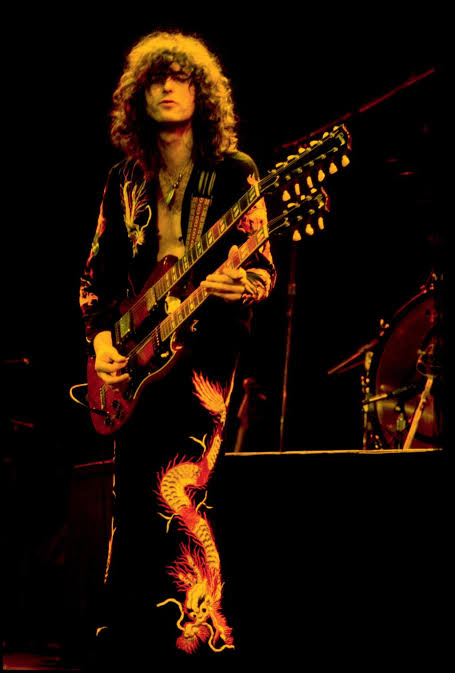
The History of the Riff: How Jimmy Page Built the Monumental Guitar Part Behind Led Zeppelin's "Kashmir"
Inside DADGAD tuning, John Bonham's rhythmic illusion, and the orchestral scale that made "Kashmir" one of the most ambitious pieces of music Led Zeppelin ever recorded.
There are guitar riffs that make you want to pick up a guitar.
There are riffs that make you turn the volume up.
And then there are riffs that seem to alter the atmosphere of the room.
Led Zeppelin's "Kashmir" belongs firmly in the last category.
It doesn't explode from the speakers with the frantic energy of "Communication Breakdown." It doesn't have the blues-soaked swagger of "Whole Lotta Love." It isn't built around the kind of immediately accessible pentatonic hook that powered countless hard-rock records in Led Zeppelin's wake.
Instead, "Kashmir" moves. Slowly. Deliberately. Inevitably.
Jimmy Page's guitar figure feels less like a conventional rock riff and more like a massive piece of machinery gradually turning over. John Bonham's drums push against it with one of the most deceptively powerful grooves of his career. John Paul Jones surrounds the entire thing with orchestral weight. Robert Plant sings above it all as if he's narrating a journey across some endless, mythical landscape.
The result is one of the most ambitious pieces of music Led Zeppelin ever recorded. And at the center of it is a riff that challenged one of rock guitar's most basic assumptions: a riff doesn't have to move quickly to feel powerful. Sometimes, the heaviest thing you can do is make the listener wait.
Before the Riff
By the time Led Zeppelin released Physical Graffiti in February 1975, the band had already spent years expanding the vocabulary of hard rock. The first album had established the formula: blues, volume, dynamics and an almost frightening level of chemistry between four musicians. Led Zeppelin II made that formula enormous. Led Zeppelin III revealed the acoustic, folk and modal influences that had always existed beneath the surface. Led Zeppelin IV turned the band into something approaching mythology. Houses of the Holy pushed further outward, incorporating funk, reggae and progressive textures.
Then came Physical Graffiti. The sprawling double album captured perhaps the widest possible version of Led Zeppelin. Heavy blues sat beside acoustic pieces. Funk collided with hard rock. Older recordings were placed alongside newer material. The album sounded less like a band following a genre and more like four musicians who had reached the point where genre itself had become optional.
"Kashmir" was the ultimate expression of that freedom. The song developed over an extended period, with its foundations emerging from Jimmy Page's experimentation with alternate tuning and his musical partnership with John Bonham. Page and Bonham worked on the early framework at Headley Grange, the Hampshire house that had become central to the Led Zeppelin recording mythology.
Page knew he had something unusually powerful. But "Kashmir" would eventually become much larger than a guitar riff. It would become an exercise in tension, orchestration and rhythmic illusion.
The Tuning That Changed Everything
To understand "Kashmir," you have to begin with the guitar. But you also have to temporarily forget the guitar as most rock players know it.
Page used DADGAD tuning — a modal alternate tuning he had explored elsewhere in his playing. Instead of standard tuning's E-A-D-G-B-E arrangement, the guitar is tuned D-A-D-G-A-D. Immediately, the relationship between the strings changes. Familiar chord shapes disappear. Open strings begin interacting with fretted notes in unexpected ways. The guitar becomes less obviously major or minor.
That ambiguity is crucial. "Kashmir" doesn't sound like a blues progression dressed up as hard rock. It has a modal quality that creates a feeling of movement without offering the listener the usual harmonic resolution. The tuning allows Page to use ringing open strings while shifting other notes around them. The guitar can sound simultaneously grounded and unsettled.
That is one of the secrets of the riff. There is always something familiar to hold onto. But there is also something moving underneath your feet.
For guitarists accustomed to standard tuning, DADGAD can initially feel disorienting. But that disorientation is also its creative advantage. Your hands can no longer automatically reach for the same familiar blues boxes and chord voicings. You have to listen differently. Page used that freedom to construct something that feels almost architectural. The riff doesn't simply repeat. It unfolds.
• Alternate tuning: DADGAD (D-A-D-G-A-D)
• Guitar most associated: Danelectro 3021
• Rhythmic illusion between guitar and drums
• Orchestral arrangement by John Paul Jones
• Recorded during the Physical Graffiti sessions (1974-75)
The Riff That Climbs Without Going Anywhere
Get Jimmy Page’s “Kashmir” Tone
Tell ToneMD what guitar and gear you own and we’ll show you how to get as close as possible using the equipment you already have — full signal chain, real numbered settings, no guesswork.
Included with The Guitar Plugged Premium
Listen closely to the opening guitar figure and something strange happens. It feels like it is constantly moving forward. Yet it also feels trapped inside an endless cycle.
Page creates this effect by allowing the internal movement of the riff to develop against a persistent tonal foundation. Notes shift. Chord shapes change. The tension rises. But the music refuses to resolve in the way your ear expects. It is musical suspense.
The riff seems to climb. Then it begins again. Climb. Begin again. Over and over. This repetition could have become monotonous in the hands of another band. With Led Zeppelin, it becomes hypnotic.
Part of the reason is Page's restraint. There is no need for excessive distortion. No rapid-fire guitar fills. No attempt to demonstrate technical complexity for its own sake. The riff itself is the event.
That is an important distinction. Some of the greatest riffs in rock history function as introductions before the "real" song begins. "Kashmir" never leaves its central gravitational pull. Everything else is built around it.
Then John Bonham Changes the Equation
If Jimmy Page created the architecture of "Kashmir," John Bonham made it move. And this is where the song becomes rhythmically fascinating. The guitar figure and the drums seem to experience time differently.
Page's riff creates one rhythmic implication while Bonham establishes a massive, deliberate pulse underneath it. The resulting tension gives the listener the sensation that the instruments are pulling against one another. But they never actually lose each other. Instead, they periodically reconnect. That is the magic.
Bonham doesn't chase every accent in Page's guitar part. He does the opposite. He stays enormous. His groove gives the riff a foundation strong enough to allow the guitar to create tension above it.
This is one of the great lessons hidden inside "Kashmir." Power does not always come from playing more. Sometimes power comes from refusing to move.

X Concepts Strings • Made in USA
Never Run Out of Strings Again.
Join the X Concepts String Club and get fresh USA-made strings delivered every month—plus Premium membership options for the full Guitar Plugged experience.
Imagine a less disciplined drummer attacking the song with constant fills, cymbal crashes and rhythmic embellishment. The entire illusion would collapse. Bonham leaves space. And because he leaves space, every kick drum feels heavier. Every snare hit feels larger. Every transition matters.
The drums don't merely accompany the riff. They create a second perspective on it. You can listen to "Kashmir" by following Page. Or you can listen by following Bonham. The song feels different depending on which musician your ear chooses. That rhythmic tension is one of the reasons the track remains fascinating after repeated listens.
The Sound of Something Larger Than a Rock Band
“A riff doesn't have to move quickly to feel powerful. Sometimes, the heaviest thing you can do is make the listener wait.”
Page understood that the central idea behind "Kashmir" could extend beyond guitar, bass and drums. The orchestration became essential to the final recording. John Paul Jones' arrangements helped transform the song from a hypnotic rock track into something cinematic.
Strings and brass don't merely decorate the guitar riff. They expand it. They answer it. They reinforce its movement. At certain moments, the arrangement seems to make the riff physically larger — as if Page's guitar has been duplicated across an entire ensemble.
That was a significant creative decision. The orchestra isn't placed politely behind the band. It becomes part of the machinery. The guitar provides one layer. Bonham provides another. The orchestration adds scale. Plant adds the mythology. Together, they create something that feels almost impossible to locate geographically or musically.
There are elements that evoke sounds beyond British and American rock traditions, but "Kashmir" isn't easily reduced to one specific influence. It sounds like Led Zeppelin absorbing ideas from everywhere they had traveled, everything they had heard and everything Page had explored — and turning those influences into something distinctly their own.
A Song Named After a Place They Hadn't Visited
The title adds another layer to the mythology. Despite the song being called "Kashmir," Robert Plant's lyrical inspiration came from traveling through Morocco rather than visiting the Kashmir region itself. That almost makes the title more appropriate. "Kashmir" isn't really a travelogue. It's a destination of the imagination.
Plant's lyrics describe movement through an immense landscape. The words feel dreamlike and impressionistic rather than geographically precise. That matches the music perfectly. Page's riff feels like travel without arrival. Bonham's drums suggest forward motion. The orchestration expands the horizon. Plant becomes the traveler. The destination always seems to remain somewhere beyond the next mountain.
That sense of scale is one reason the song's considerable length doesn't feel excessive. "Kashmir" isn't in a hurry. It couldn't be. The journey is the point.
Jimmy Page's Genius Wasn't Speed
When guitarists discuss Jimmy Page, the conversation often turns toward his solos — the frantic attack of "Heartbreaker," the architecture of "Stairway to Heaven," the blues phrasing of "Since I've Been Loving You", the controlled chaos of Led Zeppelin's live performances.
But "Kashmir" reveals another side of Page's genius: composition. Page understood the guitar not merely as a lead instrument but as an arranging tool. He could use it to create texture. Rhythm. Harmony. Tension. Atmosphere.
In "Kashmir," the guitar isn't fighting to occupy the entire frequency spectrum. It establishes an idea strong enough that other instruments can expand upon it. That takes confidence. A lesser guitarist might have added more. Page knew when the riff was enough.
Why the Riff Still Sounds Heavy
Modern guitar players often associate heaviness with equipment. More gain. Lower tunings. More strings. Larger amplifiers. Extended-range guitars. But "Kashmir" is a reminder that heaviness begins with composition.
The riff feels heavy because of its relationship with the drums. It feels heavy because of the space between the notes. It feels heavy because the arrangement builds tension instead of releasing it immediately. It feels heavy because Bonham plays with authority rather than urgency. And it feels heavy because the riff repeats long enough to become almost physical.
The listener doesn't simply hear "Kashmir." Eventually, you inhabit it.
That is why the song has influenced musicians far beyond traditional classic rock. Metal musicians can hear heaviness in it. Progressive musicians can hear rhythmic complexity. Film composers can hear scale. Guitarists can hear the possibilities of alternate tuning. Producers can hear the power of arrangement. Drummers can spend an entire lifetime studying what Bonham doesn't play. Few rock songs contain that many lessons simultaneously.
The Danelectro Factor
Another piece of the "Kashmir" story is Page's use of a Danelectro guitar, an instrument that became closely associated with his alternate-tuned material. For many players, the mental image of Jimmy Page is inseparable from a sunburst Gibson Les Paul slung low across his body. But Page's guitar arsenal was always broader than that image suggests.
The Danelectro offered a different personality. Its construction and pickups produced a character that could remain articulate while interacting with unusual tunings and dense arrangements. That clarity matters on "Kashmir." A heavily saturated guitar sound could have turned the central figure into mud once the drums, bass and orchestration arrived. Instead, the guitar retains definition. You can hear the shape of the riff.
That is another useful lesson for modern players attempting to recreate Page's sound. More gain isn't necessarily the answer. The riff has to breathe.
How to Approach the "Kashmir" Sound
You don't need Jimmy Page's exact vintage equipment to understand the philosophy behind the tone. Start with the tuning. DADGAD fundamentally changes the instrument's response and encourages the droning, modal quality that defines the riff.
From there, keep the guitar tone relatively open. You want enough drive to create authority, but not so much saturation that individual notes disappear. A British-voiced amplifier or convincing Marshall-style amp model is a natural starting point. Keep the low end controlled. Let the drums provide much of the physical impact.
Use your picking hand deliberately. The riff needs weight, but it also needs space. And most importantly: don't rush. "Kashmir" loses its power when played nervously. The riff should feel inevitable.
The Ultimate Lesson of "Kashmir"
The greatest guitar riffs often contain a contradiction. "Smoke on the Water" is simple but unforgettable. "Whole Lotta Love" is repetitive but endlessly exciting. "Back in Black" is spacious but enormous. "Kashmir" feels both stationary and constantly moving. That contradiction is its genius.
Jimmy Page created a guitar figure that seems to travel without ever reaching its destination. John Bonham placed a monumental groove underneath it. John Paul Jones expanded it into an orchestral landscape. Robert Plant gave that landscape a mythology. And Led Zeppelin turned the entire thing into eight-and-a-half minutes of music that still sounds unlike almost anything else in the classic-rock canon.
Fifty years after Physical Graffiti, guitarists are still retuning their instruments to DADGAD and trying to understand exactly why the riff feels the way it does. Maybe that's the ultimate measure of a truly great riff. You can learn the notes. You can buy the gear. You can tune the guitar correctly. You can study the rhythm. But somehow, the original still contains something mysterious.
"Kashmir" isn't simply one of Jimmy Page's greatest riffs. It's a reminder of what happens when a guitarist stops thinking about the guitar as six strings and starts thinking about it as an entire landscape.
What to Remember
- ▸Page wrote "Kashmir" in DADGAD tuning — the modal alternate tuning is what gives the riff its droning, ambiguous, mythical character.
- ▸The riff's power comes from a rhythmic illusion between Page's guitar and Bonham's drums, which imply different pulses without ever losing each other.
- ▸John Paul Jones's orchestral arrangement doesn't decorate the riff — it expands it, giving "Kashmir" cinematic scale beyond a conventional rock band.
- ▸Page used a Danelectro-style guitar for clarity in alternate tunings. Chasing the tone with more gain destroys the definition that makes the riff work.
- ▸Heaviness in "Kashmir" comes from composition, space and restraint — not from equipment. Bonham's discipline is what makes the guitar sound monumental.
Keep Exploring History of the Riff
- Led Zeppelin — Physical Graffiti (Vinyl)$34·Check on Amazon →
- Led Zeppelin Complete Guitar TAB Songbook$29·Check on Amazon →
- Ernie Ball Regular Slinky Electric Strings$7·Check on Amazon →
Some links are affiliate links — we may earn a small commission at no cost to you.
Shop "Kashmir"–Inspired Gear
Some links may be affiliate links. We may earn a small commission at no cost to you.
Experience-driven coverage, not algorithm bait.
- 20+ years of guitar playing experience
- Real-world retail experience at Guitar Center
- Thousands of hours testing guitars, amps, and pedals
- A community of 50,000+ guitar enthusiasts across platforms
- Partnerships with Fender, DistroKid, TrueFire, Card Chords, and Enya
- Editorial standards published openly — see how we test gear
The Modern Guitar Magazine. Delivered to your inbox.
No spam. No gimmicks. Just great guitar content — stories, tones, iconic solos, and honest gear takes. Every week.
Ask GP
3 free questions a dayStill curious? Ask GP about this story.
Your personal classic-rock and guitar guide — ask anything about The History of the Riff.
Discussion (0)
Sign in to join the discussion.
Sign in to commentLoading comments…
Discover another guitar story
Swipe through our latest features, breaking news and iconic solos — one story at a time.
Open Swipe →More in Guitar Talk
Happy Birthday, Joe Perry: The Riff Machine Who Gave Aerosmith Its Swagger
Joe Perry turns 76 today. From the swampy grind of “Sweet Emotion” to the reunion that saved a band, this is the career of the guitarist who taught American hard rock how to strut.
History of the Riff: How Joe Satriani Made “Flying in a Blue Dream” Feel Weightless
An acoustic guitar in an unusual tuning, a stray broadcast and a melody that seems to hang in the air: inside the construction of Satriani’s 1989 masterpiece.

Tony Iommi Opens Up About His Final Conversation With Ozzy Osbourne: “I Still Can't Get It in My Head”
The Black Sabbath guitarist says Ozzy was exhausted after the band's emotional farewell — but determined to give fans one final show.