How to Intonate Your Guitar: The Complete Guide
Have you ever noticed that your guitar sounds perfectly in tune when you play an open chord, but starts sounding off as you move up the neck? If so, your guitar may need an intonation adjustment.
Have you ever noticed that your guitar sounds perfectly in tune when you play an open chord, but starts sounding off as you move up the neck?
If so, your guitar may need an intonation adjustment.
Proper intonation ensures that every note on your guitar plays in tune, whether you're strumming an open G chord or ripping a solo at the 17th fret. The good news? Intonating a guitar is one of the easiest setup tasks you can do at home.
In this guide, we'll walk you through the entire process step by step.
What Is Guitar Intonation?
Intonation refers to how accurately a guitar plays in tune across the entire fretboard.
A guitar with poor intonation may be perfectly tuned open, but notes higher up the neck will sound sharp or flat.
The most common cause is improper saddle positioning at the bridge.
By adjusting the saddle forward or backward, you change the effective length of the string and bring the guitar back into tune.
Signs Your Guitar Needs Intonation
You may need an intonation adjustment if:
Chords sound good near the nut but bad higher up the neck. The 12th fret note sounds different than the harmonic. You recently changed string gauges. You changed string brands. You installed a new bridge. You completed a full setup.
Even a brand-new guitar may require intonation from the factory.
Tools You'll Need
Essential: Accurate tuner, screwdriver or Allen wrench, fresh strings.
Recommended: String action ruler, guitar maintenance kit, neck support.
Step 1: Install Fresh Strings
Before checking intonation, make sure your strings are relatively new.
Old strings can produce inaccurate readings and make intonation nearly impossible.
If you're changing gauges, always install the new gauge first before adjusting intonation.
Step 2: Tune the Guitar
Tune every string precisely to pitch. Use the most accurate tuner available. Clip-on tuners work, but pedal tuners generally provide more precise readings.
Remember: intonation adjustments should always be made with the guitar tuned to pitch.
Step 3: Check the 12th Fret Harmonic
Lightly touch the string directly above the 12th fret wire. Pick the string and immediately lift your finger. This creates the natural harmonic.
Check the tuner reading. The harmonic should read exactly in tune.
“Proper intonation is free, takes less than 30 minutes, and the improvement can be dramatic.”
Step 4: Check the Fretted 12th Fret Note
Now fret the note normally at the 12th fret. Pick the note and compare it to the harmonic. This is where you'll identify the problem.
If the fretted note is SHARP — the string is too short. Move the saddle backward.
If the fretted note is FLAT — the string is too long. Move the saddle forward.
Step 5: Make Small Adjustments
Turn the saddle adjustment screw only a small amount at a time. A quarter-turn can make a noticeable difference.
After each adjustment: retune the string, recheck the harmonic, recheck the fretted note. Repeat until both notes match perfectly.
Step 6: Repeat for Every String
Once one string is complete: retune, move to the next string, repeat the process.
Each string must be adjusted individually. Don't assume that fixing one string fixes the entire guitar.
Fixed Bridge vs Tremolo Systems
Telecaster and Hardtail Bridges are generally the easiest guitars to intonate. Each saddle can be adjusted independently.
Tune-O-Matic Bridges are found on many Gibson-style guitars. These typically require a small flathead screwdriver. Adjustments are simple and quick.
Floyd Rose Bridges are more complicated because the strings are locked. You may need to loosen string locks, release tension, move the saddle, retune, then relock. The process takes longer but follows the same principles.
Common Intonation Mistakes
Adjusting Before Setting Action. Always set neck relief, then string height, then intonation — in that order.
Using Old Strings. Dead strings create inaccurate readings.
Making Large Adjustments. Small changes are the key. Big movements often make the problem worse.
Forgetting to Retune. Every saddle adjustment changes pitch. Always retune before rechecking.
A perfectly intonated guitar won't just sound better — it will make recording, layering tracks, and playing with other musicians significantly easier.
If you record at home, proper intonation is one of the fastest ways to instantly improve your overall sound.
Our Take
Learning to intonate your guitar is one of those skills every guitarist should have.
It's free, it takes less than 30 minutes, and the improvement can be dramatic.
Whether you're playing a budget beginner guitar or a custom shop masterpiece, proper intonation helps every note ring true.
Take the time to do it right, and your guitar will reward you every time you pick it up.
Frequently Asked Questions
- What is guitar intonation?
- Intonation is how accurately your guitar plays in tune across the entire fretboard. A properly intonated guitar sounds in tune whether you're playing open chords near the nut or notes high up the neck. It's controlled by the position of each saddle at the bridge.
- How often should I intonate my guitar?
- Most players should check intonation any time they change string gauge, change string brand, complete a full setup, or notice that chords sound off higher up the neck. Even without those triggers, a quick check every few months is good maintenance.
- Can changing strings affect intonation?
- Yes. Changing string gauge almost always requires re-intonating because thicker or thinner strings change tension and effective length. Even switching brands at the same gauge can subtly shift intonation due to slight construction differences.
- Can beginners intonate their own guitars?
- Absolutely. Intonation is one of the most beginner-friendly setup tasks. With a tuner, the right screwdriver or Allen wrench, and a little patience, most players can intonate a fixed-bridge guitar in under 30 minutes. Floyd Rose systems take longer but follow the same logic.
Recommended Gear for Intonation
Some links may be affiliate links. We may earn a small commission at no cost to you.
Experience-driven coverage, not algorithm bait.
- 20+ years of guitar playing experience
- Real-world retail experience at Guitar Center
- Thousands of hours testing guitars, amps, and pedals
- A community of 50,000+ guitar enthusiasts across platforms
- Partnerships with Fender, DistroKid, TrueFire, Card Chords, and Enya
- Editorial standards published openly — see how we test gear
The Modern Guitar Magazine. Delivered to your inbox.
No spam. No gimmicks. Just great guitar content — stories, tones, iconic solos, and honest gear takes. Every week.
Discussion (0)
Sign in to join the discussion.
Sign in to commentLoading comments…
Discover another guitar story
Swipe through our latest features, breaking news and iconic solos — one story at a time.
Open Swipe →More in Guitar Garage
10 Things Every Gigging Guitarist Needs (And the One Thing They Always Forget)
Every guitarist obsesses over amps and pedals, but smooth gigs come down to preparation. Here are 10 essentials every gigging guitarist needs — plus the one thing almost everyone forgets.
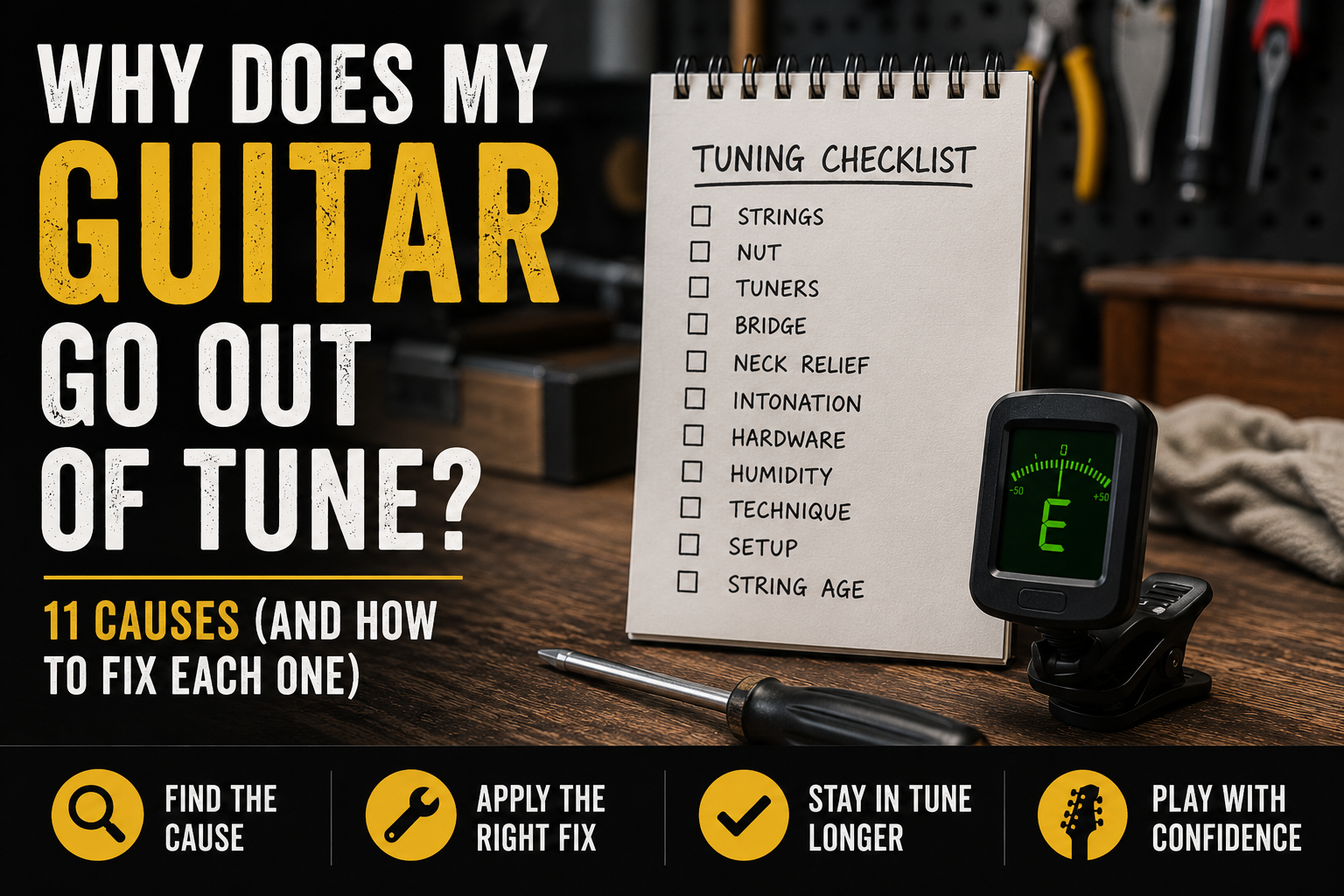
Why Does My Guitar Go Out of Tune? 11 Causes (And How to Fix Each One)
Discover the 11 most common reasons guitars go out of tune and learn practical fixes to keep your instrument stable and sounding its best.

How to Record Guitar at Home (And Actually Get a Professional Sound)
From your very first riff to a polished recording — everything you need to know without wasting money on gear you don't need.