
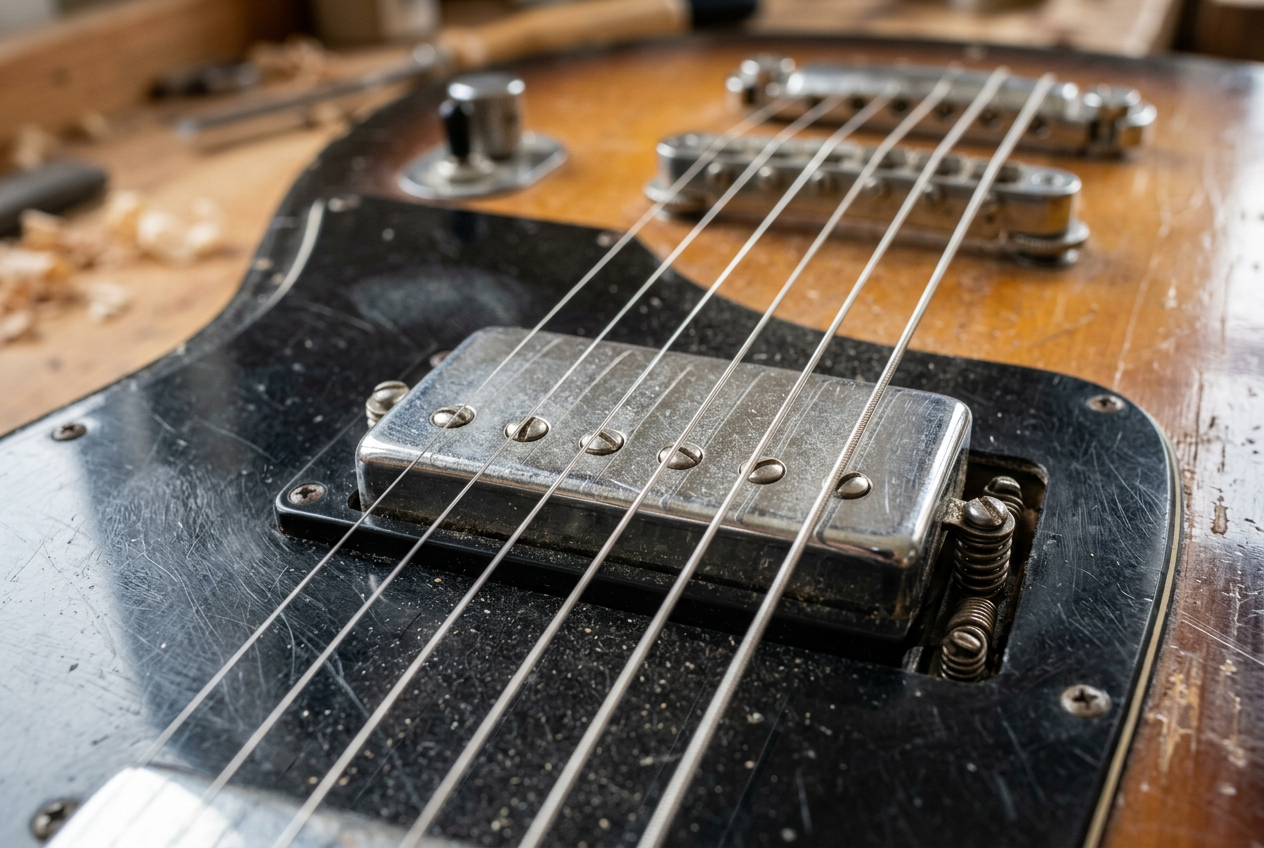
Pickup Height Matters More Than You Think: The Free Guitar Tone Upgrade
Two screws per pickup separate most electric guitars from sounding noticeably better. Pickup height affects output, clarity, dynamics and tuning stability more than most players realise — and it costs nothing.
Ask a guitarist what they would change about their instrument's tone and you will hear about pickups, capacitors, wood, amps and cables. You will very rarely hear about the distance between the pickup and the string — which is strange, because it is the one variable that changes the character of an electric guitar substantially, immediately and for free.
An electric guitar pickup is a magnet wrapped in wire. The strings sit inside its magnetic field, and when they move, they disturb that field and induce a voltage in the coil. How strongly they disturb it depends on how much of the field they occupy. Move the pickup a millimetre closer and the string sits in a denser part of the field: more output, more compression, more low-end weight. Move it away and the field thins out: less output, more headroom, more clarity, more perceived string separation.
That is the whole physical principle. Everything below follows from it.
What Actually Changes When You Move a Pickup
Output
The most obvious effect. Closer pickups drive the front end of your amp or pedal harder, which on a cranked amp means more saturation without touching a knob. This is why a guitar with its bridge pickup set high can sound like a hotter instrument than it really is.
Clarity and Note Separation
The less obvious effect, and the reason experienced players often set pickups lower than beginners expect. Pickups set very close capture a large amount of string movement, but they also capture it unevenly along the string's length and tend to sound thick and smeared under gain. Backing a pickup off frequently produces the sensation that chords have suddenly opened up — individual notes become distinguishable inside a distorted chord instead of blurring into one mass.
Dynamics and Pick Attack
This is the one worth caring about most. A pickup set close is already near its ceiling: play softly and it is loud, play hard and it is only slightly louder. The guitar compresses itself. Set the same pickup lower and the gap between a soft stroke and a hard one widens dramatically. If you have ever felt that your guitar does not respond to how hard you play, pickup height is the first place to look — before you buy a new set of pickups that will behave identically at the same height.
Bass Response
Low strings have more mass, move in a wider arc and generate more signal. That means the bass side of a pickup reaches 'too much' before the treble side does. Set flat and level, most pickups sound bass-heavy and muddy on the wound strings. This is why almost every pickup on almost every guitar should sit slightly lower on the bass side than the treble side.
String-to-String Balance
Beyond bass-versus-treble tilt, the individual strings matter. Adjustable pole pieces on humbuckers, P-90s and many Tele bridge pickups let you fine-tune the balance so that the G string does not dominate and the high E does not disappear. Traditional Stratocaster single coils generally have fixed staggered magnets — the stagger was designed around older string sets with a wound G, which is why some modern players find the G string sits proud on vintage-style pickups.
Neck-to-Bridge Balance
The neck pickup sits under a section of string with a much wider vibrational arc than the bridge position, so it produces more output at the same physical height. It also lives closer to the fretboard, where the string moves most. For those two reasons, the neck pickup essentially always needs to be set lower than the bridge pickup — often noticeably lower — to make switching between them musically usable.
Set the bridge pickup for the sound you want first. Then set the neck pickup by ear so that flipping the switch mid-phrase does not change your volume. Balance between positions matters more in real playing than the absolute output of either one.
Too Close: The Problems Nobody Warns You About
Beyond mud and compression, pickups set too close cause a mechanical problem: magnetic pull. The magnet is physically attracting the steel string. Get close enough and that attraction fights the string's natural vibration, damping sustain and pulling the pitch. The classic symptom is a warbling, out-of-tune wobble on the low strings, particularly on the neck pickup, and particularly on pickups with strong alnico or ceramic magnets.
The old term for the most extreme version of this is 'Stratitis' — a Strat neck pickup set too high producing a beating, chorused, slightly sick sound on the low E and A. The instant fix is to lower the pickup. It is not a fault in the guitar.
There is also a physical clearance issue. Fret at the very last fret and bend: if the string contacts the pole pieces, the pickup is unquestionably too high regardless of how it sounds.
Too Far: The Other Failure Mode
Backing pickups too far off is a real mistake in the opposite direction. You lose output, you lose the harmonic bloom that comes from a strong signal driving an amp's input stage, and the guitar begins to sound thin and polite. Beyond a certain point you simply lose the top end and the attack transient too — the pickup stops sounding open and starts sounding distant.
The correct height is always a negotiation between clarity and authority. Somewhere between the two failure modes is the point where the guitar sounds like itself.
Pickup Type Changes the Answer

X Concepts Strings • Made in USA
Never Run Out of Strings Again.
Join the X Concepts String Club and get fresh USA-made strings delivered every month—plus Premium membership options for the full Guitar Plugged experience.
Humbuckers
Two coils, generally strong output, usually adjustable pole pieces on the traditional PAF-style design. Humbuckers tolerate being closer than single coils partly because they are typically covered and set into rings that keep them a little further from the strings anyway, and partly because the dual-coil design handles low-end differently. Common published starting points for classic humbuckers sit around 1/16" on the treble side at the last fret, with the bass side lower — but ceramic-magnet high-output humbuckers usually want to be further away than a vintage-output alnico set.
Traditional Strat-Style Single Coils
“Players spend thousands chasing tone in pedals and amps while ignoring the two screws that determine how the guitar talks to the amp in the first place.”
The most sensitive to magnetic pull, because the magnets are the pole pieces themselves and sit directly under each string. Vintage-style single coils generally need more clearance than players expect, particularly at the neck. Fender's published starting specs vary by pickup type — vintage-style, modern, and Texas Special sets all list different figures — which is itself the point: even one manufacturer does not have a single answer.
P-90s
Single coils with bar magnets under the coil and adjustable screw poles. They are hotter than Strat single coils, warmer and thicker, and they respond very obviously to height changes. Because the magnets are beneath rather than through the coil, magnetic pull is generally less problematic than on a Strat, which allows a bit more freedom. The characteristic P-90 growl lives in a fairly narrow window — a millimetre either way genuinely changes the personality.
Actives and Modern High-Output Designs
Active pickups with onboard preamps behave differently again; manufacturers of active sets often specify closer positioning than passive equivalents because the design tolerates it. Follow the maker's documentation for these.
Manufacturer Specs Are Starting Points, Not Truths
Every major pickup maker publishes recommended heights, and they are all useful — as a place to begin. They are not universal, and they cannot be, because they do not know your string gauge, your neck radius, your action, your pick attack, your amp or the position of the guitar in your band's arrangement.
A player using 11s digs into a heavier, higher-mass string that generates more signal than the 9s the spec sheet assumed. A player with 6/64" action has a different string-to-pickup geometry than one running as low as the neck allows. A player driving an already-saturated high-gain amp needs less output from the guitar than a player pushing a clean Twin.
Start at spec. Then use your ears. That is not a cop-out; it is how the people who write the specs set up their own guitars.
How to Set Pickup Height by Ear
This takes about ten minutes and requires a small screwdriver and a string action ruler if you want numbers.
1. Fresh strings, tuned to pitch. Same rule as any other adjustment. New strings behave differently from dead ones, and you want to set up for how the guitar will actually be played.
2. Set your amp the way you actually play. Not clean if you play dirty. The whole point is how the guitar drives your rig.
3. Start with the bridge pickup. Fret the highest fret on the low E and again on the high E — this puts the strings at their closest realistic point to the pickup. Note the gap. Set the treble side slightly closer than the bass side.
4. Raise it until it gets ugly. Keep going up in small increments, playing chords and single notes, until the sound thickens, compresses and loses definition. Note where that happens.
5. Come back down until it opens up. Lower in small increments until chords clarify and the pick attack returns. You are looking for the point where hard picking sounds aggressive and soft picking sounds genuinely soft.
6. Check the low strings for warble. Play the open low E and let it ring. If the note wavers, beats against itself or dies early, magnetic pull is the culprit. Lower the bass side and retest.
7. Now do the neck pickup. Set it by volume balance against the bridge, not by measurement. Play a phrase, switch pickups mid-phrase, and adjust until the switch does not change your apparent loudness.
8. Check the middle position. On a guitar with a middle pickup or a both-pickups switch position, verify that the combined sound is not thin or phase-cancelled. If it is weak, small changes to the middle pickup's height often fix it.
9. Balance individual strings. If your pickups have adjustable pole pieces, raise the poles under quiet strings and lower those under dominant ones. Play the same lick on each string and listen for anything that jumps out or disappears.
10. Play a full song. Then leave it for a day and play it again. Ears adapt, and the setting that seemed perfect in ten minutes of tweaking sometimes reveals itself as too bright the next morning.
| Symptom | Likely Cause | Adjustment |
|---|---|---|
| Muddy, blurred distorted chords | Pickup too close | Lower in small increments |
| Wavering, out-of-tune low E sustain | Magnetic pull | Lower the bass side |
| Thin, weak, distant tone | Pickup too far | Raise in small increments |
| Neck pickup much louder than bridge | Normal — needs balancing | Lower the neck pickup |
| G string dominates the chord | Pole piece or magnet stagger | Lower G pole, or raise the others |
| No dynamic range when picking hard | Pickup too close, self-compressing | Lower and re-test attack |
| Strings hit the poles when bending high | Pickup far too high | Lower immediately |
Why This Is Worth Your Afternoon
There is a common progression among players chasing tone: new pedal, new amp, new pickups, new guitar. Somewhere in that sequence is a fifteen-dollar screwdriver and two screws that were never touched.
A well-set pickup makes the guitar feel responsive under the hands. It changes how you play — you dig in more, you pick softer for quiet passages, you use the volume knob because it now does something musical. That is a bigger upgrade than most gear purchases, and you already own it.
Once the pickups are right, run the rest of the inspection: The 15-Minute Guitar Setup covers relief, action, intonation and everything else in the same session.
Experience-driven coverage, not algorithm bait.
- 20+ years of guitar playing experience
- Real-world retail experience at Guitar Center
- Thousands of hours testing guitars, amps, and pedals
- A community of 50,000+ guitar enthusiasts across platforms
- Partnerships with Fender, DistroKid, TrueFire, Card Chords, and Enya
- Editorial standards published openly — see how we test gear
More From the Guitar Garage
Setup, tone and maintenance guides written by working guitarists — straight to your inbox.
Ask GP
3 free questions a dayStill curious? Ask GP about this story.
Your personal classic-rock and guitar guide — ask anything about Pickup Height Matters More Than.
Discussion (0)
Sign in to join the discussion.
Sign in to commentLoading comments…
Discover another guitar story
Swipe through our latest features, breaking news and iconic solos — one story at a time.
Open Swipe →More in Guitar Garage

10 Things Every Gigging Guitarist Needs (And the One Thing They Always Forget)
Every guitarist obsesses over amps and pedals, but smooth gigs come down to preparation. Here are 10 essentials every gigging guitarist needs — plus the one thing almost everyone forgets.

Why Does My Guitar Go Out of Tune? 11 Causes (And How to Fix Each One)
Discover the 11 most common reasons guitars go out of tune and learn practical fixes to keep your instrument stable and sounding its best.

How to Record Guitar at Home (And Actually Get a Professional Sound)
From your very first riff to a polished recording — everything you need to know without wasting money on gear you don't need.