
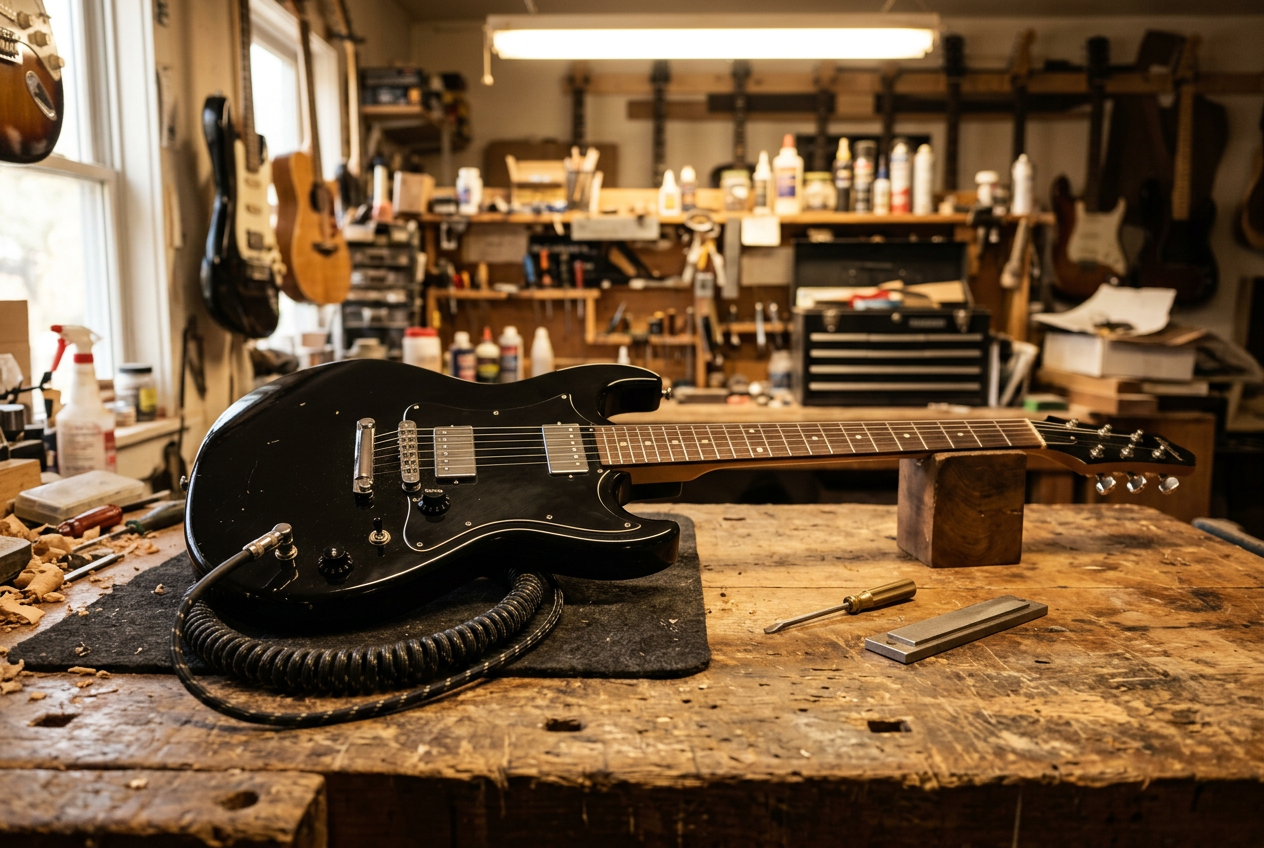
Why Does My Guitar Buzz? How to Find the Problem Before You Start Replacing Parts
Buzz is not one problem. It is three completely different problems that happen to sound similar through an amplifier. Here's how to tell them apart in under ten minutes.
Every guitar tech has had this conversation. A player arrives convinced they need a fret level. Ten minutes later the actual culprit is a loose tuner bushing, a dying 9V power supply, or a truss rod that moved when the heating came on in October.
Buzz is a symptom, not a diagnosis. There are three fundamentally different families of buzz, they have nothing to do with each other, and the fastest way to waste money is to start replacing parts before you know which family you are dealing with.
The single most useful test takes five seconds: unplug the guitar and listen.
If the buzz is still there acoustically, it is mechanical — either the string striking metal, or something on the instrument vibrating. If it disappears when you unplug, it is electrical, and it lives somewhere in your signal chain, your power or your room.
Do the unplugged test before anything else, every time. It splits the problem space in half in five seconds and saves you from chasing an amp problem with a screwdriver.
Category One: Fret Buzz
Fret buzz is the string physically striking a fret while it vibrates. It is audible unplugged, it is location-specific, and it is almost always a setup issue rather than damage.
Neck Relief
A vibrating string moves in an arc, widest near the middle of its length. Neck relief — the very slight forward bow in the neck — is what gives that arc room. Too little relief and the string collides with the frets in the middle of the neck, typically frets 1 through 7.
Check it by fretting the low E at the first fret and again where the neck meets the body, then looking for a small gap at the 7th or 8th fret. Feeler gauges give a real number; published targets vary by manufacturer and neck profile, so check your model's spec rather than assuming a universal figure.
If relief is genuinely wrong, a truss rod adjustment is the fix — but in small increments only, retuning and re-measuring between each one. Checking relief is a job for anybody. Making large truss rod adjustments is not, and a neck with a twist or a hump belongs with a technician.
Action
The other half of the geometry. If the action is set below what your picking attack requires, the strings will buzz across the entire neck no matter how perfect the relief is. There is no universally correct action height — a heavy-handed blues player on a 7.25"-radius neck simply cannot run the action a light-touch shred player uses on a flat compound-radius neck.
Raise the saddles slightly, retest, and stop as soon as the buzz clears. Then check intonation, because saddle height changes it.
High or Uneven Frets
The telltale sign is a buzz at one specific fret, on one specific string, that does not follow the pattern of a relief or action problem. Frets wear unevenly, and a single fret sitting slightly proud of its neighbours will buzz when you fret the note behind it.
A fret rocker — a small precision straightedge — confirms this in seconds: rest it across three frets at a time and see if it pivots. Fret leveling, crowning and polishing is genuine lutherie work requiring specific tools and experience. This is the point at which the correct answer is a repair tech.
Nut Slots
If the buzz occurs only on open strings and vanishes as soon as you fret any note, the nut is your suspect. The slot has either been cut too deep or worn deeper over years of string contact, letting the open string sit close enough to the first fret to rattle.
Confirm it: fret at the third fret and look at the clearance over the first fret. There should be a very small but visible gap. No gap means a low slot. Temporary shims exist, but the real fix is slot filling or a new nut — again, a tech job, and an inexpensive one.
Playing Technique
Uncomfortable but true: a great deal of fret buzz is generated by the player. Picking hard enough to drive the string into the frets on a guitar set up for a light touch will buzz on any instrument. So will fretting behind the fret rather than close to it, or applying inconsistent finger pressure.
The test is simple. Have someone else play the same passage on the same guitar. If it does not buzz for them, the setup is fine and your attack is the variable. Either lighten up or have the guitar set up for the way you actually play — both are valid answers.
Category Two: Electrical Hum and Buzz
This is the buzz that disappears when you unplug. It is not coming from the guitar's woodwork; it is coming from electromagnetic interference, a grounding problem or a fault in the chain.
Normal Single-Coil Hum
Start by accepting a fact: traditional single-coil pickups hum. That is what a single coil does. It is an antenna as well as a pickup, and it picks up the 50 or 60 Hz field from mains wiring along with your strings. Humbuckers were literally invented to solve this by using two coils wound in opposite directions so the interference cancels out.
If you own a Stratocaster or a Telecaster and it hums at high gain, the guitar is not broken. What is worth knowing is that on a three-pickup Strat, positions 2 and 4 are typically hum-cancelling because the middle pickup is reverse-wound and reverse-polarity. If the hum drops noticeably in those positions, everything is working exactly as designed.
Grounding
A ground fault produces hum that changes when you touch the strings or the bridge — see the dedicated section below, because this test is diagnostic gold. Inside the guitar, the usual causes are a broken ground wire from the bridge or tremolo claw, a cold solder joint at the back of a pot, or a jack whose ground lug has fractured after the jack spun in its hole.
This is low-voltage work inside the guitar and safe to inspect. Take the control cavity cover off, look for a wire that has come adrift, and check that the bridge ground wire is still attached and making contact.
Cables
Cables fail constantly and produce buzz, crackle and dropouts. Swap in a known-good cable before you investigate anything else — it is the single most common cause of mystery noise and takes ten seconds to rule out. Test each cable in your chain individually, including patch cables, which live a harder life than anything else on your board.
Pedals
Some pedals are simply noisy — high-gain distortion, fuzz and older analogue delays especially. Others introduce noise through their power arrangement. Diagnose by building the chain one pedal at a time: guitar straight into amp first, then add one pedal, listen, add the next.
Power Supplies
Daisy-chaining multiple pedals from one unregulated supply is a classic source of hum, because pedals share a ground path and inject noise into each other. Digital pedals are particularly bad neighbours. An isolated-output power supply solves a remarkable number of pedalboard noise problems permanently.

X Concepts Strings • Made in USA
Never Run Out of Strings Again.
Join the X Concepts String Club and get fresh USA-made strings delivered every month—plus Premium membership options for the full Guitar Plugged experience.
Failing wall-wart adapters also produce a rising hum as they degrade. If your board got noisier over months, suspect the supply.
Ground Loops
If your amp and another mains-powered device — a mixer, an audio interface, a laptop — are both connected to your signal path via different outlets, you can create a ground loop, which typically produces a steady low hum. The correct fixes are plugging everything into the same power circuit or using a proper isolation transformer or DI box with a ground lift. Never remove the ground pin from a mains plug or use a ground-lift adapter on the power cord. That is a genuine electrocution risk, not a tone solution.
Amplifiers
“The most expensive thing about buzz is guessing. Diagnose first, and most buzzes turn out to be free to fix.”
Amps develop noise as they age. Tubes get microphonic or noisy, filter capacitors dry out, and preamp valves are the usual suspect for hiss and hum in a tube amp.
Here the safety line is absolute. Do not open a tube amplifier. The filter capacitors in a valve amp store lethal voltage for a long time after the amp is unplugged, and they do not care how careful you are being. Swapping preamp tubes from the outside on a fully cooled, unplugged amp is a normal user task. Everything inside the chassis — bias adjustment, capacitor replacement, transformer work, anything requiring the chassis to come out — is work for a qualified amplifier technician. There is no version of this article in which that changes.
Environmental Interference
Rooms are noisy. Dimmer switches, fluorescent and some LED lighting, computer monitors, phone chargers, wireless routers, refrigerators and neon signs all radiate interference that single coils happily receive.
The diagnostic is free: stand up, rotate slowly through 360 degrees while playing, and listen. If the noise level changes dramatically with your orientation, you are receiving interference rather than generating it. Move, turn, or switch off the offending device. Shielding the guitar's control cavity with copper tape reduces susceptibility, though it will not eliminate the fundamental hum of a single coil.
Category Three: Mechanical Rattles
The most under-diagnosed category, because a rattle transmits through the body into the pickups and comes out of the amp sounding exactly like fret buzz.
The giveaway: mechanical rattles are usually note-specific rather than position-specific. A part with a particular resonant frequency will rattle when you play the note that excites it and stay silent everywhere else.
Loose screws. Pickguard screws, neck plate screws, control plate screws, strap buttons. Go around the guitar and snug every one — without over-tightening into wood.
Bridge hardware. Saddle height screws that protrude and vibrate, saddle intonation screws with loose springs, a Tune-o-matic saddle not seated in its slot, retaining wire not sitting properly.
Tuner hardware. Loose bushings at the front of the headstock and loose mounting screws at the back are extremely common. A slightly loose tuner button rattles at specific pitches and is maddening to find.
Pickup springs. The springs or surgical tubing under a pickup can buzz sympathetically. Height adjustment screws that have backed off leave the pickup free to move.
Tremolo components. Springs in the back cavity ringing is normal to a degree and part of the character of a Strat, but excessive spring noise can be damped with a small piece of foam. Also check the arm collar, the claw screws and the bridge block.
Output jacks. A loose jack nut allows the whole assembly to rotate, which produces intermittent crackle and eventually breaks the wiring.
Knobs. A knob that does not sit flush on its shaft rattles. So does a switch tip that has loosened.
Sympathetic vibration. Sometimes nothing is loose at all — the string behind the nut, the length between the saddle and the tailpiece, or a truss rod inside its channel is simply resonating. A small piece of felt or foam behind the nut is a standard, invisible fix used on countless recordings.
Diagnostic Walkthroughs
Buzzes Unplugged But Not Through the Amp
Almost always mechanical or fret-related, and often benign. Acoustic buzz that the pickups do not hear is frequently coming from behind the nut, from the headstock, or from a part that vibrates but does not couple strongly into the body.
Work through it methodically: play the note that causes it, then press a finger firmly on each candidate part in turn while repeating the note — the strings behind the nut, the tuner buttons, the truss rod cover, the pickguard, the jack plate, the trem springs. The buzz stopping when you damp a part identifies the part.
Buzzes Only Through the Amp
Electrical. Rule out the cheapest causes first: swap the cable, try a different outlet, bypass the pedalboard entirely and plug guitar straight into amp.
If guitar-straight-to-amp is quiet, add pedals back one at a time. If guitar-straight-to-amp is still noisy, swap the guitar. If it is noisy with every guitar and every cable, the amp or the room is your problem — and if it is the amp, that is a technician's job, not yours.
Buzzes on One Fret
Highly diagnostic. A buzz at one fret on one string that clears further up the neck means a high or unseated fret in that immediate area, or occasionally a divot worn into an older fret.
Confirm with a fret rocker across the suspect fret and its two neighbours. If it rocks, the diagnosis is done. Do not attempt to file the fret down yourself — the fix requires leveling across multiple frets, recrowning to restore the profile, and polishing. A tech will do it properly for a fraction of what a botched attempt costs to correct.
Buzzes Across Several Frets
This is setup geometry, not a fret defect. Buzz in the lower register generally points to insufficient relief; buzz everywhere generally points to action that is too low for your attack; buzz that appeared with the seasons points at humidity moving the neck.
Measure relief, measure action at the 12th fret, compare both to your manufacturer's published starting figures, and adjust in the correct order: relief, then action, then intonation. The full sequence is laid out in The 15-Minute Guitar Setup.
Buzzes When I Stop Touching the Strings
This is the classic grounding signature, and it is worth understanding rather than fearing. When you touch the strings, bridge or any metal connected to the guitar's ground, your body becomes part of the shield and the hum drops. Let go and the noise returns.
A moderate version of this is completely normal on single-coil guitars — it is the interference-antenna behaviour described above, and every Strat player on earth lives with some of it.
A severe version, where the difference is dramatic and the noise is loud, points at a grounding fault: a disconnected bridge ground wire, a broken solder joint, or shielding that is not connected. Open the control cavity and look.
One critical exception: if you feel any tingle, shock or sensation when you touch the strings and a microphone at the same time, stop playing immediately. That indicates a fault in mains earthing somewhere in your setup, and it is a genuine safety hazard requiring a qualified technician — not something to work around.
| What You Observe | Category | Where to Look First |
|---|---|---|
| Buzz is present unplugged | Mechanical / fret | Relief, action, loose hardware |
| Buzz only appears through the amp | Electrical | Cable, pedals, power supply |
| One fret, one string | High or uneven fret | Fret rocker, then a tech |
| Frets 1–7 across strings | Not enough relief | Neck relief measurement |
| Every fret, every string | Action too low for your attack | 12th-fret action height |
| Open strings only | Nut slot too low | Gap over 1st fret when fretting 3rd |
| Noise drops when touching strings | Normal shielding effect or ground fault | Bridge ground wire, cavity shielding |
| Noise changes as you turn around | Environmental interference | Lights, monitors, dimmers, chargers |
| Rattle only on certain notes | Sympathetic resonance | Damp parts one at a time |
| Hum that grew over months | Failing power supply or amp | Swap supply; amp goes to a tech |
Spend Money Last
The order in this article is deliberate. Unplug and listen. Swap the cable. Change the outlet. Bypass the board. Snug the hardware. Measure the relief and action. Only then consider parts, and only then consider a tech.
That sequence resolves the overwhelming majority of buzzes without spending anything, and when it does not, it tells you precisely what to tell the repair shop — which makes the visit shorter and cheaper. And when the trail leads inside a tube amp chassis, the correct move is always the same: hand it to a qualified amp technician.
If your buzz turns out to be tuning-related rather than mechanical, our companion guide covers that ground: Why Does My Guitar Go Out of Tune?.
Experience-driven coverage, not algorithm bait.
- 20+ years of guitar playing experience
- Real-world retail experience at Guitar Center
- Thousands of hours testing guitars, amps, and pedals
- A community of 50,000+ guitar enthusiasts across platforms
- Partnerships with Fender, DistroKid, TrueFire, Card Chords, and Enya
- Editorial standards published openly — see how we test gear
More From the Guitar Garage
Troubleshooting, setup and repair guides written by working guitarists — straight to your inbox.
Ask GP
3 free questions a dayStill curious? Ask GP about this story.
Your personal classic-rock and guitar guide — ask anything about Why Does My Guitar Buzz?.
Discussion (0)
Sign in to join the discussion.
Sign in to commentLoading comments…
Discover another guitar story
Swipe through our latest features, breaking news and iconic solos — one story at a time.
Open Swipe →More in Guitar Garage

10 Things Every Gigging Guitarist Needs (And the One Thing They Always Forget)
Every guitarist obsesses over amps and pedals, but smooth gigs come down to preparation. Here are 10 essentials every gigging guitarist needs — plus the one thing almost everyone forgets.

Why Does My Guitar Go Out of Tune? 11 Causes (And How to Fix Each One)
Discover the 11 most common reasons guitars go out of tune and learn practical fixes to keep your instrument stable and sounding its best.

How to Record Guitar at Home (And Actually Get a Professional Sound)
From your very first riff to a polished recording — everything you need to know without wasting money on gear you don't need.