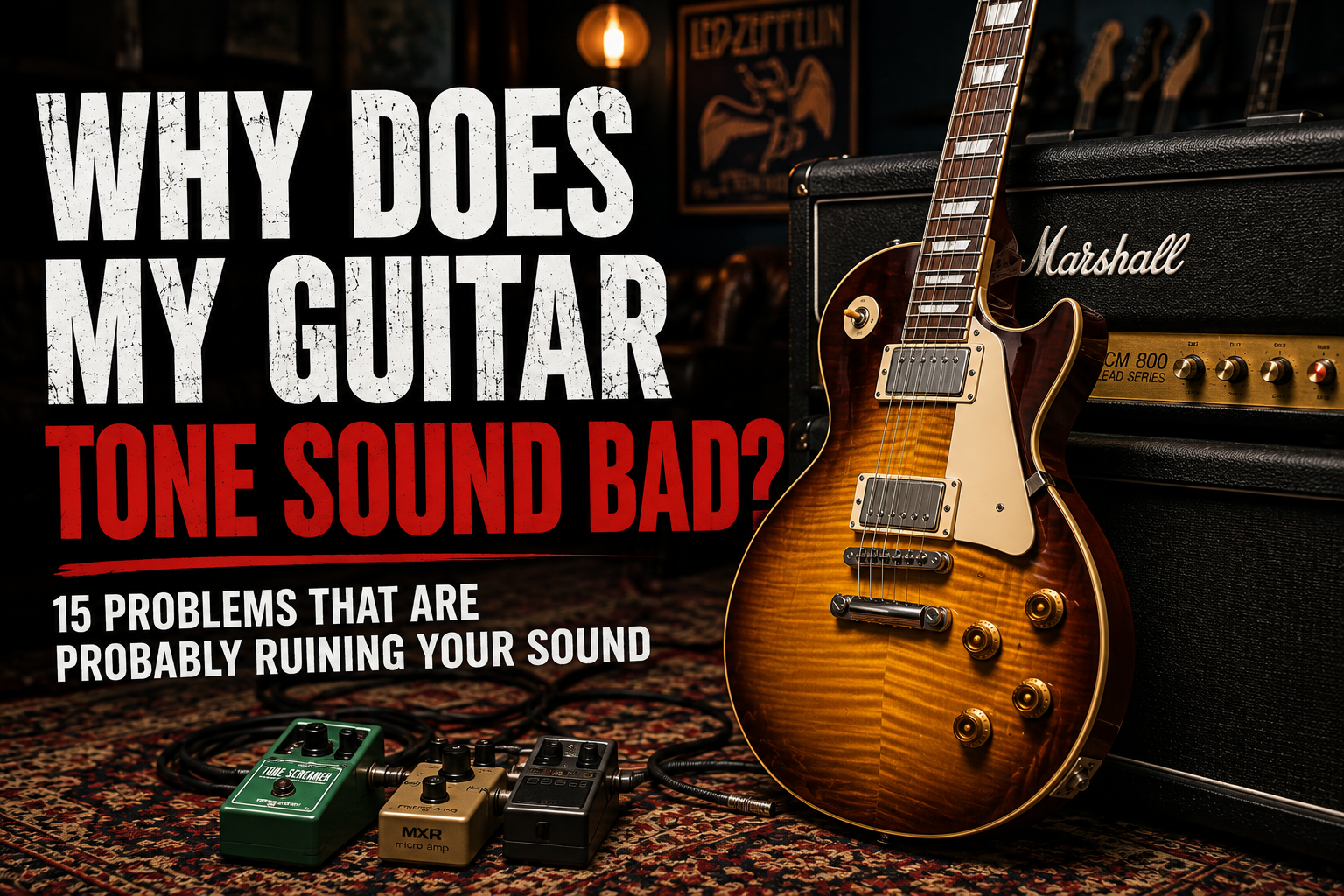
Why Does My Guitar Tone Sound Bad? 15 Problems That Are Probably Ruining Your Sound
You bought the right guitar and amp, but your tone still sounds thin, muddy or lifeless. Before spending another dollar on gear, check these 15 common problems that are probably ruining your sound.
You bought the guitar.
You bought the amp.
Maybe you even bought the same distortion pedal your favorite guitarist uses.
You dialed in the settings you found online, hit an open chord and…
It still doesn't sound right.
This is one of the most frustrating experiences in guitar playing. You can seemingly have all the right equipment and still end up with a tone that's thin, muddy, harsh, lifeless or simply nothing like the sound you're chasing.
Here's the good news: your gear probably isn't the problem.
Great guitar tone is the result of dozens of small variables interacting with each other. Pickups, gain, EQ, speakers, strings, pick attack, pickup height and even where you stand in relation to your amplifier can change what you hear.
Before buying another pedal, pickup or amplifier, check these 15 things.
1. You're Using Way Too Much Gain
This might be the most common guitar-tone mistake of all.
More gain doesn't necessarily mean a bigger guitar sound.
In fact, excessive gain frequently does the opposite.
Turn distortion high enough and individual notes begin losing definition. Chords become increasingly difficult to distinguish. Pick attack gets compressed, noise increases and the entire sound can turn into a wall of fuzz.
This becomes particularly noticeable when playing with a band.
A huge, saturated bedroom tone can disappear once drums and bass enter the equation.
Listen carefully to isolated guitar tracks from professionally recorded rock songs and you may be surprised by how little distortion some supposedly "massive" guitar sounds actually contain.
The solution is simple:
Turn the gain down.
Try reducing it farther than you initially think is necessary. Then compensate with volume if appropriate.
You'll often discover that the guitar becomes clearer, punchier and — strangely enough — heavier.
2. You're Scooping Too Much Midrange
Bass: 7.
Mid: 2.
Treble: 7.
It has probably been one of the most popular bedroom-metal EQ settings for decades.
There's just one problem.
The guitar lives in the midrange.
Scooping mids can create an enormous sound when you're playing alone because the extended lows and highs make the amplifier feel wider.
Put that sound beside a drummer and bassist, however, and things change.
The bass guitar and kick drum occupy much of the low-frequency space. Cymbals occupy the highs.
Your guitar suddenly has nowhere to go.
Midrange is one of the frequencies that allows an electric guitar to establish its own place in a mix.
Before increasing your volume, try increasing your mids.
You may suddenly hear yourself.
3. You're Dialing In Your Amp With Your Eyes
This is surprisingly easy to do.
You see that your bass knob is at 8 and think:
"That's probably too much bass."
Or you see the treble sitting at 3 and automatically assume the sound must be dark.
Forget the numbers.
Amplifier controls don't all behave the same way. A setting that works on one amplifier may be completely inappropriate on another.
Even two different models from the same manufacturer can have radically different tone stacks.
Close your eyes if necessary.
Turn the knobs until the guitar sounds good.
The correct setting is whatever sounds correct — not whatever looks correct.
4. Your Pickup Selection Doesn't Match the Tone
A Stratocaster neck pickup and a Les Paul bridge humbucker are fundamentally different starting points.
That sounds obvious, yet it's frequently overlooked when guitarists attempt to reproduce famous tones.
Trying to recreate a thick hard-rock rhythm sound using a low-output single-coil bridge pickup may require completely different amplifier settings than using a hot humbucker.
Likewise, attempting to reproduce a glassy Strat neck tone with a dark neck humbucker presents another challenge.
That doesn't mean you need the exact guitar used on the recording.
It means you need to understand the compromises.
If you're chasing a particular guitarist's sound, start by determining:
What type of pickup was used?
Which pickup position?
Approximately how hot was the pickup?
Was the guitar's volume control wide open?
Were the tone controls adjusted?
These details can matter more than another $300 pedal.
5. Your Pickup Height Is Wrong
Pickup height is one of the cheapest tone adjustments available.
It costs exactly nothing.
Move a pickup closer to the strings and you'll generally increase its output and change how aggressively it drives the rest of your signal chain.
Move it farther away and the response can become cleaner and less forceful.
There is no universal perfect measurement because pickups, guitars and player preferences vary.
Make small adjustments.
Listen.
Then adjust again.
Just remember that extremely high pickups can create their own problems, particularly with magnetic pickups interacting too strongly with the strings.
6. You're Ignoring Your Speaker or Cabinet
Guitarists obsess over amplifiers.
Want This Tone?
Tell ToneMD what guitar and gear you own and we’ll show you how to get as close as possible using the equipment you already have — full signal chain, real numbered settings, no guesswork.
Included with The Guitar Plugged Premium
They should probably obsess more over speakers.
The speaker is literally the component turning the electrical signal into the sound entering your ears.
Change the speaker and the character of the entire rig can change.
This becomes even more important with digital modeling.
If you're using an amp modeler such as a Helix, Fractal, Quad Cortex, ToneX or HeadRush, the cabinet or impulse response selection can completely transform the patch.
You can spend 30 minutes adjusting amplifier EQ when the real problem is the cab.
If your modeler sounds harsh, muddy or unnatural, try changing the cabinet or IR before rebuilding the entire preset.
7. You're Adding Bass Because Your Tone Sounds Thin
Thin guitar tone?
Turn up the bass.
Makes sense, right?
Not always.
A guitar that sounds thin may actually need more low-midrange rather than sub-bass frequencies.
Adding excessive bass can create mud without providing the thickness you're looking for.
This is especially important in a band or recording environment.
The guitar doesn't need to reproduce every frequency.
It needs to occupy the correct frequencies.
Sometimes cutting bass actually makes the guitar sound bigger because the important frequencies become easier to hear.
8. You're Using Someone Else's Exact Amp Settings
We've all searched for them.
"Eddie Van Halen amp settings."
"Stevie Ray Vaughan amp settings."
"Metallica Master of Puppets amp settings."
There is nothing wrong with using another guitarist's settings as a starting point.
The mistake is assuming those numbers are a formula.
Your guitar is different.
Your pickups are different.
Your speaker is different.
Your room is different.
Your hands are different.
Even if you somehow assembled the exact equipment used on the original recording, you're still hearing your rig in a completely different environment.
Treat published settings as coordinates pointing you in the right direction.
Don't treat them as commandments.
9. You're Forgetting That Famous Guitar Tones Were Recorded
This is enormous.
You're standing in a bedroom listening to a guitar amplifier.
The tone you're attempting to reproduce may have been created using:
Multiple microphones
Multiple amplifiers
Double-tracked guitars
EQ
Compression
Studio preamps
Tape
Reverb
Delay
Post-production
“Gear creates the boundaries of the sound. The player creates what happens inside them.”
Mastering
Sometimes you're not actually trying to recreate an amplifier.
You're trying to recreate a recording of an amplifier.
Those are two different things.
Consider David Gilmour's enormous lead sounds. Eddie Van Halen's early rhythm tone. Jimmy Page's layered guitar parts. Metallica's massive rhythm tracks.
The finished record contains more than the sound that existed directly in front of the amplifier.
Modern modelers and plugins can get astonishingly close, but understanding the recording chain helps establish realistic expectations.
10. Your Strings Are Dead
Guitarists will spend $200 on a pedal while playing strings that should have been replaced weeks ago.
Old strings gradually lose brightness, sustain and responsiveness as oils, sweat, dirt and corrosion accumulate.
The change happens slowly enough that you may not immediately notice it.
Then you install a fresh set.
Suddenly the guitar sounds alive again.
If your tone has gradually become dull and uninspiring, don't immediately blame the amplifier.
Change your strings.
It's one of the easiest variables to eliminate.
11. Your Pick Is Changing More Than You Realize
The pick is the first piece of equipment in your signal chain.
Technically, your hands come first — but you get the idea.
Thickness, material, shape and the angle at which the pick hits the string can noticeably alter attack.
A thin pick can respond very differently from a thick, rigid pick.
Even using the exact same pick, changing your picking angle changes the transient at the beginning of the note.
This is one reason two guitarists can play the same guitar through the same amplifier and still sound different.
Tone isn't exclusively stored inside electronics.
Part of it is mechanical.
12. You're Using Too Many Effects
Pedals are fun.
That's part of the problem.
Compressor.
Overdrive.
Distortion.
Chorus.
Delay.
Reverb.
EQ.
Another overdrive because apparently three wasn't enough.
Every effect changes the signal in some way.
If your tone has become difficult to diagnose, simplify everything.
Plug directly into the amplifier or begin with a completely empty digital preset.
Get a great basic sound.
Then add effects one at a time.
You'll quickly discover which effect is helping and which one is merely occupying space.
13. Your Delay and Reverb Are Hiding Your Playing
There's a wonderful moment when you add delay and reverb to a lead tone and suddenly everything feels enormous.
Then there's the moment when you add too much.
Heavy ambience can smear notes together and push the actual guitar farther into the background.
Instead of sounding three-dimensional, the tone becomes distant.
Try reducing the effect mix while maintaining the basic character of the effect.
This is especially important with high-gain lead tones, where distortion is already adding compression and harmonic complexity.
A little ambience can make the guitar breathe.
Too much can make it disappear.
14. You're Creating the Tone at the Wrong Volume
Amplifiers behave differently at different volumes.
Your ears do too.
A preset created quietly at midnight may sound piercingly bright when turned up to rehearsal volume.
Likewise, a tone designed at high volume may sound dull or weak when played quietly.
This is particularly important for guitarists using digital modelers.
If you're building a preset for live performance, audition it at something reasonably close to the level at which you'll actually use it whenever practical and safe.
Don't assume a bedroom preset will automatically translate to the stage.
15. The Missing Ingredient Might Be You
This is the answer nobody wants.
It's also one of the most important.
Give two guitarists the exact same Les Paul, cable and Marshall.
They will not sound identical.
Picking strength matters.
Vibrato matters.
Muting matters.
Where you strike the string matters.
How long you allow notes to ring matters.
The angle of the pick matters.
The pressure of your fretting hand matters.
This is why buying your favorite guitarist's equipment can get you closer to their sound without making you sound exactly like them.
Gear creates the boundaries of the sound. The player creates what happens inside them.
That's not bad news.
It's actually liberating.
It means some of the biggest improvements to your guitar tone are completely free.
Stop Chasing Settings. Start Understanding the Signal Chain.
The endless search for better guitar tone becomes much easier once you stop thinking about individual pieces of equipment and start thinking about the complete signal chain.
Your guitar feeds your pedals.
Your pedals feed your amplifier.
Your amplifier feeds a speaker.
The speaker interacts with the room or microphone.
And every part of that chain is responding to the way you play.
Change one variable and everything downstream can react differently.
That's why copying "Bass 6, Mid 4, Treble 7" from a YouTube comment rarely produces the exact tone you're expecting.
The numbers aren't the tone.
They're simply part of the recipe.
The 5-Minute Guitar Tone Reset
If your guitar currently sounds terrible and you don't know where to begin, try this:
Step 1: Turn off every effect.
Step 2: Reduce your gain.
Step 3: Set your EQ somewhere near neutral.
Step 4: Choose the pickup that best fits the sound you're chasing.
Step 5: Get the basic amplifier sound right before adding anything else.
Step 6: Add effects individually.
Step 7: Adjust the sound with your ears rather than copying knob positions.
Step 8: Play the tone in context — ideally with the backing track, band or mix where you'll actually use it.
That last step matters.
A guitar tone doesn't exist in isolation.
The greatest guitar sound isn't necessarily the one that sounds best when you're playing alone.
It's the one that sounds right when the music starts.
Great Tone Usually Doesn't Require More Gear
There will always be another pedal.
Another amplifier.
Another plugin.
Another pickup promising to finally unlock the sound in your head.
Sometimes new equipment really does solve the problem.
But before reaching for your wallet, spend an hour with what you already own.
Reduce the gain.
Move the mids.
Try another pickup.
Change the cabinet.
Replace those ancient strings.
Turn off half the effects.
And listen.
You may discover that the tone you've been trying to buy was already sitting inside your rig.
You just hadn't dialed it in yet.
Gear. Players. Tone. No filler.
Experience-driven coverage, not algorithm bait.
- 20+ years of guitar playing experience
- Real-world retail experience at Guitar Center
- Thousands of hours testing guitars, amps, and pedals
- A community of 50,000+ guitar enthusiasts across platforms
- Partnerships with Fender, DistroKid, TrueFire, Card Chords, and Enya
- Editorial standards published openly — see how we test gear
The Modern Guitar Magazine. Delivered to your inbox.
No spam. No gimmicks. Just great guitar content — stories, tones, iconic solos, and honest gear takes. Every week.
Discussion (0)
Sign in to join the discussion.
Sign in to commentLoading comments…
Discover another guitar story
Swipe through our latest features, breaking news and iconic solos — one story at a time.
Open Swipe →More in Guitar Garage
10 Things Every Gigging Guitarist Needs (And the One Thing They Always Forget)
Every guitarist obsesses over amps and pedals, but smooth gigs come down to preparation. Here are 10 essentials every gigging guitarist needs — plus the one thing almost everyone forgets.
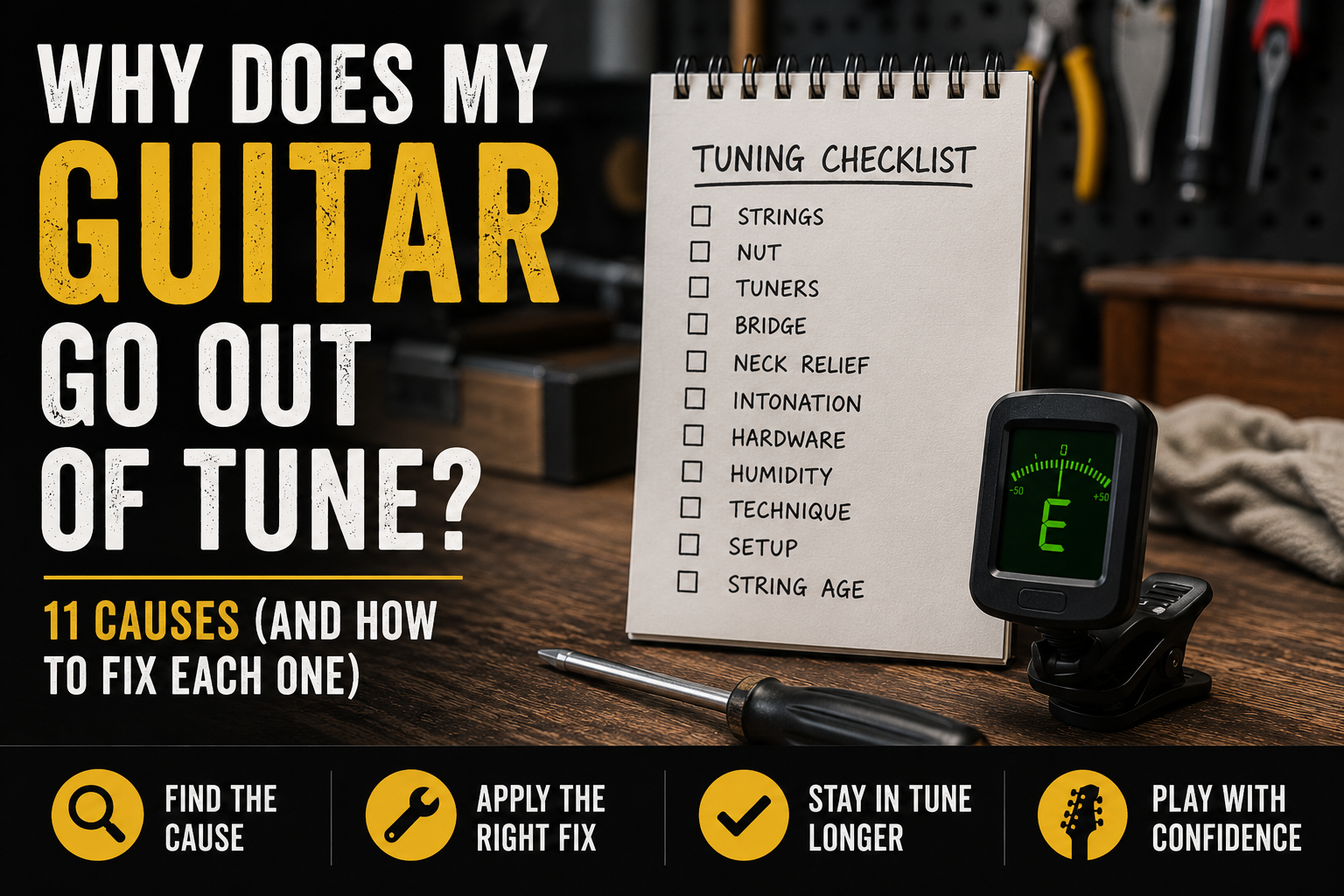
Why Does My Guitar Go Out of Tune? 11 Causes (And How to Fix Each One)
Discover the 11 most common reasons guitars go out of tune and learn practical fixes to keep your instrument stable and sounding its best.
How to Record Guitar at Home (And Actually Get a Professional Sound)
From your very first riff to a polished recording — everything you need to know without wasting money on gear you don't need.