
The Shred Years
THE GUITAR PLUGGED
AC/DC Answers Tragedy With Back in Black
Months after losing Bon Scott, AC/DC returns with a new singer and a record built entirely on the Young brothers' guitar interplay, cut in the Bahamas with producer Mutt Lange.
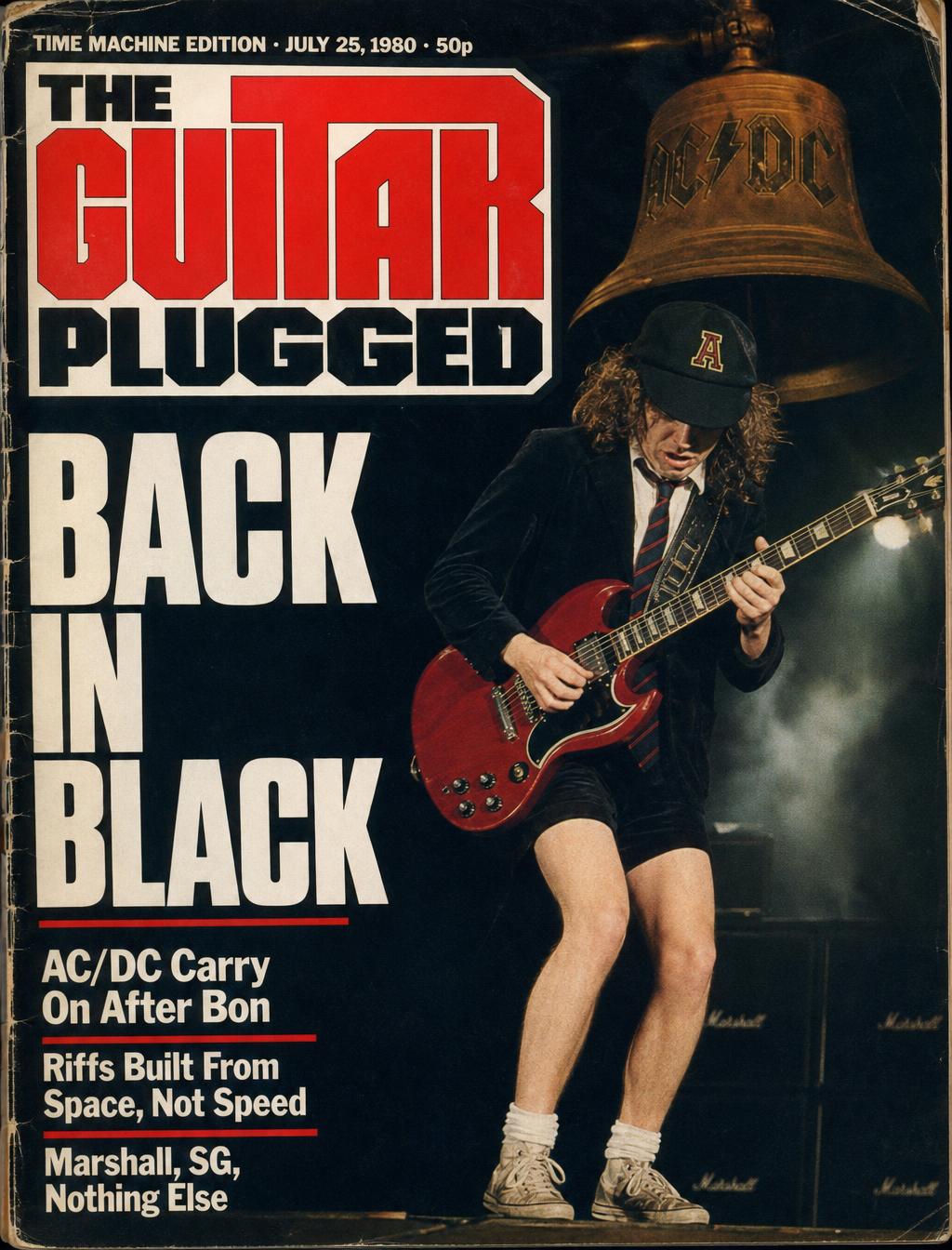
It has been a hard year for AC/DC. Singer Bon Scott died in February, and for a stretch nobody outside the band's inner circle knew whether AC/DC would carry on at all. They have, with Newcastle singer Brian Johnson stepping into the frontman role, and this week they've released Back in Black, a record that manages the difficult trick of mourning without wallowing and sounds, from the first chord, like a band that knows exactly what it wants to say.
Bon Scott's death in a car in South London in early February, after a night of heavy drinking, left the surviving members facing an agonizing decision about whether AC/DC could or should continue at all. Guitarists Angus and Malcolm Young have said publicly that Scott's parents encouraged them to keep going rather than let the band's momentum die with him, and within weeks of the funeral the brothers were already writing new material, determined that grief would not be allowed to stall the group's progress after nearly a decade of steadily building an audience across Australia, Britain, and the United States.
Compass Point and Mutt Lange
The album was tracked at Compass Point Studios in Nassau, in the Bahamas, with Robert John 'Mutt' Lange back in the producer's chair after his work on Highway to Hell. Lange has a reputation for demanding take after take until the timing and tone are exactly where he wants them, and that discipline shows. Nothing on this record sounds loose in the sloppy sense; every rhythm guitar hit lands in the same place, every drum fill resolves cleanly into the next bar. It's a tightness that never feels sterile, because the songs themselves are built from simple, blunt riffs that don't need embellishment.
Two Guitars, One Job
Angus Young plays his usual Gibson SG, that thin, biting midrange sound that cuts through even at high volume without turning to mud, the instrument he's been associated with since the band's earliest days. His brother Malcolm, meanwhile, has been playing a Gretsch that's been stripped down and modified well past stock, a Jet Firebird with the extra switches and finish removed, wired more simply so it does one job extremely well: rhythm guitar, and nothing else. Malcolm doesn't solo on this record, doesn't reach for attention, and that restraint is precisely what makes AC/DC's sound work. He supplies the pulse. Angus decorates it.
The Riff on the Title Track
The title track opens with a tolling bell before the riff drops in, and it's a masterclass in how much AC/DC can do with almost nothing: a handful of notes, heavy on the open low strings, built around simple power-chord movement that leaves enormous space for the rhythm section. Malcolm's chord voicings stay low and compact, letting Angus's single-note fills poke through the gaps. It's a riff you could hum after one listen, which has always been the band's real skill, writing hooks as memorable as any pop chorus but built entirely from distorted guitar.
Hells Bells and the Sound of the Record
"Hells Bells" opens the album with a real bell, tolling over a thunderstorm effect, before Malcolm's rhythm figure enters, slow, heavy, and patient in a way that's almost unusual for the band. Angus's guitar tone throughout the record has plenty of midrange bite but doesn't sound overly saturated. It's a hot, cranked-amp overdrive rather than a fuzz-pedal distortion, which keeps the chords from turning to sludge even when both guitars are running at full volume together. That amp-driven grain, rather than pedal-driven fuzz, is a big part of why the record sounds as direct as it does through a car stereo or a small club PA alike.
A New Voice Up Front
Finding Brian Johnson
The Youngs found their new singer in Brian Johnson, a Geordie vocalist the brothers had noticed years earlier fronting the glam-tinged rock band Geordie, reportedly after Bon Scott himself had spoken admiringly of Johnson's voice at some point before his death. Johnson auditioned by singing over old Jimi Hendrix and Ike and Tina Turner records rather than AC/DC material, and the band has said his gravelly, powerful delivery convinced them almost immediately that he could handle the physical demands of songs written for Scott's very different rasp.
Cutting the Album at Compass Point
Compass Point, a relatively new facility built by Island Records founder Chris Blackwell on the island of New Providence, gave the band isolation from the press and from the ongoing speculation in the British music papers about whether AC/DC could survive Scott's death. Lange, who had already proven with Highway to Hell that he could sharpen the band's arrangements without softening their attack, reportedly pushed both Young brothers through extensive rehearsal of guitar parts before rolling tape, insisting on a level of rhythmic precision that Malcolm in particular has credited with giving the record its unusually consistent, driving feel from the first track to the last.
Amps, Not Pedals
Both Young brothers continue to rely almost entirely on amplifier-driven overdrive rather than outboard distortion or fuzz units, with Angus favoring Marshall stacks pushed hard enough to break up naturally and Malcolm running his modified Gretsch through his own Marshall setup dialed for a slightly cleaner, more percussive edge that leaves room for Angus's leads to cut through. The simplicity of the signal chain, guitar straight into a loud tube amplifier with essentially nothing in between, is very much in keeping with the band's long-standing preference for a stripped-back approach to nearly everything, from stage volume to songwriting structure.
Brian Johnson's arrival changes the vocal texture considerably, a rasping, higher register that sits differently over the riffs than Scott's did, but the songwriting chemistry between Angus and Malcolm hasn't shifted, and if anything the tracks on this record are leaner and more direct than the band's earlier work. Whether audiences fully embrace a reconfigured AC/DC remains to be seen this summer, but early reaction suggests the band has not just survived a devastating loss, it has made one of the most focused records of its career in the process.
Why it matters now
Back in Black went on to become one of the best-selling albums in history, and its riffs, particularly the title track and 'Hells Bells,' remain staples of arena PA systems and guitar amp demo videos decades later. Malcolm Young's stripped-down rhythm approach, no solos, tight low-string chord voicings, became a widely studied blueprint for rock rhythm guitar, influencing generations of players who realized that restraint and pocket could be as powerful as flash. The album also cemented Brian Johnson's place in the band for good, proving that AC/DC's songwriting engine, driven by the Young brothers' guitar interplay, could survive the loss of its original singer without losing its identity.
Sources
- Mick Wall, 'AC/DC: Hell Ain't a Bad Place to Be' — Back in Black recording sessions and Compass Point Studios details
- Guitar World interviews with Angus Young — Gibson SG and amp setup discussion
- Classic Rock magazine — Malcolm Young's modified Gretsch Jet Firebird