
The Album Era
THE GUITAR PLUGGED
Ibanez's Tube Screamer Rewrites the Rules of Overdrive
A new green box from Ibanez promises the sound of a cranked tube amp on demand, and it works by clipping the signal in a way fuzz boxes never did.
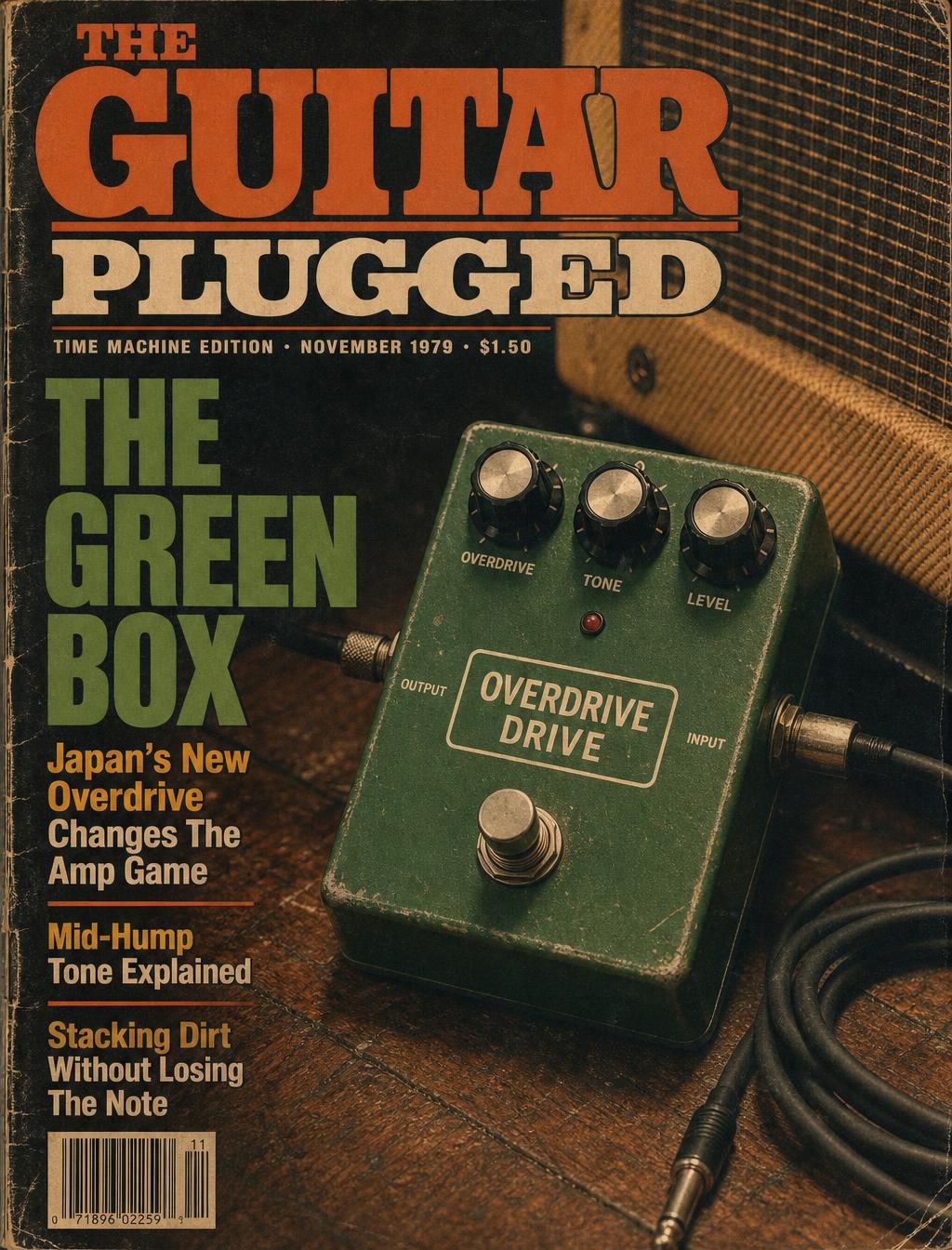
Walk into a music shop this year and ask for an overdrive pedal, and there's a decent chance the clerk reaches for a small green box with three knobs and a name that sounds more like a warning label than a product: Tube Screamer. Ibanez has been building stompboxes for a few years now, but this one behaves differently from anything else on the pegboard, and players who've spent the last decade wrestling fuzz boxes into submission are starting to notice.
Not Another Fuzz Box
Fuzz pedals, the Fuzz Face and its many cousins, work by slamming a signal into hard clipping until the waveform is nearly a square wave. That's a glorious, gnarly sound, but it's also unforgiving: touch dynamics get flattened, and the tone can turn to mush the moment you add a low string or roll back the guitar's volume. Distortion boxes like Boss's OD-1, which beat Ibanez to market by a stretch, use op-amp clipping too, but the Tube Screamer's circuit takes a different approach to how it shapes the waveform, and the difference is audible the instant you plug in.
The Tube Screamer clips softly and symmetrically. Instead of chopping the top and bottom of the waveform off abruptly, the circuit rounds the peaks, more like what happens naturally when a valve amplifier's output stage starts to run out of headroom. The result doesn't sound like a fuzz box wearing a guitar amp's clothes. It sounds like an amp being pushed harder than it normally would be, which is exactly the sales pitch and, more importantly, exactly what it delivers through a decent rig.
The Mid Hump
The other thing players notice immediately is that the Tube Screamer doesn't sound big on its own. Plugged straight into a clean amp, it can sound almost thin, a scooped low end and a pronounced push in the midrange, roughly in the area where a guitar solo needs to cut through a bass and drum kit without turning to noise. That mid hump is not a flaw. It's the entire design philosophy. A guitarist running the pedal into a clean channel gets a boost that sits forward without smearing the note definition, and a guitarist stacking it in front of an amp that's already breaking up gets something else entirely: the amp's own harmonics reinforced and focused, with the pedal essentially pre-shaping the signal so the power tubes distort in a more controlled, singing way.
Stacking In Front of a Cranked Amp
This is where the Tube Screamer earns its keep for players who gig with amps too loud for most rooms or studios. Push the input of an already-overdriven tube amp with the Tube Screamer's boosted mids and slightly compressed dynamics, and the amp's distortion tightens up. Low strings stay articulate instead of flubbing out, and single notes bloom into sustain rather than collapsing into fizz. It's a trick session players and touring guitarists are quietly building whole tones around: get the amp dirty, not screaming, then use the pedal to push it the rest of the way only when a solo needs the extra push. Rhythm parts stay controllable; leads get the push.
Ibanez's Own Prior Attempt
Ibanez wasn't starting from zero here. The company had already put out an Overdrive pedal before the Tube Screamer arrived, and while it saw some use, it never caught fire commercially or tonally in the way this new one is starting to. The refinement between the two pedals, most players who've tried both agree, is in how much more amp-like and less like a treble booster with a compressor bolted on the new box sounds. Boss's OD-1, released around the same period, uses germanium diode clipping and has its own devoted following for a slightly grittier, more aggressive voice. The choice between the two is shaping up to be one of the more interesting gear debates going into the new decade: Boss's more direct, immediate crunch, or Ibanez's smoother, amp-sympathetic push.
Why Players Are Paying Attention
Session players cutting records on tight schedules like the Tube Screamer because it doesn't fight the amp it's plugged into. You can leave it on for an entire session and vary the amount of dirt with the guitar's volume knob, something that's much harder to do convincingly with a fuzz circuit. It also plays nicely with other pedals in the chain, since its clipping is gentle enough that it doesn't fully saturate the signal before a delay or another gain stage gets to it. Nobody's calling this pedal a classic yet. It's a new tool, one more option in a market that's rapidly filling up with small boxes promising big amp tone. But the design logic behind it, soft symmetrical clipping doing the work that used to require an actual overdriven tube stage, is different enough from what came before that it's worth watching where Ibanez takes the idea next.
Why it matters now
The Tube Screamer, particularly the TS808 and later TS9 versions, would become arguably the single most cloned circuit in guitar-pedal history. Boutique builders across the world have spent decades reverse-engineering and tweaking its op-amp and clipping-diode configuration, and 'Tube Screamer clone' is its own entire product category by the 2000s. Its most famous association came a few years after this piece was written, when Stevie Ray Vaughan used one to push his already-loud Fender and Marshall amps into singing lead tones, cementing the pedal's reputation as a boost-into-a-cranked-amp tool rather than a standalone distortion. The mid-hump voicing that seemed almost like a limitation in 1979 became the pedal's defining, sought-after trait, prized specifically for how well it sits in a mix and pushes a tube amp without smothering pick dynamics.
Sources
- Ibanez company history archives — product lineage of Overdrive and Tube Screamer pedals
- Guitar Player magazine gear coverage of late-1970s overdrive pedals — general circuit design commentary