
The Shred Years
THE GUITAR PLUGGED
Randy Rhoads Brings Classical Discipline to Ozzy's Blizzard of Ozz
A young Los Angeles guitarist trained in classical technique gives Ozzy Osbourne's solo debut a sound built on layered harmony leads rather than raw riffing alone.
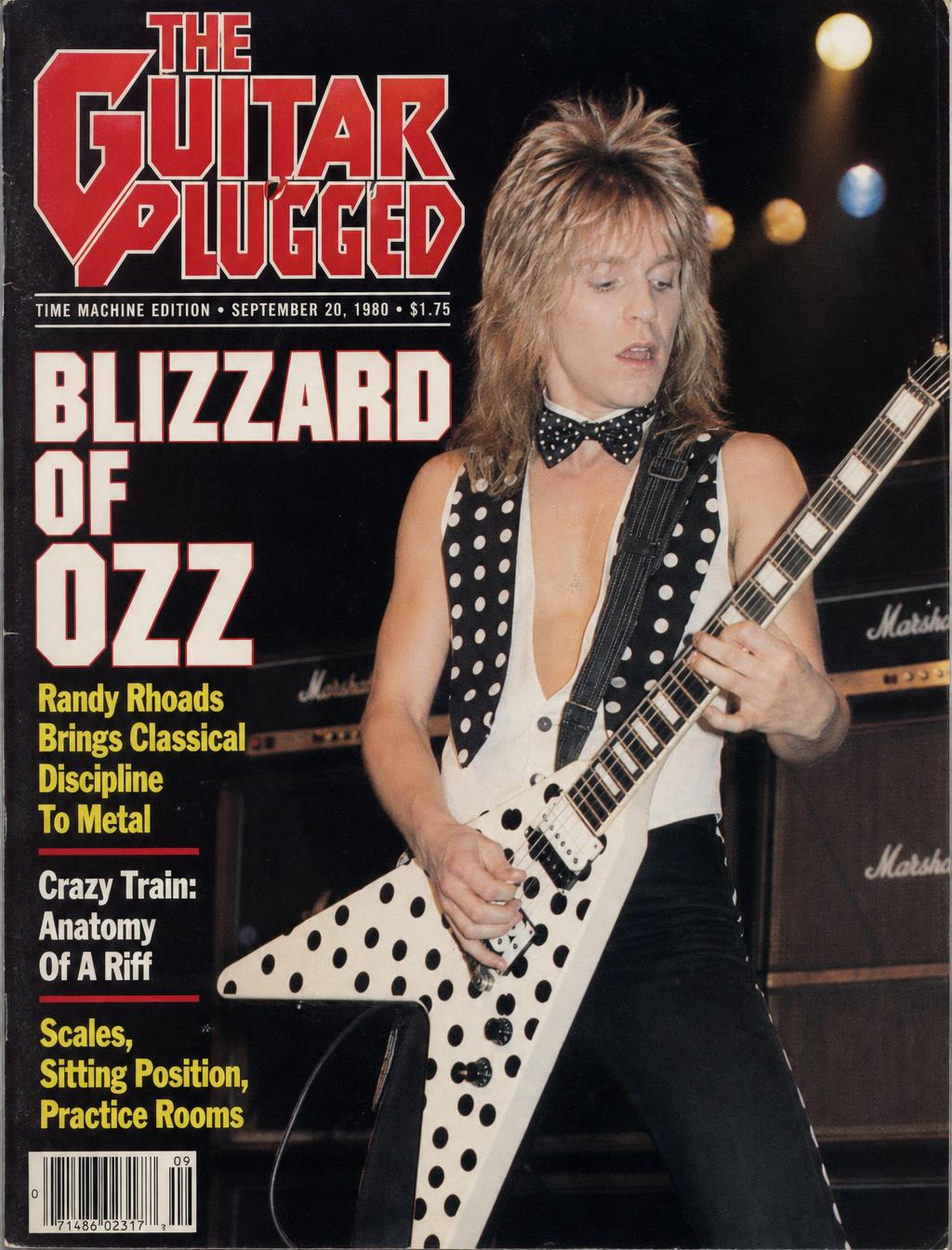
Ozzy Osbourne's first record without Black Sabbath, Blizzard of Ozz, is out this month, and the guitar player driving it is a name most audiences outside Los Angeles are only now learning: Randy Rhoads. He came up out of the Quiet Riot scene on the Sunset Strip, but what separates his playing from the pack of hard rock guitarists chasing volume and speed is where he actually spent his hours before he ever plugged into a Marshall: taking classical guitar lessons, studying theory and technique with a rigor more associated with a conservatory than a rock club.
A Classically Trained Ear in a Loud Band
That background shows up constantly on this record, not as ornamentation but as structure. Rhoads builds his solos the way a composer builds a phrase: motifs that repeat, invert, and resolve, rather than strings of licks strung together for effect. He's also been layering harmonized guitar lines, two or more takes of the same lead line stacked a third or a sixth apart, a technique more associated with orchestral arranging than with the blues-based single-line soloing that's dominated hard rock guitar up to now.
The Guitars: A Polka-Dot V and a New Kind of Flying V
Rhoads recorded much of this album on a Flying V built for him by luthier Karl Sandoval, finished in a black-and-white polka-dot scheme that's become as much a visual signature as his playing already is a sonic one. He's also been working with builder Grover Jackson on a new instrument, a sharper, more angular take on the Flying V shape that Jackson is calling the Concorde, designed to Rhoads's own specifications for comfort and access to the upper frets. It's a guitar built by a player who clearly thinks about ergonomics as much as tone, an instrument tailored for the kind of fast position work his classical background demands.
Crazy Train and Mr. Crowley
"Crazy Train" opens the record with a riff that's tight and rhythmically precise, but it's the guitar solo where Rhoads' training really announces itself, phrases built from arpeggios and scale runs that resolve with a composer's sense of tension and release rather than simply peaking in speed. "Mr. Crowley" gives him even more room, an extended solo section that unfolds in two distinct passes, each building on ideas introduced in the first, almost like a set of variations. It's unusual to hear a hard rock record leave that much space for a guitarist to develop musical ideas rather than just deliver a climax.
The Rhythm Section and Ridge Farm
The record was tracked at Ridge Farm Studio in the English countryside, with bassist Bob Daisley and drummer Lee Kerslake forming the rhythm section, both musicians who came to the sessions from stints in other well-regarded bands and who give Rhoads' guitar work a foundation solid enough to build the layered leads on top of. The rural, relatively isolated setting seems to have suited the record's careful, considered approach, a long way from the pressure-cooker atmosphere of a big city studio.
What Comes Next
Ozzy Osbourne's commercial fortunes after leaving Black Sabbath were genuinely uncertain going into these sessions, and this record answers that uncertainty directly. Whatever happens with the band's future lineup, Rhoads has already given hard rock guitar something it didn't quite have before: a player equally fluent in blues-rock aggression and formal harmonic construction, unafraid to let a solo actually develop rather than simply detonate.
Marshall Stacks and a Careful Studio Approach
For all the classical precision in his phrasing, Rhoads' sound on tape still comes from a fairly conventional hard rock signal chain: Marshall amplification pushed into distortion, with minimal effects beyond what's needed to give his leads a bit of extra sustain. What sets the recorded tone apart is less the gear itself than the care taken in tracking it. Producer Max Norman, working alongside the band at Ridge Farm, reportedly had Rhoads record his rhythm parts with an unusual degree of precision, redoing passages until the timing and tone matched exactly, an approach that suits a guitarist already inclined toward exacting, composed playing rather than loose improvisation.
From Quiet Riot to a Solo Audition
Before this record, Rhoads had already built a local following in Los Angeles fronting Quiet Riot, a band that, despite strong club draws on the Strip, struggled to secure American label interest and released records only in Japan. It was almost by accident that Rhoads ended up auditioning for Ozzy Osbourne at all: as the story has circulated among Los Angeles musicians, he initially planned only to demonstrate a few warm-up exercises before being cut off and told, in effect, that he already had the gig. That such a self-effacing player, more comfortable teaching guitar lessons back home than promoting himself, would end up defining the guitar sound of a major label solo debut says something about how quickly raw talent can reroute a career in this business.
Teaching Between Tours
Even as Blizzard of Ozz climbs the charts, Rhoads has reportedly kept up an interest in formal music education that goes beyond his own classical study, telling associates he intends to pursue a degree in classical guitar once touring commitments allow. It's a detail that fits everything else about how he approaches the instrument: technical achievement here isn't treated as an end point but as groundwork for further study, an attitude rare among hard rock guitarists whose ambitions more typically run toward bigger amps and longer solos rather than formal instruction.
A New Vocabulary for Hard Rock Guitar
Taken as a whole, Blizzard of Ozz plays like an argument that hard rock guitar doesn't have to choose between visceral heaviness and formal musical sophistication. Rhoads' arpeggiated runs, his diminished and harmonic minor-flavored phrases, and his patient, motif-based solo construction sit comfortably alongside crunching Marshall-driven rhythm parts built for arenas, suggesting a vocabulary for the instrument that plenty of guitarists coming up through hard rock and metal clubs right now have likely never encountered outside a conservatory.
Why it matters now
Randy Rhoads died in a plane accident in March 1982, meaning Blizzard of Ozz and its 1981 follow-up Diary of a Madman represent virtually his entire recorded legacy, which only intensified how closely guitarists studied every phrase on these two albums in the decades since. His fusion of classical technique with hard rock aggression, particularly the layered, harmonized leads and neoclassical phrasing, became a direct blueprint for the shred and neoclassical metal movements of the mid-1980s, influencing players like Yngwie Malmsteen and countless guitar-magazine transcription columns. The Jackson Concorde design developed with Grover Jackson during this period became a production model in its own right, and Jackson Guitars built much of its early identity around the Rhoads association.
Sources
- Guitar World — Randy Rhoads classical training and gear profiles
- Rudy Sarzo, 'Off the Rails' — Rhoads biography and Blizzard of Ozz sessions context
- Jackson Guitars company history — development of the Concorde model with Grover Jackson