
The Album Era
THE GUITAR PLUGGED
Aerosmith Sharpen Their Teeth With Jack Douglas on Toys in the Attic
At the Record Plant with producer Jack Douglas, Aerosmith trade blues-rock sprawl for tighter riffs, sharper guitars, and a breakout single called Walk This Way.
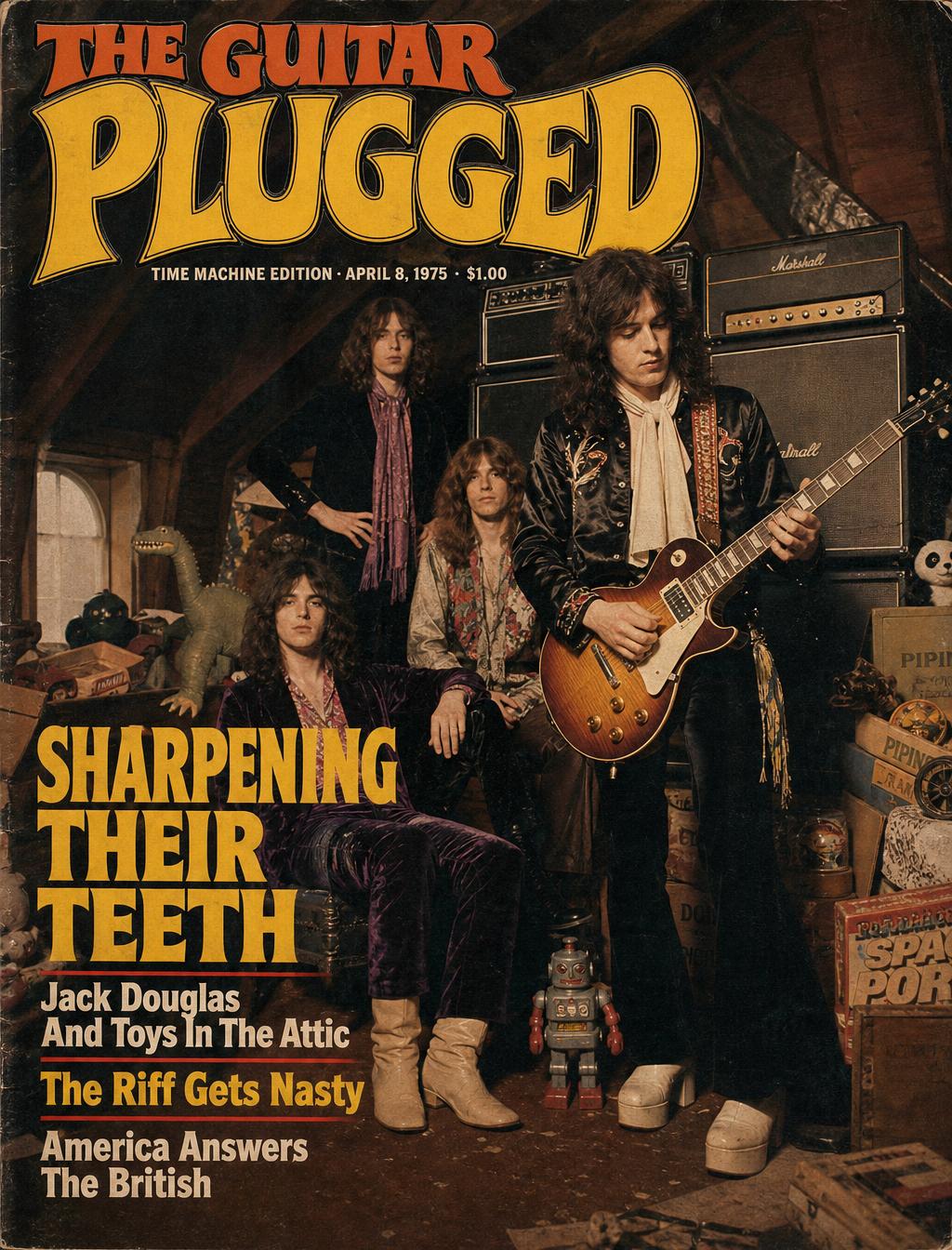
Aerosmith come into the Record Plant in New York this time with a different kind of confidence. Their first two albums built them a following, mostly on the road, but neither one translated the band's live snap onto tape the way the band wanted. For Toys in the Attic they bring back producer Jack Douglas, who had worked with them on Get Your Wings, and this time the sessions move faster and hit harder, in part because Douglas pushes the band to arrive with material tightened up before tape starts rolling rather than working it out take by take in the studio.
Jack Douglas and the Record Plant Sound
The Record Plant, already known for a string of rock sessions through the early seventies, gives Douglas the room and console flexibility to layer Aerosmith's two-guitar attack without burying either player. Douglas is known for a hands-on, almost bandmate-like approach in the room, encouraging the group to work through arrangement ideas on the spot, and the version of Toys in the Attic that results feels leaner and more urgent than the band's earlier records, songs arriving and leaving in three or four minutes rather than stretching into extended jams.
Perry's B.C. Rich, Whitford's Anchor
Joe Perry's guitar work on this record leans on a mix of Les Paul and B.C. Rich instruments, the latter a relatively new and unconventional choice for a hard rock guitarist at the time, favored by Perry for its sustain and its cutting upper midrange, useful for slide work and the more aggressive rhythm parts scattered across the album. Brad Whitford, often the less-discussed half of Aerosmith's guitar partnership, provides the steady rhythm foundation that lets Perry's leads and fills sit on top without the songs losing their footing, a role that doesn't get much ink in the press but that band members and engineers alike credit as essential to the record's tightness.
Walk This Way's Guitar-First Groove
Walk This Way begins, famously, as a drum groove that drummer Joey Kramer brings into rehearsal, but it's Perry's syncopated, funk-inflected riff, doubled and interlocked with Whitford's rhythm part, that gives the track its strut. Steven Tyler reportedly writes the lyrics against a tight deadline, but the music, built around that guitar riff, is essentially finished before a word is added, an unusual sequence for a rock single of this era and one that puts the guitar figure, rather than the vocal melody, at the center of the song's identity.
Sweet Emotion and the Talk Box
Sweet Emotion opens the album with a percussive, almost hypnotic groove built on Tom Hamilton's bassline and marimba-like percussion before the guitars enter, and its bridge features Joe Perry running his guitar through a talk box, an effect that routes amplified guitar signal through a tube into the player's mouth, shaped by the mouth cavity and picked back up by a microphone. The talk box had already been used by other rock guitarists earlier in the decade, but Perry's use of it here, combined with the song's shifting tempo and dynamics, becomes one of the record's most distinctive textures and a signature Aerosmith move going forward.
Uncle Salty and No More No More
Away from the two singles carrying the album to radio, tracks like Uncle Salty and No More No More show a band working comfortably across tempos and moods, from a slower, minor-key groove to a loose, almost autobiographical rocker about life on the road. Perry and Whitford trade rhythm and lead responsibilities freely across these tracks rather than settling into fixed roles, a flexibility Douglas encourages in the room, and the interplay gives the record a sense of two guitarists genuinely listening to each other rather than one guitarist simply soloing over the other's chords.
Steven Tyler's Piano and the Title Track
The title track opens the record at a sprint, a fast, riff-driven blast that Tyler, who also plays piano and harmonica across the album, keeps lean and direct, setting the tempo for the whole side. Tyler's piano work on other tracks, less discussed than his vocals or the guitar interplay, adds texture without competing for space, another example of the record's overall discipline about not over-stuffing arrangements that could otherwise have sprawled the way the band's earlier records sometimes did.
Amplifiers and the New York Room
Perry and Whitford both favor Marshall amplification through this period, pushed hard enough in the Record Plant's live room to generate natural tube saturation rather than relying heavily on outboard distortion, giving the rhythm tracks a thick, slightly gritty character that studio compression only sharpens rather than smooths over. Douglas and his engineering team mic the amps close and tight, favoring a present, in-your-face guitar sound over the more ambient, roomy approach some contemporary hard rock productions were using, a choice that suits a band whose reputation had been built on the visceral impact of its live shows.
A Record That Reshapes the Band's Trajectory
Toys in the Attic arrives at a moment when Aerosmith could easily have stalled after two records that undersold their live reputation, and the tighter songwriting, sharper guitar interplay, and Douglas's insistence on economy over sprawl give the band its first true commercial breakthrough. The album's success also cements the Perry-Whitford partnership as one of hard rock's more durable two-guitar teams, built less on flash than on the kind of tight, purposeful arranging that a song like Walk This Way demonstrates from its opening bars.
Why it matters now
Toys in the Attic is widely regarded as the record where Aerosmith found their commercial and artistic footing, and Walk This Way's guitar riff became so durable that it formed the backbone of a landmark 1986 collaboration with Run-D.M.C. that helped bridge rock and hip-hop for mainstream radio. Joe Perry's talk box use on Sweet Emotion sits alongside a small handful of famous rock talk box moments that introduced the effect to a generation of guitarists who'd otherwise associate it purely with novelty use. Brad Whitford's disciplined rhythm playing on this record is frequently cited by guitar teachers as a study in how a second guitarist supports a flashier lead player without disappearing into the background.
Sources
- Jack Douglas interviews — Record Plant production details
- Joe Perry and Brad Whitford interviews, guitar press — gear and arrangement details
- Aerosmith band histories and liner notes