
The Album Era
THE GUITAR PLUGGED
Pink Floyd Chase Perfection at Abbey Road for The Dark Side of the Moon
With engineer Alan Parsons at the desk, Pink Floyd spent months at Abbey Road turning odd time signatures and heartbeat loops into their most focused record yet.
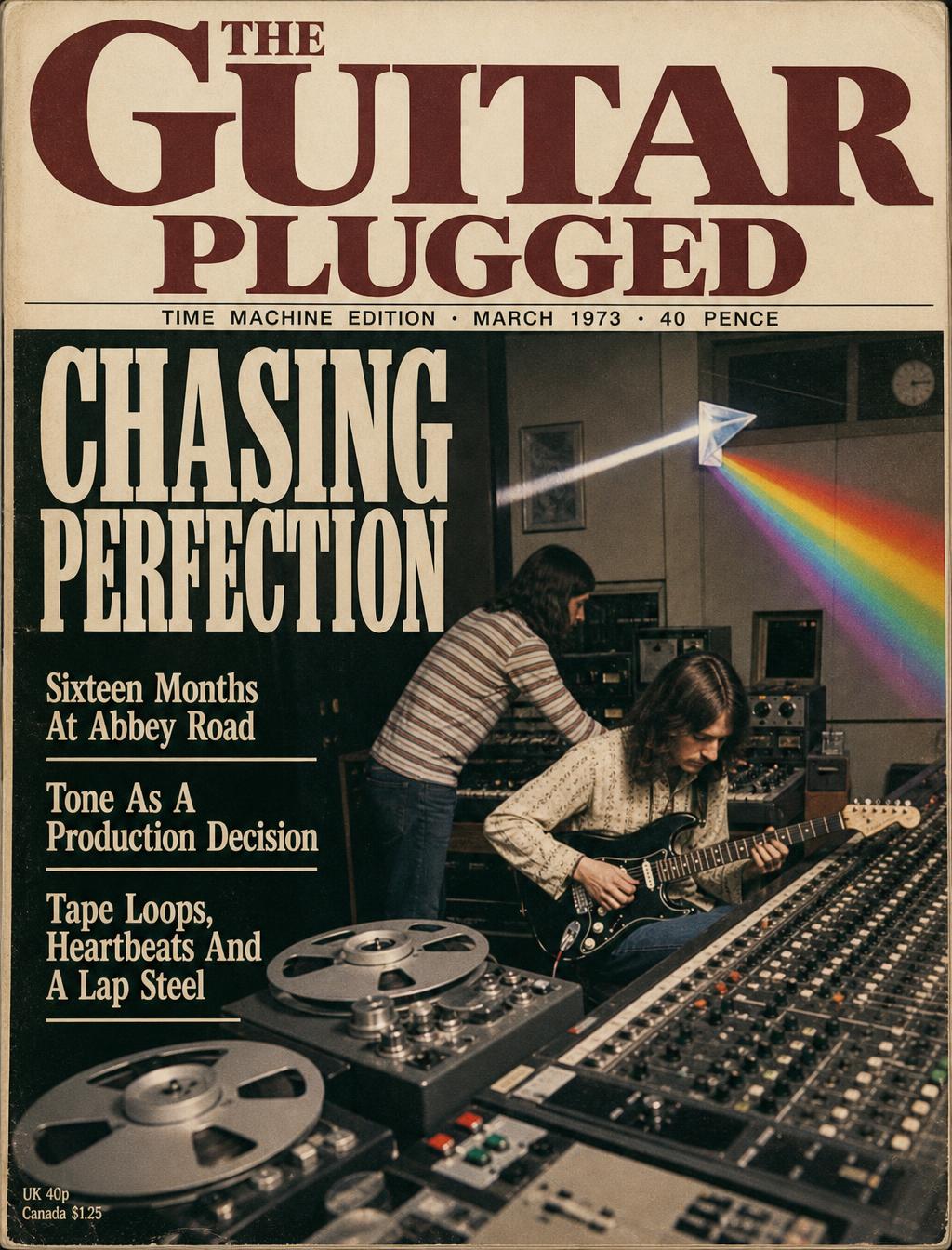
Pink Floyd have been working on this material, under the working title Eclipse, in fits and starts since mid-1972, testing pieces live on tour before ever committing them to tape. By the time they lock themselves into Abbey Road Studios across a series of sessions running from June 1972 into early 1973, the band has a clear idea that they want a record about the pressures of modern life, presented not as abstract space rock but as something disciplined and precise. That precision runs straight through the guitar work.
Alan Parsons and the Abbey Road Machine
Alan Parsons, who had worked as an assistant engineer on Abbey Road for the Beatles a few years earlier, engineers the sessions and brings both a technical rigor and a handful of experimental techniques, tape loops of chiming clocks, cash registers, and ticking heartbeats assembled from a library of studio recordings, that thread the album together. Abbey Road's EMI-built desks and the studio's collection of outboard gear give the band access to a level of multitrack sophistication that had not been available to them on earlier records, and producer credit for the album goes to the band itself, working as a unit with Parsons rather than an outside producer calling the shots.
Gilmour's Black Strat and the Money Riff
David Gilmour's black Fender Stratocaster, which he had acquired a few years prior and modified over time, anchors the record's guitar sound. Money opens with Roger Waters' famous 7/4 bass riff, built from spliced-together tape loops of cash register sounds and coins before the band comes in on that same asymmetrical meter. Gilmour's guitar work through the verses locks into that odd-time groove, but the extended instrumental section shifts the whole band into a straight 4/4 blues, giving Gilmour room to solo without fighting the meter, an arrangement choice that lets the track breathe as a showcase after its tightly constructed opening. Gilmour records his solo in stages, going back over passages and comping together the strongest phrases, a process aided by the multitrack flexibility Abbey Road affords.
Time and the Hiwatt Wall
On Time, following an opening built from ticking clocks and chiming alarms recorded by Parsons for an unrelated sound-effects project, Gilmour's guitar carries much of the emotional weight of the track, a solo constructed with sustained bends and a vocal-like phrasing sensibility that has as much in common with a horn player's breath control as with standard blues-rock lead guitar. Gilmour's rig for the album runs through Hiwatt amplification, favored by him for its clean headroom and its ability to take pedals and outboard effects without collapsing into mush, paired with a Binson Echorec, an Italian-made drum echo unit whose warm, degrading repeats give Gilmour's sustained notes their smeared, atmospheric tail rather than a crisp modern delay's sharper edges.
A Record Built to Function as One Piece
Throughout the sessions the band insists on segueing tracks into one another without gaps, treating the album as a continuous forty-odd minute piece rather than a collection of singles, an approach that shapes how the guitar parts are arranged, with Gilmour's playing often functioning as connective tissue between sections rather than discrete solos bookended by silence. The band brings in vocalist Clare Torry for a wordless, improvised vocal on The Great Gig in the Sky and gathers spoken interview snippets from Abbey Road staff and associates to scatter through the record, reinforcing the sense that this is meant to feel like an environment rather than a set of songs.
Testing the Material on the Road
Long before any of this reached Abbey Road's tape machines, Pink Floyd performed the entire piece live under the Eclipse title on tour through Britain, Japan, and North America across 1972, refining arrangements and pacing in front of paying audiences well before a note was permanently committed to tape. That road-testing is part of why the album's guitar parts feel so settled and unhurried on record: Gilmour had already worked out the shape of his solos and rhythm parts across dozens of performances, arriving at the studio with material that needed careful capture rather than invention from scratch.
Waters, Wright, and a Divided Workload
Bassist and lyricist Roger Waters takes the writing lead on the album's words, while keyboardist Richard Wright's chord voicings and harmonic sense shape much of the record's tonal palette, giving Gilmour's guitar lines a bed of sound to move against that's closer to jazz harmony than standard rock changes. That combination, Waters' direct, plainspoken lyrics about money, time, conflict, and madness set against Wright's more impressionistic keyboard writing, leaves Gilmour's guitar work to function as an emotional throughline across the record's disparate movements, something closer to a narrator's voice than a soloist stepping forward for a single showcase moment.
Breathe, Us and Them, and the Album's Quieter Corners
Not every guitar moment on the record chases the sustained intensity of Time or the blues-inflected release of Money's instrumental section. On Breathe, which opens the album proper, Gilmour's slide guitar work, played through a bottleneck rather than fretted, sets a hazy, unresolved tone that recurs when the same musical material returns later in the record. Us and Them, built around Wright's chord changes more than any single guitar figure, finds Gilmour largely restrained, adding texture rather than melody, a choice that keeps the album's emotional peaks, particularly Time and the climax of Money, from being undercut by too much guitar elsewhere on the record.
A Long Path to the Shelves
The album arrives after roughly nine months of intermittent studio work spread across several distinct recording blocks at Abbey Road, an unusually long gestation for a rock record at a moment when many acts still turn albums around in a matter of weeks. That extended timeline gave Parsons and the band room to revisit mixes, experiment with the spoken-word interview snippets gathered from Abbey Road's own staff and passersby, and refine the crossfades stitching each track into the next, the sort of patient studio work that a tighter schedule and smaller budget would almost certainly have ruled out.
Why it matters now
The Dark Side of the Moon has since become one of the best-selling records ever made, holding an extraordinary run on album charts, but its lasting influence on guitarists has less to do with technical flash than with Gilmour's economy: the Time solo in particular is frequently cited as a model of melodic restraint over sheer speed. The Binson Echorec and Hiwatt-driven tone Gilmour developed on this record helped define a specific strand of atmospheric, sustain-heavy lead playing that echoes through ambient and post-rock guitarists for decades afterward. Alan Parsons' production work here, blending tape manipulation, careful multitracking, and conceptual sound design, set a template for concept-album engineering that he continued exploring under his own name later in the decade.
Sources
- Alan Parsons interviews on Abbey Road engineering — production and tape-loop details
- David Gilmour interviews, guitar press — gear and solo construction
- Pink Floyd studio session accounts, Abbey Road archives