The Loud Revolution
THE GUITAR PLUGGED
The Beatles Land on Ed Sullivan, and America's Guitar Racks Empty Out
The Beatles' first live American television appearance puts Gretsch, Rickenbacker, Höfner, and Vox gear in front of seventy million viewers on a Sunday night.
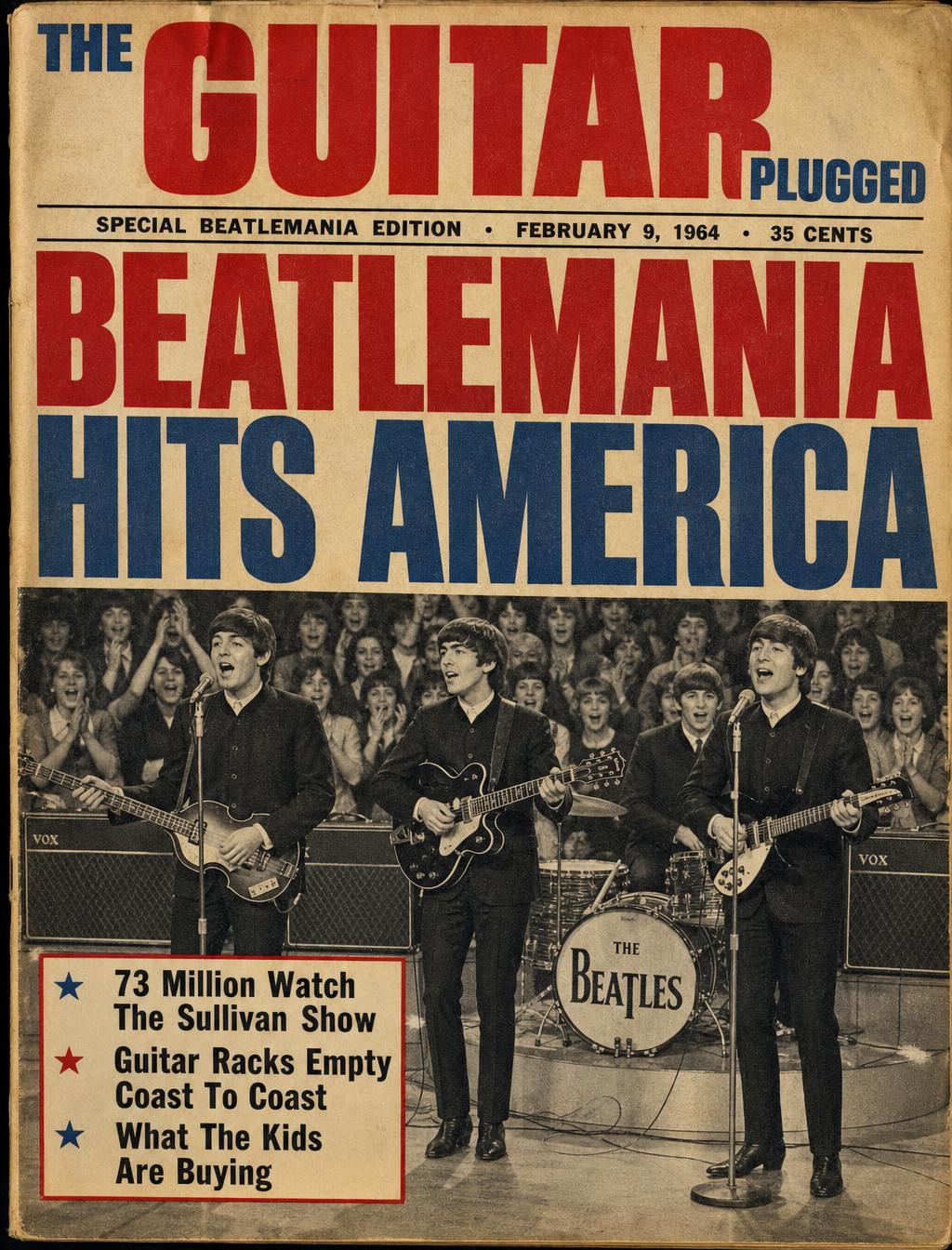
Seventy million Americans tuned their sets to CBS this Sunday night for The Ed Sullivan Show, and what they saw was four young men from Liverpool playing to a studio audience of screaming teenagers who could barely be heard over their own noise. The Beatles' first live appearance on American television is already being talked about as a turning point, and for guitarists watching closely, the gear on that stage told its own story.
Harrison's Gretsch
George Harrison plays a Gretsch, a big, orange-toned hollow-body Country Gentleman, the same family of instrument he's favored on the band's records and British television spots. It's a guitar built for the kind of clean, chiming tone Harrison uses on the band's rhythm and lead parts alike, and it looks like nothing else young guitarists in American music shops have been reaching for.
Lennon's Rickenbacker
John Lennon plays a Rickenbacker 325, a short-scale, compact hollow-body he's had since the band's Hamburg days, now finished in black for American television. It's a smaller, punchier-sounding instrument than Harrison's Gretsch, and the two guitars' contrasting textures, one full and warm, the other tight and percussive, are a big part of why the band's rhythm section sounds so distinctive on record and on this broadcast.
McCartney's Höfner and the Vox Amps
Paul McCartney's violin-shaped Höfner 500/1 bass, lightweight and hollow-bodied, is unlike the solid Fender basses most American bands favor, and its rounded, woody low end sits distinctly under the guitars. All three instruments run through Vox amplification, the British company's amps having become the band's standard rig, giving the whole performance a cohesive, slightly compressed brightness that comes through even on home television speakers.
The Morning After
Music shops across the country are reporting phone calls and walk-ins from teenagers asking for exactly what they saw on television Sunday night: a Rickenbacker like Lennon's, a Gretsch like Harrison's, drums like Ringo Starr's. Distributors who've had modest interest in these British and semi-obscure American brands are suddenly facing demand they aren't set up to fill. It isn't just about one band's popularity. Teenagers who have never picked up an instrument are asking their parents for guitars, and existing garage bands are scrambling to figure out vocal harmonies and matching gear.
A Studio Built for Radio, Not This
CBS's Studio 50 on Broadway, the same room Sullivan has used for years, was never engineered with electric guitars and screaming teenagers in mind. Crews spent the week wiring extra microphones and running additional cable to handle the band's amplifiers, and the sound the broadcast audience heard at home was a compromise: a single mono feed compressed down for television speakers that, in most American living rooms, were built for variety-show orchestras and stand-up comedians, not four amplifiers and a drum kit pushed to keep up with 728 shrieking fans inside the hall.
Sullivan's production team reportedly worried in rehearsal that the crowd noise alone would swallow the music entirely, and the band ran through its five songs, "All My Loving," "Till There Was You," "She Loves You," "I Saw Her Standing There," and "I Want to Hold Your Hand," more than once before airtime to get monitor levels somewhere close to workable. What made it to broadcast still leans hard on Ringo Starr's drums and McCartney's bass to anchor a mix in which Harrison's guitar leads are sometimes barely audible over the audience, a limitation that will matter more to engineers than to the millions of new fans watching.
Vox's Quiet Coup
The amplifiers stacked behind the band, Vox AC30s brought over from England rather than sourced from an American backline, represent their own small victory for a British manufacturer largely unknown on this side of the Atlantic. Vox's alliance with the band predates this broadcast by a couple of years, the company having supplied amplification to the group since its early British television work, and the AC30's characteristic chime, driven by its EL84 output tubes rather than the 6L6s common in American amps, is a big part of why Harrison's Gretsch and Lennon's Rickenbacker cut through with the brightness they do. Until now, American guitarists shopping for amplifiers have had eyes mostly for Fender. That is about to change.
What the Cameras Missed
Less visible to viewers, but not lost on musicians who will spend the coming days studying kinescope replays and magazine photographs, are smaller details: the capo Harrison sometimes uses to shift key without retuning, the felt pick McCartney favors for a rounder bass attack, and the close vocal harmony blend that requires all three singers to work off a shared monitor mix that, on this stage, barely exists. None of it is exotic gear by later standards, but taken together it forms a specific, reproducible rig that record store clerks and repairmen will be asked to explain hundreds of times over before the month is out.
An Industry Scrambles
Rickenbacker's California factory, a modestly sized operation compared to Fender or Gibson, is bracing for order volume it has never seen. Gretsch, based in Brooklyn, faces the same problem with its Country Gentleman and similarly styled hollow-bodies suddenly in demand from customers who, a month ago, would have walked into a shop asking for a Stratocaster or a Telecaster. Höfner's violin bass, imported from Germany and previously a novelty item on American shelves, is likewise expected to become one of the harder instruments to keep in stock this year. Retailers describe a shift that has nothing to do with an advertising campaign and everything to do with seventy million people watching the same broadcast at the same time, an audience concentration television may never replicate again in quite the same way.
Why it matters now
The Ed Sullivan broadcast is widely credited as the spark for a wave of American teenagers picking up guitars and forming bands, a phenomenon retrospectively nicknamed the garage rock boom. The specific instruments on that stage, Harrison's Gretsch, Lennon's Rickenbacker, and McCartney's Höfner, all saw sales and cultural cachet spike in the following years, reshaping which brands young American players aspired to own. Decades on, this single broadcast is still cited as one of the most consequential nights in the history of the electric guitar's popular appeal, a moment when television turned specific guitar models into objects of mass teenage desire.
Sources
- CBS broadcast records — The Ed Sullivan Show, February 9, 1964
- Beatles gear histories documenting Gretsch Country Gentleman, Rickenbacker 325, and Höfner 500/1 usage