
The Loud Revolution
THE GUITAR PLUGGED
Gibson Slims Down the Les Paul With a Radical New Body
Gibson reworks its flagship solidbody into a thin, double-cutaway mahogany guitar with beveled horns and a sideways vibrola, still wearing the Les Paul name.
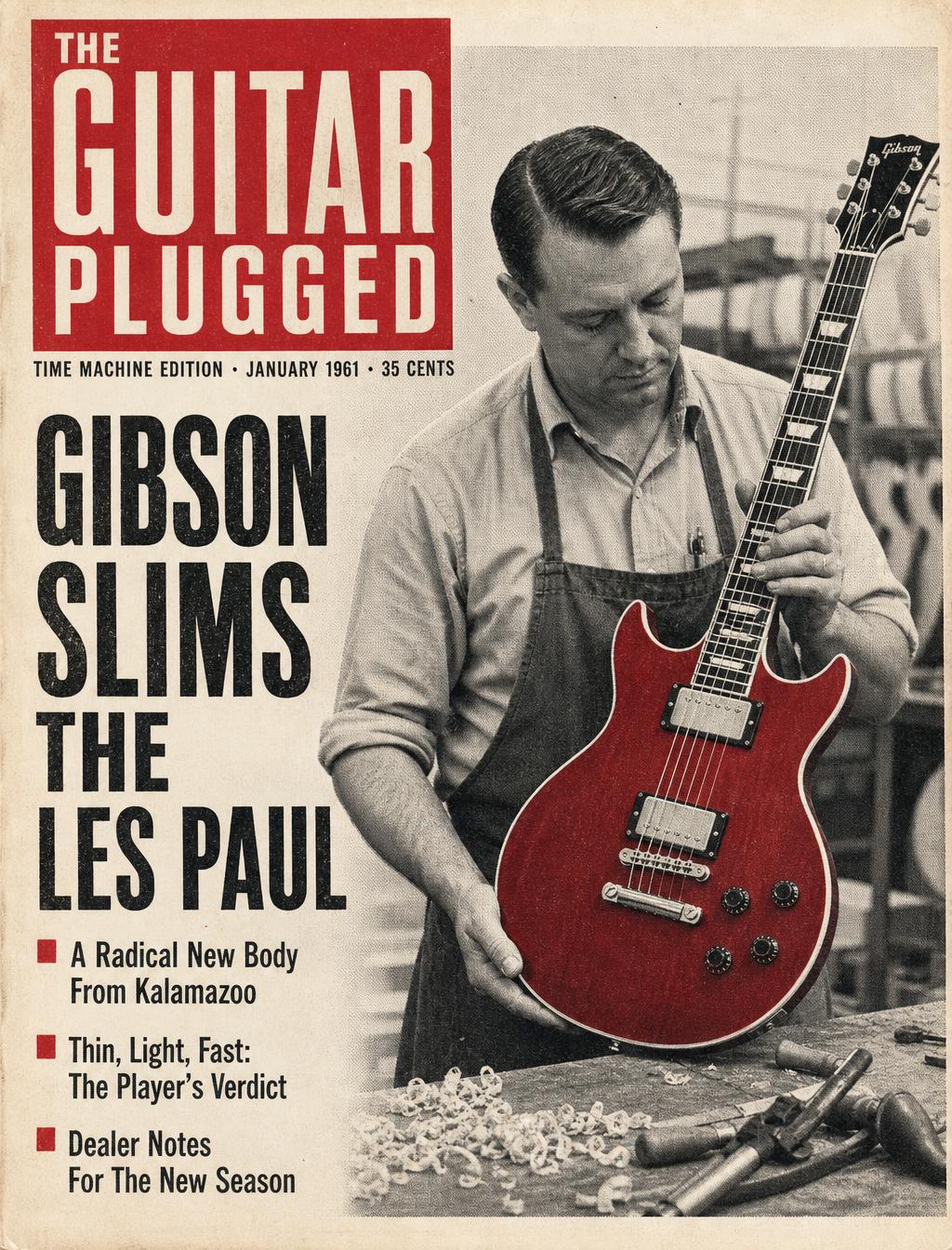
Gibson has quietly overhauled the guitar that carries Les Paul's name, and the change is anything but subtle once you see the instrument in hand. Gone is the carved, heavyset maple-topped mahogany body that's defined the Les Paul line since the early '50s. In its place is a thin, all-mahogany double-cutaway body with sharply beveled horns that give the guitar an almost architectural profile compared to anything Gibson has built before.
Weight and Access, Solved
The old Les Paul body was never light, and its single cutaway made the upper frets a stretch for players chasing higher positions. The new design solves both problems at once. Stripping the carved maple cap and slimming the mahogany down considerably cuts the weight dramatically, and the twin cutaways with their deep horns open up the neck joint so a player can reach the top frets without contorting around the body's shoulder.
Still Wearing the Les Paul Name
For now, this new guitar is still badged as a Les Paul, sold as the current standard and custom Les Paul models with the redesigned body. Gibson has made the change without much fanfare, positioning it as an evolution of the existing line rather than the launch of something new, even though the construction, tonewood, and silhouette bear almost no resemblance to the guitar that carried the name through the 1950s.
The Sideways Vibrola
Higher-spec versions of the new body are turning up with Gibson's sideways-action vibrola, a spring-loaded vibrato unit with a horizontal arm that swings side to side rather than the up-and-down motion players know from Fender's designs. It's a distinctive piece of hardware, visually striking with its engraved cover plate, though some players are finding it fussier to keep in tune than a simple stopbar.
A Different Kind of Gibson Solidbody
Where the old Les Paul leaned on its dense, resonant mass and carved top for sustain and a rounded, woody voice, this new body is lighter and more resonant in a different way, with less low-end mass but a snappier attack that plenty of players are already commenting on. Whether longtime Les Paul players take to the change remains to be seen, but Gibson clearly believes a lighter, faster-playing solidbody suits where working guitarists want the instrument to go.
Falling Sales Behind the Redesign
The decision to overhaul the Les Paul doesn't come out of nowhere. Sales of the single-cutaway model have been sliding for several years as the guitar-buying public's tastes shift toward brighter, twangier instruments and away from the heavier, more expensive carved-top solidbody Gibson introduced in 1952. Gibson's president Ted McCarty, who has overseen a run of significant design work at the company through the 1950s, is said to have pushed for a lighter, cheaper-to-produce body as much for manufacturing economics as for tone, a mahogany slab requiring less hand-carving labor than the old maple-capped design.
Humbuckers Carry Over
Whatever else has changed, the electronics haven't been thrown out with the old body. The new guitars retain Gibson's PAF humbucking pickups, the same design engineer Seth Lover patented at the end of the 1950s to cancel the 60-cycle hum that plagued single-coil pickups on stage. Paired with the thinner mahogany body, the humbuckers produce a sound that's noticeably different from the fuller, more compressed voice of the maple-topped guitars: brighter on the top end, quicker to respond, with less of the sustained, almost horn-like midrange that made the older Les Paul a favorite among players chasing a warm, singing lead tone.
A Fingerboard Built for Speed
The new body isn't the only change aimed at faster playing. The slimmer neck heel and the deep double cutaways mean a player can access frets as high as the twenty-second without the body getting in the way, a genuine departure from the earlier single-cutaway design where anything above the fifteenth fret required real effort. Combined with the reduced overall weight, hovering noticeably below what the old carved-top guitars weighed on a strap, the new instrument is being marketed, quietly, as the guitar for a player who wants to move around the neck and around the stage without fighting the instrument itself.
Mixed Reception in the Shops
Reaction from dealers and working guitarists so far is split. Some praise the lighter weight and improved access; others say the thinner body sacrifices the sustain and low-end density that made the original Les Paul distinctive, and complain that the new sideways vibrola, while striking to look at, drifts out of tune more readily than they'd like under heavy use. There is also simply the matter of the name: longtime Les Paul players walking into shops expecting the familiar carved-top shape are, by several dealer accounts, startled to find something that barely resembles the guitar they know, still wearing the same badge on the headstock.
Gibson's dealers report that the new guitars are, for now, being stocked alongside remaining old-style Les Paul inventory rather than replacing it outright, giving shoppers an unusual side-by-side choice between the familiar carved-top shape and the new thin double-cutaway body under the same model name. How long that overlap lasts, and whether Gibson eventually settles on a different name for the new design once it's clearly established itself, is a question the company has left unanswered for now.
Why it matters now
Within a couple of years Gibson would drop the Les Paul name from this body altogether and rename it the SG, after Les Paul himself reportedly asked to have his name removed from a design he'd had no hand in and didn't care for. The SG went on to become one of Gibson's most enduring solidbody shapes, closely associated with players like Angus Young and, in Tony Iommi's hands, foundational to the sound of heavy rock and early heavy metal. What reads in 1961 as a quiet running change to an existing product line turned out to be the birth of an entirely new, standalone Gibson icon.
Sources
- Gibson company history — Les Paul body redesign and later SG renaming
- Guitar magazine retrospectives on the Les Paul/SG transition