
The Album Era
THE GUITAR PLUGGED
Black Sabbath's Debut Sounds Like Doom, and a Factory Accident Is Part of Why
Recorded in a single day at Regent Sound and named for a horror film, Black Sabbath's first album turns Tony Iommi's detuned strings and severed fingertips into a new kind of heaviness.
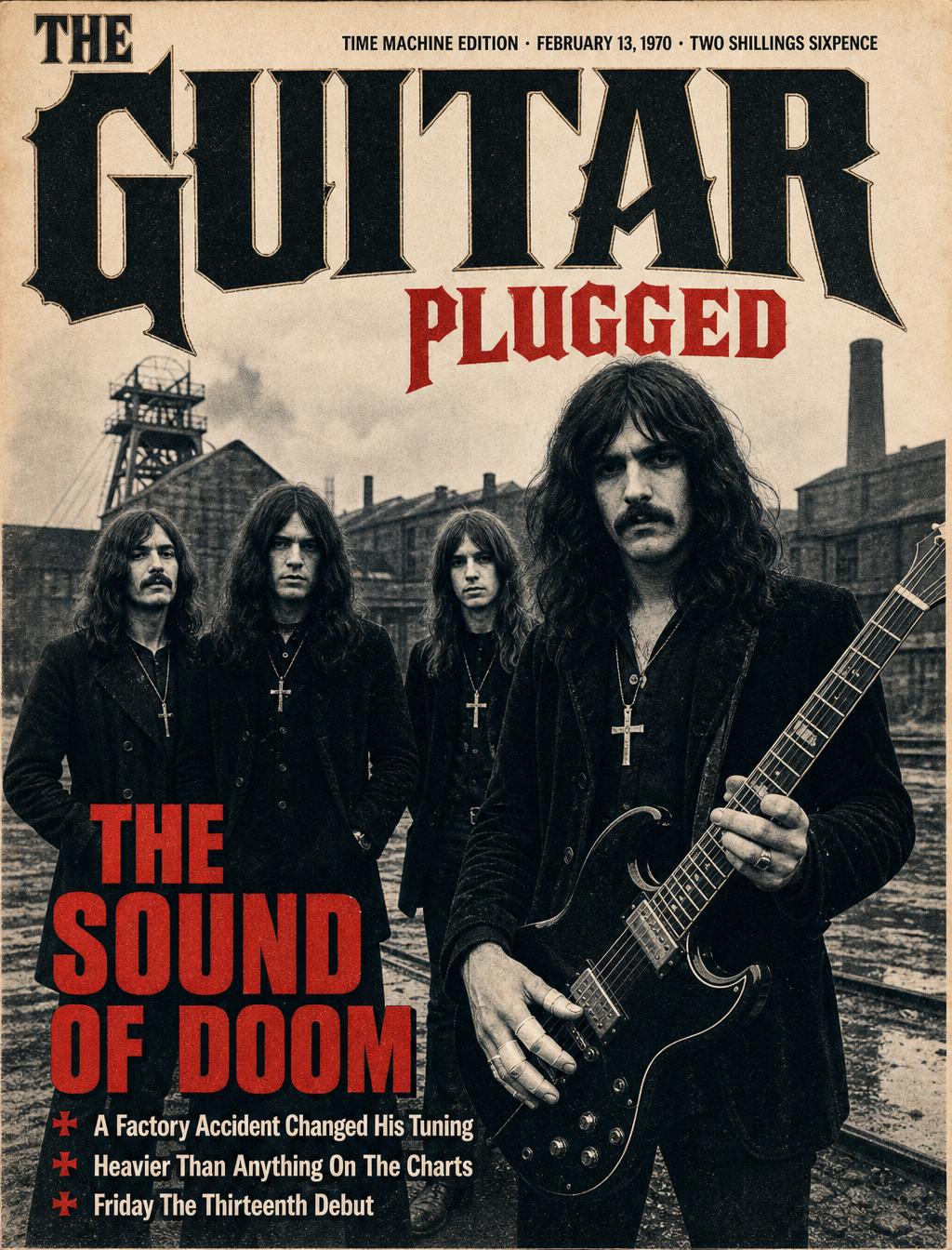
Black Sabbath's self-titled debut album arrived in shops on Friday the 13th of this month, a release date that fits the record's mood perfectly. Where most of the British blues-rock scene has spent the last few years chasing brightness and virtuosity, this Birmingham quartet has gone the other direction entirely, building an album out of dread, low tunings, and a guitar tone that sounds like it's dragging something heavy behind it.
The band, all four of them raised within a few streets of each other in Aston, a working-class district of Birmingham scarred by wartime bombing and dominated by heavy industry, had spent the back half of the 1960s gigging under the name Earth, playing blues covers in clubs across the Midlands and in Hamburg before deciding the name invited confusion with another band and settling on Black Sabbath instead, after a 1963 Boris Karloff horror film of the same title. That industrial backdrop is not incidental to the record. Iommi, Butler, Ward, and Osbourne have all spoken of factory work, foundries, and the constant hum of machinery as part of the everyday soundscape of their youth, and it is not hard to hear an echo of that grinding, mechanical weight in the album's tone.
An Accident That Reshaped a Player
Guitarist Tony Iommi lost the tips of two fingers on his fretting hand in an industrial accident at a sheet metal factory years before this record, on what was meant to be his last day at the job before leaving to become a full-time musician. Rather than giving up the guitar, he fashioned homemade prosthetic tips, reportedly melting down a plastic bottle and shaping thimble-like caps to fit over the damaged fingers, and switched to lighter gauge strings that are easier to press down with the reduced sensation in his fingertips. To compensate further, and to ease the tension the lighter strings couldn't handle at standard tuning, Iommi began detuning his guitar, a choice that turned out to reshape the band's entire sound rather than simply being a workaround.
The Interval That Started It
The album's title track opens with a slow, three-note figure built around the interval of a flattened fifth, sometimes called the tritone — a combination long associated in old music theory texts with an unsettling, ominous quality, occasionally referred to by the nickname diabolus in musica. Paired with thunder-and-rain sound effects and Ozzy Osbourne's vocal entering high above the riff, it sets a tone unlike anything currently on the British album charts, trading the blues-derived swagger of Cream or the Bluesbreakers for something closer to horror-film dread.
Cut Almost Live at Regent Sound
Producer Rodger Bain recorded the album quickly at Regent Sound Studios in London, with the band capturing most of the material essentially live in the room, the way they'd play it on any given night at a club, rather than building up the arrangements piece by piece over extended studio time. That approach preserves the tightness and rawness of Iommi, bassist Geezer Butler, and drummer Bill Ward playing off one another in real time, and it means the record captures a genuine document of a band that had already logged plenty of hours playing these songs onstage before ever getting near a tape machine.
Gibson SG Through Laney
Iommi's core rig on the record is a Gibson SG run through Laney amplification, a pairing that gives him the sustain and low-end weight the material demands without relying purely on distortion pedals to get there. The SG's slim neck likely also plays a part in making the guitar more manageable for his altered playing technique, and the combination of detuned, light-gauge strings and a hard-driven Laney stack produces a thick, sagging low end that many guitarists haven't heard generated by a single guitar and amp before.
Critics Confused, Audiences Less So
Geezer Butler's Occult Reading
Much of the album's darker subject matter traces back to bassist Geezer Butler, who has described an interest in occult literature and horror paperbacks that fed directly into lyrics about black masses and supernatural dread. Butler's playing itself often doubles Iommi's riffs in unison rather than holding down a separate root-note pattern underneath, a decision that thickens the low end considerably and makes the guitar and bass sound, in places, almost like a single fused instrument rather than two separate parts. That unison approach, paired with Bill Ward's loose, jazz-influenced feel behind the kit, gives the record a churning, unsteady quality that is very different from the metronomic rhythm sections common on blues-rock records of the period.
A Sleeve as Unsettling as the Music
The album's cover, a hazy photograph of a woman in a black cloak standing before a watermill at Mapledurham in Oxfordshire, was shot by photographer Keith Macmillan and sets the same tone as the music inside before the needle ever hits the groove. Vertigo Records, the Philips subsidiary handling the release, had built its early catalogue around progressive and experimental rock, and this record's stark, gothic packaging stands apart from the more colorful psychedelic sleeves that have dominated the past three years of British album design.
A Working Band, Not a Studio Creation
It is worth stressing how much stage time sits behind this record. By the time Rodger Bain brought the band into Regent Sound, Black Sabbath had already logged hundreds of club dates across Britain and Europe, often playing to indifferent or hostile crowds expecting a straightforward blues act. That grinding apprenticeship shows in the confidence of the performances captured here — nothing on the record sounds tentative, and the extended jam that closes out the second side, stretching well past the running time of a typical single-oriented track, reflects a band used to filling long sets on the strength of a handful of riffs rather than a stack of three-minute songs.
Early reviews have not been kind, with some critics dismissing the record as crude or unpleasant, but early sales and club audiences suggest a real appetite for what this band is doing. Whatever the press makes of it, there's a sense among musicians who've heard the record that something genuinely new — heavier, slower, and darker than the blues-rock currently dominating the scene — has just landed.
Why it matters now
Black Sabbath's debut is now widely regarded as one of the founding records of heavy metal, and Tony Iommi's detuned, thick-toned guitar sound became the direct ancestor of doom metal, stoner rock, and countless downtuned subgenres that followed over the next five decades. His improvised finger prosthetics, born purely out of necessity after his factory accident, are now told and retold as one of rock's great stories of adaptation shaping innovation. The initially hostile critical reception the album received would be reversed dramatically over time, with the record eventually recognized by critics and musicians alike as a genre-defining work rather than the crude curiosity some reviewers dismissed it as on release.
Sources
- Tony Iommi, Iron Man: My Journey Through Heaven and Hell — accident and gear details
- Mick Wall, Black Sabbath: Symptom of the Universe — recording history at Regent Sound
- Guitar World interviews with Tony Iommi — tuning and technique discussion