
The Loud Revolution
THE GUITAR PLUGGED
Monday Morning at Woodstock: Hendrix Plays to the Ones Who Stayed
Delayed for hours and greeting a fraction of the weekend's crowd, Jimi Hendrix closed Woodstock with a Stratocaster performance no one who stayed behind will forget.
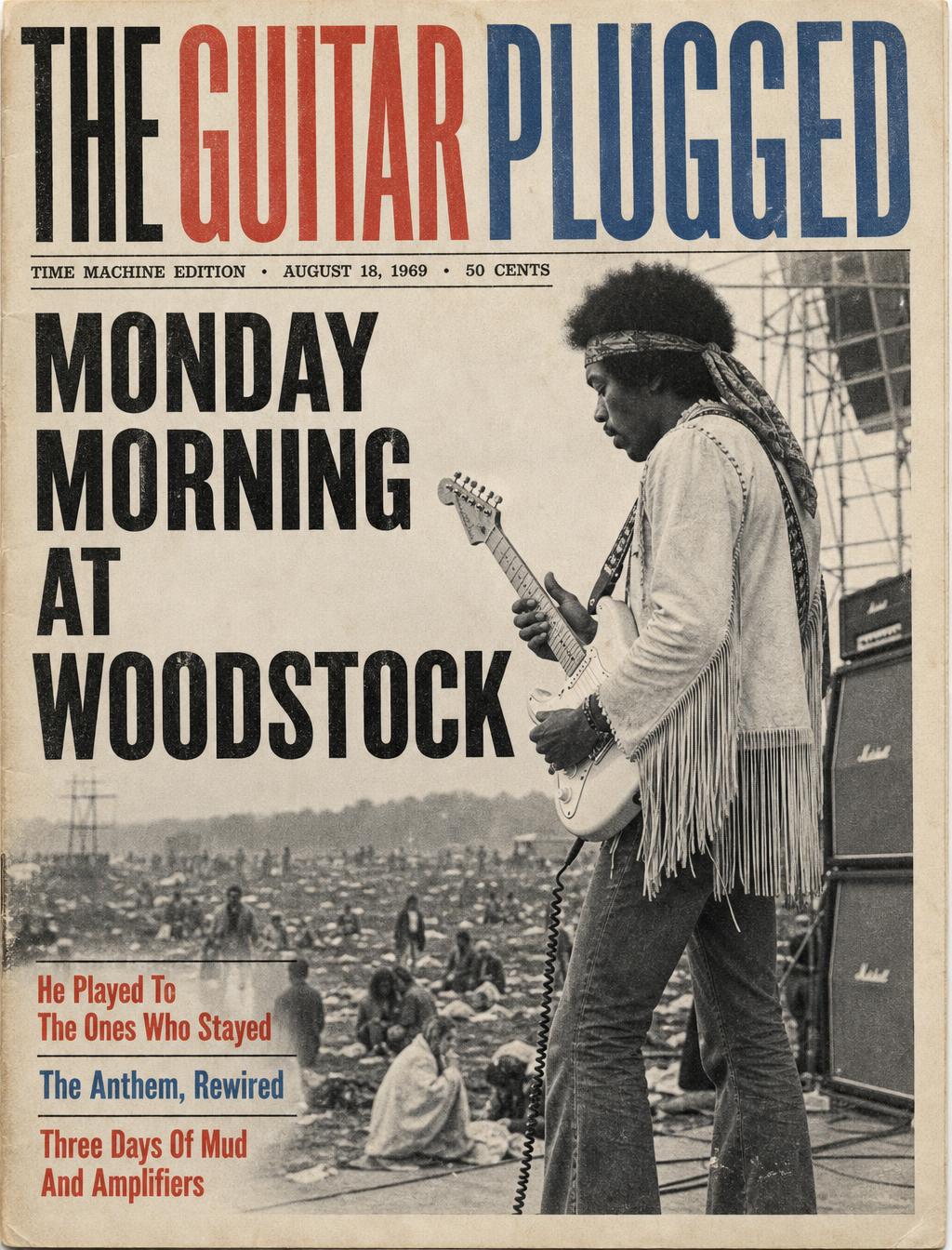
By the time Jimi Hendrix finally took the stage at the Woodstock Music and Art Fair in Bethel, New York, it was Monday morning, not the Sunday night slot originally planned, and the crowd that three days earlier had swelled past anyone's estimate had thinned dramatically. Scheduling delays throughout the weekend pushed act after act back, and Hendrix's set didn't begin until roughly nine in the morning, to a field that organizers say held perhaps thirty or forty thousand people rather than the several hundred thousand who'd packed in for the weekend's peak.
A New Band for a New Decade
This isn't the Jimi Hendrix Experience that made Are You Experienced two years ago. Hendrix arrived at Woodstock with a new, expanded outfit billed as Gypsy Sun and Rainbows, featuring additional percussion and rhythm guitar alongside his rhythm section, a lineup he'd been rehearsing with for weeks leading into the festival. The larger band gives the set a looser, more exploratory character than the tighter trio arrangements audiences knew from his earlier records, with extended jams stretching several of the songs well past their studio lengths.
The Olympic White Stratocaster
Hendrix played a white Fender Stratocaster, its finish worn from stage use, run through the Marshall amplification he's relied on since his earliest days in London. His pedalboard for the set includes the Fuzz Face he's used for years alongside a Univox Uni-Vibe, a pedal designed to simulate the swirling modulation of a rotating speaker cabinet, which gives several passages in the set a watery, undulating character quite different from the more direct fuzz tones on his earlier records. Between the Uni-Vibe, the fuzz, and the sheer size of the outdoor sound system straining to cover an open field, the tone is thicker and more diffuse than anything captured on his studio albums to date.
The Anthem
The set's most talked-about moment comes when Hendrix, alone, plays an instrumental rendition of 'The Star-Spangled Banner.' He bends the melody through waves of fuzz and heavy vibrato, working in dive-bombing whammy bar effects and passages of feedback and noise that evoke, without a word being sung, the sound of explosions and sirens. It's a piece he's played in various forms at other shows this year, but performed here, at the tail end of a weekend that has already taken on outsized meaning for the young people who attended, it lands as commentary on the country's mood, war included, whether or not Hendrix intended it as a direct statement.
Playing to Whoever Stayed
Those still on the site Monday morning — muddy, exhausted, many having stuck it out through overnight rain — describe an intimacy to the set despite the outdoor scale, a sense that the people remaining were the ones who most wanted to be there. Whatever the eventual word-of-mouth on this festival turns out to be, Hendrix's closing set, anchored by that solo 'Star-Spangled Banner,' already seems destined to be one of the moments people point back to when they talk about what happened in Bethel this August.
A Festival Running Hours Behind
The delays that push Hendrix's set to Monday morning are not the result of any single mishap but the cumulative effect of a festival that outgrew its own planning from the first afternoon, when the crowd swelled far past the fences and organizers abandoned ticket-taking altogether. Rain soaked the site more than once over the weekend, forcing repeated equipment stoppages, and by the time Sunday night's headliners finish, the schedule has drifted so far that a slot originally intended to close out prime time instead becomes a dawn performance for whoever is still standing in the mud.
Message to Love and the Rest of the Set
Before the solo national anthem, Hendrix and the expanded band work through a set stretching past two hours, including a new, still-unrecorded piece called Message to Love and extended takes on Fire and Voodoo Child (Slight Return), the additional percussion and second guitar giving these arrangements a rougher, more percussive sprawl than the tighter trio recordings audiences know. Hendrix, visibly fatigued after a set delayed overnight and a band still finding its footing after only weeks of rehearsal, nonetheless drives the group through passages of extended improvisation that stretch several songs well past double their studio running time.
Amplification for an Open Field
Covering an outdoor crowd of any size with usable guitar tone is its own engineering problem, and the sound system assembled for Woodstock, built specifically for the festival by a team led by Bill Hanley, represents one of the largest concert audio rigs attempted to that point. Hendrix's amplifiers, a bank of Marshall stacks, are pushed hard to cut through both the size of the rig and the natural sound-swallowing effect of open air rather than an enclosed hall, part of why the tone captured on tape that morning carries a rawer, more physical edge than his indoor club and theater dates from the same year.
A Performance the Film Made Permanent
Michael Wadleigh's film crew captures the performance on multiple cameras, and it's largely through the resulting 1970 documentary, rather than through firsthand experience, that most people encounter the 'Star-Spangled Banner' solo at all, given how few witnessed it live in the field. That mismatch between the modest size of the actual audience and the performance's eventual reach says as much about the power of the film as it does about the guitar playing itself, though few dispute that the playing alone would have traveled on reputation regardless of the cameras.
Why it matters now
Hendrix's Woodstock 'Star-Spangled Banner' became one of the most iconic guitar performances ever captured on film, endlessly excerpted, taught, and imitated by generations of guitarists exploring feedback, whammy bar technique, and tone-as-commentary. It remains a reference point for using a Stratocaster's tremolo system expressively rather than just for pitch bends. The small crowd size at the time of his set is often forgotten given how central the performance became to Woodstock's mythology through the 1970 concert film; most people who consider it one of the defining moments of the festival actually experienced it only later, on film or record, rather than live in the field that Monday morning.
Sources
- Woodstock: Three Days of Peace and Music (1970 documentary) — performance footage and crowd context
- Charles Cross, Room Full of Mirrors — Hendrix biography, Woodstock chapter
- Michael Lang, The Road to Woodstock — festival scheduling and logistics