
The Album Era
THE GUITAR PLUGGED
How a Casino Fire in Montreux Gave Deep Purple Machine Head
Forced out of a burning casino, Deep Purple cut their heaviest album yet in a hotel corridor with the Rolling Stones' mobile truck parked outside.
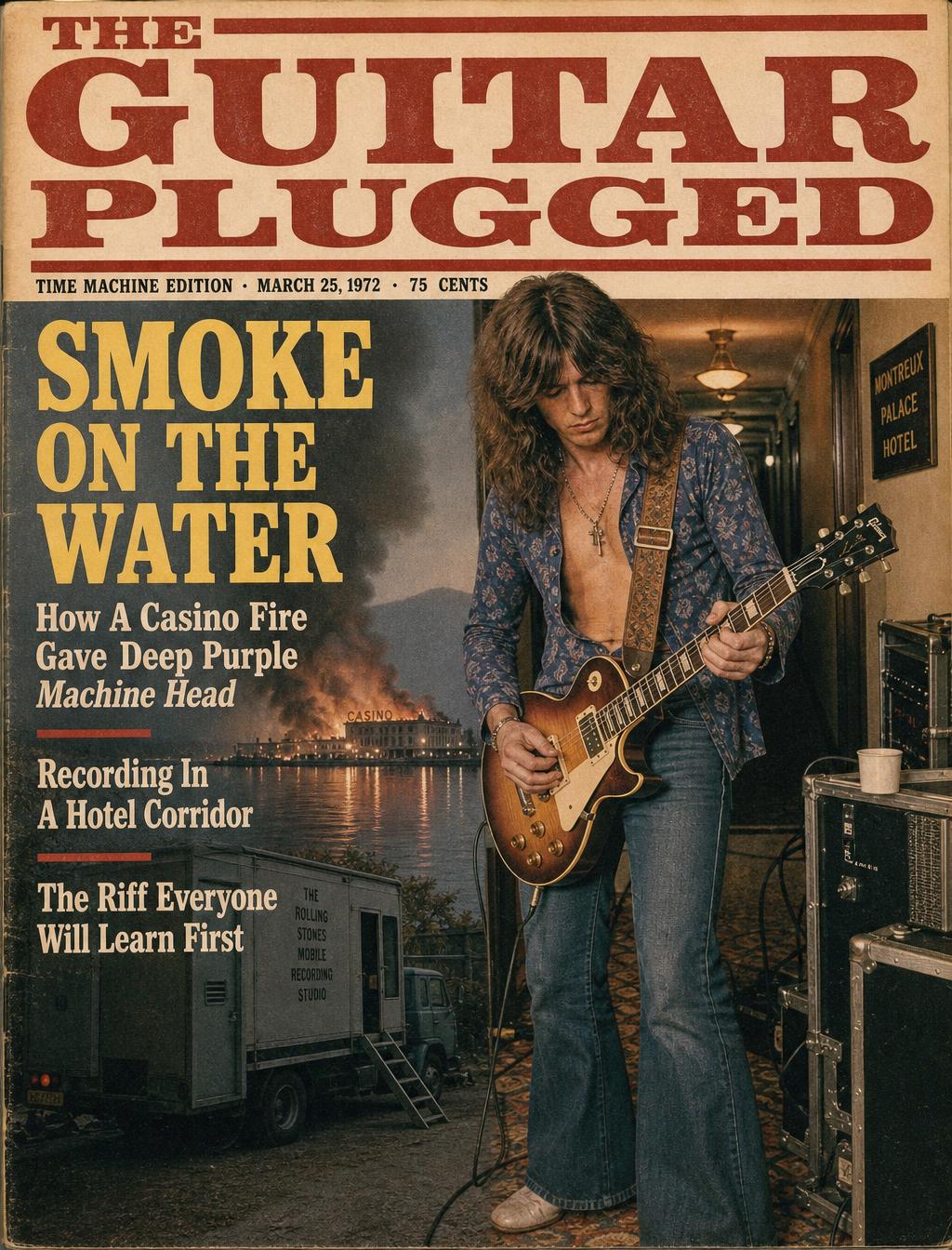
Deep Purple arrived in Montreux, Switzerland in December of 1971 planning to record their next album inside the Montreux Casino, a lakeside venue they'd booked for its natural acoustics and its proximity to the Rolling Stones Mobile Studio, which the band had hired for the sessions. The plan lasted exactly one night. On December 4th, during a Frank Zappa and the Mothers of Invention concert in the casino's theatre, a fan fired a flare gun into the rattan-covered ceiling. The building burned to the ground. Nobody in Deep Purple's camp was hurt, but the recording space they'd built the whole session around was gone, along with most of the town's usable venues for a rock band with a wall of Marshall stacks.
What followed is now part of hard rock's foundational mythology, and it happened not because anyone planned it that way but because Deep Purple needed somewhere, anywhere, to plug in. They found an empty theatre, the Pavillon, and used it for a few days until noise complaints and building constraints shut that down too. Eventually they settled into the corridors and function rooms of the Grand Hotel, a mostly shuttered lakeside property, running cables from the Rolling Stones Mobile Studio parked outside through hotel windows and into a make-do control room. Mattresses got shoved up against doorways for isolation. Amplifiers faced into stairwells. It was not glamorous, and it is exactly how Machine Head got its sound.
Blackmore's Strat and the Marshall Major
Ritchie Blackmore had switched from Gibsons to a Fender Stratocaster a few years earlier, and by the Machine Head sessions he was running his Strat into a Marshall Major, the 200-watt behemoth Marshall built for bassists and PA use that Blackmore adopted for the sheer physical push it gave a guitar signal. Recording in hotel rooms with a rig built for stadiums meant close-miking a genuinely dangerous amount of air pressure, and the compression and grit that resulted became a signature of the record. Blackmore's touch on the Strat's tremolo, his pick-scrape pinch harmonics and his classically-inflected phrasing already set him apart from the blues-rock lead guitarists of the day, but Machine Head is where his tone hardened into something new: crunchy, mid-forward, and built for riffs rather than just leads.
A Riff Built on Fourths
The story behind Smoke on the Water is well worn at this point but worth restating precisely: the song documents the fire itself, with lyrics naming the casino, Frank Zappa, and the Rolling Stones Mobile Studio directly. Musically, the riff that opens the track is built from parallel fourths rather than the power chords or thirds most rock guitarists reached for, giving it a slightly hollow, ominous quality that's instantly recognizable played on a single string or two. Blackmore has talked about drawing on Beethoven's Fifth for the rhythmic shape of the phrase, and the riff's simplicity, four notes, repeated and shifted, is precisely why it became one of the first things handed to anyone picking up an electric guitar in a music shop.
Highway Star and the Album Around It
Machine Head is not a one-riff record. Highway Star, which opens the album, moves at a sprint, built on a galloping rhythm figure and a Blackmore solo constructed over a descending classical-style chord sequence rather than a standard blues turnaround, previewing the neoclassical vocabulary he'd lean on further with Rainbow later in the decade. Jon Lord's Hammond organ, run through a Marshall stack of its own, trades blows with Blackmore's guitar throughout the record rather than sitting behind it, and that dual-lead-instrument approach, alongside Ian Gillan's vocals and Ian Paice's drumming, gives Machine Head its density. Roger Glover and Ian Paice have both spoken about how the makeshift recording conditions, cramped rooms, mattresses, borrowed corridors, forced the band to play tighter and louder to get a usable take, and you can hear that pressure in the performances.
Released Into a Genre Still Forming
When Machine Head reaches shops this March, hard rock as a codified genre barely exists yet, Deep Purple, Led Zeppelin, and Black Sabbath are still being sorted out by critics who aren't sure what to call any of them. Machine Head arrives as a statement that this band, previously known as much for orchestral experiments and pop covers as riffs, has settled into a heavier, more direct sound purpose-built for arenas. Whether audiences realize it yet, the sound recorded in a Swiss hotel corridor is about to become a blueprint.
Why it matters now
Smoke on the Water's opening riff has become arguably the single most-played phrase in guitar shop history, a rite of passage taught to beginners decades before most of them know the story behind it. The fourths-based voicing Blackmore used has been analyzed and imitated across generations of hard rock and metal writing. Machine Head's makeshift recording process, driven entirely by necessity rather than aesthetic choice, became an early and influential example of how constraint can shape a record's identity. The Rolling Stones Mobile Studio itself went on to be used for a string of landmark 1970s albums, but its work in that Montreux hotel corridor remains its most-told story. Ritchie Blackmore's Stratocaster-into-overdriven-amp approach, developed further here, helped push the Strat into hard rock territory it hadn't fully occupied before, expanding the instrument's identity beyond blues and surf associations.
Sources
- Deep Purple, Machine Head liner notes and band interviews — recording location details
- Ritchie Blackmore interviews, various guitar publications — gear and riff construction
- Contemporary press coverage of the Montreux Casino fire, December 1971