
The Loud Revolution
THE GUITAR PLUGGED
Are You Experienced? The Jimi Hendrix Experience Rewrites the Rules of the Electric Guitar
With Olympic Studios' new facilities, a stolen Stratocaster restrung upside down, and a box called the Fuzz Face, three young men have made the most radical debut album London has heard yet.
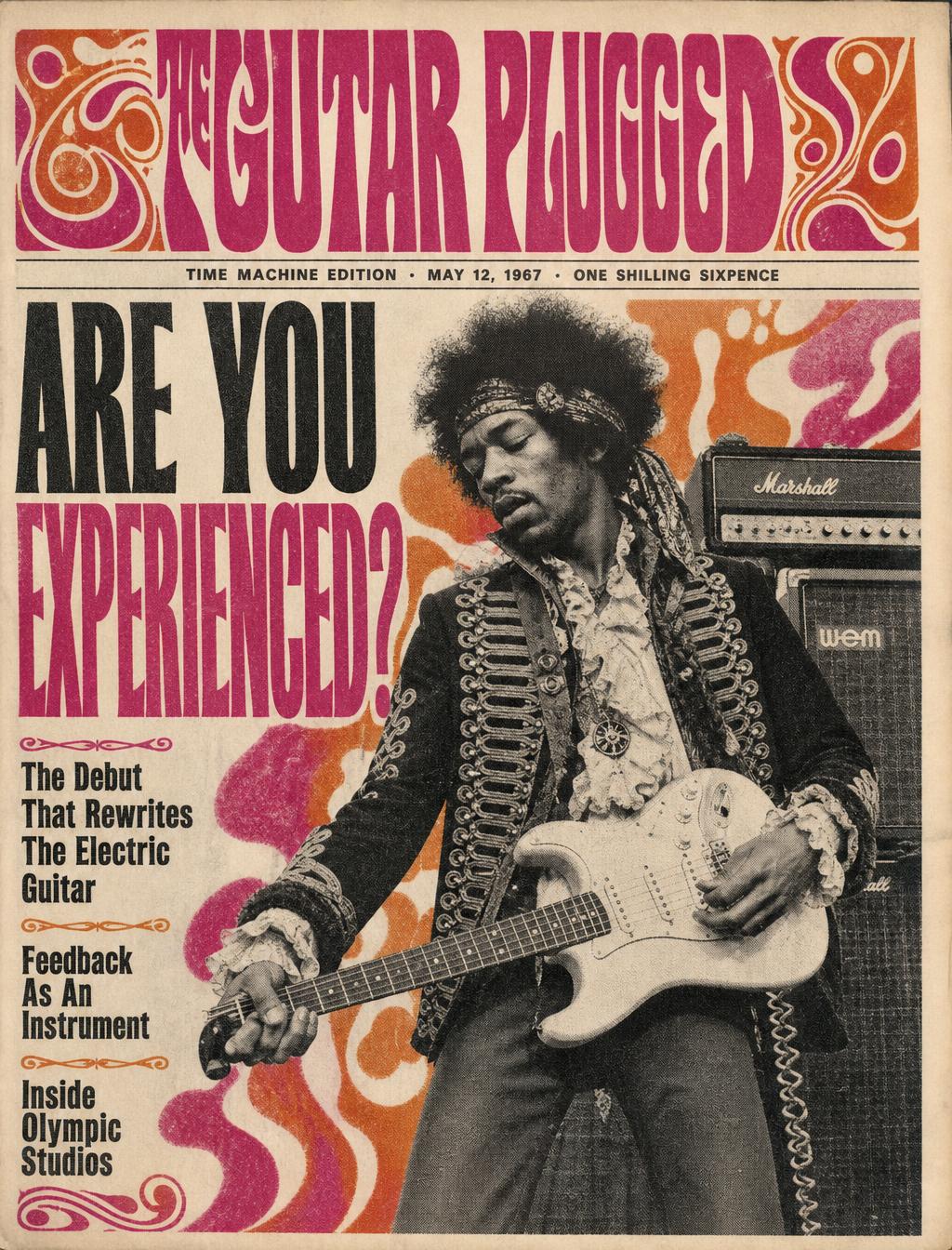
Track Records has put out the debut album by The Jimi Hendrix Experience, and London's guitarists have been talking about little else. Are You Experienced arrived in shops this month, following the trail blazed by the singles 'Hey Joe,' 'Purple Haze,' and 'The Wind Cries Mary,' and it confirms what club audiences at the Bag O'Nails and the Marquee have suspected since the American arrived here last autumn: nobody plays the instrument quite like this.
A Left-Handed Guitar Played Upside Down
Hendrix is left-handed, but he plays a standard right-handed Fender Stratocaster flipped upside down and restrung so the low E sits where the high E would normally be. The reversed setup changes more than convenience — the built-in slant of the Strat's bridge pickup, angled for the opposite orientation, alters the tone the pickup delivers at the low and high ends, giving his sound a brightness in the bass strings that a right-handed player wouldn't get from the same guitar. He favors the instrument in white or sunburst finishes and has already gone through several, having a habit of setting them alight or smashing them at the end of a show.
The bulk of the record was cut at Olympic Studios in Barnes, a facility that only opened its new premises last year and has quickly become the favored room for the more adventurous London sessions. Engineer Eddie Kramer, who joined Olympic not long before the Experience began working there, has developed a close working rapport with Hendrix, willing to push the four-track machines and the console into territory that more conservative engineers would flinch at. Producer Chas Chandler, formerly the bass player with the Animals, oversaw the sessions with a disciplined ear, keeping the group's more freeform tendencies pointed toward finished, releasable takes even as the arrangements sprawl.
Marshall Stacks and a Little Black Box
Onstage and in the studio, Hendrix drives his Stratocaster through Marshall amplification, stacking cabinets to a volume that has become part of his reputation. But the sound on this record isn't simply loud — it's textured in ways British audiences haven't heard from a guitar before. Much of that comes down to a small foot pedal built by Dallas Arbiter called the Fuzz Face, a fuzz box in a distinctive round enclosure that Hendrix has adopted as a near-permanent fixture on his pedalboard, using it to push his amplifiers into a thick, sustaining distortion quite unlike the thinner fuzz tones that have circulated in pop records over the past couple of years.
Alongside the Fuzz Face sits a device few outside Hendrix's circle have laid hands on: the Octavia, built by engineer and sometime guitarist Roger Mayer, who has been quietly supplying Hendrix with hand-made electronics since the guitarist arrived in England. The Octavia tracks the note being played and adds a tone an octave above it, producing the strangled, keening solo tone that opens 'Purple Haze' and recurs throughout the album — a sound so unfamiliar that several London guitarists have reportedly asked around trying to identify what pedal, exactly, is responsible.
Backwards Tape and the Title Track
The album's closing title track, 'Are You Experienced?,' pushes the studio itself into the arrangement. Guitar and drum parts were recorded and then the tape flipped, so the instruments play in reverse against the forward-running vocal and other elements — a technique that requires the musicians to essentially perform against a mental image of the piece run backwards, since a reversed guitar part has to be worked out by ear from a tape that sounds nothing like the intended result once flipped back. The effect is disorienting in the best way, guitar lines swelling and blooming rather than decaying, cymbals sighing rather than crashing.
What Guitarists Are Saying
Word from the sessions and from Hendrix's live sets around London has already reached players well outside the psychedelic underground. Members of Cream and the Who have turned up to watch him play, and guitar shops around Denmark Street report a run on fuzz pedals since 'Purple Haze' started getting airplay. Whatever chart position the album settles into, it's already clear among working musicians that the vocabulary of the electric guitar has just been expanded considerably in a matter of months.
Why it matters now
Are You Experienced would become one of the foundational documents of rock guitar, and Roger Mayer's Octavia and the Dallas Arbiter Fuzz Face are still referenced by pedal builders decades later as the templates for octave and fuzz effects. Hendrix's death in 1970 would only intensify the mythology around this debut, but the record's influence on generations of guitarists — from the hard rock and metal players of the 1970s through to indie and blues-rock revivalists today — was already visible within a year of its release. The reversed-guitar production on the title track and Eddie Kramer's willingness to experiment at Olympic Studios also helped establish the recording studio itself as a compositional tool, a lesson that Led Zeppelin, among many others, would take directly from this record's example.
Sources
- Steven Roby, Black Gold: The Lost Archives of Jimi Hendrix — production and gear details
- Guitar Player archival interviews with Eddie Kramer — Olympic Studios sessions
- Roger Mayer interviews — Octavia development history