The Loud Revolution
THE GUITAR PLUGGED
Led Zeppelin Arrives Fully Formed: Inside the Blistering Sessions for Their Debut
Recorded in a matter of days at Olympic Studios, Jimmy Page's self-produced debut album leans on a borrowed Telecaster, a tiny Supro amp, and a violin bow.
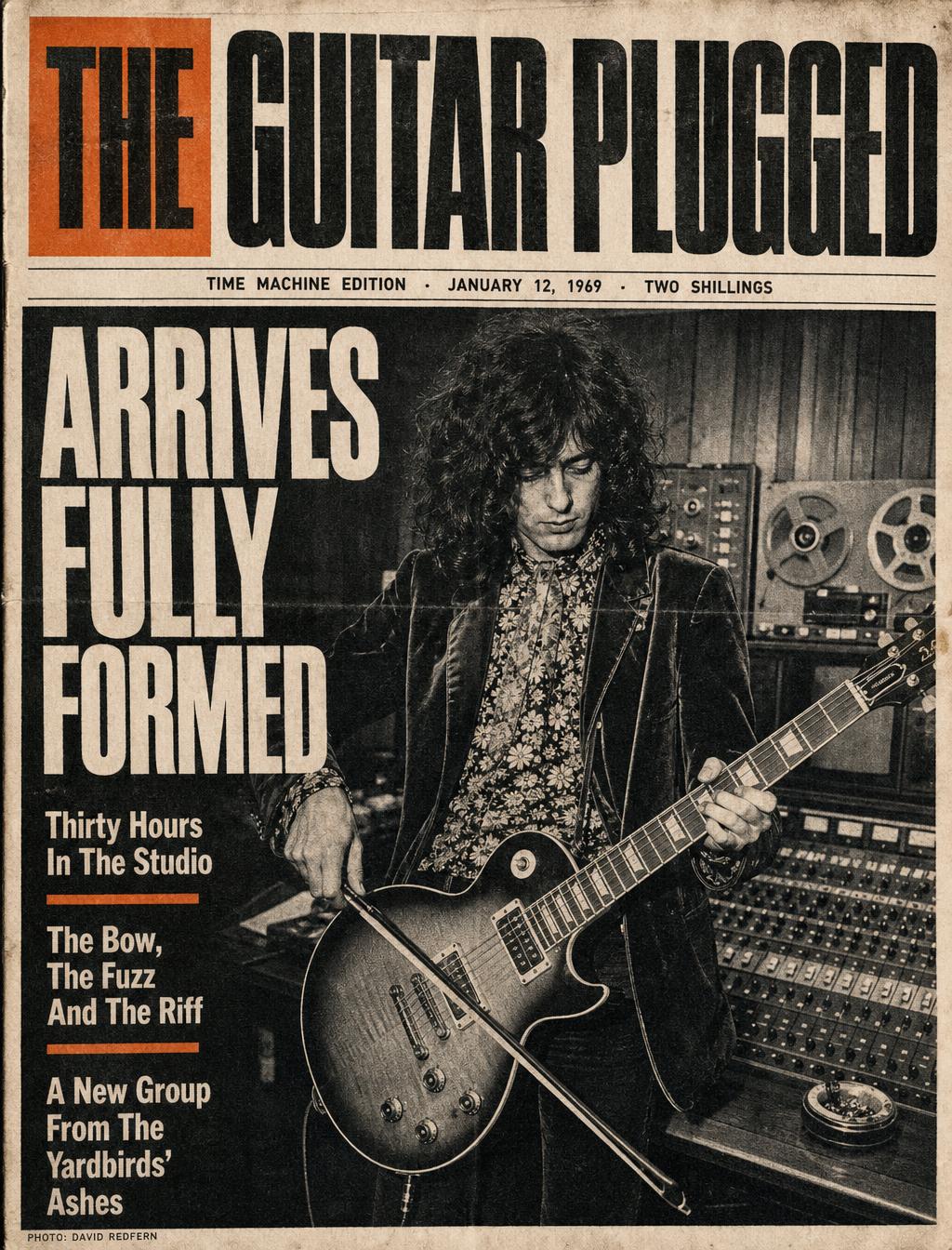
Led Zeppelin's debut album has landed on Atlantic Records, and anyone expecting a straightforward continuation of the Yardbirds, the band Jimmy Page exited last year, is in for a surprise. This is heavier, more controlled, and considerably more confident than anything that group put to tape, and the reason is simple: Page produced it himself, and he'd been planning exactly this sound for months before the band even had a name.
Page assembled this band with unusual deliberateness. After the Yardbirds folded, he had contractual obligations to fulfill and put together what was briefly billed as the New Yardbirds for a short Scandinavian tour before rechristening the group Led Zeppelin, reportedly after Who drummer Keith Moon joked that a project involving Page would go over like a lead balloon. The lineup he settled on — singer Robert Plant and drummer John Bonham, both pulled from the Midlands scene around Birmingham, and bassist and keyboardist John Paul Jones, another well-regarded session player Page had crossed paths with on countless London recording dates — came together with almost no rehearsal time before they were already writing and arranging the material that fills this record.
Recorded in Days, Not Months
The album came together at Olympic Studios in Barnes with remarkable speed, the band cutting the bulk of it in a handful of sessions squeezed in between live dates, working with engineer Glyn Johns, who had already built a reputation on sessions for the Rolling Stones and the Who. Page, who spent years before this as one of London's most in-demand session guitarists, came into the studio knowing exactly what he wanted and paid for the sessions himself, giving him full control over the record before Atlantic ever had a chance to weigh in.
The Dragon Telecaster and a Tiny American Amp
Much of the album's lead guitar work was cut on a Fender Telecaster given to Page by Jeff Beck during their overlapping time in the Yardbirds — the same guitar Page later decorated himself with a hand-painted dragon design, and the instrument responsible for the solo on 'Stairway to Heaven' further down the road, though that's a story for another record. For amplification on much of the session, Page favored a small Supro amplifier rather than the large stacks one might expect given the album's weight, running it hard enough that its modest wattage breaks up into a thick, singing distortion — proof that raw volume matters less than how hard you push a smaller amp.
Distance, Not Just Volume
Page's real innovation on this record is in the miking rather than the amp choice. Drawing on ideas he developed producing sessions before Zeppelin existed, he had Glyn Johns place microphones at a distance from the amplifier cabinets rather than pressed right up against the speaker cone, capturing the way the sound develops in the room rather than just the raw signal off the grille. The result is an ambient, three-dimensional guitar tone that stands in sharp contrast to the tighter, more clinical guitar sounds on most British rock records of the past couple of years.
The Bow and 'Dazed and Confused'
The album's centerpiece, 'Dazed and Confused,' is built around a riff and arrangement Page has been developing since his Yardbirds days, reworked here with new lyrics credited to the band. Live and on record, Page draws a violin bow across the guitar strings during the song's extended middle section, producing eerie, sustained textures unlike anything a pick or fingers alone can generate — a trick he picked up from a session musician years ago and has been folding into his live performances and now into the Zeppelin sound. Combined with Robert Plant's vocals, John Paul Jones's bass and keyboard work, and John Bonham's famously heavy drumming, the track sets a tone of controlled menace that runs through the whole record.
A Producer as Much as a Guitarist
Session Pedigree Behind the Kit and the Keys
John Paul Jones brings the same session-honed precision to this record that Page does, having arranged strings and horns for other artists' records and played bass and keyboards on sessions across London for several years before joining. His organ work on 'Your Time Is Gonna Come' and his bass lines throughout give the album a harmonic sophistication that sets it apart from most guitar-bass-drums blues-rock records currently on release. Bonham, for his part, plays with a heavier, more forward-sounding kick and snare than is typical, helped along by Page's room-miking approach, which captures the size of Bonham's playing rather than flattening it down to a tight, close-miked thud.
Blues Sources, Reworked and Credited Loosely
Several tracks lean heavily on older blues material — 'You Shook Me' and 'I Can't Quit You Baby' both come from songs already associated with Willie Dixon, and 'Dazed and Confused' itself has roots in a song by American singer-songwriter Jake Holmes that Page encountered during his Yardbirds days. The band's arrangements diverge enough from the originals in tempo, dynamics, and instrumentation that they function as substantial reworkings rather than covers, though how the songwriting credits on the album's sleeve handle that borrowing has already drawn some quiet grumbling among musicians who know the source material well.
What separates this record from other blues-rock debuts flooding out right now is that Page isn't just playing guitar on it, he's shaping every element of the sound from the ground up — arrangement, mic placement, mix decisions, even the pacing of the track list. Reviews have been mixed so far, with some critics unsure what to make of the album's raw power, but musicians who've heard it are already talking about the guitar tone and Bonham's drum sound as a new standard other studios will be trying to match.
Why it matters now
Led Zeppelin's debut set the template for hard rock and heavy metal production for the next decade, and Jimmy Page's distant-miking technique on drums and amps became a standard studio approach still taught in recording courses today. The Dragon Telecaster, later replaced in Page's main rotation by his famous Gibson Les Paul, remains one of the most storied guitars in rock history. Critical reception at the time was notably cooler than history would eventually judge the record, with some reviewers dismissing it as derivative blues rock; the album's reputation only grew over subsequent decades as it came to be viewed as one of the most important debuts in rock music.
Sources
- Guitar World interviews with Jimmy Page — recording and gear details
- Glyn Johns, Sound Man — memoir account of the Olympic Studios sessions
- Dave Lewis, Led Zeppelin: The Concert File — session chronology