
The Shred Years
THE GUITAR PLUGGED
Stevie Ray Vaughan Cuts Texas Flood Live to Tape in Days
A Texas blues guitarist who stunned Montreux with an unbooked festival set puts out a debut recorded almost entirely live in the studio, strings thick and amps wide open.
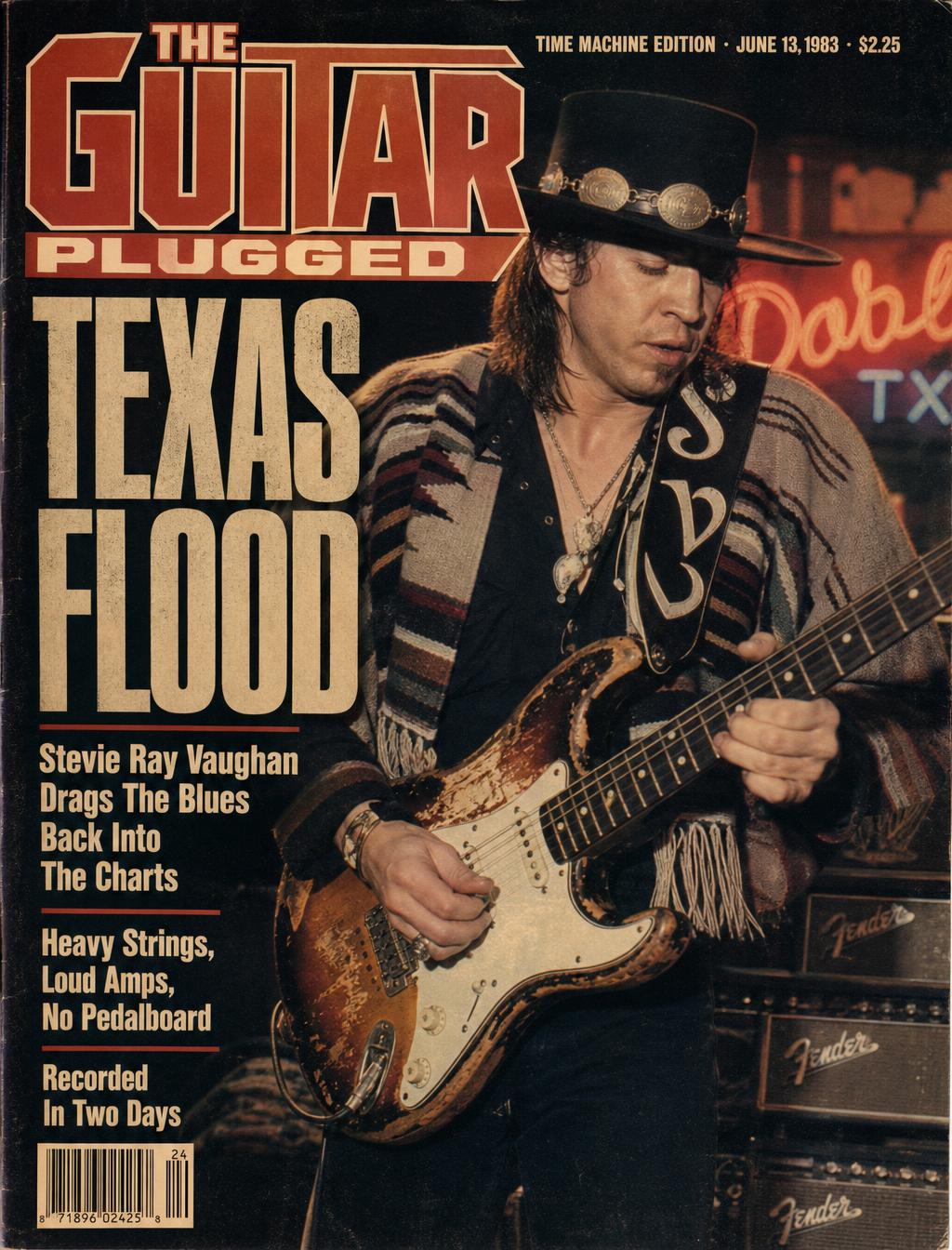
Stevie Ray Vaughan's debut record, Texas Flood, hits shelves this month, and the story behind how quickly it was made is almost as striking as the playing on it. Vaughan and his trio, Double Trouble, cut the bulk of the album at Jackson Browne's studio in Los Angeles in a matter of days, more or less recording live, few overdubs, minimal fixing, the kind of pressure-cooker session that either exposes a band's weaknesses or, as here, reveals exactly how strong they already were before anyone hit record.
From Montreux to a Record Deal
The path here runs through the Montreux Jazz Festival last summer, where Vaughan and Double Trouble played an unbilled slot that left a sharply divided room, some in the audience unmoved, others floored. Among the latter was David Bowie, who would go on to invite Vaughan to play on his next album, and producer and talent scout John Hammond, the same figure who'd championed Bob Dylan and Bruce Springsteen decades apart, who pushed hard to get Vaughan signed. That Montreux set is the reason this record exists at all, a single festival appearance that turned into a deal with Epic within the year.
Number One and the Weight of the Strings
Vaughan's main guitar, a battered sunburst Stratocaster he calls Number One, is central to everything on this record. It's rigged with unusually heavy strings for a working guitarist, and he tunes down a half step, a combination that thickens the tone considerably and also makes the instrument fight back under his fingers in a way that shapes his vibrato and bend technique. He also plays a second Stratocaster known as First Wife on parts of the sessions. The heavy-gauge strings aren't a gimmick; they're a huge part of why his tone has so much low-end body even on single-note lines, and why his bends have that wide, vocal wobble rather than a thinner blues-rock quiver.
Amps Doing the Heavy Lifting
The tone on Texas Flood comes almost entirely from amplifiers being pushed hard rather than from pedals doing the distorting. Vaughan favors a Fender Vibroverb, an amp with a reputation for breaking up beautifully at volume, sometimes alongside Marshall heads and a Dumble amplifier known for its own particular smooth-but-aggressive overdrive character, for extra grunt. Where a pedal does show up, it's an Ibanez Tube Screamer, used not to create distortion from scratch but to push an already-dirty amp a stage further and tighten the front end when he needs a solo to cut. It's the same basic trick session players have been using with that pedal for a few years now, boost into breakup rather than replace the amp's own character.
Live in the Room
The title track and the rest of the record carry the loose, in-the-room energy of a working bar band captured on a good night, not a heavily produced studio creation. Vaughan's playing draws visibly from Albert King's string bending and note choice, from Jimi Hendrix's rhythm-and-lead hybrid approach, and from a deep well of Texas blues tradition, but the combination, and the sheer physical force he applies to the guitar, doesn't sound like an imitation of any of them. It sounds like a guitarist who has been playing loud clubs around Austin for years finally getting the chance to put that sound on tape without anyone smoothing it over.
Jackson Browne's Studio, Borrowed for a Weekend
The sessions take place at Down Town Studios, the Los Angeles facility Jackson Browne built and offered up to Vaughan's camp free of charge after catching that same Montreux performance. There's no big label budget behind the record at this point, no elaborate pre-production, just a band that has been playing these songs live for years walking into a studio they know they can only hold for a couple of days before Browne needs it back for his own work. That time pressure ends up working in the record's favor: there's no space to second-guess a take or chase an imagined perfect version of a song the trio already knows cold from years on the Austin club circuit.
Double Trouble's Chemistry
Bassist Tommy Shannon and drummer Chris Layton, the rhythm section billed alongside Vaughan as Double Trouble, aren't hired guns brought in for the sessions; they're a working band that has logged countless nights together in Texas dives, and that familiarity shows in how loosely the trio breathes around Vaughan's lead lines. Layton's shuffle feel on the title track and Shannon's walking lines underneath the slower blues numbers give Vaughan the freedom to push and pull against the beat rather than lock rigidly to it, the kind of interplay that typically only comes from years of playing the same rooms together, not from a band assembled for a record deal.
A Scene That Almost Missed Him
It's worth remembering how close Vaughan came to being just another name on the Austin club circuit rather than a signed recording artist. He'd spent years fronting bands around Austin and Dallas, building a local reputation loud enough that word eventually reached Jackson Browne and, separately, the organizers scrambling to fill a gap in the Montreux bill, but with little interest from major labels who tend to look toward Los Angeles, New York, or Nashville rather than the Texas blues clubs Vaughan called home. Blues itself, meanwhile, has spent much of the past decade as a commercially unfashionable genre in the U.S., kept alive more by British rock bands citing its influence than by American labels signing its practitioners directly. That a record this uncompromisingly rooted in Texas blues tradition is arriving on a major label at all says as much about the strength of that one Montreux set as it does about any broader industry appetite for the genre.
Tone Before Effects
What separates Vaughan's approach from a lot of guitarists working the blues-rock side of the street right now is how little he relies on effects to shape his identity. Where plenty of contemporaries reach for chorus, flanger, or heavy delay to add character to a solo, Vaughan's rig here stays close to guitar, cable, and amplifier, with the Tube Screamer functioning as the only real coloring device and even that used sparingly. The tone comes from touch: the force of his right-hand attack, the way he digs into those heavy strings, and the physical demands of that half-step-down tuning combining to produce a sound that would be difficult for another player to fully replicate even with an identical guitar and amp sitting in front of them.
Why it matters now
Texas Flood is widely credited with single-handedly reviving mainstream interest in blues guitar in the 1980s, a decade otherwise dominated by synthesizers and shred metal, and it made Stevie Ray Vaughan the most influential blues guitarist of his generation almost overnight. His rig choices from these sessions, heavy strings, half-step-down tuning, a Tube Screamer pushing an already-overdriven Fender or Marshall, became one of the most widely imitated guitar setups in blues and blues-rock, still referenced constantly in gear demos and rig-rundown features decades later. Vaughan died in a helicopter crash in August 1990, which makes this debut, recorded in a handful of days on the strength of one festival set, an especially significant document of how fully formed his playing already was at the very start of his recording career.
Sources
- Joe Nick Patoski and Bill Crawford, 'Stevie Ray Vaughan: Caught in the Crossfire' — Texas Flood recording sessions and Montreux appearance
- Guitar World rig rundowns — Number One Stratocaster and amp setup
- John Hammond interviews — signing of Stevie Ray Vaughan to Epic Records