
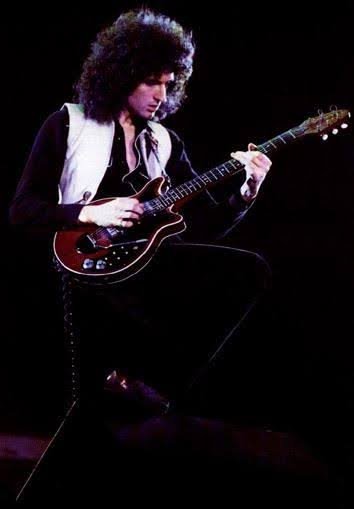
Brian May Never Wanted a Fender or Gibson — So He Built the Guitar That Changed Rock
Brian May's latest comments about Fender, Gibson and the guitar he actually wanted reveal something deeper about the Red Special: Queen's unmistakable guitar sound may exist precisely because the instrument May needed simply didn't exist.
There are guitars that become associated with players, and then there are guitars that become almost impossible to separate from them.
Jimmy Page had his Les Paul. Jimi Hendrix transformed the Fender Stratocaster. Angus Young made the SG part of his silhouette. Eddie Van Halen famously tore apart and rebuilt the conventional idea of what an electric guitar could be.
Brian May went one step further.
Before Queen filled stadiums, before "Bohemian Rhapsody," before the walls of harmonized guitars, before the Vox AC30s were roaring behind him, May needed a guitar.
So he and his father built one.
More than six decades later, that homemade instrument — the Red Special, or the "Old Lady," as May affectionately calls it — remains at the center of one of the most recognizable guitar sounds ever recorded.
And May's recent comments make its existence seem even more consequential.
Speaking about the hypothetical question of what he might have played had the Red Special never existed, May explained that the obvious alternatives never quite provided what he was looking for. He characterized Fender guitars as tending toward a thinner, scratchier response for his tastes, while Gibsons could be darker than the sound he had in his head.
That seemingly simple observation tells us a tremendous amount about Brian May.
He wasn't trying to build a cheaper Stratocaster.
He wasn't trying to build a homemade Les Paul.
He was searching for something between — and beyond — both.
The result became one of the great accidents of rock history: a guitar built because a young musician couldn't simply walk into a shop and buy the instrument he wanted ultimately helped create a guitar sound that millions of players have spent decades trying to reproduce.
Before Queen, There Was a Problem
It is easy to look backward at a legendary instrument and assume its creator somehow knew what he was making.
In reality, the Red Special began from far more practical circumstances.
May has explained that expensive American guitars simply weren't financially realistic for him at the time. In an earlier interview, he recalled that it would have been years before he could have afforded something in the class of a Fender or Gibson.
So Brian and his father, Harold May, decided to build a guitar themselves.
Construction began in the early 1960s, with the instrument completed around 1963. Queen's official site describes it as a guitar built by Brian and his father using hand tools, with materials that today sound almost absurdly humble considering the stages the finished instrument would eventually occupy.
The neck was fashioned from mahogany reclaimed from an old fireplace — wood that was already around a century old at the time.
The body incorporated blockboard and an old oak insert before being covered with mahogany veneer. Brian stained and polished the instrument himself.
This wasn't simply assembling parts from a catalog. They were making a guitar.
And when conventional guitar hardware didn't provide the solution they needed, father and son engineered their own.
The tremolo is perhaps the greatest example.
Rather than installing an existing commercial design, they created a floating system in which string tension was balanced against motorcycle valve springs. The tremolo arm itself incorporated a repurposed bicycle saddlebag component and was finished with part of a knitting needle.
• Neck: mahogany reclaimed from a roughly century-old fireplace
• Body: blockboard with an oak insert, covered in mahogany veneer
• Tremolo springs: motorcycle valve springs
• Tremolo arm: a repurposed bicycle saddlebag component, tipped with part of a knitting needle
• Pickups: three Burns Tri-Sonic single coils, switchable in series and out of phase
Read those materials again. Fireplace wood. Motorcycle valve springs. A bicycle component. A knitting needle.
This is the guitar that would eventually be heard in arenas around the planet.
It sounds less like the specification sheet for one of rock's most famous instruments and more like the contents of a particularly resourceful garage workshop.
Yet that's precisely what makes the Red Special remarkable.
Its unconventional construction wasn't cosmetic eccentricity added decades later to sell a signature model. It was the result of solving problems.
And those solutions created sounds.
It Wasn't Supposed to Sound Like Everybody Else
Perhaps the most important thing about the Red Special is that it does not neatly fit into the established Fender-versus-Gibson vocabulary.
May himself has described the distinction. Discussing Queen's debut, he said the Red Special was warmer than a Strat but possessed more top end than a Gibson. He remembered initially having doubts precisely because the guitar sounded different from what everyone else was using.
That difference became his advantage.
Listen to classic Queen guitar tracks and May's tone occupies an unusual space.
It can be thick without becoming muddy. Bright without becoming brittle. Saturated without completely losing articulation. Smooth enough to create violin-like lead lines yet aggressive enough to drive a hard-rock riff.
And then there are the harmonies.
May frequently approached guitar arrangements less like a conventional rock guitarist stacking rhythm tracks and more like an orchestrator assigning different voices to sections of an ensemble.
The guitar could sing. It could answer itself. It could become a choir.
That would become one of Queen's defining sonic signatures. And much of that flexibility begins with what is underneath May's right hand.
Three Pickups — But Not a Stratocaster
At a glance, a Red Special's three-pickup layout might suggest some conceptual relationship with a Stratocaster. Electronically, however, the comparison falls apart quickly.
The original guitar uses three Burns Tri-Sonic single-coil pickups. Crucially, the pickups can operate in series rather than the familiar parallel arrangement associated with a traditional Strat.
That matters.
Series wiring can produce greater output and a thicker response when pickups are combined. May's switching system then dramatically expands what can be done with those pickups.
There are individual pickup on/off controls and individual phase-reversal controls. That allows combinations that are simply unavailable from the traditional five-way selector found on a conventional Strat.
One combination can produce a muscular, powerful voice. Reverse the phase relationship and the sound can become thinner, nasal and cutting. Bring another pickup into the equation and the personality changes again.
Guitar World's technical examination of the Red Special notes that May's famous rhythm setup uses the bridge and middle pickups together, in phase, producing a fuller overdriven sound. Altering the phase relationship dramatically changes the response.
That electronic flexibility became extraordinarily important once May started treating guitar tracks as orchestral voices. Instead of reaching for five different guitars to create five colors, he could extract remarkably different voices from the same instrument.
The Red Special wasn't merely Brian May's guitar. It was his palette.
Get Brian May’s “Bohemian Rhapsody” Tone
Tell ToneMD what guitar and gear you own and we’ll show you how to get as close as possible using the equipment you already have — full signal chain, real numbered settings, no guesswork.
Included with The Guitar Plugged Premium
Then Came the AC30
A Red Special by itself doesn't create the complete Brian May sound. The other major piece of the equation is the Vox AC30.
May's classic signal chain became deceptively straightforward: Red Special, treble booster and cranked Vox AC30 amplifiers.
Yet the interaction between those pieces is anything but ordinary.
A treble booster doesn't simply mean "add more treble." Used with an already driven tube amplifier, it can reshape what hits the front end, emphasizing the frequencies that allow notes to remain articulate while pushing the amplifier harder.
Combined with the Red Special's naturally distinctive frequency response and switching options, that produced a sound capable of enormous sustain without sacrificing the clarity May needed for elaborate harmonized passages.
Guitar World's breakdown of his setup identifies the Red Special's bridge and middle pickups operating together in series and in phase, a treble booster and driven AC30s as central ingredients in May's revered sound.
And then there's May's picking technique. Instead of relying exclusively on a conventional plastic pick, he became famously associated with using a sixpence.
The rigid metal edge contributes its own attack and feel, and May can alter the way the string responds by changing how he strikes it.
This is why recreating Brian May's tone is more difficult than buying a Brian May-style guitar and selecting an AC30 model.
The equipment matters enormously. But the system includes the player. It always does.
The Sound of a Guitar Orchestra
To understand why the Red Special matters, listen beyond individual solos. Listen to Queen's arrangements.
Brian May did not simply use overdubbing to make guitars louder. He used overdubbing to make them larger.
There is a difference.
May's harmonized guitar work could function almost like arranged vocal parts. Individual lines occupy their own melodic spaces, combining into a larger musical statement.
You hear that philosophy across Queen's catalog, but perhaps nowhere is it more culturally embedded than "Bohemian Rhapsody."
That solo remains one of the most recognizable guitar passages ever recorded, but focusing exclusively on the famous lead misses part of May's genius.
The guitar appears throughout Queen's music as a character. Sometimes it is aggressive. Sometimes orchestral. Sometimes almost vocal. Sometimes deliberately strange.
Queen's own retrospective on May's guitar work describes the Red Special's extraordinary range of voices as one of the cornerstones of the band's sound.
May has also singled out his "Killer Queen" solo as a personal favorite, describing it as an adventure in guitar harmonies.
That's an illuminating phrase. An adventure in harmonies.
For May, guitar playing wasn't restricted to riffs followed by solos. The recording studio became another instrument, and the Red Special became his orchestra.
Why "Bohemian Rhapsody" Could Never Sound Quite the Same Without It
Imagine the famous "Bohemian Rhapsody" solo played with a completely different guitar tone.
X Concepts Strings • Made in USA
Never Run Out of Strings Again.
Join the X Concepts String Club and get fresh USA-made strings delivered every month—plus Premium membership options for the full Guitar Plugged experience.
The notes could remain identical. The bends could be identical. The phrasing could be replicated perfectly.
It still wouldn't feel quite right.
May's tone occupies the unusual space between vocal and instrumental expression. There is bite at the beginning of a note, followed by a smoothness as it blooms. His vibrato gives sustained notes movement, while the amplifier compression and saturation allow them to remain present.
Then May often layers guitars into harmonies. Suddenly the electric guitar stops sounding like one instrument. It becomes an arrangement.
That's the central lesson of Brian May's sound. Tone isn't simply EQ. It is composition.
May's gear allowed him to think differently about arranging guitar parts, and his arranging instincts in turn pushed him to explore more of what his equipment could do. The two evolved together.
What If Brian May Had Bought a Strat?
It's one of the great alternate-history questions in guitar culture. What if Brian May had simply owned a Stratocaster? Would Queen still sound like Queen?
Probably in many respects. Freddie Mercury, Roger Taylor, John Deacon and May were far too distinctive as musicians for their identities to depend entirely on a single piece of equipment.
“The Red Special doesn't need to be the perfect guitar. It needed to be the perfect Brian May guitar.”
But Queen's guitar vocabulary could have been substantially different.
A traditional Strat might have encouraged different pickup combinations, different amplifier interactions and ultimately different arrangement choices. A Les Paul would have presented another direction entirely.
May has used other guitars during his career. The point isn't that he is incapable of sounding like Brian May without the Red Special.
The point is that the Red Special and Brian May developed together. He learned the instrument as the instrument helped define him.
That relationship is almost impossible to recreate later.
The Guitar Became an Extension of the Player
May has said that if he could go back and change the Red Special, he wouldn't.
In a previous Guitar World interview, he described the instrument as essentially part of his body and said everything about it feels right for him.
That statement may be the best explanation of why certain artist-and-instrument combinations become legendary.
Most guitarists adapt themselves to a guitar. May helped design his around himself.
Neck shape. Switching. Tremolo behavior. Resonance. Pickup combinations. Control placement. Feel.
All of it developed from decisions made by Brian and Harold May long before anyone knew those decisions would matter to millions of guitar players.
That personalization can even make the instrument unusual for other elite guitarists. Steve Vai has discussed getting his hands on May's original Red Special and finding its substantial neck dramatically different from his preferred setup.
That is almost perfect. The Red Special doesn't need to be the perfect guitar. It needed to be the perfect Brian May guitar.
A Homemade Guitar on Every Queen Album
There is another part of this story that becomes almost unbelievable through repetition. May didn't retire the original once Queen became successful. He kept playing it.
Queen's official site says May used the Red Special on every Queen album and across the band's live career, including performances on some of the largest stages imaginable.
Think about the journey contained within that instrument.
A father and son build a guitar because buying the desired professional instrument isn't financially realistic. Decades later, the same guitar appears at Live Aid. It appears on Queen records. It appears in front of stadium audiences. It appears during May's Buckingham Palace rooftop performance. It appears at the closing ceremony of the 2012 London Olympics.
It becomes not merely a piece of guitar equipment but a recognizable artifact of British rock history.
Most professional guitarists eventually accumulate instruments. May certainly has access to virtually anything he could want today. But none of that replaces the Red Special.
Money solved the original problem decades ago. The guitar remained.
The Irony of Brian May and Gibson
There is an amusing twist to May's recent Fender-and-Gibson comments. Today, May has a relationship with Gibson.
In 2024, May confirmed discussions had taken place around the possibility of a Gibson/Murphy Lab recreation of the Red Special.
There is something beautifully circular about that.
The young Brian May couldn't simply buy an expensive American guitar, so he and his father built an instrument specifically suited to his needs. That instrument helped him become one of rock's defining guitarists.
Decades later, one of the companies whose instruments once represented the professional guitars beyond his budget could potentially reproduce the homemade instrument he created instead.
You couldn't write the story much better.
The Red Special Is Also an Engineering Story
Brian May's background makes the instrument even more fascinating. This wasn't simply youthful woodworking. The Red Special reflects an engineering mindset.
When something didn't exist, Brian and Harold May attempted to design it. When conventional components weren't available, they adapted something else. When the tremolo required a particular mechanical behavior, they created a system.
That attitude would follow May throughout his musical life.
Listen to his guitar arrangements and you can hear it. There is creativity, certainly. But there is also architecture. Parts are stacked. Frequencies are considered. Voices are arranged. Problems are solved.
The scientist and guitarist aren't separate characters. They're often doing the same thing.
The Most Important Feature Wasn't on the Specification Sheet
You can list every technical characteristic of the Red Special and still miss what made it important. Its greatest feature was that it encouraged individuality.
Guitar culture often works in the opposite direction. A player loves Hendrix, so he buys a Strat. He loves Page, so he buys a Les Paul. He loves Angus, so he buys an SG. He loves Eddie, so he buys a striped superstrat.
There is absolutely nothing wrong with that. Those instruments became standards because they are extraordinary designs.
But Brian May's story offers a different lesson. He heard something that existing instruments weren't giving him. So he pursued the sound anyway.
That may be the most important part of the Red Special story for modern guitarists.
Chasing Brian May's Tone With Modern Gear
You don't need an original Red Special and a wall of vintage Vox amplifiers to explore May's tonal philosophy.
Modern modelers have made it possible to approximate the broader architecture of his rig using equipment many players already own.
The starting point is a Vox-style AC30 model. From there, the goal is not necessarily extreme preamp gain. May's classic sound comes from an amplifier being pushed hard while retaining articulation.
Place a treble-booster-style effect before the amp. Keep the sound bright enough to cut without turning the upper frequencies brittle.
Pickup choice becomes more complicated because conventional guitars don't reproduce the Red Special's series wiring and phase options exactly.
With a humbucker-equipped guitar, experiment with bridge and combined pickup positions while controlling low-end buildup. With a Strat-style guitar, combinations involving the bridge and middle pickups can provide useful starting points, although conventional parallel wiring behaves differently from May's series-wired system.
Then pay attention to the part guitarists frequently overlook: the mids.
May's sound isn't simply "bright." It is focused. The guitar needs enough midrange information to remain large when layered without requiring excessive low end.
Add delay carefully for lead sounds. Use enough gain for sustain, but not so much that individual notes lose their identity.
Most importantly, listen to the attack. Brian May's sound begins before the amplifier.
TGP Tone Lab: Build Your Own Brian May-Inspired Rig
If you're using a Helix, POD Go, Headrush, ToneX, Kemper, Fractal, Neural DSP or another modern digital setup, the basic recipe remains similar:
Guitar → Treble Booster → Vox-style AC30 → Cabinet → EQ → Delay/Reverb
Target characteristics: vocal sustain, focused mids, tight bass, clear upper-mid attack, controlled brightness and moderate-to-heavy power-amp-style saturation.
But treat that as a starting point rather than a preset. Your pickups, guitar, speakers, monitoring setup and hands change the result.
That is exactly why we built ToneMD. Instead of blindly copying someone else's settings, ToneMD is designed to help translate the tone you're chasing into a rig that makes sense for the equipment you actually own.
For a May-inspired sound, focus on the characteristics rather than simply the artist's name: vocal sustain, focused mids, tight bass, clear upper-mid attack, controlled brightness and moderate-to-heavy power-amp-style saturation.
Then refine.
Because the entire lesson of Brian May's career is that great tone doesn't come from following a specification sheet perfectly. It comes from finding what works for you.
The Guitar That Shouldn't Have Become Famous
There is an alternate universe in which the Red Special is simply a teenage project sitting in a closet.
Perhaps Brian May eventually buys a Fender. Perhaps he buys a Gibson. Perhaps Queen forms anyway. Perhaps the songs are still extraordinary.
But the guitar parts sound different.
The opening of "Tie Your Mother Down" feels different. The harmonies of "Killer Queen" speak differently. The solo in "Bohemian Rhapsody" has another voice. The enormous guitar arrangements across Queen's catalog occupy another sonic world.
We'll never know. And that's exactly why May's recent comments are so interesting.
The Red Special wasn't merely an inexpensive substitute until Brian May could afford a "proper" guitar. It became the proper guitar. For him.
That distinction changed everything.
More Than 60 Years Later, The Experiment Is Still Working
Guitar companies spend enormous amounts of money developing instruments. Engineers use computer modeling, CNC machines, advanced manufacturing techniques and decades of accumulated knowledge to refine designs by fractions of millimeters.
Brian and Harold May started with an idea, hand tools and whatever materials they could intelligently put to use.
In 1963, they couldn't have known what would follow. They couldn't know Queen would exist as we know it. They couldn't know "Bohemian Rhapsody" would become one of rock's defining recordings. They couldn't know Brian would eventually stand on the roof of Buckingham Palace playing "God Save the Queen." They certainly couldn't know guitarists would still be studying the instrument more than six decades later.
They were simply trying to build Brian a guitar.
Maybe that's why the Red Special still feels so compelling.
It wasn't designed by a marketing department. It wasn't created as an artist signature model after the artist became famous. It wasn't a vintage reissue. It wasn't intended to become collectible.
It was a solution to a problem.
Brian May heard a sound that he couldn't quite find in the instruments available to him. So he and his father created another option.
A century-old fireplace became part of a guitar neck. Motorcycle springs became part of a tremolo. A knitting needle helped become a tremolo arm. Three unusual pickups and an unconventional switching system became an electronic playground. A treble booster and roaring Vox amplifiers completed the circuit.
And eventually that homemade guitar helped become the voice of Queen.
The most remarkable part? After all the records, all the tours, all the technological advances and all the guitars Brian May could possibly own today, the basic answer never changed.
He already had his guitar. He and his dad built it.
— The Guitar Plugged | TGP
For more guitar history, artist features, gear reviews and deep dives into the sounds behind the records, follow The Guitar Plugged.
What to Remember
- ▸May has said Fenders leaned too thin and scratchy for his taste while Gibsons could be too dark — so he built an instrument that sat between them.
- ▸The Red Special was built by Brian and his father Harold using hand tools, finished around 1963, with a neck from a century-old fireplace and a tremolo balanced on motorcycle valve springs.
- ▸Three Burns Tri-Sonic pickups with individual on/off and phase switches — wired in series — give the guitar voices a conventional Strat or Les Paul can't produce.
- ▸The full sound is Red Special → treble booster → cranked Vox AC30, played with a sixpence instead of a plastic pick.
- ▸Queen's official site says May has used the Red Special on every Queen album and throughout the band's live career.
Keep Exploring
Sources & further reading
- 1.Queen official site — The Red Special
- 2.Guitar World — Brian May's Red Special and rig breakdowns
Experience-driven coverage, not algorithm bait.
- 20+ years of guitar playing experience
- Real-world retail experience at Guitar Center
- Thousands of hours testing guitars, amps, and pedals
- A community of 50,000+ guitar enthusiasts across platforms
- Partnerships with Fender, DistroKid, TrueFire, Card Chords, and Enya
- Editorial standards published openly — see how we test gear
The Modern Guitar Magazine. Delivered to your inbox.
No spam. No gimmicks. Just great guitar content — stories, tones, iconic solos, and honest gear takes. Every week.
Ask GP
3 free questions a dayStill curious? Ask GP about this story.
Your personal classic-rock and guitar guide — ask anything about Brian May Never Wanted a.
Discussion (0)
Sign in to join the discussion.
Sign in to commentLoading comments…
Discover another guitar story
Swipe through our latest features, breaking news and iconic solos — one story at a time.
Open Swipe →More Guitar News

How Brian May Got His Legendary Queen Guitar Tone: Gear, Secrets & Settings
From the homemade Red Special to the Vox AC30, the sixpence coin, and the treble booster — how Brian May built one of the most recognizable guitar voices in history.
Happy 79th Birthday, Brian May: Celebrating the Guitar Hero Who Gave Queen Its Voice
From the homemade Red Special to "Bohemian Rhapsody," Live Aid and some of the most recognizable guitar tones ever recorded, we celebrate the extraordinary career of Queen legend Brian May.

The 10 Greatest Guitar Harmonies of All Time
One guitar states the melody. The second one changes its emotional weight. We rank the ten harmonized guitar moments that define the twin-lead sound.