The Disappearing Guitar Rig: Are We Witnessing the Death of the Guitar Amp?
Guitar tone has never been more powerful, portable or convincing. So why do so many players still refuse to let the amplifier die?
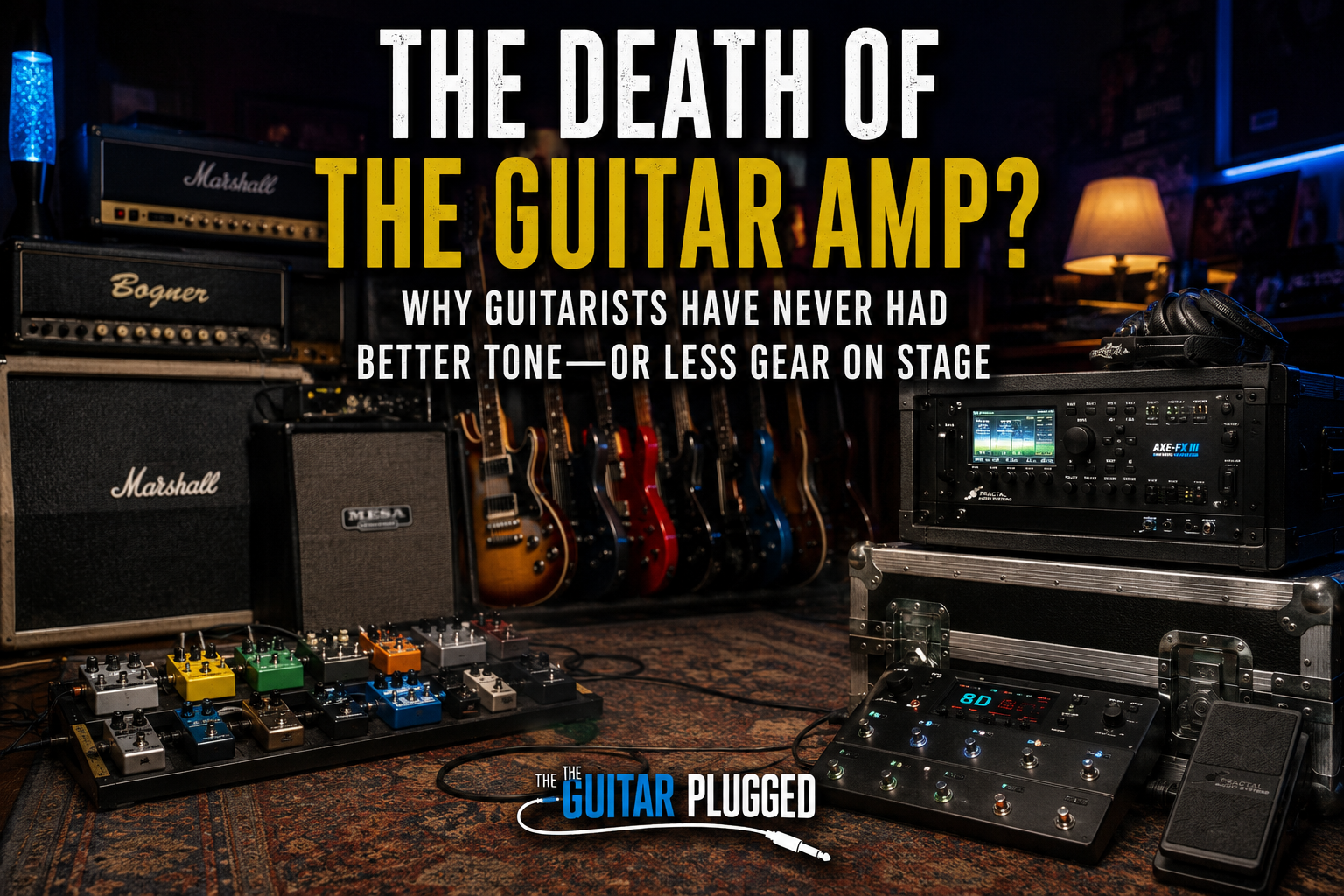
A guitarist walks onto a stage. Behind them is a wall of amplifiers — Marshall stacks reaching almost to the lighting rig, a smaller Bogner half-stack, a Mesa combo pushed off to the side, glowing tubes and a bird's nest of speaker cables running across the boards. A pedalboard sits at their feet, wired like a small city. The rig itself communicates something before a single note is played: power, volume, danger, possibility.
Now imagine the same guitarist walking onto the same stage a decade later. Behind them, nothing. Maybe a small floor unit at their feet, one XLR running toward the front-of-house rack. They step on a switch and a perfectly dialed high-gain amplifier appears. Another switch, and it's a pristine American clean. Another, and it's a vintage British crunch with a stereo ambient rig sitting behind it. All of it happens without a single traditional guitar amplifier on stage.
This is the transformation the guitar rig has quietly gone through in the past decade or two. Not a fad. Not a boutique corner of the market. A structural shift in how amplified guitar tone is created, transported and heard. Which raises a question guitarists have been arguing over in comment sections and green rooms for years: are we watching the death of the guitar amplifier?
[TOC]
What to Remember
- ▸Digital rigs have made traditional amplifiers optional for many professional and amateur guitarists.
- ▸Modern modelers offer portability, consistency and access to enormous virtual gear collections.
- ▸Traditional amplifiers still provide a physical playing experience that many guitarists consider difficult to replicate.
- ▸The future may be hybrid rather than purely digital or analog.
- ▸The guitar amplifier may not be dying — but its role in guitar culture is fundamentally changing.
When the Amp Was Part of the Guitarist
For most of electric guitar history, you couldn't separate a player from their rig. Ask any guitarist over forty to picture Jimi Hendrix and they'll picture him in front of Marshall stacks. Picture Angus Young and it's a wall of Marshall plexis, no matter what he was actually running through in the studio. Picture Brian May and it's Vox AC30s stacked in threes. Picture Stevie Ray Vaughan and it's Fender Vibroverbs, Super Reverbs and Dumbles daisy-chained across a stage. Picture Carlos Santana and it's Mesa/Boogie.
The amplifier was part of a guitarist's public identity. Guitar magazines shot rig rundowns as reverently as they shot the guitars themselves. Young players spent hours in music stores, plugging into whatever combo they could reach, trying to figure out what their hero was using and how close they could get. Eric Clapton with a Marshall JTM45 and a Les Paul on the Beano album became such a specific sonic archetype that the phrase "Bluesbreaker tone" is now a genre unto itself. Jimmy Page's live rigs — Marshall stacks with a Theremin off to the side and a violin bow within reach — turned the equipment behind him into part of the mythology.
The amplifier wasn't hidden infrastructure. It was part of the dream. If you were a teenager staring at a guitar magazine in 1978, you weren't just staring at the guitar. You were staring at what stood behind it.
The Wall of Amps Wasn't Always What It Seemed
It's worth being honest about one thing early: the visual of the giant amplifier wall was, at least partially, theater. Not every cabinet was necessarily active. As concert PA systems improved through the 1970s and 1980s, the practical need for physically enormous amplifier setups started to shrink. Front-of-house systems could put more of the sound in the room than any collection of stage cabinets ever could. The stacks stayed because the stacks looked like rock and roll, not because every 4×12 was pushing air at the audience.
That matters because it means the disappearance of huge stage rigs didn't begin with digital modeling. The process had already started decades earlier, quietly, as soundcraft got better. Digital technology didn't kill the wall of amps. It just accelerated a shrinkage that PA engineers had already been driving for a long time.
The First Great Shrinking of the Guitar Rig
Track the evolution of guitar equipment and you can see the same story unfolding in fast motion. Combo amp and a couple of pedals in the 1960s. Bigger stacks and modest pedalboards in the 1970s. Refrigerator-sized rack systems in the 1980s, with preamps and power amps split up so guitarists could switch between three or four completely different sounds mid-song. Multi-effects units taking over the pedal role at the end of the decade. And then, in the mid-1990s, the arrival of the Line 6 POD.
None of this reads like a dry product timeline once you frame it correctly. What was really happening across those decades was guitarists slowly getting comfortable with a genuinely radical idea: that the sound of an amplifier could exist independently of the amplifier itself. The POD didn't just offer digital versions of famous amps in a red bean-shaped box. It offered a philosophical shift. If your amp sound could live inside a processor, then "amp sound" was no longer inseparable from "amp."
That was the crack in the foundation. Once players accepted that a great tone could come out of a direct box into a mixing console, everything that followed — Fractal, Kemper, Neural, Quad Cortex, plugins — was inevitable. Our earlier feature on the evolution of guitar modeling from POD to Quad Cortex traces that arc in detail. But the important beat, culturally, is the same: modelers didn't have to be perfect to change guitar. They just had to be good enough to make the traditional signal chain feel optional.
The Modeler Changed Everything
The generation of modelers that arrived in the 2010s made "good enough" look conservative. Fractal Audio's Axe-Fx line pushed digital signal processing into serious professional territory. Kemper's profiling technology proved you could capture a specific amp, in a specific state, with a specific mic, and reproduce it faithfully on the other side of the world. Line 6's Helix flattened the price of pro-grade modeling. Neural DSP's Quad Cortex added on-the-fly capture, a touchscreen interface and plugin integration in a device the size of a small pedalboard.
Meanwhile, plugins caught up. Neural DSP's Archetype series, STL Tones, Nembrini, IK Multimedia, Line 6 Helix Native and dozens of smaller developers turned the average bedroom guitarist's laptop into a rig that would have cost tens of thousands of dollars in hardware only twenty years ago. A modern working guitarist can walk into a session with a floor unit, a USB cable and a set of headphones and cut a professional-quality track without ever hearing a real speaker in the room.
Add in impulse responses, third-party captures, MIDI control, stereo signal routing, FOH-ready outputs, silent recording, USB audio interfaces built into the same box, and instant preset recall between songs, and the appeal becomes obvious. A modern audio interface and modeling ecosystem is not a novelty anymore. It is, for a lot of guitarists, the entire rig.
The Argument That Is Getting Harder to Make
Here's the uncomfortable question that tube amp traditionalists don't love to sit with: can the average listener actually tell?
It's tempting to answer yes reflexively. Guitarists have opinions. But the honest answer requires splitting the question into several different ones. What the guitarist feels while playing is not the same as what the microphone captures. What the microphone captures is not the same as what the front-of-house engineer receives after processing. What the engineer sends to the PA is not the same as what the audience hears bouncing around a hockey arena. What survives in a two-channel mixed and mastered record is different again.
A guitarist standing three feet in front of a cranked tube amp is experiencing an interaction — sag, compression, feedback, the physical shove of moving air — that headphones and studio monitors simply can't reproduce at any price. That is a real, measurable, meaningful experience. But once that same amplifier's output has been captured by an SM57, EQ'd, compressed, panned, layered against another guitar and played back through a PA in a room with three thousand people in it, most of the qualities the guitarist felt at the amp have been mediated out of the signal. The audience is hearing speakers. The guitarist was hearing air.
This is why the amp-versus-modeler debate never resolves cleanly. Both sides are usually arguing about different parts of the signal chain without realizing it. If the audience only ever hears the result of a microphone reproduced through more speakers, the question of whether the source was a real tube amp or a digital model becomes philosophical more than technical. Which is either liberating or heartbreaking depending on where you stand.
By the time the sound hits the audience, most of what the guitarist felt at the amp has already been stripped away. That's the part of the debate nobody wants to admit.
What the Modeler Gets Right
Give the digital side its strongest case, because it is a genuinely strong one.
Consistency. A modeler sounds the same in Tokyo, Toronto and Toledo. The room changes. The rig doesn't. For a touring guitarist who plays every night, that is priceless.
Want This Tone?
Tell ToneMD what guitar and gear you own and we’ll show you how to get as close as possible using the equipment you already have — full signal chain, real numbered settings, no guesswork.
Included with The Guitar Plugged Premium
Portability. A pro-grade rig now weighs less than a boutique overdrive pedal weighed in 1998. Fly dates, international tours and quick pickup gigs stop being logistical nightmares. Backline is no longer a fight.
Silent recording. A working guitarist in an apartment can track album-quality parts at three in the morning without waking anyone up. That was science fiction in the 1990s. It is a Tuesday now.
Preset recall. Complex rigs that would have required three techs, a MIDI switcher and a truck full of gear can now live behind two footswitches. Setup and teardown collapse to minutes.
Cost. A player can access convincing versions of a Marshall stack, a Fender Twin, a Vox AC30, a Dumble, a Diezel and a Bogner for a small fraction of what a single one of those amps costs used. That doesn't make the models identical to the originals — but for most human ears, most of the time, it's close enough to matter.
Reliability. Tubes fail. Transformers hum. Speaker cones tear. A modeler boots up.
Professional touring guitarists tend to value reliability and consistency far more than romantic attachment. The rig has to work. Every night. In every country. That's not a betrayal of tone. That's a job.
What the Amp Still Does That a Menu Cannot
And now the other side.
Playing through a loud tube amplifier is not a passive experience. The guitar, the amplifier, the speaker and the room form a feedback loop that a screen full of parameters can approximate but never fully replace. When a cabinet is loud enough in a room, notes bloom differently. Sustain becomes conversational. Feedback becomes musical. The amp reacts to the guitar. The guitar reacts to the amp. The room reacts to both. The player reacts to all of it. That interaction is one of the things guitarists talk about when they use the word "feel."
There's also a tactile simplicity to an amp that unlimited digital flexibility can't match. You walk up. You turn a knob. You play. There is no menu diving. No preset selection. No firmware update. No IR loader. No global EQ page. No output configuration screen. No signal chain reordering. The amp is just there, doing exactly one thing, unapologetically, and you spend your time making music rather than making decisions.
That simplicity is not a small thing. Anyone who has spent an hour tweaking cab blocks instead of writing a riff knows the feeling. A classic-style tube combo or a small boutique-flavored amp from the used market is a completely different creative environment than a modeler with three thousand presets. Fewer choices, more commitment.
When Having Every Tone Means Choosing None
This may be the most interesting cost of the modeler era, and it doesn't get discussed enough. Unlimited options are their own problem.
For most of guitar history, players developed identifiable sounds partly because their equipment was fixed. They owned an amp. They learned how it responded. They adjusted their playing to work around what it did well and what it didn't. Over years, the equipment became part of their voice. Angus Young sounds like Angus Young in part because he has been fighting with the same basic rig for fifty years. David Gilmour sounds like David Gilmour in part because he built a signal chain and lived inside it long enough to make it his.
X Concepts Strings • Made in USA
Never Run Out of Strings Again.
Join the X Concepts String Club and get fresh USA-made strings delivered every month—plus Premium membership options for the full Guitar Plugged experience.
A modeler user, in contrast, can wake up tomorrow morning and become a completely different guitarist. British crunch for breakfast, high-gain Uberschall for lunch, chimey Vox AC30 for dinner. That is astonishing power. It is also, potentially, a slow-motion identity crisis. If your rig changes every week, when does it become your rig? If your tone is a preset, whose tone is it?
This is not an argument that modelers are bad. Plenty of world-class guitarists have found a strong voice inside them. But there is a real risk that the sheer volume of choice makes it harder for younger players to develop the deep, obsessive relationship with a single sound that produced so many of the tones we still argue about today. Limitation, historically, has been a creative gift. The modeler era doesn't offer many of those.
The Disappearing Stage
Walk into a modern arena show and look behind the guitarist. Then look at a Led Zeppelin photo from 1975. Something has changed, and it isn't just fashion.
Direct rigs, in-ear monitors, isolation cabinets, amps parked backstage, silent stages — these are all significant improvements from an audio engineering perspective. Cleaner mixes. Better monitoring. Less bleed into vocal mics. More consistent front-of-house sound. Any live engineer will tell you the modern setup is better in almost every measurable way.
“The amplifier hasn't died. It's just been demoted from necessity to choice — and once something becomes optional, the reasons people still choose it get a lot more interesting.”
But visually, a guitarist standing in front of an empty stage plays differently than one framed by a wall of amps. Not necessarily worse. Different. The amp was part of the theater of rock. It signaled volume and power before the first chord. It gave the eye something to look at when the guitarist stepped forward for a solo. When that visual disappears, something is lost — even if what replaces it sounds objectively cleaner. Whether that loss matters depends on what you think a rock concert is for.
The Audience Probably Doesn't Care — But the Guitarist Might
Concertgoers are not, in general, analyzing impulse responses. They are not comparing power-amp saturation curves. They want the guitar to sound good, feel loud and hit them in the chest. Whether the source is a Kemper profile or a real 1968 plexi Marshall is, for most listeners, invisible.
The guitarist, however, is experiencing something else entirely. The player feels latency, response, dynamics, feedback, room volume, the way a note decays into or out of the amp. That is why the debate never ends. The audience and the guitarist are judging two completely different experiences. It's possible for the modeler to win the audience argument decisively and still lose the guitarist argument. Both things can be true.
The Bedroom Changed the Guitar Industry
Most guitar playing in 2026 doesn't happen on a stage. It happens in a bedroom, an apartment, a home studio, a spare room converted into a content-creation setup, a laptop-plus-headphones rig at a kitchen table. Practically no one under thirty is regularly cranking a 100-watt tube head to the volume it needs to feel its best. That volume simply isn't compatible with modern life for most players.
This has changed the industry more than any single product release. When the average guitarist can't use a traditional amp the way it was designed to be used, the tools that give them convincing tone at bedroom volume — audio interfaces, studio monitors, closed-back headphones, plugins, small modelers — become the default. A generation of players is growing up learning through DI rigs and cab sims. When they eventually become touring pros, why would they suddenly develop nostalgia for equipment they never actually needed?
That generational shift may end up mattering more than any specific piece of technology. Habits form early. So do loyalties.
The Rise of the Hybrid Guitarist
The framing that gets closest to how working guitarists actually operate today isn't digital versus analog. It's hybrid.
Real amps in the studio when the record calls for it. Modelers on the road when the logistics call for it. Plugins for demoing on the couch. A small combo for rehearsals. Direct rigs for fly dates. FRFR speakers on stage when the venue demands more air. Different solutions for different rooms, different budgets, different nights of the week. The modern working guitarist has stopped picking a team. They pick a tool.
That flexibility is genuinely new. Ten years ago, choosing digital meant identifying as a digital player, with all the culture-war baggage that came with it. Today, plenty of players use a Kemper on tour and a hand-wired 18-watt in the studio and don't feel any particular loyalty to either. The gear is just the gear. The music is the music.
Are Tube Amps Becoming the Vinyl Records of Guitar?
Streaming didn't kill vinyl. In some ways, the frictionless perfection of digital music made physical media feel more special — collectible, tactile, intentional. Vinyl sales have been growing again for years, not because vinyl is objectively better but because the experience of vinyl means something specific in a streaming world.
It's possible we're watching the same thing happen to tube amps.
In a world where perfect, portable, silent digital rigs are the practical standard, the traditional amplifier could easily settle into the same cultural position as vinyl records, film cameras, mechanical watches and manual-transmission sports cars: no longer necessary for practical reasons, but increasingly desirable because they are physical, imperfect and tactile. A cranked tube amp in a live room is not the most efficient way to make a guitar sound in 2026. It is, however, one of the most enjoyable ways to spend an afternoon as a guitarist.
That kind of value is very hard to firmware-update out of existence.
The Economics of the Modern Guitar Rig
Zoom out and the economic argument is stark. Historically, recreating multiple iconic amp sounds meant owning multiple amps — Marshall, Fender, Vox, Mesa, Dumble if you had the budget and the connections. A premium modeler now approximates all of that in one box for less than the cost of a single real Dumble on the vintage market. If pure sonic coverage per dollar is the metric, modelers won this argument years ago.
But there's a counterargument that guitarists don't always want to think about. Digital hardware ages differently than analog. A tube amplifier built in 1965 is often still useful today, sixty years later. A digital modeler built in 2005 is a paperweight. Firmware support ends. Operating systems move on. USB protocols change. Software ecosystems die. The high-end digital rig you buy today is a piece of technology with a lifespan measured in years. The mid-range tube combo you buy today is more like an instrument, with a lifespan measured in decades.
That's not a knockdown argument against modelers. It's a framing choice: are you buying gear as technology, or gear as an instrument? A well-built small tube amp or a used boutique combo from Reverb is a bet on longevity. A Quad Cortex is a bet on the next few years of software support. Both are legitimate bets. They're just different ones.
What Happens to the Music Store?
The transition also lands, uncomfortably, on the traditional guitar store. For generations, the amp room was a rite of passage. Guitar Center, Sam Ash, Long & McQuade, independent shops — you'd walk in as a teenager, plug into whatever combo was closest, discover you liked the way a Vox AC15 sounded compared to a Marshall DSL, and go home wanting one.
How does a music store demonstrate hundreds of virtual amplifiers contained inside one processor? A Kemper on a demo pedestal doesn't have the same physical presence as a wall of half-stacks. A Quad Cortex doesn't glow like tubes. The traditional amp wall, already shrinking in most big-box music stores, will keep shrinking as more customers arrive already knowing that their entire signal chain will live in something the size of a hardcover book.
The retail experience itself is starting to change. Demo videos on YouTube already do more work than any in-store audition ever did. Preset packs sell online. Some players buy a professional-grade modeler without ever hearing it in person. If you're a shop that built your identity on the amp room, that trend is not friendly to you.
What Happens to the Next Generation?
Picture a fourteen-year-old picking up an electric guitar for the first time today. Their first serious rig may not include a traditional amplifier at all. A modeler with a headphone jack. An audio interface. A plugin. Studio monitors on the desk next to their computer. That's not a compromise. That is, increasingly, the default starting point.
Ten years from now, that kid becomes a working guitarist. Will they suddenly develop nostalgia for tube amps they've never needed? Some will. Many won't. For that generation, the traditional amplifier may become a specialty choice — something you buy after you already know you love guitar, the way people buy film cameras today. A conscious decision, not a default.
That's a very different world from the one that produced Hendrix, Page, Van Halen and every guitarist since. Whether it produces the next set of icons is a genuinely open question.
The Guitar Amp Isn't Dead Yet
For all the structural change of the past two decades, the amplifier isn't dead. Boutique amp builders are still busy. Fender, Marshall, Vox and Mesa/Boogie are still shipping hardware. Vintage amps continue to appreciate on the used market. Serious recording studios still track guitars through real cabinets more often than not. Plenty of touring guitarists — including some who quietly use modelers for backline consistency — still keep a small collection of real amps at home for the sheer pleasure of playing them.
The amplifier has lost its monopoly on professional guitar tone. That is not the same as dying. A format doesn't die when it loses market share. It dies when nobody chooses it. And guitarists, stubborn creatures that we are, keep choosing amplifiers.
The Real Revolution: The Amp Is Now Optional
This is the intellectual conclusion the last twenty years have been driving toward, and it deserves to be said plainly.
The biggest change in guitar culture isn't that the amplifier is dying. It's that, for the first time in electric guitar history, the amplifier is genuinely optional. A guitarist can build a professional career — record albums, tour arenas, cut sessions, run a YouTube channel, do the whole job — without ever owning a traditional guitar amp. That is a completely new state of affairs. Every previous generation of electric guitar player had to own at least one amplifier to be taken seriously. This one doesn't.
Once something moves from necessity to choice, the reasons people continue choosing it become the interesting part of the story. Nobody buys a tube amp in 2026 because they have to. They buy it because they want to. That changes what an amplifier means. It stops being infrastructure and starts being a statement.
The Final Verdict
So — is the guitar amplifier dying?
Probably not. But its role has fundamentally changed. For most of the electric guitar's history, the amplifier was the gateway between the instrument and the world. If you wanted to be heard, you needed one. That is no longer true. Digital technology has won the argument that professional guitar tone can exist without a traditional amp. On records, on stages, in bedrooms, in content creation setups, direct rigs are demonstrably good enough for almost anything a player might need to do.
What digital technology has not replaced is the experience of playing through one. A modeler can recreate the sound of a cranked amplifier with extraordinary accuracy. Whether it can replace what that amplifier means to the player — the physicality, the room interaction, the tactile simplicity, the decades of mythology piled on top of a plywood box full of tubes — is a different question, and it's the question that will keep tube amps alive long after every practical argument for them has fallen away.
The amp isn't dying. It's being liberated. Once something becomes optional, the players who still love it have a better reason to keep turning it up.
One rig for the rest of your life — which are you taking?
Tap your pick. One vote per reader.
The Journey
The Amp Becomes the Sound
The electric guitar and its amplifier arrive together. Fender, Vox and Marshall define the vocabulary of amplified guitar tone.
The Amp Becomes the Sound
The electric guitar and its amplifier arrive together. Fender, Vox and Marshall define the vocabulary of amplified guitar tone.
The Wall of Sound
Stacks and stadium rigs turn the amplifier into part of the theater of rock. If you could see it from the back row, it was doing its job.
Rack Systems and Complexity
Preamp/power-amp splits, MIDI switching and refrigerator-sized rigs push tone control to its most technical extreme.
Rack Systems and Complexity
Preamp/power-amp splits, MIDI switching and refrigerator-sized rigs push tone control to its most technical extreme.
The First Serious Digital Push
Line 6 POD, early amp modeling and multi-effects prove a whole rig can live inside one small box — imperfectly, but convincingly.
Modeling Grows Up
Fractal, Kemper and refined Line 6 platforms move digital rigs from novelty to legitimate professional tools.
Modeling Grows Up
Fractal, Kemper and refined Line 6 platforms move digital rigs from novelty to legitimate professional tools.
Profiling and Pro Adoption
Session players and touring pros openly embrace modelers. Silent stages and in-ear monitoring become standard on major tours.
Plugins, Captures and the Amp-Free Stage
Neural DSP, Quad Cortex, plugin ecosystems and native captures push the ceiling higher. Amp-free rigs stop being unusual.
Plugins, Captures and the Amp-Free Stage
Neural DSP, Quad Cortex, plugin ecosystems and native captures push the ceiling higher. Amp-free rigs stop being unusual.
The Amp Is No Longer Mandatory
For the first time in electric guitar history, a professional career is genuinely possible without ever owning a traditional guitar amplifier.
Related Reading From The Guitar Plugged
If this piece resonated, our long-form on the evolution of guitar modeling from POD to Quad Cortex traces the technical arc in more detail. For the other side of the coin, our review of Joe Bonamassa's Fender Tone Master Pro looks at what happens when a lifelong tube guy embraces a modeler, and our Marshall 1959BJA review is a reminder that classic amp design isn't going anywhere quietly. Tone chasers should also start with our Tone Decoded series.
The Guitar Plugged is reader-supported. When you buy through links on our site, we may earn an affiliate commission at no extra cost to you. We only recommend gear we would happily plug into ourselves.
Experience-driven coverage, not algorithm bait.
- 20+ years of guitar playing experience
- Real-world retail experience at Guitar Center
- Thousands of hours testing guitars, amps, and pedals
- A community of 50,000+ guitar enthusiasts across platforms
- Partnerships with Fender, DistroKid, TrueFire, Card Chords, and Enya
- Editorial standards published openly — see how we test gear
The Modern Guitar Magazine. Delivered to your inbox.
No spam. No gimmicks. Just great guitar content — stories, tones, iconic solos, and honest gear takes. Every week.
Ask GP
3 free questions a dayStill curious? Ask GP about this story.
Your personal classic-rock and guitar guide — ask anything about The Disappearing Guitar Rig.
Discussion (0)
Sign in to join the discussion.
Sign in to commentLoading comments…
Discover another guitar story
Swipe through our latest features, breaking news and iconic solos — one story at a time.
Open Swipe →More in Guitar Talk
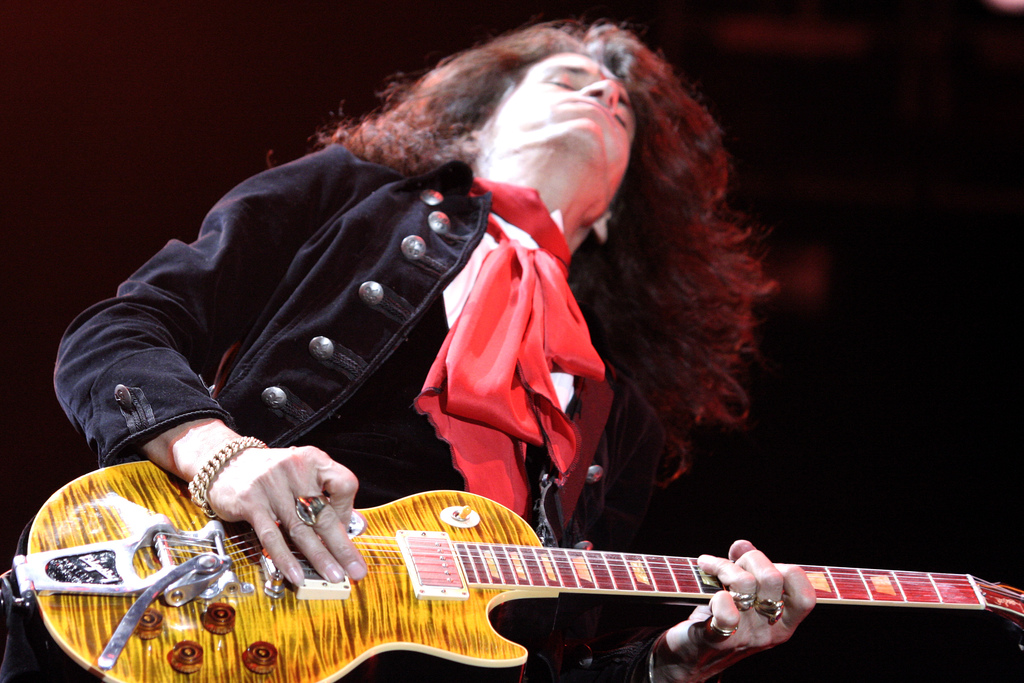
Happy Birthday, Joe Perry: The Riff Machine Who Gave Aerosmith Its Swagger
Joe Perry turns 76 today. From the swampy grind of “Sweet Emotion” to the reunion that saved a band, this is the career of the guitarist who taught American hard rock how to strut.
History of the Riff: How Joe Satriani Made “Flying in a Blue Dream” Feel Weightless
An acoustic guitar in an unusual tuning, a stray broadcast and a melody that seems to hang in the air: inside the construction of Satriani’s 1989 masterpiece.
Tony Iommi Opens Up About His Final Conversation With Ozzy Osbourne: “I Still Can't Get It in My Head”
The Black Sabbath guitarist says Ozzy was exhausted after the band's emotional farewell — but determined to give fans one final show.