
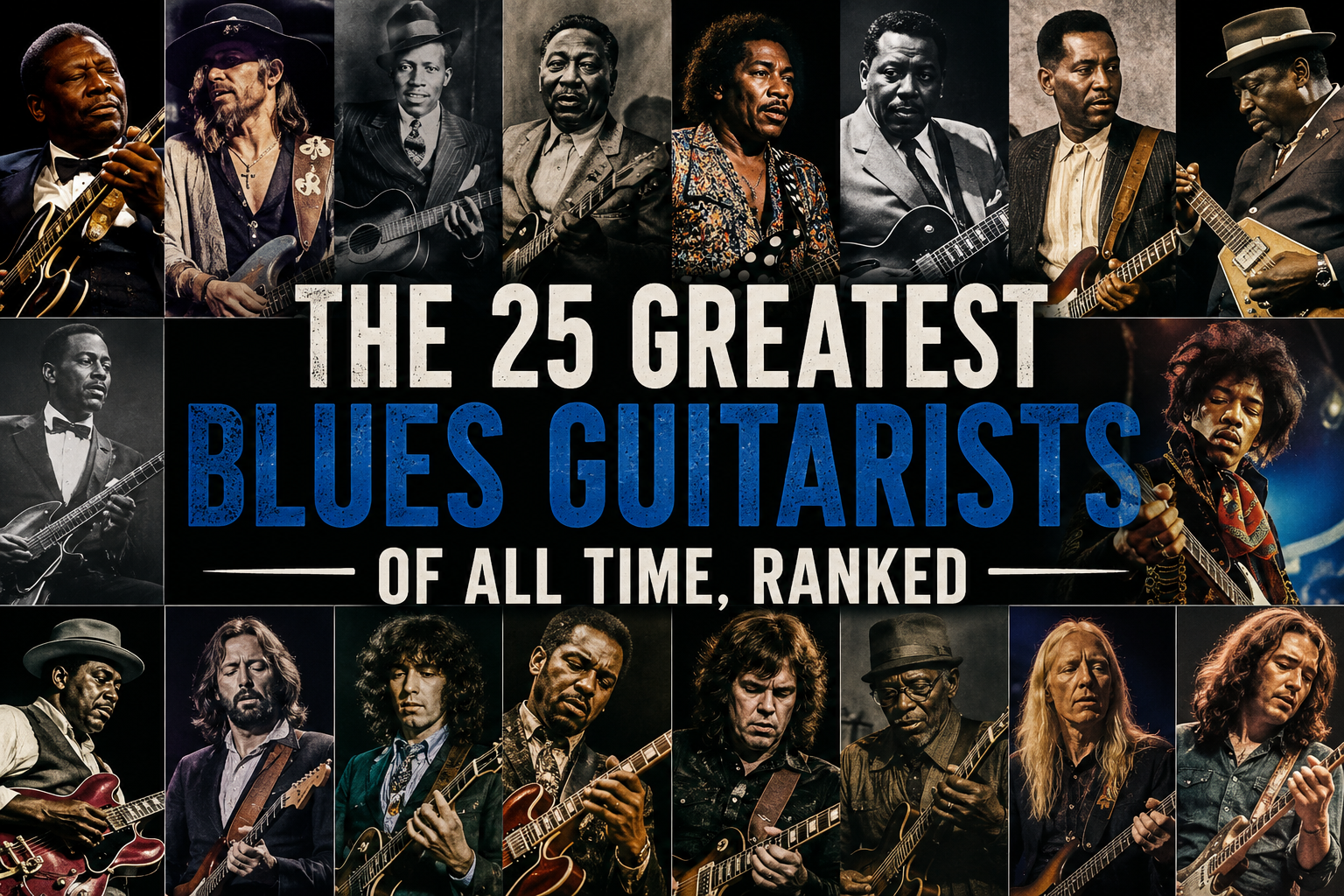
The 25 Greatest Blues Guitarists of All Time, Ranked
From B.B. King and Stevie Ray Vaughan to Robert Johnson, Buddy Guy and the Three Kings — The Guitar Plugged's editorial ranking of the 25 greatest blues guitarists ever to plug in.
Ranking the greatest blues guitarists of all time is an invitation to an argument.
So let's have one.
The blues has never been about playing the most notes, owning the most expensive guitar or having the cleanest technique. It's about what happens between the notes. It's the bend that hangs in the air a fraction longer than expected. The vibrato you recognize before the singer ever opens his mouth. The battered slide guitar that sounds like it has lived through something.
More than a century of guitar history runs through the blues. Rock and roll came from it. Hard rock borrowed from it. Metal pushed its riffs into heavier territory. Players from Eric Clapton and Jimi Hendrix to Stevie Ray Vaughan built careers on foundations laid decades earlier by musicians playing in juke joints, clubs, churches and street corners.
Trying to reduce that history to 25 names isn't easy.
For this list, The Guitar Plugged considered influence, originality, body of work, signature sound, impact on future generations and, ultimately, what each guitarist contributed to the language of the instrument.
Technical ability matters. But this isn't a shred contest.
This is about the players who changed the way the blues guitar sounds.
Here are The Guitar Plugged's 25 greatest blues guitarists of all time.
25. Joe Bonamassa
Few modern guitarists have done more to keep blues-rock visible to a mainstream guitar audience than Joe Bonamassa.
Bonamassa arrived as a prodigious young player and developed into one of the most commercially successful blues guitarists of his generation. His playing draws openly from the giants who came before him — British blues, the Three Kings, Eric Johnson and classic rock all live somewhere inside his vocabulary — but his technical command and relentless commitment to the genre have made him a major figure in his own right.
He's also helped keep the culture surrounding vintage guitars and amplifiers alive for a new generation of players. Read our full Joe Bonamassa feature for a deeper dive.
Essential listening: Sloe Gin
24. Derek Trucks
Derek Trucks doesn't sound like anyone else on this list.
Playing slide guitar without a pick, Trucks has developed an extraordinarily vocal style influenced not only by blues but by Southern rock, jazz, gospel and Indian classical music.
His connection to the Allman Brothers Band places him inside one of blues-rock's most important lineages, but his work with the Tedeschi Trucks Band has established an identity entirely his own.
Trucks is proof that the blues doesn't have to remain frozen in the past to respect where it came from.
Essential listening: Midnight in Harlem
23. Robert Cray
At a time when blues guitar was becoming increasingly associated with high-gain amplification and fiery solos, Robert Cray went in another direction.
His playing is clean, precise and restrained. His Stratocaster tone leaves nowhere to hide, and that's exactly what makes it work.
Cray helped introduce blues and soul to a wider 1980s audience, particularly with Strong Persuader, while demonstrating that emotional intensity doesn't require distortion or endless notes.
Essential listening: Smoking Gun
22. Sister Rosetta Tharpe
Before rock and roll had a name, Sister Rosetta Tharpe was already playing it.
Tharpe combined gospel music with aggressive electric guitar decades before the instrument became the defining symbol of rock culture. Her rhythmic attack, stage presence and willingness to push the guitar forward make her one of the crucial links between gospel, blues and early rock and roll.
Any history of electric guitar that leaves her out is incomplete.
Essential listening: Didn't It Rain
21. Son House
Son House could make a guitar sound dangerous.
His raw Delta blues style relied on powerful rhythm, open tunings and slide guitar that felt less like decoration and more like another human voice.
House was a major influence on Robert Johnson and Muddy Waters, placing him near the foundation of two separate branches of blues history that would eventually reshape popular music.
Essential listening: Death Letter
20. Rory Gallagher
Rory Gallagher played the blues as if the guitar might be taken away from him at any moment.
The Irish guitarist's battered 1961 Stratocaster became nearly as recognizable as the man holding it. Gallagher combined blues fundamentals with rock energy, folk influences and ferocious live performances.
He never achieved the mainstream superstardom of some contemporaries, but among guitar players, his reputation has only grown.
Essential listening: A Million Miles Away
19. Johnny Winter
Johnny Winter brought Texas blues to the stage with the intensity of a rock guitarist.
His rapid-fire phrasing, slide playing and aggressive tone made him one of the most distinctive blues-rock players of his era.
Winter could burn through a solo with astonishing speed, but beneath the fireworks was a musician deeply connected to traditional blues. His later work producing Muddy Waters also helped introduce Waters to another generation.
Essential listening: Be Careful with a Fool
18. Hubert Sumlin
Take Hubert Sumlin out of blues history and the sound of rock guitar changes with him.
As Howlin' Wolf's guitarist, Sumlin developed an unpredictable style full of angular phrases, strange accents and sharp bursts of guitar that seemed to answer Wolf's voice.
His playing influenced generations of British rock guitarists, including players who would carry Chicago blues ideas into stadiums around the world.
Essential listening: Smokestack Lightning
Want This Tone?
Tell ToneMD what guitar and gear you own and we’ll show you how to get as close as possible using the equipment you already have — full signal chain, real numbered settings, no guesswork.
Included with The Guitar Plugged Premium
17. Lightnin' Hopkins
Lightnin' Hopkins played with the freedom of someone who seemed to be inventing the song while you listened.
His loose sense of timing, conversational phrasing and deeply personal approach made his performances feel spontaneous and intimate.
Hopkins represented a style of Texas blues where rhythm and lead guitar could become almost indistinguishable.
Essential listening: Mojo Hand
16. Otis Rush
The emotional intensity of Otis Rush's guitar playing helped define the West Side Chicago blues sound.
A left-handed guitarist playing a right-handed instrument upside down, Rush developed a bending and vibrato style that could sound almost unbearably tense.
His influence can be heard throughout British blues and rock, particularly in players searching for ways to make the electric guitar sound more human.
Essential listening: All Your Love (I Miss Loving)
15. Gary Moore
Few guitarists could make a Les Paul cry quite like Gary Moore.
Moore had the technical ability of a hard-rock virtuoso, but when he turned his attention fully toward the blues, he brought an enormous amount of firepower with him.
His sustained notes, huge vibrato and emotionally charged bends made Still Got the Blues a gateway into blues guitar for countless rock players. We break down the title solo in our Gary Moore "Still Got the Blues" solo feature.
Essential listening: Still Got the Blues
14. Albert Collins
They didn't call Albert Collins the Iceman for nothing.
His Telecaster tone was sharp, cutting and instantly recognizable. Using alternate tunings, a capo and his fingers instead of a conventional pick, Collins developed a style that sounded completely different from the smoother blues guitarists around him.
One note could identify him. That's one of the highest compliments you can give any guitarist.
Essential listening: Frosty
13. Peter Green
Peter Green understood the power of restraint.
As the early creative force behind Fleetwood Mac, Green developed one of the most haunting voices in British blues. His phrasing was economical, his vibrato deeply expressive and his famous Les Paul tone remains one of the most discussed guitar sounds in history.
Songs such as "Need Your Love So Bad" and "The Green Manalishi" showed just how wide the emotional range of blues guitar could become.
Essential listening: Need Your Love So Bad
X Concepts Strings • Made in USA
Never Run Out of Strings Again.
Join the X Concepts String Club and get fresh USA-made strings delivered every month—plus Premium membership options for the full Guitar Plugged experience.
12. Eric Clapton
There was a time when graffiti appeared in London declaring that Clapton was God.
Hyperbole aside, his impact on blues guitar is impossible to ignore.
His work with John Mayall's Bluesbreakers helped establish the Les Paul-through-a-Marshall combination as one of rock guitar's foundational sounds. Cream then took blues vocabulary and pushed it into heavier, louder territory.
Clapton didn't invent the blues phrases he played, but he helped introduce them to an enormous new audience.
Essential listening: Have You Heard
11. Elmore James
The opening slide riff of "Dust My Broom" is one of the foundational sounds of electric blues.
“The blues has never been about playing the most notes. It's about what happens between them.”
Elmore James took Delta slide guitar and electrified it with an aggressive edge that anticipated rock guitar.
His influence on slide players is difficult to overstate. Generations of guitarists have chased the sound of that opening riff.
Essential listening: Dust My Broom
10. John Lee Hooker
John Lee Hooker proved that a groove doesn't need to be complicated to be unstoppable.
His hypnotic boogie style ignored conventional structures when it suited him. The rhythm could stretch, contract and follow the vocal rather than a rigid arrangement.
That raw pulse became enormously influential on blues-rock and rock and roll.
Essential listening: Boom Boom
9. Jimi Hendrix
Hendrix is usually categorized as a rock guitarist, but the blues sits at the center of his playing.
Listen beyond the psychedelic production and feedback and you'll hear Albert King, Muddy Waters and the deep vocabulary of electric blues transformed by an imagination unlike anything guitar music had encountered before. Our History of the Riff: Purple Haze deep-dive traces the blues DNA running through his rock playing.
"Red House" alone would establish Hendrix as a formidable blues guitarist.
What makes him historically important is what he did with that foundation.
Essential listening: Red House
8. T-Bone Walker
Before the electric guitar became the center of popular music, T-Bone Walker was already showing musicians what it could do.
His sophisticated phrasing, smooth bends and stage presence influenced everyone from B.B. King to Chuck Berry.
Walker helped establish the electric guitar as a lead instrument capable of commanding the spotlight.
Essential listening: Call It Stormy Monday
7. Freddie King
Freddie King was the explosive member of the Three Kings.
Where B.B. could be elegant and Albert could be brutally economical, Freddie attacked the guitar with a muscular, driving style that became enormously influential on blues-rock.
Instrumentals such as Hide Away became required vocabulary for generations of guitarists.
Essential listening: Hide Away
6. Albert King
Albert King didn't need many notes. He needed the right ones.
Playing his Flying V left-handed and using enormous string bends, King developed one of the most recognizable styles in electric blues.
His phrasing became a blueprint for rock guitarists including Eric Clapton and Stevie Ray Vaughan.
You can hear echoes of Albert King's vocabulary almost anywhere blues and rock intersect.
Essential listening: Born Under a Bad Sign
5. Buddy Guy
4. Muddy Waters
3. Robert Johnson
2. Stevie Ray Vaughan
1. B.B. King
5. Buddy Guy
Buddy Guy is one of the great bridges in guitar history.
He emerged from the Chicago blues scene but played with an explosive physicality that anticipated the rock guitar heroes who followed.
Jimi Hendrix admired him. Eric Clapton admired him. Stevie Ray Vaughan admired him.
Guy could whisper with the guitar one moment and attack it the next. His influence extends far beyond blues.
Essential listening: Stone Crazy
4. Muddy Waters
Muddy Waters helped electrify the Delta.
After moving north to Chicago, Waters transformed traditional blues into something louder, tougher and perfectly suited for crowded clubs.
The sound that emerged became Chicago blues — and eventually one of the primary foundations of rock and roll.
The Rolling Stones literally took their name from one of his songs.
Essential listening: Mannish Boy
3. Robert Johnson
Robert Johnson's recorded output was small. His shadow is enormous.
Johnson's recordings became foundational documents of Delta blues guitar. His ability to combine bass movement, rhythm and melody created the illusion of multiple guitar parts happening simultaneously.
The mythology surrounding his life sometimes threatens to overshadow the music. It shouldn't.
His influence on Eric Clapton, Keith Richards, Jimmy Page and generations of blues and rock musicians makes him one of the most important guitarists who ever lived.
Essential listening: Cross Road Blues
2. Stevie Ray Vaughan
Stevie Ray Vaughan didn't invent electric blues guitar. He made an entire generation care about it again.
When Texas Flood arrived in 1983, mainstream popular music had moved far away from traditional blues. Vaughan walked into that landscape with a battered Stratocaster, heavy strings, massive tone and a right hand that seemed capable of knocking the strings off the guitar. Our Tone Decoded: Stevie Ray Vaughan piece dissects exactly how he got there.
His influences were clear — Albert King, Jimi Hendrix, Lonnie Mack and Texas blues all ran through his playing — but the combination became unmistakably SRV.
Vaughan could play with terrifying intensity, then turn around and deliver something as delicate as "Lenny" or "Riviera Paradise."
His career was tragically short. His influence was not.
For countless modern guitarists, Stevie Ray Vaughan was the doorway into the blues.
Essential listening: Texas Flood
1. B.B. King
There may have been faster blues guitarists. There may have been more technically complex blues guitarists.
But nobody sounded more like himself than B.B. King.
One note could be enough.
King's vibrato became one of the most recognizable sounds in the history of electric guitar. His phrasing treated the instrument like a second voice. Instead of filling every available space, he understood the power of leaving room.
Lucille didn't need to speak constantly. When she did, you listened.
B.B. King's influence reaches across blues, rock, soul and beyond. Eric Clapton, Gary Moore, Peter Green, Stevie Ray Vaughan and countless others absorbed pieces of his vocabulary.
But imitation never quite captured the original.
King demonstrated something every guitarist eventually has to learn: technique can give you more options, but having something to say is what makes people remember you.
That's why B.B. King sits at No. 1 on The Guitar Plugged's list of the 25 greatest blues guitarists of all time.
Essential listening: The Thrill Is Gone
The Final Word
No ranking of blues guitarists will ever satisfy everyone.
That's part of the point.
Maybe you think Stevie Ray Vaughan should be No. 1. Maybe Robert Johnson belongs at the top. Maybe leaving your favorite player outside the Top 10 is unforgivable.
The blues has survived because every generation has taken the language handed to it and found something new to say.
From Robert Johnson's acoustic recordings to Muddy Waters electrifying Chicago, from B.B. King's unmistakable vibrato to Stevie Ray Vaughan's Texas-sized Stratocaster tone, these players didn't simply play the blues.
They changed what a guitar could say.
Now we want to hear from you. Who is the greatest blues guitarist of all time — and who did we leave off the list?
Who's YOUR #1 blues guitarist of all time?
Tap your pick. One vote per reader.
Explore the Gear
As an Amazon Associate, The Guitar Plugged earns from qualifying purchases. Product mentions here reflect the article subject and are not implied endorsements by the artist unless otherwise stated.
What to Remember
- ▸The blues isn't ranked by speed or complexity — it's ranked by touch, feel, phrasing and influence.
- ▸B.B. King sits at No. 1 because nobody ever sounded more like themselves on an electric guitar.
- ▸Stevie Ray Vaughan single-handedly pulled blues guitar back into the mainstream in the 1980s.
- ▸Robert Johnson's tiny recorded output shaped nearly every important rock guitarist who followed.
- ▸The Three Kings — B.B., Albert and Freddie — built most of the vocabulary modern blues-rock still uses.
Keep Reading on The Guitar Plugged
- Stevie Ray Vaughan — Texas Flood (Vinyl / CD)Check price·Check on Amazon →
- Blues Guitar Instructional BooksCheck price·Check on Amazon →
- Guitar Picks & Strings for Blues PlayersCheck price·Check on Amazon →
Some links are affiliate links — we may earn a small commission at no cost to you.
Chase the Sound: Blues Gear Worth Exploring
Some links may be affiliate links. We may earn a small commission at no cost to you.
Experience-driven coverage, not algorithm bait.
- 20+ years of guitar playing experience
- Real-world retail experience at Guitar Center
- Thousands of hours testing guitars, amps, and pedals
- A community of 50,000+ guitar enthusiasts across platforms
- Partnerships with Fender, DistroKid, TrueFire, Card Chords, and Enya
- Editorial standards published openly — see how we test gear
More Guitar Deep Dives, Delivered Weekly
Rankings, Tone Decoded features and long-form guitar stories — straight to your inbox.
Ask GP
3 free questions a dayStill curious? Ask GP about this story.
Your personal classic-rock and guitar guide — ask anything about The 25 Greatest Blues Guitarists.
Discussion (0)
Sign in to join the discussion.
Sign in to commentLoading comments…
Discover another guitar story
Swipe through our latest features, breaking news and iconic solos — one story at a time.
Open Swipe →More in Best Of Lists

Top 15 Guitar Intros You Know in One Second
Some songs need a chorus to announce themselves. These barely need the guitarist to get started — 15 intros ranked on recognition, personality, and pure gut reaction.

20 Songs That Made an Entire Generation Want to Play Guitar
Every guitarist has one: the song that made a guitar feel less like an object and more like a doorway. These 20 didn't just become classics — they created players.
Top 20 Guitarists Defined by One Solo
One unforgettable guitar moment can turn a great player into a permanent part of rock history. These are the 20 guitarists most defined by a single solo.