
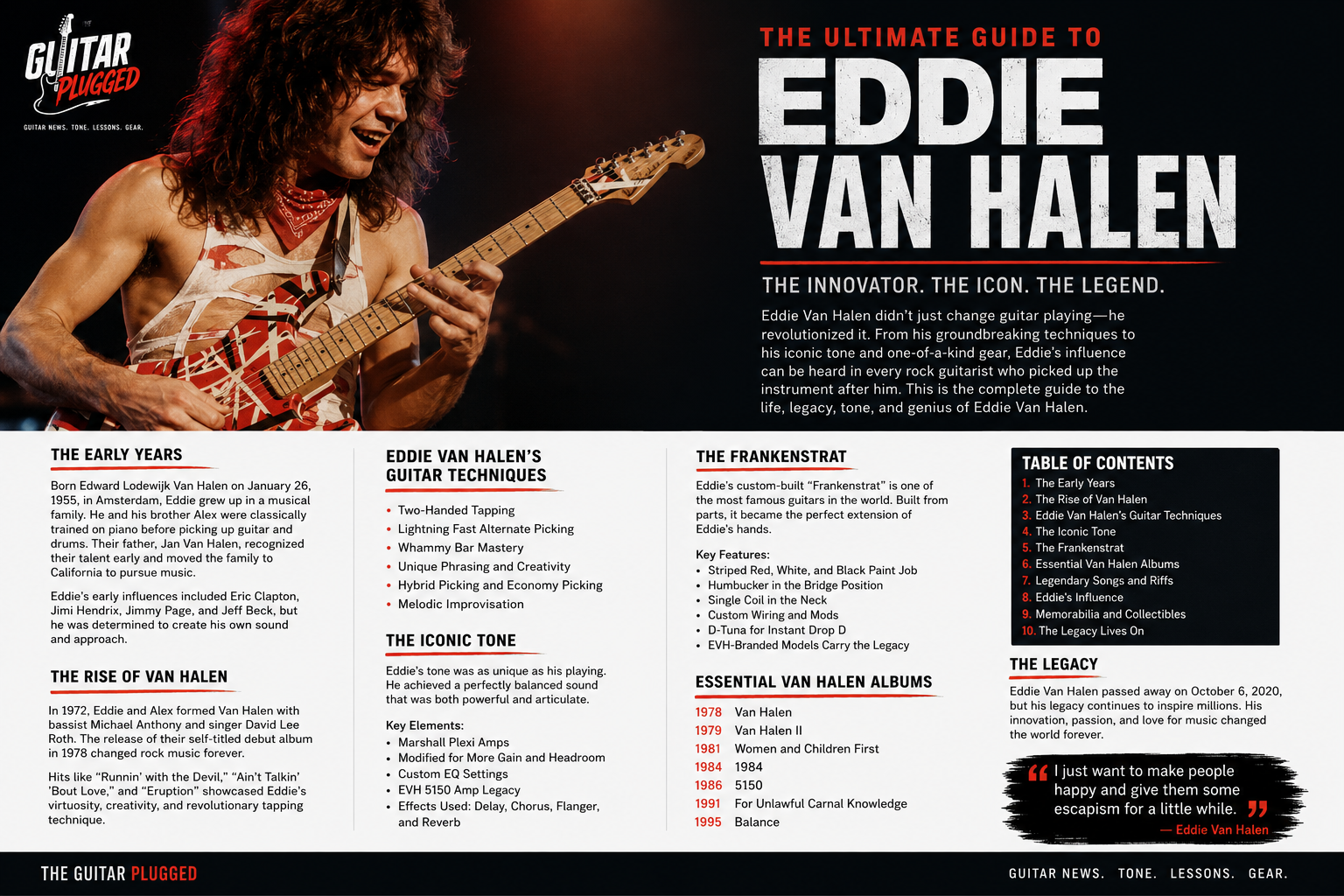
The Ultimate Guide to Eddie Van Halen: The Guitarist Who Changed Everything
The innovator. The showman. The genius. A complete guide to the life, legacy, tone, and gear of the guitarist who permanently rewrote the rules of rock.
▶ LISTEN WHILE READING
There are guitarists who become famous, and then there are guitarists who permanently alter the course of music history. Eddie Van Halen belongs in the second category.
When Van Halen's debut album exploded onto the scene in 1978, it didn't simply introduce a talented guitarist — it completely reset expectations for what rock guitar could sound like. His speed was breathtaking, his phrasing was joyful rather than mechanical, his tone was unmistakable, and his creativity seemed limitless. Even today, nearly every modern rock and metal guitarist owes something to Eddie's innovations.
Early Life
Born in Amsterdam in 1955, Eddie Van Halen moved to California with his family as a child. Originally trained as a pianist, he developed exceptional musical instincts long before becoming obsessed with guitar. Alongside his brother Alex, he spent countless hours practicing, experimenting, and pushing himself far beyond conventional techniques. Unlike many virtuosos, Eddie wasn't interested in copying everyone else — he wanted to invent.
The Birth of Van Halen
The classic lineup featured Eddie Van Halen, Alex Van Halen, David Lee Roth, and Michael Anthony. Their self-titled 1978 debut remains one of the most influential rock albums ever recorded. Songs like "Runnin' With The Devil," "Ain't Talkin' 'Bout Love," "Jamie's Cryin'," and "Atomic Punk" instantly showcased a completely fresh guitar vocabulary.
Less than two minutes long. No vocals. No chorus. Just pure guitar brilliance.
It instantly became the most influential instrumental guitar performance ever recorded — and inspired an entire generation to pick up the instrument. Countless players have admitted hearing "Eruption" changed their lives forever.
Eddie Didn't Invent Tapping — He Perfected It
One of the biggest misconceptions in guitar history is that Eddie invented two-handed tapping. He didn't. But he transformed it into a musical language. Rather than treating it as a gimmick, he integrated tapping into melodic phrases, blazing runs, and unforgettable hooks. His execution was clean, rhythmic, expressive, and astonishingly fluid. After Eddie, virtually every shred guitarist adopted some version of the technique.
The Brown Sound
Want Eddie Van Halen's Brown Sound?
Tell ToneMD what guitar and gear you own and we’ll show you how to get as close as possible using the equipment you already have — full signal chain, real numbered settings, no guesswork.
Included with The Guitar Plugged Premium
Ask ten guitar players what "Brown Sound" means and you'll get ten different answers. What made Eddie's tone special wasn't simply distortion — it had warmth, compression, clarity, aggression, sustain, and articulation in equal measure. Every note remained musical. His sound was alive. Even heavily distorted passages retained dynamics that many modern high-gain rigs still struggle to achieve.
The Rig — Decoded
Single humbucker, Floyd Rose, basswood body — the blueprint for the modern superstrat.
The original Brown Sound came from a Variac'd Marshall Super Lead. The 5150 bottled that magic.
The shimmer on "Eruption" and "Unchained." Subtle, never showy.
Short slap delay for thickening leads — barely audible, but everything sounds bigger.
Broken-in 25W Greenbacks gave the Brown Sound its compressed, vocal-like midrange.
Eddie lowered his Marshall's voltage to push the power tubes into early breakup without ear-bleeding volume.
The Frankenstrat
Perhaps no guitar is more iconic. Built from mismatched parts rather than expensive custom craftsmanship, Eddie's famous Frankenstrat perfectly represented his philosophy: experiment first, ignore the rules, keep what works. The striped paint job became one of the most recognizable guitars ever created and inspired countless replicas across generations.
X Concepts Strings • Made in USA
Never Run Out of Strings Again.
Join the X Concepts String Club and get fresh USA-made strings delivered every month—plus Premium membership options for the full Guitar Plugged experience.
His Gear Philosophy
Ironically, Eddie's greatest innovation wasn't buying expensive gear — it was modifying everything. Throughout his career he constantly experimented with pickups, electronics, wiring, bridges, amplifiers, speakers, power attenuation, effects, and homemade solutions. He wasn't chasing vintage authenticity. He was chasing sounds nobody had ever heard before.
“Eddie didn't just become famous — he permanently altered the course of music history.”
Effects and Signature Sound
Although many focus exclusively on his amplifier, Eddie's complete sound relied on careful use of effects. His signature textures frequently incorporated the MXR Phase 90, MXR Flanger, analog delay, plate reverb, chorus, and Eventide harmonizing. Used tastefully, they helped create massive stereo soundscapes while preserving articulation.
Rhythm Guitar: His Most Underrated Skill
Lead playing often dominates discussions about Eddie, but his rhythm playing may have been equally revolutionary. Tracks like "Panama," "Unchained," and "Hot For Teacher" demonstrate incredible groove, precision, dynamics, and feel. Every riff swings. Every chord breathes. His right-hand attack remains one of the most copied in rock history.
The Songs Every Guitar Player Should Hear
The 1:42 instrumental that reset the rulebook. Required listening — full stop.
The riff, the swagger, the tone. The opening statement of a revolution.
Two chords. Infinite groove. Proof that simplicity in Eddie's hands was lethal.
Flanger-soaked riff perfection — arguably the greatest hard-rock rhythm track ever cut.
Tapping, shuffle feel, and showmanship. Pure joy in audio form.
The riff every guitar player tries to nail. Few get the right-hand attack right.
Songwriting Beyond Guitar
One of Eddie's greatest strengths was restraint. He didn't fill every measure with technical fireworks. Instead, he wrote songs. His solos served the music rather than competing with it. That balance helped Van Halen become one of the biggest rock bands on earth instead of simply a showcase for guitar virtuosity.
Innovation Never Stopped
Throughout the decades Eddie continued experimenting with new instruments, alternate tunings, amplifier designs, EVH-branded equipment, signature gear, and recording techniques. His curiosity never disappeared. He remained an inventor until the very end.
The Legacy
It's difficult to overstate Eddie Van Halen's impact. Without him, the careers of countless guitarists — from 80s shredders to today's YouTube virtuosos — would likely look very different. He changed technique, guitar design, amplifier development, recording approaches, rock production, live performance, and the very expectations of technical ability.
More importantly, he made people smile. Watching Eddie play never felt like homework. It looked like pure joy. And perhaps that's the greatest lesson he left behind.
Every generation gets a handful of truly transformational musicians. Eddie Van Halen wasn't simply one of the greatest guitar players ever — he redefined what the instrument could become.
His innovations continue to shape modern rock, metal, and instrumental guitar decades later, and his influence can still be heard every time someone reaches for a dive bomb, a tapped phrase, or a screaming harmonic.
There will never be another Eddie Van Halen. But there will always be guitarists trying to chase the magic he created.
What to Remember
- ▸Eddie didn't invent tapping — he turned it into a musical language anyone could feel.
- ▸The Brown Sound is dynamics + compression + clarity, not just gain.
- ▸Restraint matters: his solos served songs, not the other way around.
- ▸Modifying your gear teaches you more than buying boutique ever will.
- ▸The greatest tone in the world means nothing without joy in the performance.
- EVH Striped Series Frankie$1,299·Check on Amazon →
- MXR Phase 90 (EVH '74 Reissue)$129·Check on Amazon →
- Fender Stratocaster (Player Series)$849·Check on Amazon →
Some links are affiliate links — we may earn a small commission at no cost to you.
Experience-driven coverage, not algorithm bait.
- 20+ years of guitar playing experience
- Real-world retail experience at Guitar Center
- Thousands of hours testing guitars, amps, and pedals
- A community of 50,000+ guitar enthusiasts across platforms
- Partnerships with Fender, DistroKid, TrueFire, Card Chords, and Enya
- Editorial standards published openly — see how we test gear
The Modern Guitar Magazine. Delivered to your inbox.
No spam. No gimmicks. Just great guitar content — stories, tones, iconic solos, and honest gear takes. Every week.
Ask GP
3 free questions a dayStill curious? Ask GP about this story.
Your personal classic-rock and guitar guide — ask anything about The Ultimate Guide to Eddie.
Discussion (0)
Sign in to join the discussion.
Sign in to commentLoading comments…
Discover another guitar story
Swipe through our latest features, breaking news and iconic solos — one story at a time.
Open Swipe →More in Guitar Talk
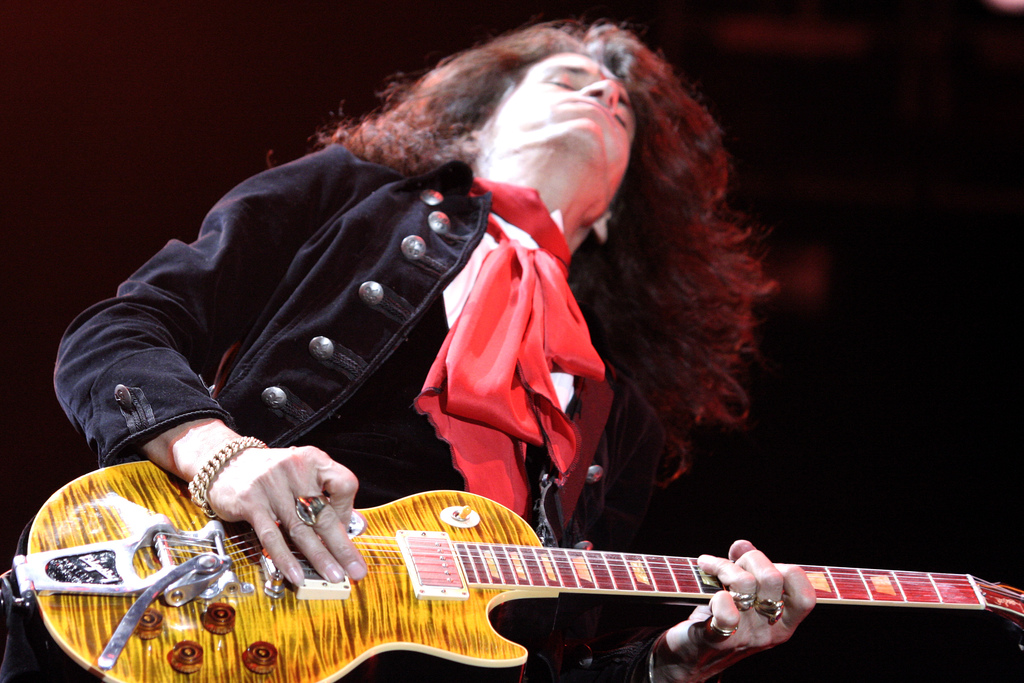
Happy Birthday, Joe Perry: The Riff Machine Who Gave Aerosmith Its Swagger
Joe Perry turns 76 today. From the swampy grind of “Sweet Emotion” to the reunion that saved a band, this is the career of the guitarist who taught American hard rock how to strut.
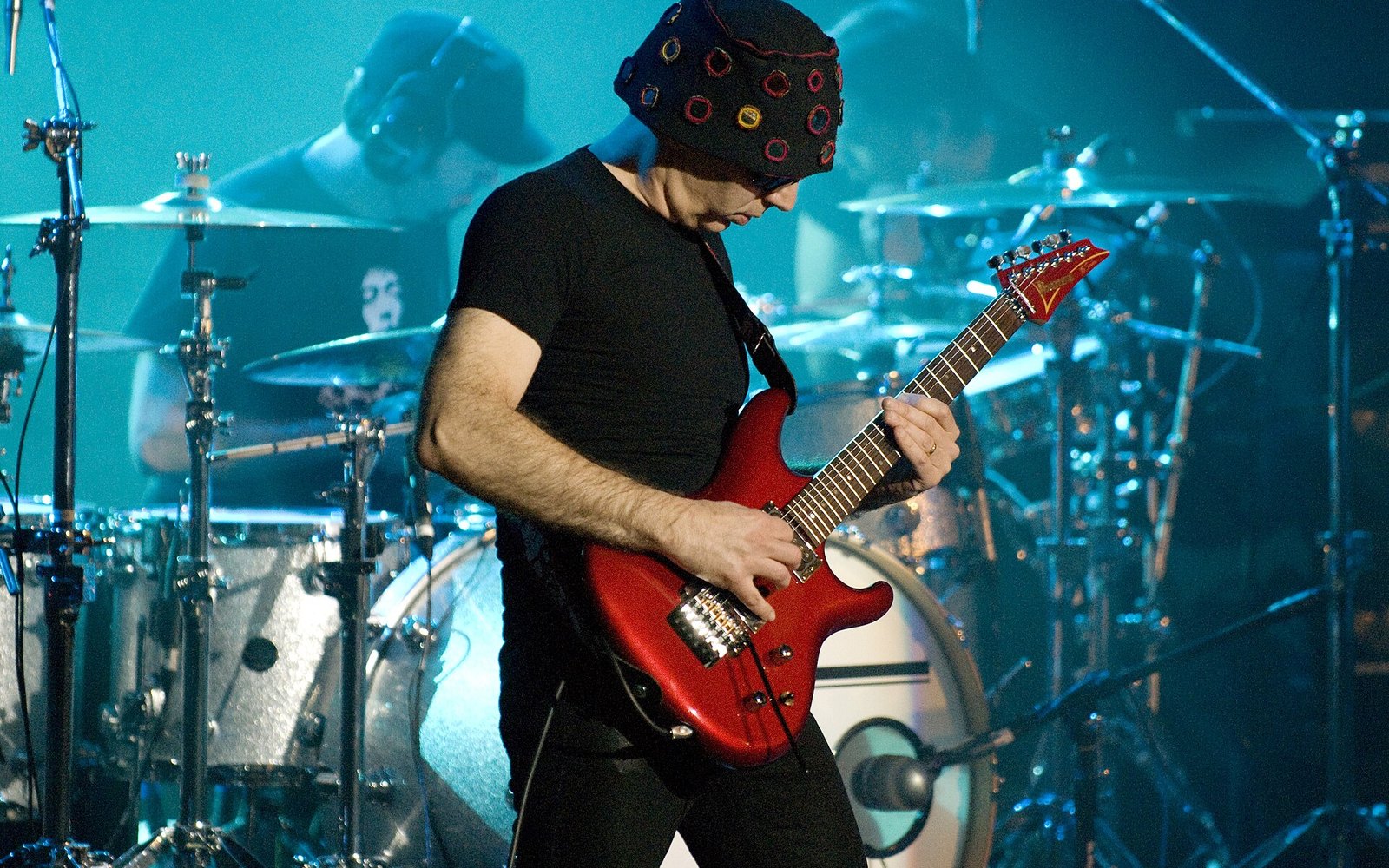
History of the Riff: How Joe Satriani Made “Flying in a Blue Dream” Feel Weightless
An acoustic guitar in an unusual tuning, a stray broadcast and a melody that seems to hang in the air: inside the construction of Satriani’s 1989 masterpiece.
Tony Iommi Opens Up About His Final Conversation With Ozzy Osbourne: “I Still Can't Get It in My Head”
The Black Sabbath guitarist says Ozzy was exhausted after the band's emotional farewell — but determined to give fans one final show.