The Ultimate Guide to Stevie Ray Vaughan: The Guitarist Who Brought the Blues Back to Life
Biography, gear, technique, tone secrets, top songs, and beginner tips for chasing the sound of the man who dragged the blues back into the spotlight.
Some links on this page may be affiliate links. As an Amazon Associate, The Guitar Plugged may earn from qualifying purchases at no additional cost to you.
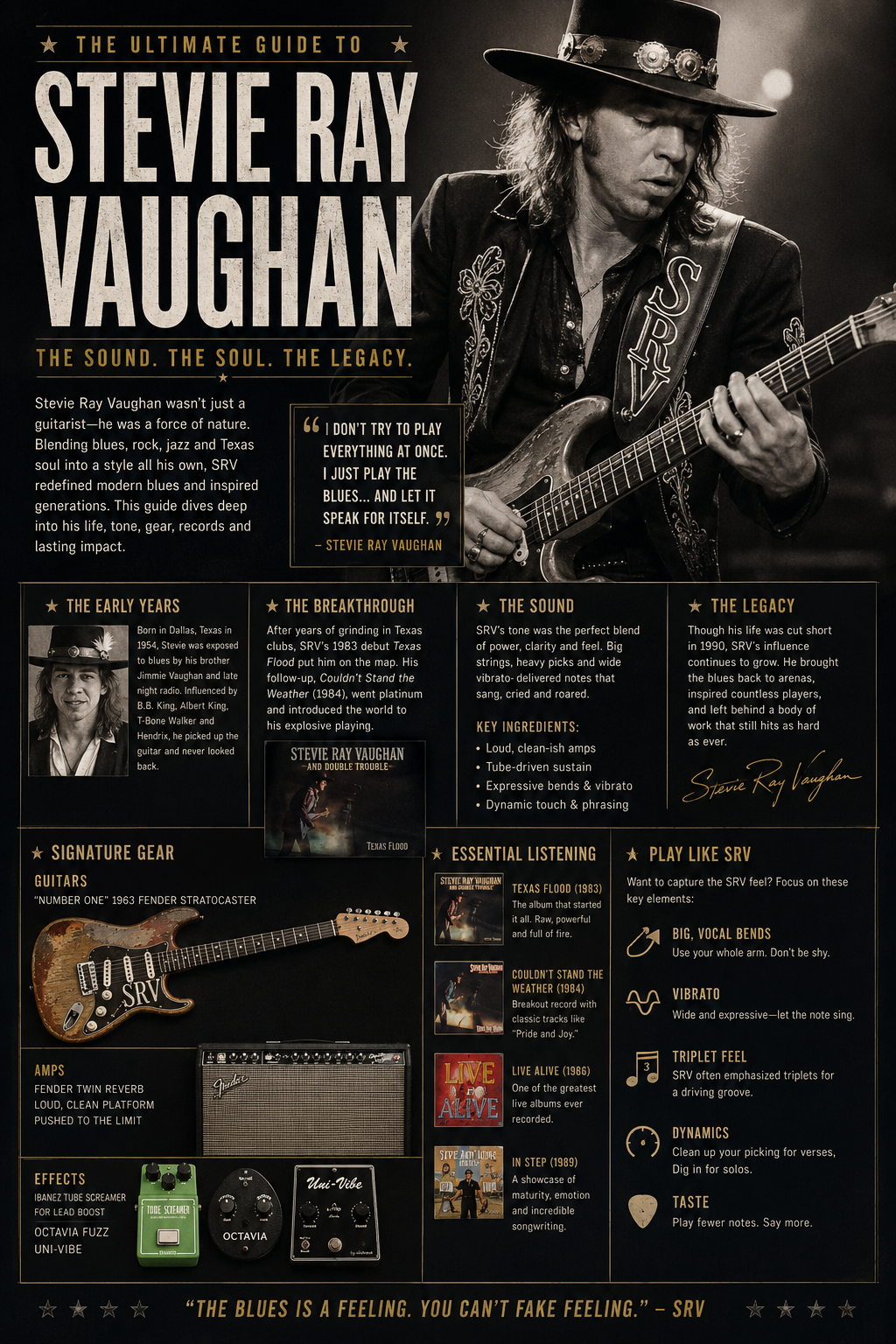
More than three decades after his passing, Stevie Ray Vaughan remains one of the most influential electric guitar players in history. His explosive combination of Texas blues, rock and roll energy, jaw-dropping technique, and emotional phrasing didn't just revive the blues — it inspired an entirely new generation of guitarists.
From his battered Stratocaster known as 'Number One' to his famously heavy strings and ferocious picking attack, every aspect of Vaughan's playing has become legendary.
This guide explores his life, career, gear, technique, tone, greatest recordings, and lasting influence.
Table of Contents
Early life, the Austin years, Texas Flood, David Bowie's Let's Dance, Couldn't Stand the Weather, Soul to Soul, In Step, addiction and recovery, Number One, full gear breakdown, amps, pedals, strings and picks, tone secrets, picking technique, left-hand technique, vibrato, double stops, raking, rhythm, top 15 songs, best live performances, greatest solos, fun facts, legacy, how to sound like Stevie today, and a long-tail FAQ.
Early Life in Dallas
Born in Dallas, Texas in 1954, Stevie Ray Vaughan was surrounded by music from an early age. Inspired heavily by his older brother Jimmie Vaughan, Stevie quickly became obsessed with guitar. By his teenage years he was already playing clubs around Texas and developing the fiery style that would later define his career.
The Austin Years
Austin's club scene became Stevie's laboratory. Playing night after night allowed him to blend influences from Albert King, B.B. King, Buddy Guy, Freddie King, Otis Rush, Jimi Hendrix, and Lonnie Mack. The result was something uniquely his own: blues played with rock intensity.
Rise to Fame
Stevie and Double Trouble — bassist Tommy Shannon and drummer Chris Layton — became the tightest power trio in Texas. A legendary 1982 Montreux Jazz Festival set caught the attention of Jackson Browne and David Bowie, and within months the band had a record deal and a session that would change Stevie's life.
Texas Flood Changed Everything
Released in 1983, Texas Flood instantly established Stevie as one of the greatest guitarists alive. Standout tracks include 'Pride and Joy,' 'Texas Flood,' 'Love Struck Baby,' 'Lenny,' and 'Dirty Pool.' His combination of explosive lead work and monster rhythm playing shocked audiences who hadn't heard blues played this aggressively in years.
David Bowie and the Turning Point
Before becoming a household name, Stevie played lead guitar on David Bowie's Let's Dance album. His solos immediately stood out. Although he ultimately declined touring with Bowie to focus on Double Trouble, the exposure introduced him to millions of listeners — and ironically, that decision is what launched his own legendary career.
Couldn't Stand the Weather (1984)
The follow-up cemented Stevie's status. The title track is one of the funkiest blues grooves ever recorded, and his cover of Jimi Hendrix's 'Voodoo Child (Slight Return)' is widely considered the definitive non-Hendrix version. 'Tin Pan Alley' and 'Cold Shot' became live staples for the rest of his career.
Soul to Soul (1985)
Adding keyboardist Reese Wynans, Soul to Soul leaned harder into soul and R&B. 'Look at Little Sister,' 'Change It,' and the instrumental 'Say What!' showed a band stretching beyond pure blues without ever losing the grit.
Addiction and Recovery
By the mid-80s, drugs and alcohol nearly killed him. After collapsing on tour in 1986, Stevie went to rehab and emerged sober — and arguably playing better than ever. The recovery is as much a part of his legacy as the music itself.
In Step (1989)
The first record written and recorded sober, In Step won the Grammy for Best Contemporary Blues Recording. 'Crossfire,' 'Tightrope,' and 'Riviera Paradise' are some of the most mature, emotionally honest performances of his career.
Get Stevie Ray Vaughan’s “Texas Flood” Tone
Tell ToneMD what guitar and gear you own and we’ll show you how to get as close as possible using the equipment you already have — full signal chain, real numbered settings, no guesswork.
Included with The Guitar Plugged Premium
Number One: The Most Famous Stratocaster Ever
Nicknamed 'First Wife,' Number One became one of the most iconic guitars ever built. Originally assembled from multiple vintage Fender parts, the instrument evolved continuously throughout Stevie's career. Characteristics included a sunburst finish, massive fret wear, a left-handed tremolo, heavy strings, years of modifications, and countless repairs. It remains one of the most recognizable Stratocasters in music history.
Stevie Ray Vaughan's Amplifiers
His massive tone wasn't coming from one amp. His live rigs often combined Fender Vibroverbs, Super Reverbs, Twin Reverbs, a Dumble Steel String Singer, and a Marshall Major. Running multiple loud amps simultaneously created incredible depth and punch.
Effects and Pedals
Despite the legendary tone, the pedalboard remained surprisingly simple. Core pedals included an Ibanez Tube Screamer (TS808 and TS9), a Dallas Arbiter Fuzz Face, a Vox Wah, a Uni-Vibe, an Octavia, and a rotating Leslie speaker. The Tube Screamer remains one of the defining ingredients of his sound.
The Heavy String Myth
Stevie famously used extremely heavy gauges — often reported as .013, .015, .019, .028, .038, .058. Combined with Eb tuning, these produced enormous tone and sustain. His massive hands and physical playing style allowed him to control them in ways few players could.
Don't start with .013s. Try a hybrid set of .011s in Eb tuning first. You'll get most of the tonal weight without destroying your fingers — or your guitar's neck.
The Secret Behind His Tone
It wasn't one pedal. It wasn't one amp. It wasn't one guitar. His sound came from an incredibly hard picking attack, dynamic touch, left-hand vibrato, heavy strings, loud tube amps, a Tube Screamer boost, natural compression, and exceptional timing. Most importantly: Stevie sounded like Stevie because of Stevie.

X Concepts Strings • Made in USA
Never Run Out of Strings Again.
Join the X Concepts String Club and get fresh USA-made strings delivered every month—plus Premium membership options for the full Guitar Plugged experience.
The Songs Every Guitar Player Should Hear
The shuffle that launched a thousand bar bands. A chord-melody rhythm disguised as a groove.
Slow blues perfection. The solo is a master class in dynamics, space, and vibrato.
Gentle, jazzy, and gorgeous — written for his wife, played on the Strat that bears her name.
Funky, sharp, and impossibly tight. The title track is pure Texas swagger.
The definitive non-Hendrix version. Wah, fuzz, and total commitment from start to finish.
Late-period SRV at his most patient and lyrical. A whispered conversation between guitar and amp.
The Gear Behind the Tone
The Rig — Decoded
Parts-Strat with a left-handed tremolo, jumbo frets, and decades of road wear. Heavy strings tuned to Eb.
Loud, clean, and on the edge of breakup. Two amps running together for depth and stereo width.
Low drive, tone at noon, level cranked. Used as a clean-ish boost to push the front end of the Fender amps.
Famously heavy. Combined with Eb tuning, they produce huge sustain and tone — at the cost of your fingertips.
Held upside down so the rounded edge hit the strings. Helped tame the attack just enough.
More tone came from how hard he hit the strings than from any pedal or amp on his stage.
Picking Technique
“Stevie sounded like Stevie because of Stevie. The Strat, the Tube Screamer, and the Super Reverb were just the delivery system.”
Every note exploded from the speakers. SRV picked from the wrist with a stiff Fender medium and dug in hard enough to break strings nightly. That violent attack is half the reason the Tube Screamer sounds the way it does in his hands.
Left Hand Technique
He fretted with thumb-over Hendrix-style grips, used his thumb to fret low E notes, and combined chords with melody constantly. His action was famously high, forcing him to play with authority on every note.
Vibrato
Wide, vocal-like vibrato became one of his signatures — fast, controlled, and as physical as his picking. If you only steal one thing from Stevie, steal the vibrato.
Double Stops
Borrowed heavily from Albert King and Hendrix, double-stop bends are everywhere in his rhythm and lead playing. They're what makes 'Pride and Joy' feel three players deep.
Raking
Muted strings dragged across with the pick before the target note — instant Texas attitude. Try it on the and-of-four into any blues lick.
Rhythm Playing
Stevie is one of the most underrated rhythm guitarists ever. 'Pride and Joy' alone is required study material for blues players — a shuffle that's actually a chord melody disguised as a groove.
Top 15 Essential Songs
Pride and Joy, Texas Flood, Lenny, Riviera Paradise, Couldn't Stand the Weather, Cold Shot, Tightrope, Scuttle Buttin', Life Without You, Mary Had a Little Lamb, Love Struck Baby, Empty Arms, Look at Little Sister, The Sky Is Crying, Little Wing.
Greatest Solos
Texas Flood, Little Wing, Riviera Paradise, Life Without You, Couldn't Stand the Weather, Voodoo Child (Slight Return), Lenny, and Leave My Girl Alone — eight performances that should be in every guitarist's listening rotation.
Best Live Performances to Watch
El Mocambo 1983, Austin City Limits, Montreux 1982, and Live at Carnegie Hall. Each performance showcases a different side of Stevie's brilliance — start with El Mocambo if you've never seen him play.
Interesting Facts
He tuned down a half step (Eb standard). He frequently broke strings due to his attack. He played with incredibly high action. He inspired generations of blues revivalists. His influence spans blues, country, rock, and even metal.
Influence on Modern Guitarists
John Mayer, Joe Bonamassa, Kenny Wayne Shepherd, Gary Clark Jr., Eric Gales, and Philip Sayce all carry pieces of Stevie's DNA. Every modern blues player owes him something — usually the vibrato.
How to Sound Like Stevie Today (Beginner-Friendly)
Start with a Strat-style guitar with decent single-coils. Tune down to Eb. Use .011 strings until your hands toughen up. Plug into any loud, clean Fender-voiced tube amp (or a modeler set to Super Reverb / Vibroverb). Put a Tube Screamer in front. Crank the amp until it breaks up, set the TS with low drive, tone around noon, and level high to slam the front end. The last and most important step: dig in.
FM3 / Quad Cortex / Headrush Starting Point
Load a Fender Super Reverb or Vibroverb model. Set Volume around 6, Treble 6, Mid 5, Bass 4, Reverb 3. Add a TS808 block before the amp — Drive 2, Tone 6, Level 8. Use a 4x10 Bassman cab IR with an SM57 cap edge. Light plate reverb. Bridge pickup. Pick hard.
Legacy
Very few musicians changed the direction of guitar history. Stevie Ray Vaughan did. At a time when synthesizers dominated popular music, he reminded the world that six strings plugged into loud tube amps could still be the most exciting sound on Earth. Modern players across virtually every genre continue to study his phrasing, feel, and tone.
Final Thoughts
Stevie Ray Vaughan wasn't simply a great blues guitarist — he was one of the greatest electric guitarists of all time. His combination of technical brilliance, emotional expression, and unmistakable tone created a legacy that continues to inspire millions of players worldwide. Whether you're chasing his sound, studying his phrasing, or discovering his music for the first time, one thing becomes obvious almost immediately: nobody sounded like Stevie.
Frequently Asked Questions
What strings did Stevie Ray Vaughan use? GHS Nickel Rockers in extra heavy gauges — typically .013, .015, .019p, .028, .038, .058 — tuned to Eb standard.
What amp did Stevie Ray Vaughan play? Mostly vintage Fender Vibroverbs and Super Reverbs, often run in pairs, with a Dumble Steel String Singer and Marshall Major for additional power on bigger stages.
Why did Stevie tune down a half step? It made his heavy strings easier to bend, took some tension off his hands, fit his vocal range, and gave his tone an extra layer of weight and warmth.
What pedal did Stevie Ray Vaughan use most? The Ibanez Tube Screamer (TS808 and later TS9) as a clean-ish boost into already-loud Fender amps.
How can I sound like Stevie Ray Vaughan? Strat-style guitar, Eb tuning, heavier strings than you think you need, a Tube Screamer in front of a loud Fender-voiced amp, and — most importantly — aggressive picking and wide vibrato. Tone is in the hands first.
What guitar was Number One? A 1962/1963 Fender Stratocaster assembled from mixed-year parts, featuring a left-handed tremolo and heavily worn sunburst finish.
Was Stevie Ray Vaughan self-taught? Largely yes — he learned by ear, copying records by Albert King, Hendrix, and his brother Jimmie Vaughan.
What to Remember
- ▸SRV revived the blues at a time when synth-pop dominated the charts.
- ▸His tone came from heavy strings, Eb tuning, hard picking, and loud Fender tube amps.
- ▸Number One was a parts-Strat that became one of the most iconic guitars in history.
- ▸The Ibanez Tube Screamer is the single most affordable piece of his signature sound.
- ▸Vibrato, dynamics, and rhythm playing matter more than any pedal you can buy.
- Ibanez TS9 Tube Screamer$109·Check on Amazon →
- Fender Player Stratocaster$849·Check on Amazon →
- GHS Nickel Rockers (Heavy)$8·Check on Amazon →
- Dunlop Cry Baby Wah$99·Check on Amazon →
Some links are affiliate links — we may earn a small commission at no cost to you.
Experience-driven coverage, not algorithm bait.
- 20+ years of guitar playing experience
- Real-world retail experience at Guitar Center
- Thousands of hours testing guitars, amps, and pedals
- A community of 50,000+ guitar enthusiasts across platforms
- Partnerships with Fender, DistroKid, TrueFire, Card Chords, and Enya
- Editorial standards published openly — see how we test gear
The Modern Guitar Magazine. Delivered to your inbox.
No spam. No gimmicks. Just great guitar content — stories, tones, iconic solos, and honest gear takes. Every week.
Ask GP
3 free questions a dayStill curious? Ask GP about this story.
Your personal classic-rock and guitar guide — ask anything about The Ultimate Guide to Stevie.
Discussion (0)
Sign in to join the discussion.
Sign in to commentLoading comments…
Discover another guitar story
Swipe through our latest features, breaking news and iconic solos — one story at a time.
Open Swipe →More in Guitar Talk
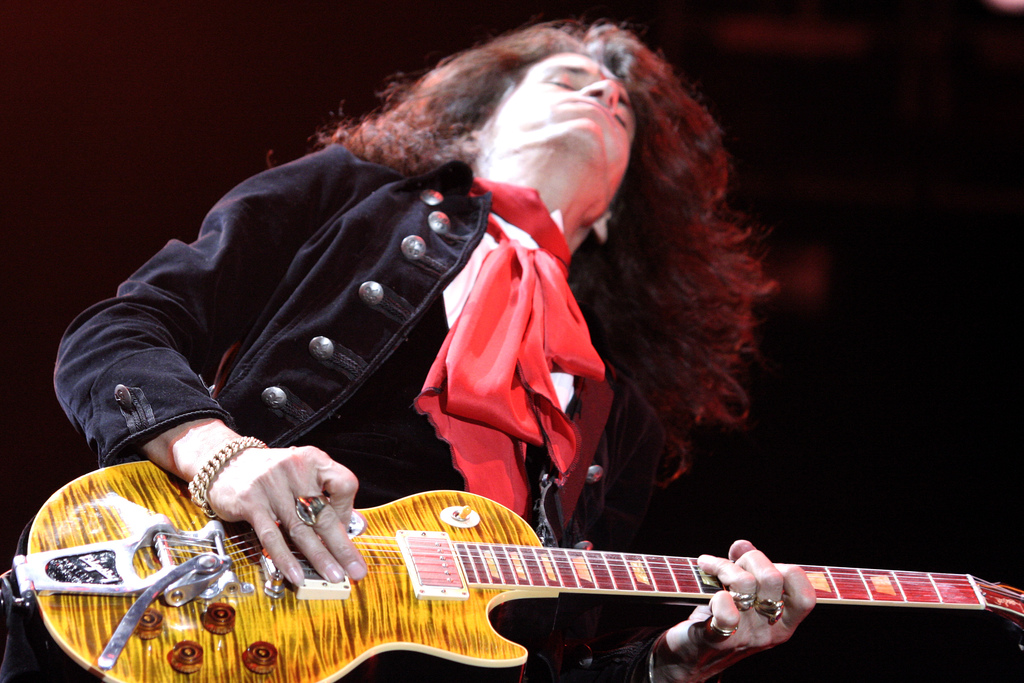
Happy Birthday, Joe Perry: The Riff Machine Who Gave Aerosmith Its Swagger
Joe Perry turns 76 today. From the swampy grind of “Sweet Emotion” to the reunion that saved a band, this is the career of the guitarist who taught American hard rock how to strut.
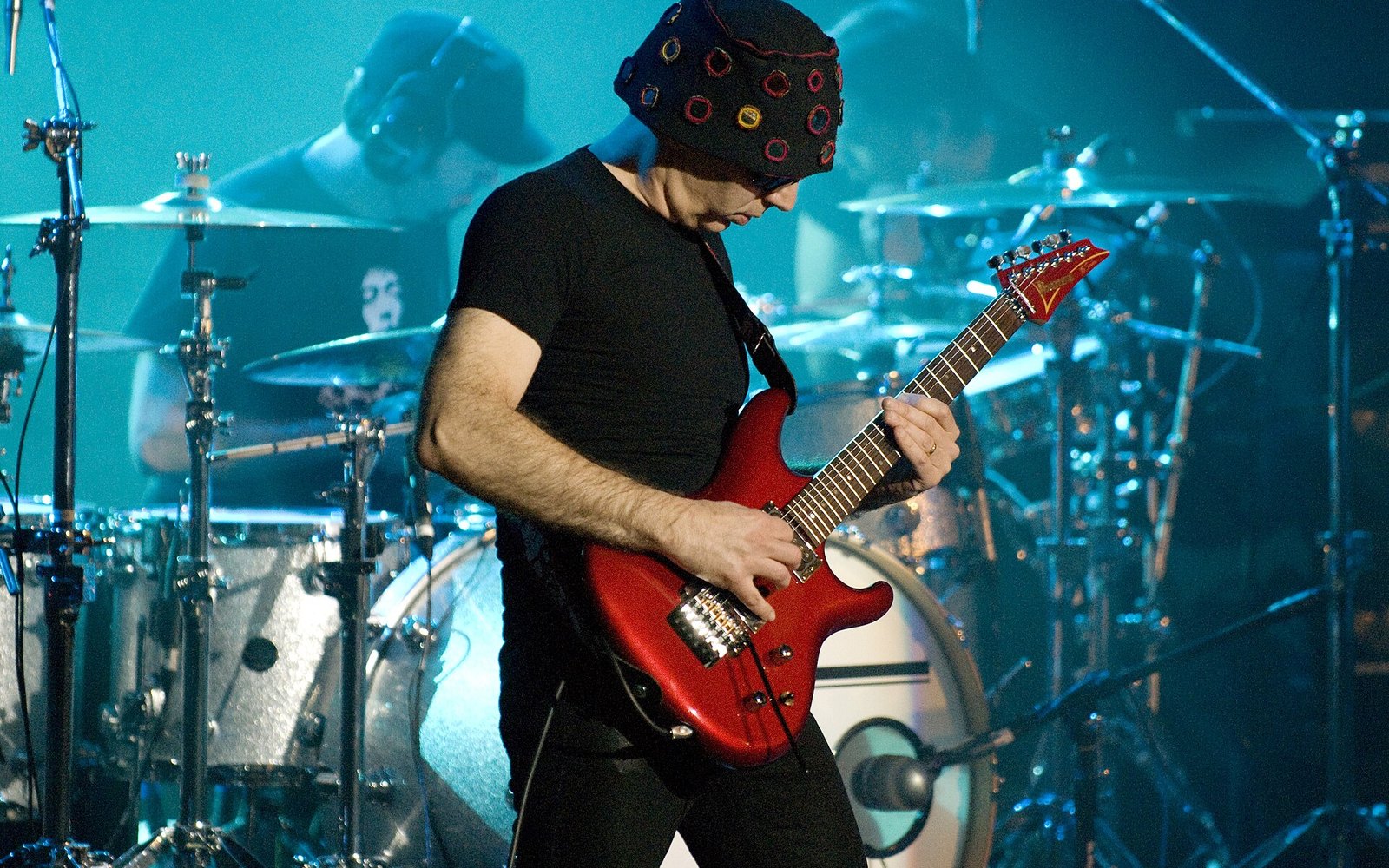
History of the Riff: How Joe Satriani Made “Flying in a Blue Dream” Feel Weightless
An acoustic guitar in an unusual tuning, a stray broadcast and a melody that seems to hang in the air: inside the construction of Satriani’s 1989 masterpiece.
Tony Iommi Opens Up About His Final Conversation With Ozzy Osbourne: “I Still Can't Get It in My Head”
The Black Sabbath guitarist says Ozzy was exhausted after the band's emotional farewell — but determined to give fans one final show.