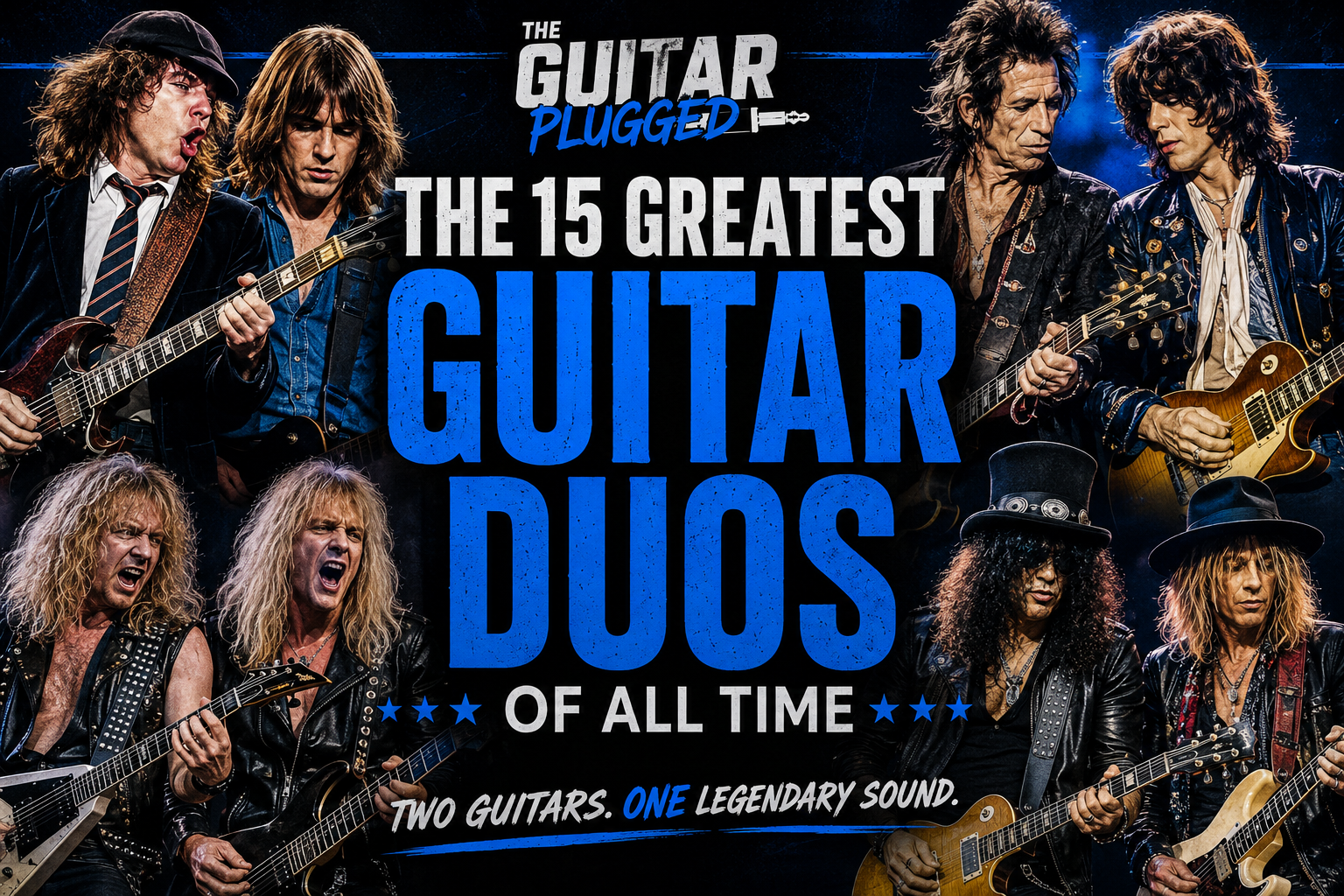
The 15 Greatest Guitar Duos of All Time — When Two Guitars Became One Sound
Rock history is full of guitarists who became greater because of the person standing on the other side of the stage. These are the 15 partnerships that changed the sound of electric guitar.
There are great guitarists, and then there are guitarists who become greater because of the person standing on the other side of the stage.
Rock history is full of them.
One guitarist finds the pocket while the other tears across the fretboard. One writes the riff while the other discovers the harmony that makes it unforgettable. Sometimes their styles fit together perfectly. Sometimes they seemingly shouldn't fit together at all — and that's precisely why they work.
For this list, we're not simply picking the 15 best pairs of guitarists who happened to play in the same band.
We're ranking guitar partnerships.
Chemistry matters. Influence matters. Songs matter. And most importantly, we're asking a simple question: How much of the band's identity disappears when you separate these two players?
By that standard, one pair stands above everybody else.
What to Remember
- ▸Great guitar partnerships are built on complementary roles, not two players competing for space.
- ▸AC/DC's Angus and Malcolm Young top the list for how perfectly their two jobs fit together.
- ▸Thin Lizzy, Iron Maiden and Judas Priest helped define harmonized twin-guitar playing in rock and metal.
- ▸The Rolling Stones' Keith Richards and Mick Taylor produced some of the band's most celebrated guitar work.
- ▸Television's Tom Verlaine and Richard Lloyd proved two guitars could weave without traditional rhythm/lead divisions.
Here's the countdown, from 15 to 1.
15. Billy Gibbons & Dusty Hill — ZZ Top
Yes, we're bending the rules immediately.
Dusty Hill was a bassist, not the second guitarist in ZZ Top, but listen to the way Hill and Billy Gibbons operated and you'll understand the inclusion. They were essentially two halves of one enormous Texas groove.
Gibbons' guitar playing has always been a masterclass in restraint. His tone could be huge, but his parts rarely became cluttered. Hill occupied the space around him, locking with Frank Beard and allowing Gibbons' riffs to breathe.
That's why something as seemingly simple as "La Grange" feels so enormous.
Later, when ZZ Top incorporated synthesizers and heavily processed production on records like Eliminator, that relationship remained intact. Underneath the technology was still that same pocket.
Essential listen: La Grange, Tush, Sharp Dressed Man, Gimme All Your Lovin'
14. Tom Scholz & Barry Goudreau — Boston
Boston's debut album is one of the great guitar records.
Not because it's filled with endless shredding, but because Tom Scholz approached guitar almost architecturally.
Parts were stacked, harmonized and meticulously arranged until the guitars sounded enormous without becoming muddy.
Barry Goudreau was an important part of that equation.
Listen to "More Than a Feeling." The guitar isn't merely accompaniment. Every layer has a purpose. The distorted guitars, clean passages, harmonies and leads are arranged almost like an orchestra.
Scholz would ultimately become synonymous with the Boston sound — and with the technology he developed to create it — but the early Scholz/Goudreau combination deserves recognition among rock's great guitar partnerships.
Essential listen: More Than a Feeling, Peace of Mind, Foreplay/Long Time
13. Jeff Hanneman & Kerry King — Slayer
Pretty was never the point.
Jeff Hanneman and Kerry King sounded dangerous.
Where some twin-guitar bands built their identity around perfectly synchronized harmonies, Slayer frequently used two guitars to create controlled chaos.
The riffs were brutally precise. The solos could sound almost unhinged.
And somehow it worked.
Hanneman was responsible for some of Slayer's most important material, while King's instantly recognizable playing and visual presence became inseparable from the band.
Together, they helped establish a guitar language that generations of extreme-metal players would borrow from.
Put on "Angel of Death" or "Raining Blood" and it's difficult to imagine those songs having the same impact with a more conventional guitar approach.
Essential listen: Raining Blood, Angel of Death, South of Heaven, War Ensemble
12. Gary Rossington & Allen Collins — Lynyrd Skynyrd
Lynyrd Skynyrd famously expanded beyond a traditional two-guitar lineup, particularly with the addition of Ed King, but Gary Rossington and Allen Collins remained central to the band's guitar identity.
Collins brought a fiery lead-guitar personality. Rossington could deliver riffs and slide guitar parts that were immediately recognizable.
And then there's "Free Bird."
That outro has become so culturally ubiquitous that it's easy to forget just how outrageous it is. The song spends several minutes building tension before finally exploding into one of rock's great extended guitar climaxes.
But reducing Skynyrd to "Free Bird" misses the point.
From "Tuesday's Gone" to "Simple Man" and "Gimme Three Steps," the band's guitar arrangements demonstrated how multiple players could occupy the same musical space without turning everything into noise.
Essential listen: Free Bird, Simple Man, Tuesday's Gone, Gimme Three Steps
11. Tom Verlaine & Richard Lloyd — Television
This is probably the selection that will surprise some readers.
It shouldn't.
Television's Marquee Moon remains one of the great examples of what two electric guitars can do when neither player accepts the traditional "rhythm guitarist/lead guitarist" division.
Tom Verlaine and Richard Lloyd intertwined.
One part might begin as accompaniment and suddenly become melodic. Another might disappear completely, creating room for the other guitarist.
The title track is the masterpiece.
"Marquee Moon" unfolds gradually, with guitar lines weaving around each other instead of simply stacking chords underneath a solo.
You can hear echoes of that approach throughout alternative rock, indie rock and post-punk.
Not every influential guitar duo needed Marshall stacks.
Essential listen: Marquee Moon, See No Evil, Venus
10. Don Felder & Joe Walsh — Eagles
Sometimes one song is enough to guarantee immortality.
Felder and Walsh obviously contributed far more to the Eagles than "Hotel California," but that outro alone belongs in any serious discussion about dual-guitar playing.
The brilliance isn't simply the solos. It's the conversation.
Felder and Walsh trade phrases before eventually joining together in the famous harmonized section. The parts are melodic enough that millions of people who have never touched a guitar can essentially sing them.
That's difficult to achieve.
Walsh brought a rawer rock personality into the Eagles. Felder brought precision, composition and his own distinctive melodic sense.
Their differences created tension — musically and, eventually, personally — but when it worked, the results were spectacular.
Essential listen: Hotel California, Victim of Love, Life in the Fast Lane
9. James Hetfield & Kirk Hammett — Metallica
James Hetfield may be the greatest rhythm guitarist in metal history.
Get AC/DC’s “Back in Black” Tone
Tell ToneMD what guitar and gear you own and we’ll show you how to get as close as possible using the equipment you already have — full signal chain, real numbered settings, no guesswork.
Included with The Guitar Plugged Premium
That's what makes this partnership unusual.
In many bands, the rhythm guitarist exists largely to support the lead player. In Metallica, Hetfield's rhythm playing is frequently the main event.
His downpicking, timing and ability to make complicated riffs feel impossibly heavy created the foundation.
Kirk Hammett had to find a way to exist on top of that.
He did.
From the melodic solo in "Fade to Black" to the wah-drenched aggression that became one of his trademarks, Hammett gave Metallica a contrasting lead voice.
The combination became one of heavy music's most commercially successful guitar partnerships.
Hetfield supplies the machine. Hammett supplies the volatility.
Essential listen: Master of Puppets, One, Fade to Black, Creeping Death
Want to Chase Their Guitar Sounds?
Knowing the notes is only half the battle.
ToneMD is built around the other half: figuring out how to get closer to the sound.
Choose the guitarist or tone you're chasing, tell ToneMD what guitar, pickups, amp/modeler or plugin you're actually using, and build a practical starting point around your rig rather than copying settings designed for somebody else's equipment.
Whether you're chasing Hetfield's crushing rhythm sound, Angus Young's open Marshall roar or Slash's singing lead tone, the goal isn't to own the exact museum-piece rig. It's to understand what makes the sound work.
8. Slash & Izzy Stradlin — Guns N' Roses
Slash became the guitar hero. Izzy Stradlin made it possible for him to be one.
That's an oversimplification, but there's truth in it.
Early Guns N' Roses had a looseness that disappeared from much of mainstream rock during the highly polished late-'80s era.
Izzy's rhythm playing was a major reason why.
He wasn't trying to compete with Slash.
Instead, Stradlin brought a Stones-like sense of groove and restraint while Slash occupied the larger melodic spaces.
Listen closely to Appetite for Destruction and you'll hear how frequently the guitars are doing subtly different things.
That's the magic.
Slash's Les Paul-through-Marshall vocabulary became iconic, but without Izzy's rhythm guitar sitting underneath it, those early records would feel very different.
Essential listen: Welcome to the Jungle, Mr. Brownstone, Paradise City, Rocket Queen
Gear Pick: Players chasing Slash-style territory don't necessarily need vintage equipment. A humbucker-equipped Les Paul-style guitar into a British-voiced amp remains the classic starting point.
7. Dave Murray & Adrian Smith — Iron Maiden
There may be no sound more immediately associated with classic heavy metal than harmonized electric guitars.
Iron Maiden perfected it.
Dave Murray's smooth, fluid lead playing and Adrian Smith's more composed, melodic approach created an extraordinary partnership.
They could trade solos. They could harmonize. They could double riffs.
Most importantly, you could often tell who was playing without looking at the credits.
That's the mark of great chemistry.
Smith's songwriting contributions also became increasingly important to Maiden, helping create material such as "Wasted Years," while Murray remained one of the band's defining instrumental voices.
Iron Maiden eventually expanded to three guitars after Smith returned alongside Janick Gers, but the Murray/Smith partnership remains foundational.
Essential listen: The Trooper, Wasted Years, 2 Minutes to Midnight, Powerslave
6. Brian Robertson & Scott Gorham — Thin Lizzy
Before harmonized guitars became a metal cliché, Thin Lizzy demonstrated just how powerful the concept could be.
Scott Gorham and Brian Robertson weren't merely doubling each other.
Their guitar parts could separate, intersect and then suddenly lock into harmony.
“The greatest guitar duos rarely consist of two players trying to do the same thing. Their differences were the point.”
"The Boys Are Back in Town" is the obvious example, but dig deeper into Thin Lizzy's catalog and the sophistication becomes clearer.
Their harmonized lines influenced generations of guitar bands that followed, particularly in hard rock and heavy metal.
Iron Maiden's twin-guitar vocabulary didn't appear from nowhere.
Neither did countless other bands that discovered the enormous sound produced by two overdriven guitars playing harmonized melodies.
Thin Lizzy helped write the manual.
Essential listen: The Boys Are Back in Town, Emerald, Cowboy Song
5. Joe Perry & Brad Whitford — Aerosmith
Joe Perry gets the photographs. Brad Whitford deserves far more of the credit.
Aerosmith's guitar sound has always depended on the interaction between them.
Perry brings swagger, riffs and a bluesy looseness. Whitford is a remarkably tasteful player whose precision and lead work often quietly elevate the song.
The fascinating thing about Aerosmith is that casual listeners sometimes assume Perry played every famous guitar moment.
He didn't.
That's precisely why Whitford belongs in this conversation.
The band had two legitimate lead guitarists who understood when not to play like lead guitarists.
That restraint is part of why the classic Aerosmith records groove as hard as they do.
Essential listen: Last Child, Back in the Saddle, Sweet Emotion, Walk This Way
4. Glenn Tipton & K.K. Downing — Judas Priest
If Thin Lizzy helped establish the twin-guitar vocabulary, Judas Priest weaponized it for heavy metal.
Glenn Tipton and K.K. Downing could harmonize, trade solos and attack riffs from slightly different angles.
Their visual presentation mattered, too. Two guitarists on opposite sides of the stage, both armed with angular guitars and stacks of amplification, became part of what heavy metal was supposed to look like.
But beneath the image was serious musicianship.
Priest's catalog contains countless examples of Tipton and Downing turning guitar arrangements into hooks.
"Breaking the Law." "Electric Eye." "You've Got Another Thing Comin'." "Painkiller."
The guitars weren't decoration. They were the architecture.
Essential listen: Electric Eye, The Hellion, Breaking the Law, You've Got Another Thing Comin'
3. Duane Allman & Dickey Betts — The Allman Brothers Band
Duane Allman and Dickey Betts didn't sound alike. Thank God.
Duane's slide guitar could sound vocal — sometimes beautiful, sometimes almost violent.
Betts brought a more lyrical melodic vocabulary with strong country, blues and jazz influences.
Together, they helped redefine what improvisational rock guitar could be.
Their harmony playing became hugely influential, but their real magic emerged when the songs opened up.
The Allman Brothers could stretch a performance far beyond the studio arrangement without making it feel like pointless noodling.
The guitarists listened. They responded. They pushed each other.
That distinction matters.
Great improvisation isn't two musicians playing as many notes as possible. It's conversation.
Duane and Dickey were having one of rock's greatest conversations.
Essential listen: Whipping Post, In Memory of Elizabeth Reed, Statesboro Blues, Blue Sky
2. Keith Richards & Mick Taylor — The Rolling Stones
There have been several important guitar partnerships in the Rolling Stones.
Keith Richards and Brian Jones built the original sound. Richards and Ronnie Wood developed their famous "ancient art of weaving."
But the Mick Taylor era was different.
Taylor was a stunning lead guitarist — fluid, melodic and technically accomplished without sounding sterile.
Richards was almost his opposite.
Keith's genius has never depended upon technical perfection. It's about riffs, rhythm, timing and knowing exactly where a guitar belongs inside a song.
Put those two approaches together and you get one of the Stones' most celebrated periods.
Sticky Fingers. Exile on Main St. The live performances from that era could be extraordinary because Taylor had room to stretch while Richards kept the entire machine moving.
Taylor gave the Stones something they never quite had before or after him. Richards gave Taylor the perfect canvas.
Essential listen: Can't You Hear Me Knocking, Sway, Tumbling Dice, Midnight Rambler
1. Angus Young & Malcolm Young — AC/DC
This is what a guitar duo is supposed to be.
Not two players fighting for attention. Not two virtuosos attempting to outplay each other.
Two musicians doing completely different jobs in service of one enormous sound.
Angus Young became one of the most recognizable guitar heroes in history. The schoolboy uniform. The Gibson SG. The duckwalk. The vibrato. The screaming blues-rock solos.
But behind Angus was Malcolm. And Malcolm Young may have been the secret weapon of AC/DC.
His rhythm playing was brutally economical. He didn't bury riffs beneath excessive gain. He didn't fill every available space. He hit chords with astonishing authority and left room around them.
That space is everything.
Listen to "Back in Black." There's air between those chords. That's part of why the riff sounds gigantic.
The Young brothers' rigs reflected that division as well. Angus became inseparable from the Gibson SG, while Malcolm's heavily modified 1963 Gretsch Jet Firebird — "The Beast" — became his signature instrument. Modern recreations of Malcolm's guitar even reproduce its stripped-down pickup layout.
Even their string choices reflected their jobs. Angus historically used lighter strings for lead work while Malcolm favored heavier gauges, appropriate for the sheer physical force of his rhythm playing.
That's the fascinating thing about AC/DC tone. People hear those records and assume there must be mountains of distortion. There aren't. The sound comes from volume, dynamics, guitars, amplifiers and — critically — the hands. Malcolm's guitar tech described his sound as the combination of his hands, Gretsch, Marshalls and cabinets, with Malcolm hitting the instrument exceptionally hard.
Angus created excitement. Malcolm created gravity. And when Angus exploded into a solo, Malcolm didn't suddenly become less important. His playing made Angus sound bigger because the foundation never disappeared.
That's why they're No. 1.
You can find guitarists who play faster. You can find guitarists who use more sophisticated harmony. You can find duos with more technically complicated arrangements. But it's difficult to find two guitarists whose individual roles fit together more perfectly.
AC/DC didn't need more. They needed Angus and Malcolm Young.
Essential listen: Back in Black, Riff Raff, Let There Be Rock, Highway to Hell, Whole Lotta Rosie
Get Closer to the Young Brothers' Sound
If you're trying to recreate AC/DC tone, resist the temptation to drown everything in gain.
Start with a humbucker-equipped guitar, a British-style amp, moderate drive and far more volume and pick attack than you might expect.
Then use ToneMD to translate that philosophy to the gear you actually own.
The Gear
For Angus territory, the SG is the obvious starting point. Players on a smaller budget can get into the general format with an Epiphone SG, while used Gibson SGs provide plenty of options farther up the ladder.
And if you're completely committed to Malcolm's side of the equation, Gretsch currently produces the G6131-MY Malcolm Young Signature Jet, modeled after his famous modified '63 Jet Firebird.
Affiliate disclosure: Some gear links on TheGuitarPlugged are affiliate links. We may earn a commission from qualifying purchases at no additional cost to you.
What Actually Makes a Great Guitar Duo?
After going through this list, a pattern emerges.
The greatest guitar duos rarely consist of two players trying to do the same thing.
Malcolm didn't need to become Angus. Izzy didn't need to become Slash. Hetfield didn't need to become Hammett. Murray didn't need to become Smith.
Their differences were the point.
Two-guitar bands become interesting when each guitarist develops an identity inside the arrangement. One might play higher inversions while the other stays low. One might use less gain. One might play straight while the other swings. One might leave enormous amounts of space while the other fills it.
And sometimes the most important guitar part isn't the one anybody notices.
That's something worth remembering the next time you're playing with another guitarist.
Stop trying to sound bigger than each other. Try to make each other sound bigger. That's what the great ones did.
Who Did We Miss?
Now comes the dangerous part.
Where do Dave Mustaine & Marty Friedman belong? What about Steve Clark & Phil Collen? Keith Richards & Ronnie Wood? Gary Holt & Rick Hunolt?
And should a different version of the Rolling Stones have made the Top 15?
We know nobody is going to agree with every ranking. That's the fun of it.
Drop your greatest guitar duo of all time in the comments — and tell us which ranking we got completely wrong.
Which guitar duo should be number one?
Tap your pick. One vote per reader.
Keep Reading
Frequently Asked Questions
- What makes a great guitar duo?
- The best guitar partnerships are built on complementary roles. One player might hold the rhythm foundation while the other handles melody, or two players may harmonize and weave around each other. The key is that the whole becomes greater than the sum of its parts.
- Why are Angus and Malcolm Young number one?
- Angus and Malcolm Young represent a near-perfect division of labor. Angus supplied the iconic lead voice and stage energy; Malcolm supplied the enormous, spacious rhythm foundation that made Angus sound bigger. Their roles were completely different but inseparable.
- Is this list limited to two-guitar bands?
- Not strictly. We include partnerships where the guitar interaction was central, even if one partner played bass, as with ZZ Top's Billy Gibbons and Dusty Hill.
- What is twin-guitar harmony?
- Twin-guitar harmony is when two guitarists play different notes at the same time to create an interval or chord effect. Thin Lizzy, Iron Maiden and Judas Priest all made it a signature element of their sound.
- Who else could have made the list?
- Dave Mustaine and Marty Friedman, Steve Clark and Phil Collen, Keith Richards and Ronnie Wood, and Gary Holt and Rick Hunolt are all commonly mentioned as duos that could be argued onto a list like this.
A note on these rankings: this list is an editorial opinion, assembled by The Guitar Plugged's editors and intended to spark discussion among guitar fans. It is not a scientific measurement, a chart or a definitive verdict. Reasonable people will disagree — loudly — and that conversation is the entire reason we published it.
- Gibson SG StandardCheck price·Check on Amazon →
- Gretsch G6131-MY Malcolm Young Signature JetCheck price·Check on Amazon →
Some links are affiliate links — we may earn a small commission at no cost to you.
Duos Worth Chasing
Some links may be affiliate links. We may earn a small commission at no cost to you.
Sources & further reading
Experience-driven coverage, not algorithm bait.
- 20+ years of guitar playing experience
- Real-world retail experience at Guitar Center
- Thousands of hours testing guitars, amps, and pedals
- A community of 50,000+ guitar enthusiasts across platforms
- Partnerships with Fender, DistroKid, TrueFire, Card Chords, and Enya
- Editorial standards published openly — see how we test gear
The Modern Guitar Magazine. Delivered to your inbox.
No spam. No gimmicks. Just great guitar content — stories, tones, iconic solos, and honest gear takes. Every week.
Ask GP
3 free questionsQuestions about The 15 Greatest Guitar Duos?
Get a straight answer from The Guitar Plugged's knowledge engine.
Discussion (0)
Sign in to join the discussion.
Sign in to commentLoading comments…
Discover another guitar story
Swipe through our latest features, breaking news and iconic solos — one story at a time.
Open Swipe →More in Best Of Lists
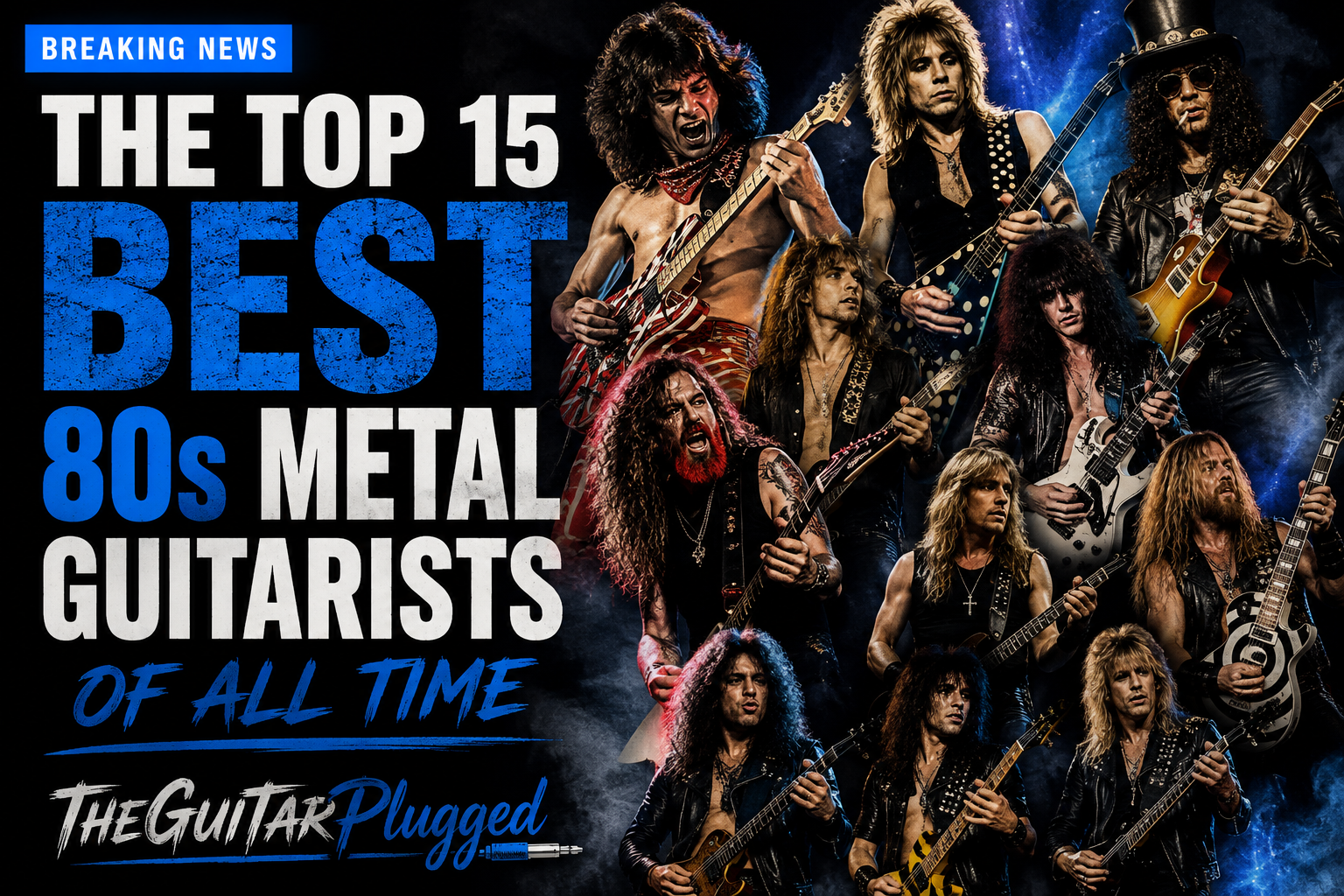
The 15 Best '80s Metal Guitarists of All Time
From Eddie Van Halen and Randy Rhoads to George Lynch, Steve Vai and Dimebag Darrell, these are the players who made an entire generation want to turn the gain up.

20 Easy Guitar Riffs That Sound Way Harder Than They Are
Great riffs are not necessarily complicated riffs. Some of rock's most recognisable guitar moments are built from two strings, three chords and a rhythm that refuses to let go. Here are twenty of them — and how to make each one sound like the record.
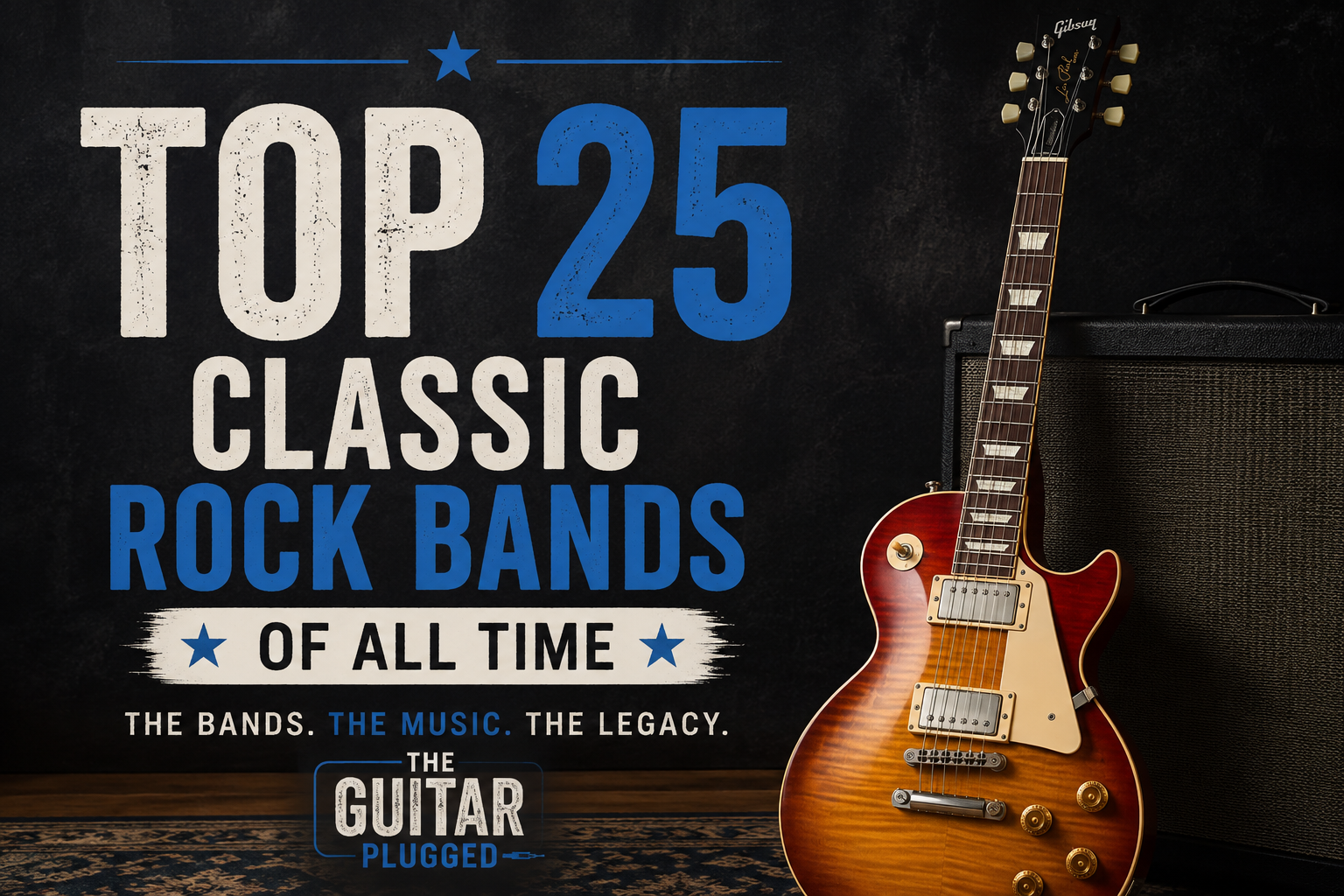
Top 25 Classic Rock Bands of All Time
From Led Zeppelin and the Rolling Stones to Rush and the Allman Brothers, these are the 25 classic rock bands that shaped everything that followed — ranked on influence, songwriting, musicianship, longevity and legacy.