
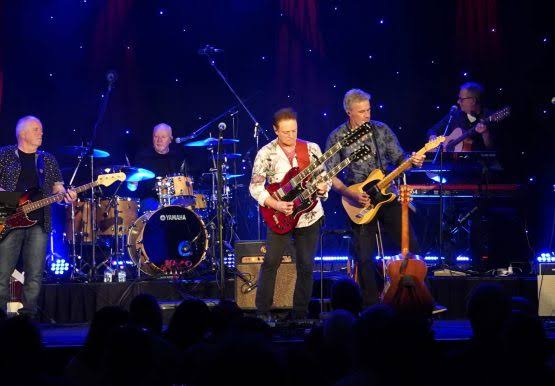
The Story Behind the "Hotel California" Guitar Solo: How Don Felder and Joe Walsh Created Rock's Greatest Guitar Duel
Nearly five decades on, the final minutes of the Eagles' "Hotel California" still stop guitarists in their tracks. Inside the composition, tone, and interplay of Don Felder and Joe Walsh's legendary dual-guitar finale.
Ask a room full of guitar players to name the greatest solo ever recorded and you'll get a fistfight. Ask them to name the greatest dual-guitar solo, and the argument shortens considerably. "Hotel California" almost always ends up on the short list — usually at the top of it.
The song has been playing on rock radio since 1976. It has been covered, parodied, misinterpreted and stitched into more late-night car rides than any of us can count. And yet the final two minutes remain remarkable. Not because the notes are impossible. Not because it's the fastest thing anyone has ever heard. But because two very different guitar players — Don Felder and Joe Walsh — take turns having a conversation and eventually finish each other's sentences in perfect thirds.
This isn't one guitarist showing off. It's composition. It's chemistry. It's the sound of two personalities agreeing, on tape, forever.
[TOC]
The Song Before the Solo
"Hotel California" started life as a demo Don Felder made on a rented beach house cassette deck in Malibu, sometime in 1976. Felder has said in multiple interviews that he was working out ideas on a 12-string acoustic when the progression that would become the song's foundation surfaced. He passed a cassette of instrumental sketches to Don Henley and Glenn Frey, one of which the band nicknamed "Mexican Reggae" for its unusual feel — a hint at the atmosphere the finished record would carry.
Henley took the music and, together with Frey, built the now-famous lyric around it. The song's chord progression — a minor-key journey through Bm–F#–A–E–G–D–Em–F# — moves in a way most classic rock records simply don't. There is no lazy I–IV–V home base to lean on. Every chord change opens a new door, which turns out to be exactly the harmonic landscape a soloist needs if the goal is a moving, melodic performance rather than a pentatonic sprint.
By the time the Eagles brought "Hotel California" into the studio for the album of the same name, the arrangement had grown to accommodate two lead guitarists. Bernie Leadon had left the band in 1975, and Joe Walsh — already a solo star and a former member of the James Gang and Barnstorm — had joined. That single lineup change reshaped what the Eagles could do with electric guitars.
Don Felder and Joe Walsh: The Perfect Guitar Partnership
On paper, Felder and Walsh shouldn't work together. In practice, that's precisely why they do.
Felder is the architect. His playing on the Eagles' records — and on his own demos — leans on melodic construction, precise bends, and a keen sense of where each phrase belongs inside a bar. His slide work draws from Duane Allman and the Southern blues tradition, but his electric lead voice has always sounded composed, almost writerly. He plays like someone who's already heard the finished record in his head.
Walsh is the personality. His phrasing bends in strange directions. He leans on unusual note choices, off-kilter bends and a swagger that feels handed down from Peter Green by way of a bar band. Walsh doesn't finish a line the way you expect, and that's the point.
Put those two side by side and you get contrast without competition. Felder plays a phrase; Walsh answers it with a phrase that comes from a slightly different neighborhood. Neither is trying to top the other. They're building something together.
It's worth remembering what Walsh's arrival actually did for the Eagles. He didn't turn them into a hard-rock band, but he pushed the guitar production toward something bigger, dirtier and more electric — while Henley and Frey continued to write songs anchored by unmistakable vocal harmonies. The Eagles of Hotel California were still, at their core, a great American vocal group. Walsh just made sure the guitars were finally allowed to answer back.
• The "Hotel California" finale is a two-guitar conversation, not a traditional solo
• Don Felder's composed, precise phrasing and Joe Walsh's expressive, off-kilter feel create genuine contrast without competition
• The unusual minor-key chord progression forces the guitarists to play melodically over changes, not just noodle in a pentatonic box
• The harmonized descending line is one of the defining examples of twin-guitar harmony in mainstream rock
• The greatness of the solo is composition, tone and interaction — not speed or technical difficulty
Why the Hotel California Solo Works
Strip the ending down to its essentials and a few things stand out immediately.
The first is that neither guitarist is soloing over a static chord. The vamp under the finale keeps moving — Bm, F#, A, E, G, D, Em, F# — which means every phrase either lands on, resolves toward, or deliberately pushes against a chord tone. That's why so many bedroom attempts at this solo sound wrong even when the notes are right. The guitarists aren't running a single scale; they're playing over changes.
The second is phrasing. Both Felder and Walsh use bends and vibrato the way singers use words. There is no wasted movement. A held bend rings out over one chord and resolves as the next arrives. A short answering lick fills a bar and then leaves space. The dynamics rise gradually — cleaner and lower at the top, more insistent and more compressed as the ending approaches — and the pacing is deliberately unhurried.
The third is the call-and-response structure. Felder plays; Walsh answers. The answer isn't just a mirror of the original phrase — it's a comment on it, a slightly different accent, a different bend. That back-and-forth is what gives the extended ending its narrative quality. It genuinely feels like it's going somewhere, because it is.
Everything about the solo argues for melody over technique. It is not a difficult solo to play slowly. It is a very difficult solo to play convincingly.
Who Plays What?
This is where accounts start to differ, and it's worth being honest about that.
Get Don Felder & Joe Walsh’s “Hotel California” Tone
Tell ToneMD what guitar and gear you own and we’ll show you how to get as close as possible using the equipment you already have — full signal chain, real numbered settings, no guesswork.
Included with The Guitar Plugged Premium
Over the years, both Felder and Walsh have described the recording in interviews and in Felder's memoir Heaven and Hell: My Life in the Eagles (1974–2001). The generally accepted picture is that the extended ending is built from alternating lead phrases traded between the two, gradually converging into the famous harmonized descending line that closes the song. Felder's demo already contained the outline of those harmony parts — he had worked them out at home — and the band tracked the final version with both guitarists playing off that skeleton.
Where the accounts get fuzzier is in the exact bar-by-bar attribution of every phrase in the trade. Transcriptions vary. Listeners with strong opinions vary even more. What is clear is that the two distinct lead voices you hear — one more melodic and controlled, one more vocal and rougher-edged — belong to Felder and Walsh, and the harmonized passage that arrives at the end is played by both of them together.
Any article that tells you which guitarist played precisely which two-bar lick is, at best, guessing.
The Moment Two Guitars Become One
The harmonized ending is the reason the solo has outlived so many of its era.
For most of the finale, Felder and Walsh remain audibly distinct. You can hear the difference in their attack, their vibrato, their tonal fingerprint. Then, as the section winds toward its final resolution, those two independent voices step into the same descending melodic line, moved apart in thirds — and suddenly the record isn't a duel anymore. It's a duet in the strict sense of the word.
Compositionally, this is the payoff the whole solo has been leading to. Every trade before this moment has been an argument for both players. When they finally lock together in harmony, the piece resolves itself. Nothing more needs to be said. The fade begins with a sense of inevitability, the way a great film ends on exactly the right shot.
Harmonized twin-guitar lines were, of course, not invented by the Eagles. Thin Lizzy's Scott Gorham and Brian Robertson were already doing extraordinary work with parallel harmony guitar; the Allman Brothers' Duane Allman and Dickey Betts had turned it into an art form. What makes the "Hotel California" ending distinctive is that the harmony arrives at the climax of a solo, as a resolution to a two-guitar conversation, rather than as a written head or a signature riff. It's harmonized lead guitar used as a punctuation mark, not a hook.
That framing is why so many players, decades later, still point to this specific passage when the conversation turns to great dual-guitar moments in mainstream rock.
The Guitar Tone
Both guitarists are clearly using different tools, and the record makes no attempt to hide it.
Felder has long been associated with a 1959 Gibson Les Paul that he has spoken about many times over the years, and his role in the Eagles frequently put him behind humbucker-driven electric parts. That fuller, thicker voice sits underneath much of the finale, providing the melodic backbone and a rounder midrange character.

X Concepts Strings • Made in USA
Never Run Out of Strings Again.
Join the X Concepts String Club and get fresh USA-made strings delivered every month—plus Premium membership options for the full Guitar Plugged experience.
Walsh is a lifelong Telecaster and single-coil devotee — his solo work and his time with the James Gang made that clear well before he joined the Eagles — and although the exact instrument he used on this specific overdub has been the subject of decades of enthusiast debate, the tonal contrast on the record is unmistakable. Where Felder's tone sings, Walsh's cuts. That difference in bite and midrange focus is a huge part of why the trades read so clearly to the ear.
The record is also carried by acoustic textures. The song's iconic 12-string figure — most closely associated with Felder — was tracked with a Takamine 12-string on a widely repeated account, and the arrangement layers those chiming acoustic voicings underneath the electric guitars for the entire tune. It is one of the reasons "Hotel California" sounds warm, spacious and cinematic rather than aggressive, even at its loudest moments.
It's worth being cautious with gear claims here. The Eagles' engineers and the players themselves have offered different recollections over the years about specific amps, microphones and signal chains. What is uncontroversial: two very different-sounding electric guitar voices, layered acoustic 12-string, tape-era compression, and Bill Szymczyk's warm, spacious production.
How to Approach the Hotel California Tone Today
“By the last harmonized line, Felder and Walsh don't sound like two guitarists trading phrases. They sound like two halves of the same instrument.”
You do not need vintage instruments to get into this neighborhood.
The core recipe is contrast. One humbucker-loaded guitar, one single-coil-loaded guitar, both hitting an amp with moderate classic-rock gain — enough breakup to sustain notes and let bends bloom, not so much that transients disappear. If you're building a rig from scratch, a modern Les Paul-style solid body paired with a Telecaster-style partner will get you most of the way there, and both can be found across a broad range of price points.
Looking for a modern guitar capable of covering this kind of classic-rock territory? An Epiphone Les Paul Standard 60s delivers the humbucker-driven side of the equation without asking for a Gibson Custom Shop budget, and a Fender Player II Telecaster will give you the single-coil bite Walsh brought to the record. Neither will magically recreate the exact 1976 recording, but both will get you into the tonal contrast that makes the finale work.
For amplification, a mid-gain classic-rock combo does the job. A tube combo in the Marshall or Fender family, dialed for a controlled crunch, is a natural fit. Roll the guitar volume back a touch and the amp cleans up; dig in harder and it saturates. That responsiveness matters more than any specific model. If a smaller footprint is a priority, a Fender Blues Junior IV gives you a compact tube platform that responds well to overdrive pedals and honest fingers.
For time-based effects, keep it tasteful. A short slap-back or medium delay adds space to the harmonized ending. A plate-style reverb rounds off the edges of longer sustained notes. A workhorse like the MXR Carbon Copy analog delay is more than enough — you're looking for a light halo, not a wash.
Above all: guitar volume knob, picking dynamics, and vibrato. Every recording has to answer for its tone eventually, but the reason "Hotel California" sounds like "Hotel California" is the hands on the fretboard, not the serial numbers on the amps.
The Technique Behind the Magic
The lessons are the ones every serious lead player already knows, made obvious in a single performance.
Controlled string bends. Every bend in the solo hits its target pitch cleanly, held long enough to be heard against the underlying chord. Bending sharp or flat by even a small margin turns a great line into a wrong note, especially over a moving progression.
Wide, expressive vibrato. Both players use vibrato as ornamentation, not as a nervous tic. It arrives at the end of a note, deliberately, and it stays even.
Playing over the changes. The chord progression is not a suggestion. Landing on chord tones and using passing notes to move between them is what makes the melodic lines sound composed rather than improvised at random.
Leaving space. Both guitarists let phrases breathe. The silence between calls is what makes the responses land.
Developing motifs. Little rhythmic and melodic ideas are stated, answered and returned to. The ear feels the shape of the solo, not just the individual notes.
Harmonized lines. The final descending passage is a masterclass in twin-guitar harmony written to serve a song rather than to show off two guitar players. Study the interval choice; it's mostly thirds, with the harmony sitting where it belongs against each underlying chord.
Why It Is Harder to Play Than It Sounds
There is no shortage of accurate transcriptions online. Learning the notes is a weekend of homework for a competent intermediate player. Getting the solo to sound like the solo is another matter entirely.
The problem is that the solo is almost entirely feel. Bend pitch has to be perfect and held to the right length. Vibrato has to arrive at the tail of the note, not the middle. The trade sections require an internal metronome that plays around the beat rather than exactly on it. Any two-bar phrase in isolation is easy. Stringing all of them together, with dynamics that build and voices that stay distinct, is what defeats most players.
Recording yourself is unforgiving here. You'll hear immediately whether your bends are landing, whether your vibrato is steady, and whether your phrasing sounds like a musician talking or a student reciting. That is a good thing. This is exactly the solo where feel is measured in millimeters.
The Live Challenge
The studio arrangement is a layered production. Two distinct electric guitar voices, a Takamine 12-string acoustic underneath, and Randy Meisner's high harmonies floating over the top — none of which is trivial to reproduce on a stage with a fixed number of hands.
That is the practical reason Don Felder became so closely associated with the Gibson EDS-1275 double-neck in Eagles concerts. Being able to move between a six-string electric and a 12-string electric mid-song without a guitar change made the live arrangement possible, and it turned the double-neck into one of the most recognizable visual images in Eagles history — the sort of guitar Jimmy Page had already made famous with "Stairway to Heaven," now recontextualized by a very different band.
Live, Felder and Walsh (and, in later years, Steuart Smith) have also had to rework parts of the harmonized ending so it can be traded convincingly between the two players on stage without the safety net of overdubs. Every generation of the Eagles' touring guitarists has had to learn how to make the studio arrangement breathe in a room full of fans who know every note.
The Legacy
Nearly every serious rock guitarist ends up with "Hotel California" in their repertoire at some point, whether it's the whole outro or just the harmonized descending line played at a jam. It has become one of the small handful of solos — Eruption, Comfortably Numb, Stairway to Heaven, Free Bird, Sultans of Swing — that appear in every serious "greatest solo" conversation regardless of the guitarist doing the ranking. We covered many of them in our Top 25 Guitar Solos of All Time piece, and "Hotel California" sits comfortably in that company.
What makes its legacy distinctive is that the identity of this solo doesn't belong to a single player. "Eruption" is Eddie Van Halen. "Comfortably Numb" is David Gilmour. "Stairway to Heaven" is Jimmy Page. "Hotel California" is Don Felder and Joe Walsh. It belongs to both of them, and it has stayed influential precisely because so few great solos are the product of two distinct guitar voices in genuine dialogue.
For deeper reading on other solos from the same era, our note-by-note breakdowns of Free Bird, Stairway to Heaven, Highway Star and Sultans of Swing are companion pieces to this one. Our extended profile of Joe Walsh's playing fills in more of the story on the man who arrived in the Eagles just in time to help make this recording what it is.
[MEMBERS_CTA]
The Guitar Plugged Verdict
The genius of the "Hotel California" solo isn't difficulty. It isn't speed. It isn't even virtuosity in the traditional sense. It's composition, tone, phrasing, tension and — above all — collaboration.
Two guitarists with completely different personalities walked into a Los Angeles studio in 1976 and, by the end of the session, had built a two-minute passage of music that still holds up against anything the rest of rock guitar has produced. Felder brought the map. Walsh brought the fire. Between them, they left a solo where the whole is unmistakably greater than the sum of the parts.
By the time the final harmonized line arrives, they don't sound like two guitar players anymore. They sound like two halves of the same instrument.
That is why, half a century on, guitarists are still learning it, still arguing about it, and still reaching for the rewind button.
Is "Hotel California" the greatest dual-guitar solo ever recorded? If not, which solo takes the crown?
Is "Hotel California" the greatest dual-guitar solo ever recorded?
Tap your pick. One vote per reader.
Keep Exploring Iconic Solos
What to Remember
- ▸"Hotel California" is a two-guitar conversation between Don Felder and Joe Walsh, not a traditional single-guitarist solo.
- ▸The unusual minor-key progression (Bm–F#–A–E–G–D–Em–F#) forces melodic playing over changes rather than static pentatonic soloing.
- ▸The harmonized descending finale is one of the defining examples of twin-guitar harmony in mainstream rock.
- ▸The tonal contrast — Felder's humbucker-driven Les Paul voice versus Walsh's single-coil bite — is a huge part of why the trades read so clearly.
- ▸The solo's greatness is composition, phrasing and interaction between two distinct players — not speed or technical difficulty.
- Epiphone Les Paul Standard 60s$699·Check on Amazon →
- Fender Blues Junior IV Tube Combo$699·Check on Amazon →
- MXR M169 Carbon Copy Analog Delay$149·Check on Amazon →
Some links are affiliate links — we may earn a small commission at no cost to you.
Build a Hotel California-Style Two-Guitar Rig
Some links may be affiliate links. We may earn a small commission at no cost to you.
Experience-driven coverage, not algorithm bait.
- 20+ years of guitar playing experience
- Real-world retail experience at Guitar Center
- Thousands of hours testing guitars, amps, and pedals
- A community of 50,000+ guitar enthusiasts across platforms
- Partnerships with Fender, DistroKid, TrueFire, Card Chords, and Enya
- Editorial standards published openly — see how we test gear
The Modern Guitar Magazine. Delivered to your inbox.
No spam. No gimmicks. Just great guitar content — stories, tones, iconic solos, and honest gear takes. Every week.
Ask GP
3 free questions a dayStill curious? Ask GP about this story.
Your personal classic-rock and guitar guide — ask anything about The Story Behind the "Hotel.
Discussion (0)
Sign in to join the discussion.
Sign in to commentLoading comments…
Discover another guitar story
Swipe through our latest features, breaking news and iconic solos — one story at a time.
Open Swipe →More in Iconic Solos

10 Underrated Guitar Solos Every Player Should Learn
Ten overlooked guitar solos — from Larry Carlton to Derek Trucks — that will make you a better player through phrasing, feel, and note choice.
Iconic Solos: Marty Friedman's "Tornado of Souls" — The Crown Jewel of Thrash Guitar
More than 35 years later, Marty Friedman's solo on Megadeth's Tornado of Souls is still the gold standard for melodic shred — exotic phrasing, vocal-like bends, and an ending run that breaks brains.
Iconic Solos: How "Fade to Black" Made Metal Cry
Kirk Hammett's "Fade to Black" solos turned thrash into something emotional. Here's why the outro is still the most quoted lead in Metallica's catalog.