
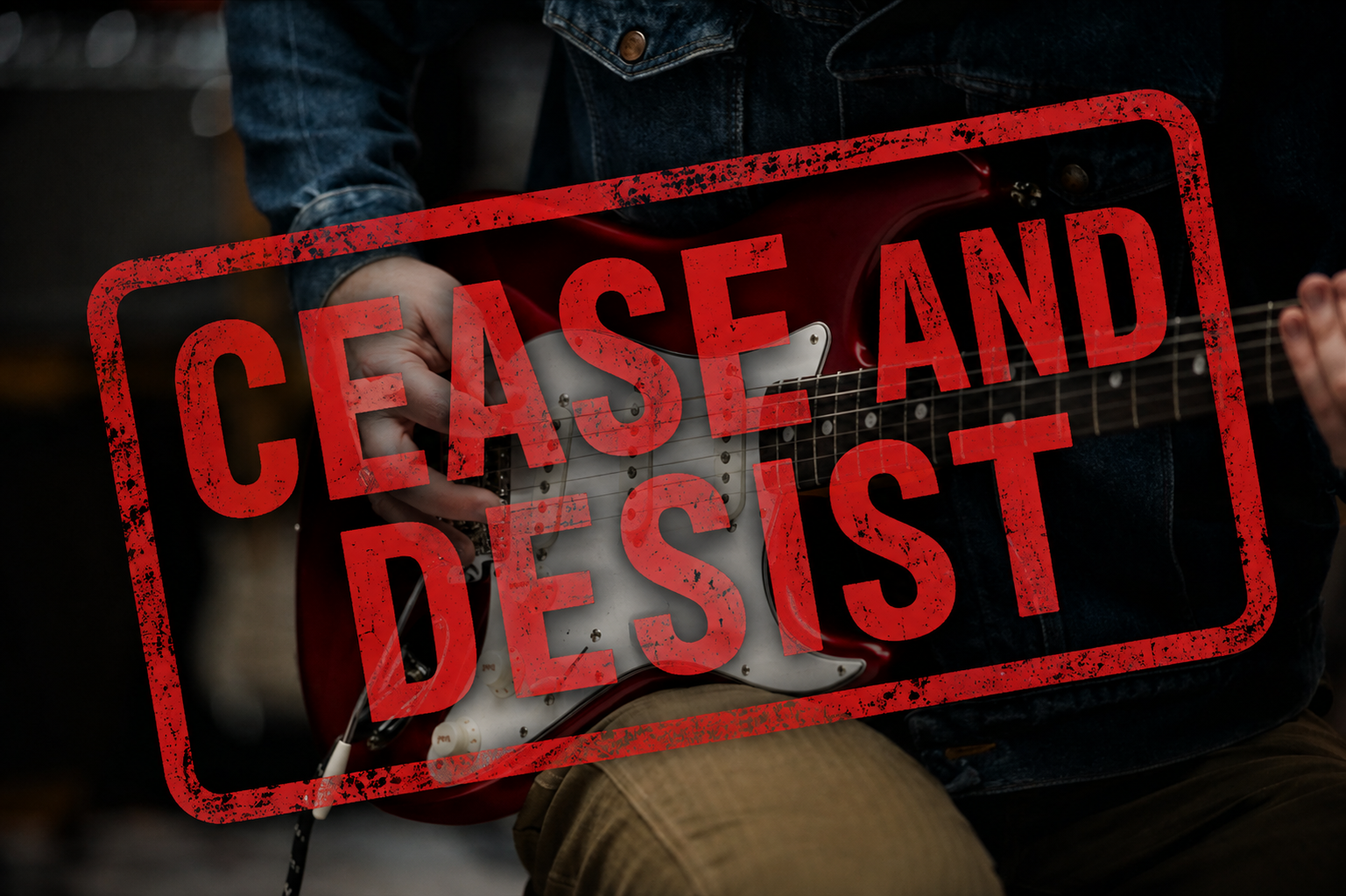
Fender's Strat Crackdown Is Already Changing Guitar Design — Is This What the Next S-Style Will Look Like?
LsL Instruments has shown its first new electric guitar since confirming it received a cease-and-desist tied to Fender's Stratocaster enforcement campaign — and the redesigned Saticoy 24 raises a much bigger question: if boutique builders can no longer lean on the Strat silhouette, does electric guitar design finally move again?
For roughly seven decades, the fastest way to build an electric guitar that sells has been to build something that looks a lot like a 1954 Stratocaster. That is now, at minimum, a more complicated business decision than it was two years ago — and the first physical evidence of what a post-crackdown S-style might look like just arrived.
LsL Instruments, the family-run California builder that was the first company to publicly confirm it had received a cease-and-desist demand connected to Fender's Stratocaster enforcement effort, has revealed the redesigned Saticoy 24: its first new electric guitar model since that letter landed. The instrument reads as a deliberate step away from conventional S-style geometry, and it was developed, according to reporting on the launch, without any contact with Fender during the process.
That makes it the closest thing the industry has to a live experiment. Not a lawsuit. Not a ruling. A guitar.
First, the legal part — stated precisely
This story is routinely flattened into "Fender is suing everyone," and that is not what the record shows. Several very different legal things are happening at once, and they do not carry the same weight.
What a court actually decided. On December 22, 2025, the Regional Court of Düsseldorf (Landgericht Düsseldorf), 14th Civil Chamber, issued a default judgment in case 14c O 64/25. Fender Musical Instruments Corporation had brought proceedings against a Chinese seller, Yiwu Philharmonic Musical Instruments Co., which was offering near-identical Stratocaster replicas to German buyers through AliExpress. The court held that the body of the Stratocaster, designed by Leo Fender in 1954, qualifies as a protected work of applied art (angewandte Kunst) under German copyright law, and prohibited the defendant from distributing the infringing guitars in Germany, with the usual coercive penalties and costs attached.
Three qualifiers matter enormously and are usually dropped. First, it was a default judgment — the reporting and the IP-firm analyses of the decision describe it as issued in the defendant's absence, meaning no opposing party mounted a defense on the merits. Second, the prohibition described in those analyses is distribution in Germany, decided under German copyright law by a German court. Third, the case concerned near-identical replicas, not the general category of double-cutaway guitars.
The ruling drew serious professional attention because of what it applied, not just what it decided: it is understood to be the first German decision to apply the Court of Justice of the European Union's December 2025 Mio/konektra framework on originality in works of applied art to an actual infringement case. That framework matters across the EU. A single German first-instance default judgment is not the same thing as an EU-wide adjudication that every S-style guitar infringes, and it should not be described as one.
What is not a court ruling. A cease-and-desist letter is a demand from a rights holder's lawyers. It is not a finding of infringement, and receiving one does not mean a company has been found to have done anything unlawful. LsL, PRS and Yamaha have all been reported as recipients. None of that establishes that any of their instruments infringe; no court has made that determination about them.
What is a lawsuit. Separately, litigation involving Fender and the German retailer Thomann, owner of Harley Benton, has been reported in both directions. That is genuine court activity, and it is distinct from the letters going to builders.
And in the United States. Fender's long-running attempt to register the Stratocaster and Telecaster body shapes as trademarks was rejected years ago, with the USPTO's Trademark Trial and Appeal Board finding the body shapes had not acquired the distinctiveness required — the shapes were, in effect, treated as generic in the marketplace. Trademark and copyright are different rights with different tests, which is exactly why the German copyright route produced a different outcome than the American trademark route. Anyone telling you Fender "owns the Strat shape worldwide" is describing something that has not been established.
Fender's position, stated fairly
Fender has not framed this as an attempt to end double-cutaway guitars. Aarash Darroodi, the company's general counsel and chief administrative officer, described the German decision as "a meaningful affirmation of the Stratocaster as an original creative work and an important step in continuing to protect the integrity of Fender's designs and intellectual property," adding that it "reinforces our commitment to originality, supports fair competition, and helps ensure that when players encounter these iconic Fender guitar shapes, they can trust the craftsmanship, quality, and heritage behind them."
The company has also stated publicly that it "fully supports innovation and competition across the guitar industry, including such guitars with two horns and/or double cutaways," and its lawyers have reportedly framed the ask to targeted builders as changing designs so they do not read as more or less exact copies of the Stratocaster — characterized in that correspondence as requiring relatively minor design changes. Fender's CEO has separately pushed back on the framing of the campaign as mass litigation.
Whether you find that reassuring depends largely on where you sit. Which brings us to the builders.
[MEMBERS_CTA]
The builder's argument
LsL's public position, made in its fundraising statement for a legal defense, is blunt: "This threatens not only our business, but also the future of S-style guitars for builders and players across the European Union. However, the demand stated that we stop making and selling S-style guitars, period. If successful, it would establish a monopoly, limiting sales and restricting choice for musicians everywhere."
The structural point small builders make is worth understanding on its own terms, separate from who is right. The S-style is not a niche within the boutique world — for a large portion of small American shops it is the business. Bodies, pickguards, routing templates, aftermarket necks, hardware, pickup dimensions and even case sizes are all standardized around it. A boutique builder who has to redraw a body outline is not just changing an outline; they are changing tooling, templates, parts suppliers, dealer photography and, in many cases, the exact thing customers ordered from them last year.
There is also the specific historical argument LsL has raised: that Leo Fender's original protection efforts concerned the headstock rather than the body. That is an argument in a dispute, not a settled fact, and the Düsseldorf court reached its conclusion under German law regardless of what was or wasn't registered in the United States in the 1950s. We're not in a position to adjudicate it, and neither is anyone else outside a courtroom.
What LsL actually changed on the Saticoy 24
Here is what has been officially shown and described about the new model, and nothing beyond it.
- A smaller overall body than the standard Saticoy
- A flatter top, moving away from the traditional soft-shouldered S carve
- An extended and deepened belly contour on the back
- A pronounced hand contour near the upper frets — the most visually aggressive change
- Narrower, more stooped cutaways, altering horn proportion
- A redesigned pickguard with a pointed lower horn
- 24 frets, versus the 21 or 22 of a traditional S
The launch finish is an exotic camphor burl top. LsL has said vintage-inspired versions with classic colorways, more traditional specs and other pickup configurations are on the way. Pricing and full option-by-option specification for the new model have not been laid out in the launch materials we can verify, so we're not going to invent numbers; LsL's existing Saticoy range sits in boutique territory, and the company's own site remains the place to confirm current build specs and lead times.
Two of those changes are more interesting than they look. The pickguard has been widely speculated to be a significant element in how these disputes are being assessed, because on a Strat the pickguard is not an accessory — it is a large, sculpted, immediately recognizable part of the visual composition. And the 24-fret neck forces real structural change: the neck pocket, the upper horn's reach, and the relationship between the neck pickup and the bridge all have to move.
Whether any of this is legally sufficient is not something we or anyone else can declare. Yamaha's Pacifica and PRS's Silver Sky are both meaningfully further from a 1954 Strat than most boutique S-styles, and both were reportedly targeted anyway.
Why the Strat became the industry's default shape
It is worth remembering that the Stratocaster's dominance was not just marketing. In 1954 it solved several problems at once, and it solved them well enough that most later "improvements" have been refinements rather than replacements.
The double cutaway gave real access to the upper register on a bolt-on neck. The forearm bevel and belly contour turned a slab of alder into something that sits against a human ribcage. The asymmetry — a longer upper horn, a shorter lower one — balances the instrument on a strap so the headstock doesn't dive. Three pickups across the string length gave a genuinely wide tonal map. Everything bolted or screwed together, which meant it could be built at scale, repaired in a shop, and modified on a kitchen table.
That last part is why the shape metastasized. The Strat is the most modifiable electric guitar ever made, and an entire parts economy grew up around its dimensions. Once thousands of businesses standardized on those measurements, deviating from them became the expensive choice.
“The most interesting outcome here isn't legal. It's the possibility that a shape which has barely moved in seventy years finally has a reason to.”
What parts of a Strat could you change without ruining what players love about it?
This is design analysis, not legal advice — nothing below should be read as a claim that any change avoids infringement. But as a purely ergonomic exercise, the Strat formula has far more slack in it than the market has bothered to use.
The belly contour. Deepen it, extend it, move its origin point. Players almost never notice the exact geometry; they notice whether the edge digs in. LsL went deeper here, and deeper is generally better.
The forearm bevel. Its angle and length can vary substantially. Many boutique builders already carve theirs differently by feel and nobody complains.
Horn proportion. This is the most legally and visually loaded area, and also more flexible than it looks. What actually matters is that the upper horn reaches far enough forward to put the strap button ahead of the neck joint — that's what stops neck dive. The horn's shape can change quite a lot while preserving that.
The pickguard. The most changeable element on the entire instrument, and the one that most defines the visual read. Reshape it, shrink it, delete it entirely and go rear-routed. LsL's own XT models already run pickguard-free.
The neck joint and heel. A sculpted heel or a contoured joint improves upper-fret access measurably. Almost nobody misses a square four-bolt heel.
Fret count. 22 to 24 changes where the neck pickup sits and shifts its tonal character slightly. Some players care intensely; most adapt within an afternoon.
Input jack location. The recessed football jack is iconic and mildly inconvenient. Side-mounting it is a non-event for feel.
Tremolo. Vintage six-screw, two-point, hardtail — this is already a menu, not a fixed feature.
Pickup arrangement. SSS, HSS, HH, humbucker-single: the market has already proven players don't require three single-coils.
What you probably cannot change without breaking the thing people love: the strap balance, meaningful upper-fret access, a comfortable body thickness and weight, a scale length in the 25.5-inch neighborhood, and controls that fall under the picking hand. Those are the actual requirements. The outline is not.
What does this actually mean for guitar players?
Realistically, here is what is and isn't supported by what we know.
More visually distinct guitars, at least at the boutique end. If builders serving the EU market decide redrawing is cheaper than fighting, the practical output is a wave of instruments that look less alike. The Saticoy 24 is exactly that: still an S at heart, visibly not a Strat.
Availability may differ by market. The Düsseldorf decision is a German ruling under German copyright law, and the EU-level framework it applied is what makes builders nervous about Europe specifically. It is entirely plausible that some models stay available in the US and change or disappear in the EU. Anyone telling you exactly how that shakes out is guessing.
Brand differentiation could become a genuine asset. For thirty years, a boutique builder's identity has lived in wood, pickups, finishing and feel, because the outline was borrowed. If the outline becomes proprietary to each shop, brand identity gets a lot more visual — and that has historically been good for small makers.
Pricing. Redesign has real cost: templates, CNC programs, prototypes, photography, dealer materials. Whether any of that reaches the customer is unknown, and we're not going to speculate about any specific company's finances.
Resale. The honest answer is that nobody knows. Discontinued instruments from small builders sometimes appreciate and sometimes don't, and a dispute-adjacent "last of the old shape" narrative cuts both ways. Treat any confident prediction here with suspicion.
And the boring but likely outcome: most players will keep buying Strats and Strat-shaped guitars, because the vast majority of the market is not in the EU boutique segment and will never think about any of this.
Does the industry actually want new shapes?
Here is the uncomfortable part of the innovation argument: guitarists say they want new designs and then overwhelmingly buy old ones. The best-selling electric guitar designs in the world are a 1950 Telecaster, a 1952 Les Paul, a 1954 Stratocaster and a 1958 SG. Original body shapes from major manufacturers have failed commercially so many times that the industry treats radical redesign as a known risk rather than an opportunity.
But the counterargument has some evidence behind it too. The most successful genuinely modern shapes — the PRS outline, the Music Man Cutlass and Axis, Strandberg's headless designs, Ibanez's S and RG bodies — mostly arrived because someone had a reason to stop copying. Constraint has a decent track record in design, and "we can no longer default to the safe answer" is a constraint.
The plausible outcome is not that the S-style dies. It's that the default dies. If small builders have to justify their outline instead of inheriting it, some will produce cynical minimum-change tweaks, and some will produce genuinely new instruments they'd never have risked otherwise. Historically, that ratio has favored the interesting stuff more than pessimists expect.
Where this actually stands
One German court, in a case the defendant did not defend, found the Stratocaster body protectable under German copyright law and blocked a replica seller's distribution in Germany. Fender has sent cease-and-desist demands to multiple builders, has said publicly that it supports competition and double-cutaway designs provided they are sufficiently distinguished, and is in active litigation with at least one major European retailer. No court has found LsL Instruments to have infringed anything.
Against that backdrop, a small California shop has drawn a new guitar. It's smaller, flatter-topped, more deeply contoured, more aggressively sculpted at the upper frets, has a pointed pickguard horn and two extra frets. Nobody knows whether that's enough for Fender's lawyers.
But it's a real instrument, and it exists because of a legal letter. Which means the most interesting question in electric guitar right now isn't who wins in court. It's whether the shape that stopped evolving in 1954 has finally been given a reason to start again.
The Guitar Plugged will update this story as verified developments emerge. Legal characterizations here reflect publicly available court reporting and published legal analysis, and are not legal advice.
Sources & further reading
- 1.LsL Instruments — official site and Saticoy model information
- 2.Regional Court of Düsseldorf, default judgment of 22 December 2025 — 14c O 64/25 (analysis, BARDEHLE PAGENBERG)
- 3.Case analysis: Fender Musical Instruments Corp. v. Yiwu Philharmonic Musical Instruments Co. (PONS IP)
- 4.MusicRadar — Fender issues cease and desist to US builder over S-style design (May 19, 2026)
- 5.Guitar World — LsL Instruments shares first new model since Fender cease-and-desist (August 12, 2026)
Experience-driven coverage, not algorithm bait.
- 20+ years of guitar playing experience
- Real-world retail experience at Guitar Center
- Thousands of hours testing guitars, amps, and pedals
- A community of 50,000+ guitar enthusiasts across platforms
- Partnerships with Fender, DistroKid, TrueFire, Card Chords, and Enya
- Editorial standards published openly — see how we test gear
The Modern Guitar Magazine. Delivered to your inbox.
No spam. No gimmicks. Just great guitar content — stories, tones, iconic solos, and honest gear takes. Every week.
Discussion (0)
Sign in to join the discussion.
Sign in to commentLoading comments…
Discover another guitar story
Swipe through our latest features, breaking news and iconic solos — one story at a time.
Open Swipe →More in Signature Gear

Does Any Guitarist Really Need 27 Frets? Solar's New ACS Makes the Case
Solar Guitars has put 27 frets on its new carved-body ACS models — a six-string at 25.5" and a seven-string at 26.5", both with stainless super-jumbo frets, Gotoh 1996 tremolos and set-thru necks. Here are the verified specs, plus the design question nobody in the launch coverage is asking: what do frets 25, 26 and 27 actually give a player, and what do they cost you further down the neck?

D'Addario's AI Guitar Controversy Is Bigger Than One String Demo — It's About Trust
D'Addario says no generative AI wrote or played the music in its NYXL HD string demo — but it has admitted the track was over-produced and that AI-assisted mastering tools were used. The row exposes a deeper problem: when a product's selling point is sound, how much production is too much before the demo stops being useful to players?

Can the Badder Monkey Beat the Legendary Tube Screamer? I Put Them Head-to-Head
The DOD Badder Monkey takes on the Ibanez Tube Screamer in a head-to-head shootout. Same guitar, same amp, same playing — here's which overdrive actually deserves a spot on your board.