
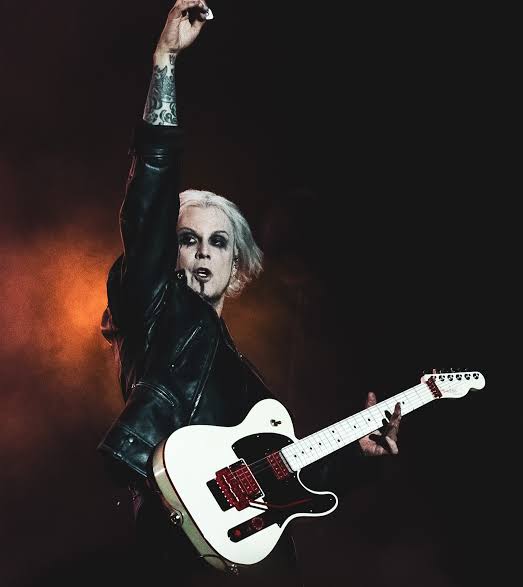
John 5 at 56: How a Telecaster Obsessive Became Rock's Ultimate Guitar Hired Gun
John 5 turns 56 today — and the real story isn't the résumé. It's how a country-schooled Telecaster obsessive became rock's most adaptable hired gun while still sounding unmistakably like himself.
John William Lowery — John 5 — was born on July 31, 1970 in Grosse Pointe, Michigan. Today he turns 56, and he does it as a full member of Mötley Crüe, a solo instrumental artist with a current album out, and arguably the most employable guitarist of his generation.
That last part is the interesting problem. The hired-gun life usually costs a player their fingerprint. You learn the parts, you match the tone, you stay out of the way. John 5 has spent nearly three decades doing exactly that job at the highest level — and somehow you can still identify him inside eight bars.
This piece is about how that's possible.
[TOC]
Hee Haw, Not Van Halen: Where the Style Actually Starts
Per his official biography, John started playing at seven after watching Hee Haw with his father — the Buck Owens and Roy Clark show — alongside influences including KISS and Jimi Hendrix. He has specifically cited seeing a young banjo prodigy on that program as a spark.
That detail explains more about his playing than any metal record he later made. Country and bluegrass players are trained on a completely different set of mechanics than rock players: hybrid picking, rolling banjo-style patterns, open-string cascades, chicken-picked snap. Those are hand mechanics, and hand mechanics are the hardest thing to fake or lose.
He took lessons from Detroit guitarist Robert Gillespie, played bars and clubs with his parents in tow, formed his first band Dirty Trixx, and at 18 moved to Los Angeles to chase session work.
Los Angeles, and the Unglamorous Part
The LA years are the part of the story most birthday write-ups skip. His biography describes being robbed on his first night in town and going door to door looking for work. The break came through the band Alligator Soup, where a fill-in vocal performance caught the attention of bassist Rudy Sarzo, who introduced him to producer Bob Marlette.
That connection led to session and sideman work — including with Lita Ford and drummer Randy Castillo — and, after being selected from a very large pool of applicants, a touring gig with k.d. lang. He later formed the industrial-rock project 2wo with Judas Priest vocalist Rob Halford; their album Voyeurs arrived in 1998 with Trent Reznor involved on the production side.
Read that list again. Country-pop, hard rock, industrial — before he was 28. The genre fluidity wasn't a later reinvention. It was the apprenticeship.
The David Lee Roth Era — and What It Actually Was
For Van Halen fans, this is the chapter worth getting right.
John 5 — then credited as John Lowery — played guitar on 1998's DLR Band, David Lee Roth's self-released record on his Wawazat!! label, produced by Bob Marlette and cut fast. He also played bass on the album under the pseudonym "B'ourbon Bob." Ray Luzier, later of Korn, was on drums.
John 5 was never a member of Van Halen. He played in David Lee Roth's solo band. Those are different jobs, and the difference matters.
The distinction is important because the two roles pull in opposite directions. A Van Halen guitarist inherits Eddie Van Halen's actual compositions — the tapping, the harmonics, the brown-sound rhythm feel — and gets measured against them nightly. A Roth solo guitarist inherits something else: Roth's taste. Big, swaggering, slightly unhinged hard rock with room for a personality on guitar.
Roth's post-Van Halen band history is a lineage of players hired to be themselves loudly — and DLR Band is a record where the guitar is allowed to be flashy without imitating anyone. For a young player who'd already logged country and industrial sessions, it was the perfect proof of concept: he could carry a legacy-adjacent gig without cosplaying the man who made it famous.
He left Roth's band in 1998.
The Name, and the Manson Years
Want John 5’s Tone?
Tell ToneMD what guitar and gear you own and we’ll show you how to get as close as possible using the equipment you already have — full signal chain, real numbered settings, no guesswork.
Included with The Guitar Plugged Premium
The stage name came from Marilyn Manson. Per John's own account, he was invited to lunch, found Manson himself at the table, and walked away with a new band and a new name — a reference both to the Bible chapter and to his position as the fifth member of the group.
The Manson period (roughly 1998–2004) is where the visual identity locked in: the makeup he'd already been experimenting with in high-school bands became inseparable from the persona. Musically, it forced a discipline that shred players often lack — playing parts. Manson's records are arrangement-driven, texture-driven, and built on restraint. He contributed to material including the Grammy-nominated "Astonishing Panorama of the Endtimes" and the Holy Wood era.
Rob Zombie: Fifteen Years of Groove
The Rob Zombie run — beginning in the mid-2000s and lasting until he joined Mötley Crüe — was the longest single relationship of his career and the one that made him a household name among rock guitarists.
Zombie's music demands enormous rhythmic authority: heavy, mid-tempo, groove-based riffing that has to sit dead-center in a mix full of samples and electronics. It's a rhythm guitarist's gig disguised as a lead guitarist's gig. Then, live, Zombie hands him the stage for an unaccompanied solo spot every night — which is where the country hands come back out in front of a metal crowd.
That combination — brutal rhythm discipline plus a nightly showcase — is unusual, and it's the closest thing to a training ground for what he does now.
[MEMBERS_CTA]
John 5 and The Creatures: The Solo Catalogue
The solo instrumental records are where the whole personality lives unfiltered. Starting with Vertigo (2004) and running through Songs for Sanity, The Devil Knows My Name, Requiem, The Art of Malice, God Told Me To, Careful With That Axe, Season of the Witch, Invasion, Sinner and 2025's Ghost, the catalogue swings between metal instrumentals, bluegrass and country-flavored picking workouts, surf, and horror-movie atmospherics — often on the same record.
X Concepts Strings • Made in USA
Never Run Out of Strings Again.
Join the X Concepts String Club and get fresh USA-made strings delivered every month—plus Premium membership options for the full Guitar Plugged experience.
Live, backed by his band The Creatures, those shows put a Telecaster in front of a metal audience and dare them to enjoy a banjo roll. Recent setlists have mixed Ghost material with older instrumentals, a Queen cover, and a Mötley Crüe medley.
In 2026 he's touring his own material internationally — UK and European dates plus Mexican shows announced for November — around the Crüe schedule.
Mötley Crüe: The Hardest Chair in Rock
In October 2022, Mötley Crüe announced that Mick Mars was retiring from touring and that John 5 would take over live guitar duties. He was subsequently elevated to full member.
“Most hired guns survive by disappearing into the gig. John 5 built a career doing the opposite.”
There is no need to manufacture drama around that transition. The musical challenge alone is enough.
Mick Mars is not a technique player in the shred sense — he's a feel player with a specific, slightly wild, slightly out-of-tune-sounding attack and a tone built on grit rather than polish. Those solos are not hard to execute for a player at John 5's level. They are extremely hard to execute correctly, because their value lives in phrasing, bend accuracy and rhythmic looseness, not in note count.
• Play the recorded parts as fans remember them, not as you'd improve them
• Match a tonal signature built on attitude, not gain
• Resist the temptation to add technique the song never asked for
• Carry an arena visually while the songs stay the star
The evidence that he understood the assignment is that the conversation moved on quickly. "Dr. Feelgood" still sounds like "Dr. Feelgood." The technical background shows up in stamina and consistency across a long set — not in extra notes.
The Technique: Why He's Not Just a Shredder
Calling John 5 a shredder is lazy, and his own biography pushes back on it. The more accurate description is that he's a hybrid stylist with a country right hand welded to a metal left hand.
Hybrid and chicken picking
Pick plus middle and ring fingers, often simultaneously. It lets him play wide interval jumps and string-skipping lines that pure alternate pickers physically can't execute at the same speed, and it produces the snapped, percussive attack — chicken picking — that reads as country the instant you hear it.
Banjo rolls on a Telecaster
Rolling patterns across adjacent strings, letting notes ring into each other, produce cascading arpeggios that sound harp-like rather than scalar. On a bridge-position Tele with a compressed clean tone, it's pure bluegrass. Under distortion, it becomes something almost nobody else in hard rock is doing.
Open strings as pedal tones
Country and bluegrass vocabulary is full of open-string pull-offs against fretted notes. Transplanted into a metal key, that becomes a signature John 5 move: lines that sound faster than they are because half the notes are ringing open strings, not picked.
The metal side
Tight alternate-picked runs, legato sequences, two-hand tapping, pinch and artificial harmonics, behind-the-nut bends for pedal-steel-style pitch effects, and the palm-muted rhythm precision the Zombie and Crüe gigs demand.
The point isn't that he owns any one of these. Plenty of players tap. Plenty chicken-pick. Almost nobody moves between them mid-phrase, and that transition — country lick into metal run without a seam — is the actual fingerprint.
Why the Telecaster
A Telecaster is, on paper, a strange choice for heavy music. Single-coils, a bright bridge pickup, a slab body, no vibrato. That's the country and rockabilly instrument.
Which is exactly the point. John 5's whole musical argument is that the Tele is not a genre instrument — in a Fender interview he's described pushing it through jazz, country, rock and metal and treating it as capable of anything. Choosing it in a world of pointy superstrats is both an aesthetic statement and a technical one: the Tele's clarity exposes sloppy hands, and his hands are not sloppy.
Fender's Custom Shop John 5 Signature Telecaster documents the modifications that make the concept work: a bound ash body, a modified three-over/three-under Tele XII headstock shape, a USA Enforcer humbucking bridge pickup paired with a Custom Shop Twisted Tele single-coil in the neck, a modern C maple neck with a 12-inch-radius board and medium jumbo frets, and a toggle switch on the upper bout.
Read the spec sheet as a design brief and it explains the playing: a humbucker for the heavy gigs, a genuine Tele single-coil in the neck for the country vocabulary, a flatter radius and jumbo frets for the bends and the speed, and the toggle placed where his hand actually is.
Signature models and touring rigs change. Treat any list of "John 5's rig" older than a season or two as history, not as what's on stage tonight. The Telecaster platform, though, has been the constant for his entire career.
Over the years his instruments have also included Floyd Rose-equipped Telecasters for the divebomb material — a modification, not a departure, since the platform stays the same.
The Real Answer
So how does a hired gun stay recognizable?
Partly it's visual: the white hair, the makeup, and a Telecaster in a room full of pointed headstocks. Partly it's reliability — the guy learns the parts, plays them clean, and doesn't make the gig about himself.
But mostly it's that his vocabulary came from somewhere nobody else in his lane went. A metal guitarist who learned from Hee Haw has access to phrases a metal guitarist who learned from Van Halen I simply doesn't. He can subordinate his ego to Manson's arrangements or Mars's solos completely — and the instant he's given four free bars, the country hands show up and there's no mistaking who's playing.
That's not adaptability defeating identity. That's identity built out of adaptability.
Happy 56th, John.
Related reading on The Guitar Plugged
Where does John 5 rank among modern hired guns? Tell us in the comments.
Experience-driven coverage, not algorithm bait.
- 20+ years of guitar playing experience
- Real-world retail experience at Guitar Center
- Thousands of hours testing guitars, amps, and pedals
- A community of 50,000+ guitar enthusiasts across platforms
- Partnerships with Fender, DistroKid, TrueFire, Card Chords, and Enya
- Editorial standards published openly — see how we test gear
More Player Deep Dives Like This
Join The Guitar Plugged newsletter for technique breakdowns, gear features and guitar history sent straight to your inbox.
Ask GP
3 free questions a dayStill curious? Ask GP about this story.
Your personal classic-rock and guitar guide — ask anything about John 5 at 56.
Discussion (0)
Sign in to join the discussion.
Sign in to commentLoading comments…
Discover another guitar story
Swipe through our latest features, breaking news and iconic solos — one story at a time.
Open Swipe →More in Guitar Talk
Happy Birthday, Joe Perry: The Riff Machine Who Gave Aerosmith Its Swagger
Joe Perry turns 76 today. From the swampy grind of “Sweet Emotion” to the reunion that saved a band, this is the career of the guitarist who taught American hard rock how to strut.
History of the Riff: How Joe Satriani Made “Flying in a Blue Dream” Feel Weightless
An acoustic guitar in an unusual tuning, a stray broadcast and a melody that seems to hang in the air: inside the construction of Satriani’s 1989 masterpiece.
Tony Iommi Opens Up About His Final Conversation With Ozzy Osbourne: “I Still Can't Get It in My Head”
The Black Sabbath guitarist says Ozzy was exhausted after the band's emotional farewell — but determined to give fans one final show.