
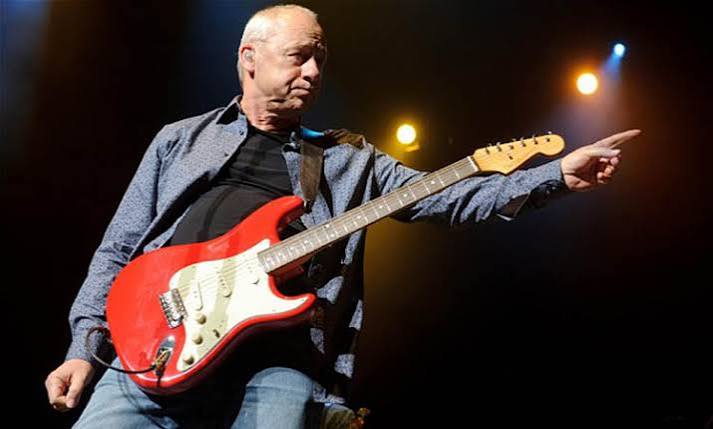
The Solo That Turns a Road Into a Reckoning: Mark Knopfler's "Telegraph Road" Under the Microscope
On Dire Straits' 1982 epic, Mark Knopfler does not simply take a solo. He builds tension, releases it, and then spends nearly five minutes proving that guitar heroics can still serve a story.
There are guitar solos that arrive like a headline.
Then there are guitar solos that feel like weather.
Mark Knopfler's closing lead break in "Telegraph Road" belongs to the second category. It does not kick the door in with a famous opening lick or announce itself with a burst of speed. It gathers. It darkens. It starts to occupy more and more space until the song's final stretch feels less like a performance and more like a force of nature moving through the room.
That is why "Telegraph Road" remains one of the most important lessons in electric guitar expression — not merely for Dire Straits fans, not merely for fingerstyle players, and not merely for musicians who like long songs. It is a masterclass in narrative soloing. Knopfler understands that a solo does not become iconic because it has the most notes. It becomes iconic because every note seems inevitable once it arrives.
Released on Love Over Gold in 1982, "Telegraph Road" runs well beyond the boundaries of normal radio logic. It begins in a near-whisper, unfolds as a widescreen story of settlement, industry, ambition, frustration, and decline, then finally erupts into one of rock's great extended guitar statements. The entire song is built around patience. So is the solo.
And that patience is the point.
A Guitar Solo That Earns Its Explosion
The mistake many players make when chasing "Telegraph Road" is starting at the end.
They hear the final stretch: the ringing overdrive, the climbing phrases, the double-stops, the urgent bends, the way Knopfler seems to pull the entire band uphill behind him. Then they grab a Strat-style guitar, add gain, hunt down a tab, and try to recreate the fireworks.
But the fireworks only work because of what comes before them.
"Telegraph Road" spends so much of its runtime withholding release. The arrangement expands slowly, almost stubbornly. Piano, keyboards, bass, drums, and guitar do not simply pile on top of one another; they create a landscape. Knopfler's vocal delivers the song's human-scale story while the band makes that story feel increasingly larger than any one person inside it.
By the time the final solo arrives, the listener has been waiting for a release without necessarily realizing it.
That is the first great lesson here: a solo is not a separate event from the song. It is the song's emotional consequence.
Knopfler does not sound like he is trying to win a guitar contest. He sounds like the road itself has finally started speaking.
The Mark Knopfler Difference: Attack Before Notes
Knopfler's tone is inseparable from his right hand.
A lot of guitarists can play a similar sequence of notes and still miss the identity of the part completely. That is because the musical information in a Knopfler phrase is not limited to pitch. It lives in the attack, the space between notes, the way a string snaps forward, the way one note is allowed to bloom while another is clipped short.
His fingerstyle approach gives the guitar a more vocal, percussive edge than a conventional pick attack. There is a little more flesh, a little more string noise, a little more unevenness in the best possible sense. The sound has personality before the amp ever begins to compress it.
On "Telegraph Road," that attack matters because the lead guitar is constantly moving between two roles:
It has to cut through a dense, dramatic arrangement.
It has to remain human enough to feel vulnerable inside that arrangement.
That tension is why the solo hits so hard. It is big without becoming faceless.
For players, this is the invitation: do not try to sand every edge off your articulation. Knopfler's phrasing has teeth. His bends are not always designed to sound polished; they are designed to sound necessary.
The Architecture of the Final Solo
The final solo is often described as an extended jam, but that undersells how carefully it is shaped. Knopfler does not just keep escalating because the song is long. He gives the listener a sequence of emotional chapters.
1. The Opening: Establishing the Voice
The first phrases feel measured, almost conversational. Knopfler gives the melody room to breathe and avoids filling every available space. The guitar is still connected to the song's reflective mood.
This is where lesser players often rush. They treat the first few bars as a runway toward the "good part."
Knopfler knows the first few bars are the good part.
The bends are deliberate. The notes land with weight. He lets sustain do some of the talking. Rather than trying to sound fast, he makes the guitar sound convinced.
2. The Climb: Repetition With More Stakes
As the band increases the pressure, Knopfler starts returning to shapes and rhythmic ideas with more force. This is not repetition as filler. It is repetition as escalation.
A phrase that would feel modest early in the solo becomes commanding later because the dynamics, drum movement, harmonic tension, and overdrive around it have changed. The same basic vocabulary suddenly carries more consequence.
This is a huge lesson for writing your own solos: you do not need an endless list of brand-new ideas. You need a small number of strong ideas that can survive being pushed harder.
Get Mark Knopfler’s “Telegraph Road” Tone
Tell ToneMD what guitar and gear you own and we’ll show you how to get as close as possible using the equipment you already have — full signal chain, real numbered settings, no guesswork.
Included with The Guitar Plugged Premium
3. The Breakthrough: Double-Stops, Bends, and Controlled Chaos
When the solo reaches its most intense passages, Knopfler's playing becomes more physical. There are searing bends, forceful stabs, rapid flourishes, and the kind of double-stop work that makes a guitar sound like it has grown larger than one instrument.
But the key word is still control.
He never loses the song's pulse. Even when the lines become jagged and urgent, they retain direction. He is not spraying notes over the chord progression. He is steering the band's emotional momentum.
That is what separates intensity from noise.
4. The Fade: No Neat Ending Required
Most guitar solos are built to resolve. "Telegraph Road" fades away while the guitar remains in motion.
That choice is perfect. A song about expansion, industry, and human struggle does not need a tidy full stop. It needs the sense that the machinery and the longing continue after the listener has left the room.
Knopfler's guitar does not sound like it has completed a speech. It sounds like it is still trying to say something.
Why the Solo Feels So Emotional
The emotional power of "Telegraph Road" is not mysterious. It comes from a few very specific choices.
First, Knopfler uses contrast relentlessly. A high bend means more after a quiet phrase. A fast run means more after a sustained note. A big overdriven attack means more after the arrangement has spent minutes building atmosphere.
Second, he treats silence as part of the phrasing. He does not fear the gap between statements. The listener gets time to absorb what the guitar just said.
Third, he avoids the trap of sounding too pleased with himself. There is no wink in this solo. No "look what I can do" moment. Even at its most technically demanding, the playing remains serious, searching, and slightly dangerous.
Finally, Knopfler understands the value of a tonal arc. The guitar tone is not just "clean" or "dirty." It evolves with the arrangement. The sound becomes more urgent as the song becomes more urgent.
That is the real secret: tone is storytelling.
The Tone: More Than a Strat and a Clean Amp
The early Dire Straits sound is often reduced to a single recipe: a Strat-style guitar, a clean British or American amp, compression, fingers, and great phrasing.
That gets you into the neighborhood. It does not build "Telegraph Road."
For this song, you want clarity at the front of the note, enough compression to make the guitar feel elastic, and enough gain for the climactic passages to sing without dissolving into mush. The sound should be bright enough to cut, but never brittle. It should be driven enough to sustain, but never so saturated that every phrase becomes the same size.
A practical starting point:
- Guitar: Strat-style guitar or another single-coil-equipped electric
- Pickup: Start at the neck or neck/middle position for warmth and definition; move toward bridge/middle only if you need more bite in a live mix
“Knopfler does not sound like he is trying to win a guitar contest. He sounds like the road itself has finally started speaking.”
- Gain: Lower than you think. Let the hands create aggression.
- Compression: Moderate, used to even the attack and add bloom — not flatten dynamics
- Overdrive: Light-to-medium drive with the volume high enough to push the amp-style section
- Delay: Short, subtle, and supportive; it should create depth, not announce itself
- Reverb: Plate or room ambience, kept restrained
- EQ: Tight low end, present upper mids, controlled top end
The biggest danger is dialing in too much gain. "Telegraph Road" needs the guitar to retain its edges. You want to hear the string, the bend, the snap of the attack, and the difference between a phrase that is whispered and one that is shouted.
A high-gain lead tone may feel exciting alone. In the context of this song, it can erase the entire point.
Build the "Telegraph Road" Tone in ToneMD
Want the Telegraph Road feel translated to your actual rig instead of a vague list of knobs?
Hear it. Chase it. Build it.
Enter the tone you want, tell ToneMD the gear and pickups you actually own, and get a recipe built for your rig — full signal chain, real numbered settings and step-by-step instructions for your exact amp or modeler.
Open ToneMDFree lookups every month · Unlimited with The Guitar Plugged Premium
Choose Mark Knopfler, choose "Telegraph Road," then enter your guitar, pickups, amp, pedals, modeler, or plugin. ToneMD can build a practical signal chain and platform-specific starting settings for rigs including Boss Katana, Line 6 Helix, Neural DSP, Fender Mustang, ToneX, Kemper, Fractal, AmpliTube, Guitar Rig, and more.
Your rig. Their tone. ToneMD.
How to Practice the Solo Without Missing the Point
Learning this solo is not about memorizing fourteen minutes of content. Start by learning the language behind it.
Practice the bends first
Knopfler's bends need to arrive at the destination pitch with confidence. Use a tuner or a reference note and train your ear until every whole-step and minor-third bend lands where it should.
Do not settle for "close enough." A bend that misses its target drains the emotion from this kind of lead playing immediately.
Learn the vocal phrases before the fast passages
The big runs will tempt you. Ignore them at first.
Find the phrases that make you hum the guitar line after the song ends. Learn their rhythm, their sustain, and the exact amount of space around them. Those lines are the foundation. The flash only works when the foundation is believable.
Practice with dynamics, not just a metronome
A metronome can help with timing, but "Telegraph Road" asks for dynamic control. Practice a phrase at three levels:
Almost too quiet to hear.
Normal performance volume.
Full emotional release.
If all three versions sound identical except louder, you are missing the lesson. Change the attack. Change the amount of vibrato. Change how long you let the note live.
Build your own three-stage solo
Take one backing track and write a solo in three sections:
A restrained opening with space.
A middle section that repeats and intensifies one idea.
A final section that uses wider bends, double-stops, and more rhythmic urgency.
This exercise will teach you more about "Telegraph Road" than playing the final run at half speed for a month.
Gear That Gets You Closer
You do not need a museum-level vintage collection to explore this sound. A responsive guitar, a good amp platform, and a few carefully chosen tools will get you much closer than a giant pedalboard full of unrelated effects.
Affiliate disclosure: The Guitar Plugged may earn a commission from qualifying purchases made through links in this article, at no extra cost to you.
The Guitarist Index: Go Deeper on Mark Knopfler
"Telegraph Road" makes more sense when you hear it as part of Knopfler's larger vocabulary.
The touch that made "Sultans of Swing" unmistakable, the cinematic restraint of "Romeo and Juliet," the grit of "Money for Nothing", and the expansive emotional language of Love Over Gold all live on the same map. Knopfler's genius was never simply that he had a recognizable tone — our full Tone Decoded breakdown of his rig shows how much of it lives in the hands. It was that he could make a guitar line feel like character development.
Premium members can go deeper with guitarist profiles, gear history, tone breakdowns, essential recordings, and the details that connect the famous songs to the player behind them.
The Verdict
There are technically faster guitar solos. There are cleaner guitar solos. There are solos with more famous opening phrases and solos with more easily copied licks.
But there are very few solos that make the passage of time feel physical.
"Telegraph Road" is what happens when a guitarist understands that restraint is not the absence of power. It is the storage of power. Knopfler spends the song accumulating tension one phrase, one chord change, one unanswered feeling at a time. When he finally lets the guitar break open, it does not feel indulgent.
It feels earned.
That is why the solo still matters. Not because it gives players another difficult piece to learn, but because it reminds them what the instrument can do when every note serves a larger story.
The road keeps going. So does the guitar.
The full story is in TGP Premium: exclusive iconic-solo deep dives, full Guitarist Index access, premium tools, Rock Court, expanded Ask GP access, and an ad-free experience built for people who actually live for guitar.
Experience-driven coverage, not algorithm bait.
- 20+ years of guitar playing experience
- Real-world retail experience at Guitar Center
- Thousands of hours testing guitars, amps, and pedals
- A community of 50,000+ guitar enthusiasts across platforms
- Partnerships with Fender, DistroKid, TrueFire, Card Chords, and Enya
- Editorial standards published openly — see how we test gear
The Modern Guitar Magazine. Delivered to your inbox.
No spam. No gimmicks. Just great guitar content — stories, tones, iconic solos, and honest gear takes. Every week.
Ask GP
3 free questionsQuestions about The Solo That Turns a?
Get a straight answer from The Guitar Plugged's knowledge engine.
Discussion (0)
Sign in to join the discussion.
Sign in to commentLoading comments…
Discover another guitar story
Swipe through our latest features, breaking news and iconic solos — one story at a time.
Open Swipe →More in Guitar Talk
From Playing Hendrix for Coins to Judas Priest: Richie Faulkner Built His Entire Life Around Guitar
He learned Hendrix's "Wild Thing" as a kid, made his first money when a passer-by left 10 pence on the wall, and ended up standing in one of heavy metal's most scrutinised guitar positions. The interesting question isn't how Richie Faulkner joined Judas Priest — it's how he did it without becoming an impersonation.
Robert Plant at 78: Why His Chemistry With Jimmy Page Was Led Zeppelin's Real Secret Weapon
Robert Plant turns 78 today. The conventional story says Page played guitar and Plant sang. The truth is stranger and more useful: they behaved like two lead instruments arguing, answering and leaving each other room.
History of the Riff: Jimi Hendrix's "Foxey Lady" — The Sound That Made the Electric Guitar Dangerous
Feedback before the riff, four Marshall cabinets, a microphone eight feet away and a Stratocaster flipped upside down — the full story of the riff that made the electric guitar sound dangerous.