
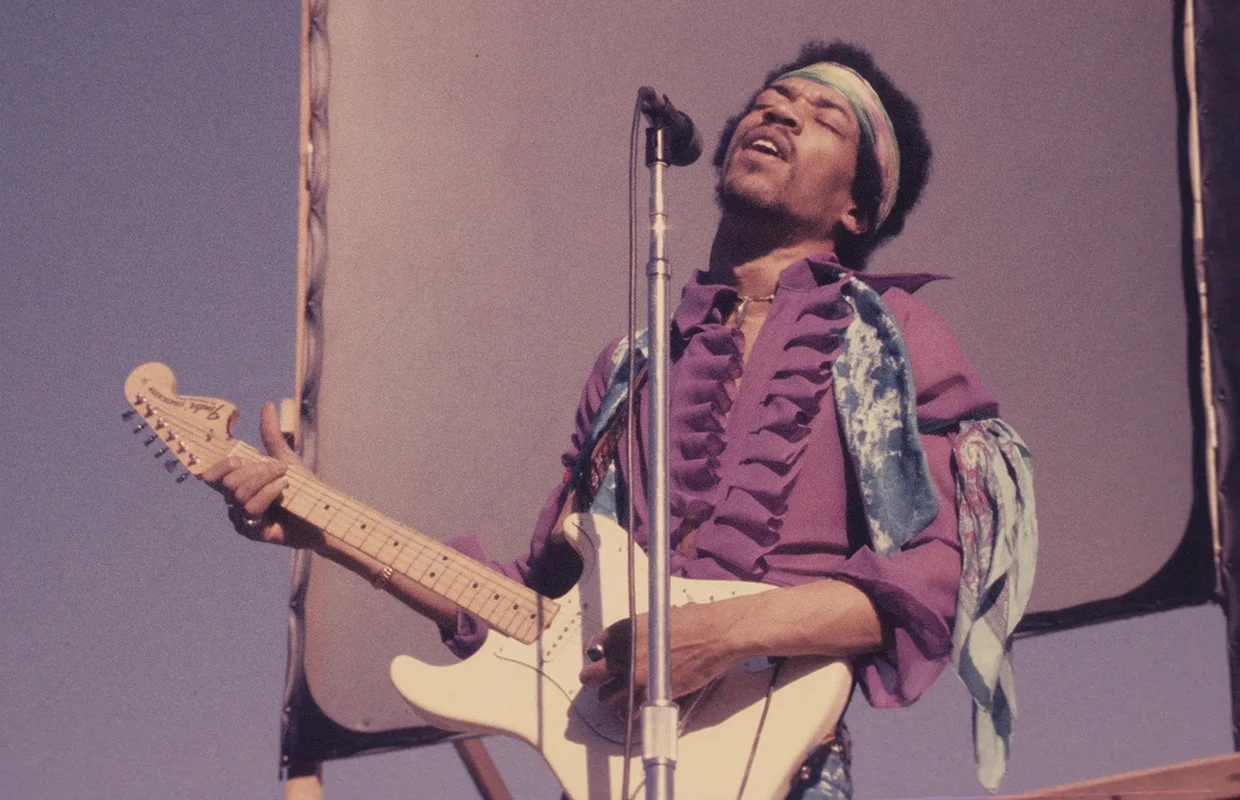
History of the Riff: Jimi Hendrix's "Foxey Lady" — The Sound That Made the Electric Guitar Dangerous
Feedback before the riff, four Marshall cabinets, a microphone eight feet away and a Stratocaster flipped upside down — the full story of the riff that made the electric guitar sound dangerous.
There are guitar riffs that introduce songs.
Then there are guitar riffs that introduce guitarists.
The opening of Jimi Hendrix's "Foxey Lady" belongs firmly in the second category.
Before the riff even arrives, Hendrix gives you the warning. A note blooms into feedback. Harmonics begin fighting with one another. The amplifier sounds less like a piece of musical equipment than something being pushed dangerously close to failure. Then Hendrix drops into that enormous F# figure and, suddenly, the vocabulary of electric guitar feels different.
It's dirty. Sexual. Heavy. Loose. And impossibly confident.
Released in 1967 on Are You Experienced, "Foxey Lady" arrived during one of the most important transformations the electric guitar has ever undergone. Hendrix wasn't simply writing memorable guitar parts. He was beginning to demonstrate that feedback, fuzz, amplifier saturation and noise weren't necessarily problems that guitarists needed to eliminate. They could be part of the music.
More than half a century later, guitarists are still trying to recreate what happened when Hendrix turned up, faced a Stratocaster toward a wall of Marshall cabinets and made electricity itself feel musical.
This is the history of the riff.
Before "Foxey Lady," There Was Jimi Hendrix
To understand why "Foxey Lady" sounded so radical, you have to remember where Hendrix was professionally only a short time before it was recorded. He wasn't yet Jimi Hendrix: Guitar God.
He had spent years working as a sideman, playing behind artists including Little Richard, the Isley Brothers and Curtis Knight. Those jobs gave Hendrix an extraordinary education in rhythm guitar, R&B, blues, soul and stagecraft. But being a sideman also meant restraint, and Hendrix had ideas that didn't always fit comfortably behind somebody else's singer.
By 1966, Hendrix was performing in New York under the name Jimmy James and the Blue Flames when former Animals bassist Chas Chandler encountered him. Chandler recognized something other people hadn't fully figured out yet. Hendrix didn't need another sideman gig. He needed his own band.
Hendrix traveled to London, where Chandler helped assemble the Jimi Hendrix Experience with bassist Noel Redding and drummer Mitch Mitchell. Within months, everything changed.
And "Foxey Lady" captures that transformation almost perfectly. This isn't Hendrix supporting somebody else's record. It's Hendrix realizing that the guitar can occupy the entire room.
The Birth of "Foxey Lady"
Hendrix later described the creation of "Foxey Lady" in remarkably uncomplicated terms: the band essentially started playing and the song emerged. That simplicity makes sense when you listen to it. "Foxey Lady" doesn't feel constructed like a complicated composition. It feels discovered.
The central riff revolves around F#, but describing it merely as a riff in F# misses what makes it work. Hendrix attacks the guitar almost percussively. Chords, muted strings, single notes and rhythmic accents blur together. He isn't separating "lead guitar" and "rhythm guitar" into neat categories. He's doing both.
That would become one of Hendrix's defining characteristics. Where many guitarists might play a chord and then add a lick between changes, Hendrix could make the embellishment feel like part of the chord itself. "Foxey Lady" is an early, brutally effective example. The riff has blues underneath it, but the presentation is something new.
And then there's that chord.
The Hendrix Chord
The 7#9 chord became so closely associated with Hendrix that generations of guitarists simply began calling it the Hendrix chord. Hendrix didn't invent the dominant 7#9 — jazz, blues and R&B musicians had used the harmony before him. What Hendrix did was give it a new cultural identity.
In "Foxey Lady," the combination of major and minor tonal information creates exactly the kind of tension Hendrix seemed drawn toward. It doesn't sound comfortably major. It doesn't sound comfortably minor. It sounds unresolved. Aggressive. Restless.
Put that harmony through an overdriven Marshall and a fuzz circuit and it becomes something else entirely. It becomes rock guitar.
You can hear variations of that harmonic vocabulary throughout Hendrix's catalog, most famously in "Purple Haze". But "Foxey Lady" demonstrates why the chord worked so beautifully for him. Hendrix wasn't interested in harmony as something static. His chords moved. They growled. They contained rhythm. And they created places for his fingers to immediately escape into fills and melodic fragments.
That philosophy would influence practically every guitarist who followed him.
December 13, 1966: Capturing the Beast
The recording history of "Foxey Lady" is almost as fascinating as the riff itself. On December 13, 1966, the Jimi Hendrix Experience entered CBS Studios in London with producer Chas Chandler and engineer Mike Ross.
Then Hendrix brought in the amplifiers. Not one little combo. According to Ross, Hendrix arrived with four Marshall cabinets. For a recording engineer working in 1966, this presented a problem. How exactly do you record something like that?
Hendrix apparently had an answer. Rather than close-miking the cabinet in the way a modern guitarist might expect, Hendrix instructed Ross to position the microphone roughly eight feet away. Ross used a Neumann U67 tube condenser microphone.
• A Stratocaster and a fuzz circuit
• Four Marshall cabinets working hard
• Eight feet of air between amp and mic
• A Neumann U67 tube condenser
• The room responding to the volume
Think about what that means. Part of the "Foxey Lady" guitar sound wasn't simply a Stratocaster, fuzz and Marshall. It was air. It was the physical distance between a brutally loud amplifier and a microphone. It was the room responding to the amplifier. It was speakers pushing enough air that the studio itself became part of the guitar rig.
That distinction matters. Modern guitarists sometimes obsess over finding the exact pedal or exact amplifier Hendrix used. But tone isn't a shopping list. The room mattered. The microphone mattered. Volume mattered. Hendrix's hands mattered. And perhaps most importantly, the interaction between all of those things mattered.
The Feedback Before the Riff
Before Hendrix gives you the famous riff, he gives you one of the song's most important sounds. Feedback.
Today, controlled feedback is a normal part of rock guitar vocabulary. In the mid-'60s, it was considerably more radical. Feedback traditionally represented something going wrong. Move too close to the amplifier. Turn up too loud. Let the guitar resonate uncontrollably. You were supposed to stop it.
Hendrix asked a different question: what if you controlled it instead?
The opening of "Foxey Lady" is essentially Hendrix demonstrating the relationship between the guitar and the amplifier. The guitar produces the note. The amplifier reproduces it. The pickups hear the amplified sound. The signal feeds back into itself. Hendrix manipulates that loop.
The resulting harmonic bloom sounds almost synthetic, yet it is produced by an extraordinarily physical process: a guitar interacting with a loud amplifier in a room. Then comes the riff. That transition is crucial. The feedback isn't an effect pasted onto the song. It's the doorway into the riff.
Get Jimi Hendrix’s “Foxey Lady” Tone
Tell ToneMD what guitar and gear you own and we’ll show you how to get as close as possible using the equipment you already have — full signal chain, real numbered settings, no guesswork.
Included with The Guitar Plugged Premium
The Guitar
Trying to identify the exact guitar used on every early Hendrix recording can become surprisingly complicated. What matters more for recreating the fundamental "Foxey Lady" vocabulary is the instrument Hendrix made synonymous with his playing: the Fender Stratocaster.
Hendrix was left-handed but famously played right-handed Stratocasters flipped over and restrung for left-handed playing. That seemingly simple modification subtly altered the instrument. The reversed bridge pickup angle changes the relationship between the pickup and the strings. The string lengths behind the nut change. The controls sit differently beneath the player's hands.
None of those details alone explain Hendrix's tone. But together they became part of the unusual physical relationship Hendrix had with the Stratocaster. More importantly, Hendrix understood single-coil pickups incredibly well. A Strat can sound glassy and delicate. Hendrix made one sound enormous.
That is part of the genius of "Foxey Lady." The basic ingredients aren't inherently massive: a solidbody guitar, single-coil pickups, a fuzz circuit, a British tube amplifier. Hendrix turns them into something that sounds ten feet tall.
TGP Gear Desk: Building a "Foxey Lady" Rig
You don't need vintage 1966 equipment to get into the neighborhood. The basic recipe remains surprisingly straightforward.
• Guitar: Stratocaster-style with single coils
• Fuzz: Germanium Fuzz Face-style circuit
• Amp: Marshall/Plexi-style British tube amp
• Gain: High
• Volume: Historically absurd — use an attenuator or a modeler
• Playing style: Aggressive, dynamic, responsive to the guitar's controls
The Fuzz Question
If you're chasing "Foxey Lady," fuzz is part of the conversation. Hendrix's relationship with the Fuzz Face became legendary.
The Fuzz Face isn't distortion in the modern high-gain sense. It doesn't simply make everything heavier and more compressed. A good vintage-style fuzz circuit can feel unstable. It responds dramatically to input level. It reacts to the guitar's volume control. It changes according to pick attack. And when paired with an already loud tube amplifier, it becomes less like a pedal sitting in front of the amp and more like an extension of the amplifier itself.
That's one reason simply buying a Fuzz Face doesn't instantly produce Hendrix. The circuit expects interaction. Roll down the guitar's volume and the sound can clean up dramatically. Turn it back up and the fuzz explodes. Change your picking dynamics and the texture changes again.
Hendrix exploited that responsiveness constantly. He didn't just switch sounds on and off. He played the entire signal chain.
The Marshall Factor
The sound of Hendrix and a Marshall stack became one of rock music's defining images, but "Foxey Lady" demonstrates why the combination mattered sonically.
Those early high-powered Marshall amplifiers weren't designed to provide modern preamp distortion at bedroom volume. You got the amplifier working. Hard. That meant volume — lots of it. The result was power-stage saturation, speaker interaction, compression and an almost physical sense of movement.
Add fuzz in front of that environment and the distinction between pedal distortion and amplifier distortion becomes increasingly irrelevant. Everything starts interacting. That's the sound.
Not: guitar → distortion pedal → clean amplifier. More like: guitar → fuzz → screaming amplifier → speakers → room → microphone. The whole chain becomes an instrument.
Why ToneMD Is Perfect for a Riff Like This
This is exactly why recreating Hendrix from a generic list of "amp settings" is frustrating. There isn't one magic setting. A player using a Fender Tone Master isn't approaching the problem the same way as somebody using a Helix. A Boss Katana needs a different strategy from a Kemper. A Neural DSP rig needs a different strategy from a real Marshall.
That's what ToneMD is built to solve. Instead of telling every guitarist to use the same arbitrary Bass 6 / Mid 7 / Treble 5 settings, ToneMD builds the tone around the gear you're actually using. Choose your platform. Choose your guitar and pickup configuration. Enter the artist or song. ToneMD creates a practical tone prescription designed around your rig.
• Aggressive British-style gain
• Thick midrange
• Controlled low end
• Vintage fuzz texture
• Enough top-end bite to retain articulation
• Guitar-volume responsiveness
• Feedback-friendly sustain
The goal isn't to digitally clone Hendrix. Nobody can. The goal is to understand the architecture of the sound and translate it to modern equipment.
But the Gear Still Isn't the Secret
Here's where every Hendrix tone article eventually has to become uncomfortable. You can buy the Strat. You can buy the fuzz. You can buy the Marshall. You can recreate the microphone position. You can use vintage-spec cables. And you still won't sound exactly like Hendrix.
“Hendrix didn't eliminate noise. He controlled it. That's the whole difference.”
Because Hendrix's technique is inseparable from his tone. Listen carefully to "Foxey Lady." The riff isn't mechanically perfect. It breathes. Notes rub against one another. Strings get struck that another guitarist might try desperately to mute. Chords aren't always pristine. Hendrix allows the guitar to sound like a physical object.
Modern players are often trained to eliminate noise. Hendrix controlled noise. That's different.
Rhythm and Lead Become One Instrument
One of the biggest lessons hiding inside "Foxey Lady" is Hendrix's refusal to respect the boundary between rhythm and lead guitar. Listen to the verses. He doesn't simply play a repeating rhythm part until it's time for the solo. There are fills. Accents. Chord fragments. Slides. Muted attacks. Little melodic responses. The guitar remains conversational.
This approach became enormously influential. You can hear its descendants in Stevie Ray Vaughan, John Frusciante, John Mayer, Prince, Lenny Kravitz and countless blues-rock players. Even guitarists who sound nothing like Hendrix absorbed the idea that rhythm guitar doesn't need to mean strumming the same chord shape repeatedly.
Hendrix made rhythm guitar feel improvisational.
Mitch Mitchell Changes Everything
It's also impossible to discuss the riff without talking about Mitch Mitchell. Imagine "Foxey Lady" with a straightforward drummer playing rigid eighth notes. It's a different song.
Mitchell's drumming gives Hendrix room because Mitchell isn't approaching rock like a conventional rock drummer. There is jazz in his vocabulary. His fills tumble around Hendrix. The drums react to the guitar. The guitar reacts to the drums. That creates the sensation that the Experience could fall apart at any second without ever actually doing so. It's controlled instability.
Noel Redding provides the foundation underneath it, allowing Hendrix and Mitchell to push and pull against the center. That's why reducing "Foxey Lady" to a guitar riff misses half the story. The riff works because of what happens around it.
February 1967: Hendrix Wasn't Finished
The December recording wasn't simply printed and forgotten. As Are You Experienced approached completion, Hendrix and the team continued working. On February 8, 1967, work on "Foxey Lady" continued at Olympic Studios with producer Chas Chandler and engineers Eddie Kramer and George Chkiantz. Additional vocal work was incorporated into the finished recording as the team worked to strengthen the track.
That detail matters because Hendrix's reputation as a wild, spontaneous guitarist sometimes obscures another side of him: he cared deeply about recorded sound. The chaos was intentional. Hendrix wasn't simply plugging into whatever happened to be sitting in the studio and hoping magic happened. He listened. He experimented. He overdubbed. He reconsidered sounds. He manipulated the studio.
When "Are You Experienced" Arrived
Imagine encountering Hendrix without decades of Hendrix-influenced guitar playing already existing. No Stevie Ray Vaughan. No Eddie Van Halen. No Prince. No Slash. No modern boutique fuzz industry. No YouTube videos explaining how Hendrix got his tone. No modelers with "Hendrix presets." Just that sound.
Are You Experienced didn't simply introduce an exceptional guitarist. It challenged the definition of what an electric guitar was supposed to do. "Purple Haze." "Manic Depression." "Fire." "Third Stone from the Sun." "Are You Experienced?" And "Foxey Lady." It's difficult to think of many debut albums that altered guitar culture so dramatically.
Monterey Turns the Riff Into Theater
If the studio version established "Foxey Lady," Hendrix's live performances turned it into something else. The 1967 Monterey International Pop Festival became Hendrix's American coming-out party, and "Foxey Lady" was part of the set.
Onstage, the controlled feedback of the record became visual theater. Hendrix could manipulate feedback by changing his position relative to the amplifier. Move closer. Turn. Change the guitar's angle. Alter the volume. Strike a note differently. The stage itself became part of the signal path.
By the end of the Monterey performance, Hendrix famously sacrificed his Stratocaster during "Wild Thing," setting the instrument on fire in one of rock history's most enduring images. But the spectacle sometimes overshadows the more important point. Hendrix didn't become legendary because he burned guitars. He could burn guitars because the playing had already made people pay attention.
The Solo
Hendrix's lead work on "Foxey Lady" isn't impressive because it contains the maximum possible number of notes. It is impressive because every phrase feels like it belongs to the personality established by the riff.
Blues vocabulary is everywhere. But Hendrix bends it. Stretches it. Distorts it. He attacks notes aggressively, then leaves space. The fuzz exaggerates every movement. The amplifier turns bends into screams. The solo doesn't feel pasted over the rhythm section. It feels like the riff has finally broken free.
That's an important lesson. Great solos don't necessarily need to introduce an entirely different musical personality. Sometimes the best solo is simply the song's existing personality pushed to its breaking point.
Why "Foxey Lady" Still Feels Heavy
By modern standards, "Foxey Lady" isn't especially heavy in terms of gain. Put it next to a contemporary metal guitar sound and the Hendrix tone can seem relatively open. Yet the record still feels enormous. Why?
Because heaviness isn't simply distortion. It's attitude plus rhythm plus frequency plus dynamics. Hendrix leaves enough definition in the guitar for the attack to remain violent. The low strings aren't buried beneath endless compression. The mids remain present. The guitar reacts to him.
Modern players chasing vintage heavy tones can learn a lot from this. More gain doesn't always make a riff heavier. Sometimes less gain makes the player sound heavier.
How to Approach the Riff
If you're learning "Foxey Lady," don't begin by obsessing over the pedalboard. Learn the rhythmic feel first. Get comfortable with F#. Learn the chord shapes and fragments Hendrix uses around the central position.
Then stop treating every unwanted string sound as a mistake. Hendrix's playing depends on controlled looseness. That doesn't mean sloppy playing — quite the opposite. You need enough muting control to decide which noise survives. That's much harder than simply making everything clean.
Next, experiment with the guitar's volume knob. If you're using a fuzz-style pedal, set the rig hotter than you might normally prefer and control some of that aggression from the guitar. Listen to how the texture changes. Now you're approaching the instrument more like Hendrix did.
A Modern "Foxey Lady" Tone Prescription
Start with a Stratocaster-style instrument. Single coils are ideal. Don't worry if you're using humbuckers — ToneMD can compensate — but you'll generally want to reduce low-end thickness and preserve upper-mid bite.
• Gain: 6–8
• Bass: 4–5
• Middle: 7–9
• Treble: 6–7
• Presence: 5–7
These aren't sacred Hendrix settings. They're a modern starting point.
For fuzz, choose a vintage Fuzz Face-style effect and don't make it too smooth. You want hair around the notes. You want the guitar to feel slightly dangerous. Keep reverb relatively restrained — the guitar should feel like it's occupying a physical room rather than floating in a giant ambient wash.
And then the most important setting of all: technique. Play harder. Then play softer. Listen to how the rig responds. If nothing changes, your sound may be too compressed.
Guitarist Index: Jimi Hendrix
• Era: 1960s
• Primary Guitar: Fender Stratocaster
• Signature Sound: Marshall amplification, fuzz, wah, feedback and extreme dynamic control
• Essential Riffs: "Foxey Lady," "Purple Haze," "Voodoo Child (Slight Return)," "Manic Depression"
• Essential Listening: Are You Experienced, Axis: Bold as Love, Electric Ladyland
• TGP Status: Foundational
Explore more in the TGP Guitarist Index.
The Players Who Heard It
The easiest way to measure Hendrix's influence is to look at the guitarists who came afterward. His fingerprints are everywhere.
Stevie Ray Vaughan took Hendrix's combination of blues vocabulary, Stratocaster dynamics and physical attack into another era. Eddie Van Halen pushed the idea of the guitarist as sonic inventor into the late '70s and '80s. Prince absorbed Hendrix's ability to combine rhythm, lead, showmanship and songwriting. John Frusciante brought Hendrix-influenced chord embellishment into alternative rock. John Mayer carried elements of Hendrix and Vaughan into modern blues-pop guitar.
But Hendrix's influence goes deeper than individual players. Every guitarist who intentionally uses feedback owes something to this era. Every player who manipulates the guitar's volume control to change the behavior of a fuzz pedal is working inside a vocabulary Hendrix helped popularize. Every guitarist who thinks of effects as creative tools rather than corrective devices lives in a post-Hendrix world.
The Riff Is Bigger Than the Notes
Write the "Foxey Lady" riff on paper and it doesn't look revolutionary. That's the problem with notation. Notation captures notes. It struggles to capture intent.
How loud was the amplifier? Where was Hendrix standing? How aggressively did he strike the strings? Which strings rang sympathetically? How was the fuzz reacting? What was the speaker doing? How did the room respond? How close was the guitar to feeding back? How much did Hendrix roll the volume control?
That's the real riff. The notes are only the skeleton. Hendrix supplied the nervous system.
Why Guitarists Are Still Chasing This Sound
We have better equipment now. Objectively. Modern guitarists have noiseless power supplies, programmable switching systems, digital modelers, impulse responses, sophisticated recording software and virtually unlimited tracks. Hendrix had comparatively primitive technology. And we're still trying to sound like him.
That should tell us something. Technology can reproduce frequencies. It can reproduce gain structures. It can reproduce speaker responses with astonishing accuracy. What it can't automatically reproduce is the decision-making of the person holding the guitar.
"Foxey Lady" remains compelling because Hendrix wasn't simply searching for a pleasant guitar tone. He was searching for expression. If the sound needed to become ugly, it became ugly. If it needed feedback, he used feedback. If a note needed to scrape, scream or collapse, that's what happened. There was no obsession with making the guitar perfectly behaved. Hendrix made misbehavior musical.
The History of the Riff
A truly great riff does more than survive its era. It becomes part of the language. That's what happened with "Foxey Lady." You can hear echoes of it across hard rock, blues rock, psychedelic rock, funk rock and eventually heavy metal — not necessarily because thousands of players copied the exact notes, but because they copied the permission Hendrix created.
Permission to turn up. Permission to use noise. Permission to let chords become riffs. Permission to let rhythm guitar become lead guitar. Permission to manipulate effects in real time. Permission to treat the amplifier as part of the instrument. Permission to make the electric guitar sound slightly out of control.
In December 1966, Hendrix walked into a London studio with an absurd amount of amplification and helped capture a sound guitarists would spend the next six decades trying to understand. The gear mattered. The studio mattered. The fuzz mattered. The Marshall cabinets mattered. The Stratocaster mattered. But none of those things explain "Foxey Lady" by themselves.
The real secret was the relationship between all of them — controlled by a guitarist who understood that electricity wasn't merely carrying his music. Electricity was part of the music.
And when that feedback begins to rise before the opening riff of "Foxey Lady," you're hearing the moment before the explosion. Then Hendrix hits F#. And the electric guitar is never quite the same again.
More From TGP Premium
Continue the History of the Riff series with more deep dives into the guitar parts, tones, recording sessions and players behind the riffs that changed guitar history.
Build a "Foxey Lady" Rig
Some links may be affiliate links. We may earn a small commission at no cost to you.
Experience-driven coverage, not algorithm bait.
- 20+ years of guitar playing experience
- Real-world retail experience at Guitar Center
- Thousands of hours testing guitars, amps, and pedals
- A community of 50,000+ guitar enthusiasts across platforms
- Partnerships with Fender, DistroKid, TrueFire, Card Chords, and Enya
- Editorial standards published openly — see how we test gear
The Modern Guitar Magazine. Delivered to your inbox.
No spam. No gimmicks. Just great guitar content — stories, tones, iconic solos, and honest gear takes. Every week.
Ask GP
3 free questionsQuestions about Jimi Hendrix's "Foxey Lady"?
Get a straight answer from The Guitar Plugged's knowledge engine.
Discussion (0)
Sign in to join the discussion.
Sign in to commentLoading comments…
Discover another guitar story
Swipe through our latest features, breaking news and iconic solos — one story at a time.
Open Swipe →More in Guitar Talk

History of the Riff: How Prince Turned "Purple Rain" Into Guitar Immortality
A song born onstage, a guitar part that barely needs distortion, and a solo built on emotion instead of excess — the full story of "Purple Rain" and its immortal guitar moment.
The Devil Went Down to the Crossroads: Inside Steve Vai's Legendary Guitar Duel
There are guitar scenes in movies. And then there is Crossroads. Forty years on, the final duel remains part movie sequence, part guitar lesson, part urban legend — and the truth behind it is stranger than the film ever let on.

Jake Kiszka and the Great Greta Van Fleet Debate: Rip-Offs—or the Band Bringing Classic Rock Back?
Greta Van Fleet have spent nearly their entire career hearing the same accusation: they sound like Led Zeppelin. But dismissing Jake Kiszka and company as imitators misses the far more interesting story.