From Playing Hendrix for Coins to Judas Priest: Richie Faulkner Built His Entire Life Around Guitar
He learned Hendrix's "Wild Thing" as a kid, made his first money when a passer-by left 10 pence on the wall, and ended up standing in one of heavy metal's most scrutinised guitar positions. The interesting question isn't how Richie Faulkner joined Judas Priest — it's how he did it without becoming an impersonation.
A new 2026 interview with Richie Faulkner has been doing the rounds, walking through his life in music via the records that shaped him. It's a good read, and it works as a reporting lead. But the list format buries the more interesting question, and it's a question every guitarist reading this has a stake in.
Faulkner spent roughly two decades absorbing other guitarists. Hendrix first, then most of the British and American metal canon. Then, at 31, he walked into a band whose guitar identity had been established over forty years by two very specific players — and had to reproduce their work note for note, night after night, in front of an audience that knew every phrase.
How do you do that and still end up sounding like yourself?
That's the actual story here. Not the fairytale. The mechanics.
Hendrix Was the Door
The beginning is unusually well documented, because Faulkner has told it consistently for years and the details don't drift.
His father played a little guitar and was a serious Hendrix fan, with Black Sabbath, Deep Purple and Gary Moore also circulating in the house. Faulkner has described hearing his father's Hendrix records at six or seven and being flattened by them — and then watching footage of Hendrix at Monterey, guitar burning, and simply deciding that this was going to be his life.
The first guitar wasn't his. It was borrowed from a friend of his father's who played in the punk band Angelic Upstarts: a double-cutaway Gibson — he's described it as something like a Melody Maker or a Les Paul Junior special — hand-painted fluorescent red and splattered with yellows, greens, blues and purples. He has called it "an amazing punk guitar," and he clearly still loves it.
The first song was Hendrix's version of The Troggs' "Wild Thing." His own assessment of that performance is worth keeping, because it's the least romantic version of a first-song story you'll ever read: "It was sort of like three chords and I wasn't playing it in the right key or the right voicings or anything, but to me it sounded like 'Wild Thing.'"
Then he took the guitar out to the street in front of his house and played it, aged around seven or eight, and a passing woman put 10 pence on the wall.
He has been very honest about not knowing what that meant. He has said, laughing, that he doesn't know whether she liked it or took pity on him. What he took from it was different and more important: he had made a stranger feel something by playing the guitar, and — in his words — a lightbulb went off. It was the first money he ever made playing guitar. It stayed ten pence for quite a while.
• He started by copying one specific, obvious hero — not by finding a voice
• He got it wrong, and it didn't matter, because it sounded right to him
• The reward wasn't technical progress, it was audience reaction
• Nothing about this stage predicted a career in metal
That last point matters, and it's the reason this section isn't titled "Faulkner plays like Hendrix." He doesn't. Nothing in his work with Judas Priest sounds primarily like Hendrix, and it would be a strange claim to make.
What Hendrix provided was the door. That's a distinct function, and it's how most guitar careers begin.
Imitation is the first stage of learning a language
Nobody invents a musical vocabulary from nothing. You acquire one the way you acquire a spoken language: by mimicking people who already speak it, badly, for a long time, until the constructions become yours.
The child copying Hendrix chords in a London street isn't developing originality. He's doing something more basic and more necessary — building the physical and aural machinery that originality later runs on. Faulkner has described the next stage of that process in almost painful detail: dropping the needle on a record, finding a single note, lifting the needle, putting it back, finding the next one. Note by note, off vinyl, for years.
That's not a charming anecdote about the old days. It's a description of extremely slow, extremely high-resolution ear training, and it's the part of the story that most closely predicts what he became. Transcribing by ear forces you to hear intent, not just pitch.
Then Metal Took Over
The Hendrix phase didn't last as a stylistic destination, because British metal arrived.
Faulkner has cited Black Sabbath, Deep Purple, Thin Lizzy, UFO, Rainbow, Iron Maiden, Metallica and Judas Priest themselves as formative bands, and named guitarists including Brian May, David Gilmour, Eddie Van Halen, Dave Murray, Randy Rhoads, Michael Schenker, Kirk Hammett and Zakk Wylde as players who shaped his hands.
Look at that list as a guitarist rather than as a fan and something jumps out: it isn't a genre. It's a set of separate technical problems.
• Twin-guitar harmony — Thin Lizzy, Iron Maiden, Priest: two lines treated as one instrument
• Palm-muted rhythm precision and the galloping triplet feel of British metal
• Aggressive alternate picking as a rhythmic engine, not just a speed trick
• Melodic soloing built from singable phrases rather than scale positions
• Vibrato as a signature — Schenker, May and Rhoads all sound different before they play a second note
• Stage presentation treated as part of the instrument
That list is what those records contain. It is not a claim about which record taught him which move, and it's worth being clear about that, because rig-and-influence writing is usually a swamp of invented cause and effect. Faulkner has been specific when he wants to be — he's said outright that he comes from what he calls the Zakk Wylde school of picking, noting that Wylde picks every note, that he can't do that himself, but that he picks most of them. When he's that direct, we can quote him. Where he hasn't drawn the line, neither will we.
The gigging started early and it was ordinary. Around 13, he met the owner of a local music shop who played in a covers band running through Iron Maiden, Thin Lizzy and UFO material, and was invited to get up and play a couple of songs. He has named the pub — the Queen's Head in Wood Green, North London — and the songs he played that night: "All Along the Watchtower" and Thin Lizzy's "Don't Believe a Word." A novelty spot became a few more songs, and eventually most of a set.
Around that he washed pots and pans after school, worked in the music shop and gigged at weekends. It's not a glamorous detail, but the shape of it — instrument, job, gig, repeat, for years — is the whole apprenticeship. Sabbath, Maiden and the rest supplied the vocabulary; the pub supplied the reps.
Then came the long middle stretch that almost every profile skips over. Deeds, whose 2002 album Blown was produced by Iron Maiden's Steve Harris. Ace Mafia. Voodoo Six, which he co-founded. Metalworks, a covers band in Camden. And from around 2005, the Lauren Harris band, which opened for Iron Maiden on the 2008 Somewhere Back in Time World Tour — arena stages, but as the first band of the night, playing to a half-empty room that came for somebody else.
He also arranged Christopher Lee's metal album Charlemagne: The Omens of Death, turning orchestral material into metal songs. It's an odd credit and a revealing one: by then he was a working musician who could be handed a brief and deliver.
That's roughly fifteen years of professional work with no household-name payoff. It's also exactly why the next part happened.
Get Richie Faulkner’s “Firepower” Tone
Tell ToneMD what guitar and gear you own and we’ll show you how to get as close as possible using the equipment you already have — full signal chain, real numbered settings, no guesswork.
Included with The Guitar Plugged Premium
What Happens When Judas Priest Calls?
In April 2011, K.K. Downing left Judas Priest after four decades as a founding member. It was Downing's decision and Downing's story to tell, and nothing about Faulkner's arrival makes sense as a contest between the two men. One guitarist stopped; the band needed another.
The recruitment was not a talent search. It was a phone call that nearly didn't land.
Faulkner had played years earlier with guitarist Pete Friesen in the London covers band Metalworks. Friesen recommended him — and passed on an old phone number. Priest's camp emailed instead. Faulkner has said he deleted the emails because he didn't recognise the name and assumed spam. The band then went through Iron Maiden's production crew, who still had his number from the Lauren Harris support tour, and Priest's manager Jayne Andrews finally got him on the phone.
His initial assumption, by his own account, was that they wanted a guitar tech.
He travelled to the Midlands the next day, played for Glenn Tipton with Rob Halford present, and talked. Then Priest sent him tracks — not to learn, but to hear what he would play over them. He came back about a week later and was offered the job. He kept it quiet for a month until the announcement on April 20, 2011. He was 31.
Tipton's account of the process is the detail worth sitting with. Asked in 2012 how many players Priest auditioned before Faulkner, Tipton said they hadn't auditioned anybody — there were tapes and feelers out, but once Faulkner came up there was no need to meet anyone else. He also said that when Downing left, his own instinct had been that it was the end of the band, and then "Richie came along and blew our minds, because he captures the essence of Judas Priest but he does his own thing as well."
That sentence is the whole assignment, stated by the man who wrote the parts.
His live debut was not a warm-up club show. It was the American Idol finale on May 25, 2011, playing "Living After Midnight" and "Breaking the Law" on network television, before the Epitaph tour opened that October.
The Hardest Job in Legacy Rock
Joining an established band is the most misunderstood gig in music. It looks like an upgrade. Functionally, it's the narrowest brief a guitarist can be handed.
• Learn a catalogue spanning decades, including material the band hasn't played in years
• Reproduce iconic parts accurately enough that fans don't flinch
• Preserve recognisable tones without simply cloning another player's rig
• Understand two-guitar arrangements from both sides — who has the harmony, who has the rhythm
• Perform with authority while playing somebody else's most famous ideas
• Avoid sounding like a very good tribute act
• And then contribute new music that still sounds like the band
Those last two pull in opposite directions, which is why so many replacement guitarists end up stuck at one pole or the other. Play it too faithfully and you're a session copyist in the band photo. Play it too freely and you've rewritten someone's favourite record in front of them.
Faulkner's route through it was to treat accuracy as the floor rather than the ceiling — and he has been candid about the consequence. Speaking after more than a decade in the band, he described how playing both Tipton's and Downing's material every night meant everything they had done became part of his own style, saying that because he plays the "Painkiller" solo nightly, it's now part of his vocabulary.
That's not a modest deflection. It's a technical observation. If you play somebody else's phrases thousands of times, they stop being quotations and become reflexes. The catalogue rewires you.
He has also been unusually straight about the techniques that came with that. He has said he's doing things like sweep picking and tapping that are "new for me," that he'd never really swept before Priest's recent material demanded it, and that he's still working it out — noting he only recently realised his picking-hand angle changes on the way back up. A guitarist in one of metal's most famous bands, describing himself as still learning, in print.
That kind of honesty is rarer than the playing.
Faulkner and Glenn Tipton
The lazy version of Judas Priest's guitar setup is lead guitarist and rhythm guitarist. Priest has never worked that way, and describing it that way makes their arrangements impossible to understand.
What Priest actually does is treat two guitars as a single composite instrument that constantly reassigns roles: harmony lines in thirds and sixths where both parts are melodic, riffs doubled for weight, riffs split so each guitar carries a different rhythmic layer, and solos traded within a single song rather than assigned by seniority.
“Every guitarist starts out sounding like somebody else. The hard part is absorbing enough people that the combination stops belonging to any of them.”
Faulkner walked into that arrangement language and had to learn it from both chairs at once — Tipton's parts and Downing's parts, plus whatever the live arrangement required on a given night.
On his relationship with Tipton's playing, Faulkner has been direct: he's said he's heavily influenced by Glenn but doesn't play as much legato, coming instead from that heavy-picking school. That single distinction explains a lot about how the two sound alongside each other. Tipton's lines tend to flow; Faulkner's tend to be articulated, each note given a pick attack. Put those together in a harmony and you get an edge that neither player produces alone.
Tipton's Parkinson's diagnosis changed the working relationship in ways the band has discussed publicly. Tipton has said he still writes and still records, that he came up with guitar parts himself, and that where Faulkner was involved he took those ideas and improved on them. Halford has described Tipton carefully handing over certain guitar passages — so that what you hear can sound unmistakably like Glenn's phrasing while being played by Richie.
That's a rare and genuinely delicate musical arrangement: one guitarist performing another's intent, with the original author in the room. It requires the thing this whole article is about — enough command of somebody else's vocabulary to speak it accurately, and enough identity of your own to not disappear into it.
When Did Richie Faulkner Start Sounding Like Richie Faulkner?
Everything below is TGP analysis — our reading of recordings he verifiably played on, not claims he has made about himself. Faulkner's credited studio work with Priest runs from Redeemer of Souls (2014) through Firepower (2018) to Invincible Shield (2024), and the change across those three records is audible.
• Picking attack: a hard, defined pick strike that stays audible even at speed, consistent with his own "pick most of the notes" description
• Phrasing: solos built in sentences with clear starts and stops rather than continuous streams
• Melodic vocabulary: strongly diatonic and harmonic-minor flavoured, aimed at lines you can sing back
• Vibrato: wide and deliberate, usually applied late in a held note rather than immediately
• Rhythm precision: tight, front-of-the-beat palm muting that locks to the kick rather than floating over it
• Harmony instinct: an evident preference for writing the second line as a counter-melody rather than a parallel shadow
On Redeemer of Souls the priority sounds like continuity — establishing that the band's guitar identity survived. By Firepower, the lead work is more confident and more aggressive, and the writing leans into speed and hook simultaneously. On Invincible Shield, the solos are noticeably more orchestrated: sweep-picked figures, longer alternate-picked runs, more architecture per solo.
That progression is exactly what you'd expect from the sequence described above. First reproduce, then contribute, then extend. He didn't arrive with a fully formed identity inside Priest. He built one there, in public, over a decade — which is a far more useful model for the rest of us than the myth of the guitarist who was always himself.
It's also worth acknowledging what nearly ended it. In September 2021, during "Painkiller" at Louder Than Life, Faulkner suffered an acute aortic aneurysm and complete aortic dissection onstage — a frequently fatal event — and underwent roughly ten and a half hours of emergency open-heart surgery, with several parts of his heart replaced by mechanical components. He has said he had no prior heart history and used his own statement to tell fans to get checked. He returned to touring and to the most technically demanding album of his career. Read the Invincible Shield lead work with that in the background.
We won't be reproducing any of his parts here as tablature — that material belongs to the writers and publishers. Learn it off the records the way he learned Hendrix off vinyl.
The Richie Faulkner Rig: What We Actually Know
The most common failure in gear writing is assembling a fictional permanent rig out of parts collected from fifteen different years. Faulkner's setup has changed substantially, so this is organised by era, and everything here comes from his own described gear or manufacturer documentation. There are no invented settings, because he hasn't published any.
Early Priest era (roughly 2011–2014)
Gibson-centred and EMG-loaded. Gear documentation from this period lists a Gibson Les Paul Custom and a Gibson Custom Shop Flying V, both with EMG pickups. He has described running EMG 81/85 actives in his Les Paul, and heavy strings — Ernie Ball Power Slinky .011–.048 and Dunlop .011–.050 sets appear in that era's documentation — with 2mm InTuneGP picks, plus custom straps made by Ray Brown, who also made the band's stage clothes.
Also from this period, one of the better small stories about how professionals actually choose gear: he wanted a pickup with a PAF-type voicing that kept active punch and definition, emailed EMG, and when a pair arrived he put them straight into the Flying V and went out on tour without trying them first. His summary — "baptism by fire" — and his verdict, that you know within three seconds.
Firepower (2018)
For the album's guitar sound he has been refreshingly plain: a Marshall JCM800 with a Tube Screamer-type pedal in front of it, EQ'd for the midrange presence he prefers, with reverb and delay added in post-production rather than tracked. Guitars were a Gibson Explorer and one of his Flying Vs. He has described himself as a mid-heavy player and credited that with giving the guitar presence and character.
Later touring era and the signature V
In more recent rig descriptions the amp changed: Wizard heads, which he has praised specifically for a midrange "bark" rather than a scooped modern voicing, noting he believes there are four KT88 power tubes in there. The pedal complement stays small — an MXR Carbon Copy delay, a chorus and a wah — with the complexity living in the switching rather than the effects. He has also mentioned an MXR Distortion+ finding a home in front of his Marshalls, and he's said plainly that he's a cable guy who doesn't like wireless systems.
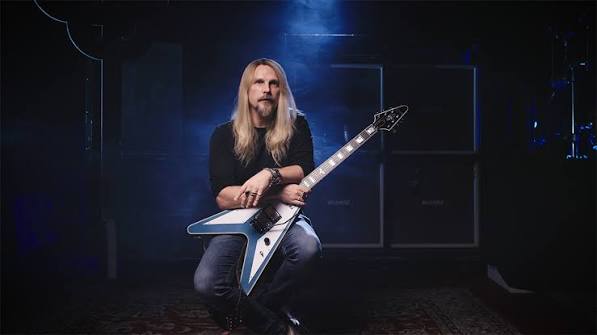
The signature instrument is Gibson. His Custom Shop Flying V is, by his description, based on the Vs he'd modified and lived with over a decade: Pelham Blue, double pickguard, ebony fingerboard, block inlays, Floyd Rose and signature EMG pickups. There was also an earlier limited-edition Epiphone V, and his position on it is a good one — he plays those Epiphones onstage unmodified, because in his words there's no point in having a signature guitar if it's different from the one you can buy.
• Not one permanent setup — the amp brand alone changed across eras
• Not a settings chart — he hasn't published dial positions, so nobody honestly can
• Not the source of his playing — heavy strings, hard picking and a mid-forward amp are tools, not technique
If you want to explore any of the above secondhand, the Reverb links in this article are affiliate links, and heavy Gibson-style instruments show up constantly on the used market. Buying his rig will not get you his right hand. Nothing will, except your right hand.
Using ToneMD for a Priest-Flavoured Metal Tone
The practical move here isn't a shopping list. It's working out what your current gear can already do.
That's what ToneMD exists for. You tell it the guitar, the pickups and the amp, modeller or plugin you actually own, and it builds a prescription around that — rather than handing you somebody else's knob positions from a rig you don't have. For this territory, the characteristics worth chasing are aggressive midrange presence rather than a scooped metal voicing, gain that stays articulate under fast palm muting, and a boost in front of the preamp used for tightness instead of extra distortion.
To be clear about what it can't do: it won't reproduce Faulkner's hands, and it won't recreate a mastered Judas Priest record. Those recordings involve specific rooms, engineers, mixes and decades of playing. What ToneMD gives you is a sensible starting point on your own gear, which is the only place any of this can actually start.
The Player Lesson — Copy Everyone Until You Sound Like Yourself
This is the transferable part, and it's the reason Faulkner's career is worth studying rather than just admiring.
1. Learn complete songs, not isolated licks
Licks teach you shapes. Complete songs teach you structure, form, endurance and the unglamorous business of where a part sits against a drummer. Faulkner's teenage education was full sets in a covers band, and his Priest education was an entire fifty-year catalogue. Neither was a lick collection. Pick one song a week and finish it, including the parts that bore you.
2. Study players from different genres
A list containing Hendrix, Gilmour, Brian May, Rhoads, Schenker and Wylde doesn't produce a clone, because those players contradict each other. Contradiction is the point. If every influence you have solves problems the same way, you'll inherit their limits along with their strengths. Go steal from somebody your friends would find embarrassing.
3. Identify why a phrase works
Most players stop at what the notes are. The useful question is why the phrase lands: is it the rhythm, the space before it, the interval it starts on, the note it refuses to play? Write the answer down in words. If you can't explain the mechanism, you can only ever reproduce the phrase — you can't generate another one like it.
4. Change the rhythmic context
Take a borrowed phrase and move it. Start it on beat two instead of beat one. Play it as triplets. Cut it in half. Play it over a different chord. Nine times out of ten it stops sounding like the original player and starts sounding like an idea you can use, because most of what identifies a lick is rhythmic placement rather than pitch content.
5. Develop your own vibrato and attack
This is where personal identity actually lives, and almost nobody practises it deliberately. Vibrato width, vibrato speed, when it starts, how hard you hit the string, where you pick relative to the bridge — these are audible within a single note and they're yours. Spend ten minutes holding one note different ways. It's dull and it's the highest-return practice you can do.
6. Write original music with borrowed vocabulary
The end of the process isn't purging your influences. It's using their vocabulary to say something they didn't. Faulkner absorbed Tipton and Downing so completely that their phrases became reflexes — and then wrote new Judas Priest material with those reflexes in his hands. That's not imitation and it's not invention from nothing. It's the normal way musicians become themselves.
The Larger Point
A child in a London street plays three wrong chords of a Hendrix song and a stranger leaves ten pence on the wall. Two decades of pub gigs, unsigned bands, support slots and covers sets later, that same guitarist is playing "Painkiller" in front of thousands of people, then rebuilding his own solo vocabulary in his forties, in public, after open-heart surgery.
Nothing in that arc involves being born original.
Every guitarist starts out sounding like somebody else. That's not a phase to be ashamed of, it's how the language gets in. The difficult part — the part that takes decades rather than months — is absorbing enough different people, thoroughly enough, that the combination eventually belongs to nobody but you.
Faulkner's version of that took twenty years of unglamorous work before anyone was watching, and it's still going. That's the whole lesson, and it's available to anyone willing to put in the reps.
If you want more on the players in his influence list, we've written at length about the best '80s metal guitarists, Zakk Wylde's picking-driven approach, Tony Iommi's invention of the form, Kirk Hammett, Brian May and Hendrix at Woodstock. For the twin-guitar tradition Priest helped build, start with the greatest guitar duos of all time.
Gear Referenced in This Article
Some links may be affiliate links. We may earn a small commission at no cost to you.
Sources & further reading
- 1.Judas Priest — official site
- 2.Gibson — Richie Faulkner artist page
- 3.EMG Pickups — artists
- 4.Premier Guitar — Judas Priest rig rundown / gear interview
- 5.Guitar World — Glenn Tipton and Richie Faulkner interview (2012)
- 6.Loudwire / Gear Factor — Faulkner on "Wild Thing"
- 7.Reverb News — Spotlight On: Judas Priest's Richie Faulkner
Experience-driven coverage, not algorithm bait.
- 20+ years of guitar playing experience
- Real-world retail experience at Guitar Center
- Thousands of hours testing guitars, amps, and pedals
- A community of 50,000+ guitar enthusiasts across platforms
- Partnerships with Fender, DistroKid, TrueFire, Card Chords, and Enya
- Editorial standards published openly — see how we test gear
The Modern Guitar Magazine. Delivered to your inbox.
No spam. No gimmicks. Just great guitar content — stories, tones, iconic solos, and honest gear takes. Every week.
Ask GP
3 free questionsQuestions about From Playing Hendrix for Coins?
Get a straight answer from The Guitar Plugged's knowledge engine.
Discussion (0)
Sign in to join the discussion.
Sign in to commentLoading comments…
Discover another guitar story
Swipe through our latest features, breaking news and iconic solos — one story at a time.
Open Swipe →More in Guitar Talk
Robert Plant at 78: Why His Chemistry With Jimmy Page Was Led Zeppelin's Real Secret Weapon
Robert Plant turns 78 today. The conventional story says Page played guitar and Plant sang. The truth is stranger and more useful: they behaved like two lead instruments arguing, answering and leaving each other room.
History of the Riff: Jimi Hendrix's "Foxey Lady" — The Sound That Made the Electric Guitar Dangerous
Feedback before the riff, four Marshall cabinets, a microphone eight feet away and a Stratocaster flipped upside down — the full story of the riff that made the electric guitar sound dangerous.
History of the Riff: How Prince Turned "Purple Rain" Into Guitar Immortality
A song born onstage, a guitar part that barely needs distortion, and a solo built on emotion instead of excess — the full story of "Purple Rain" and its immortal guitar moment.