
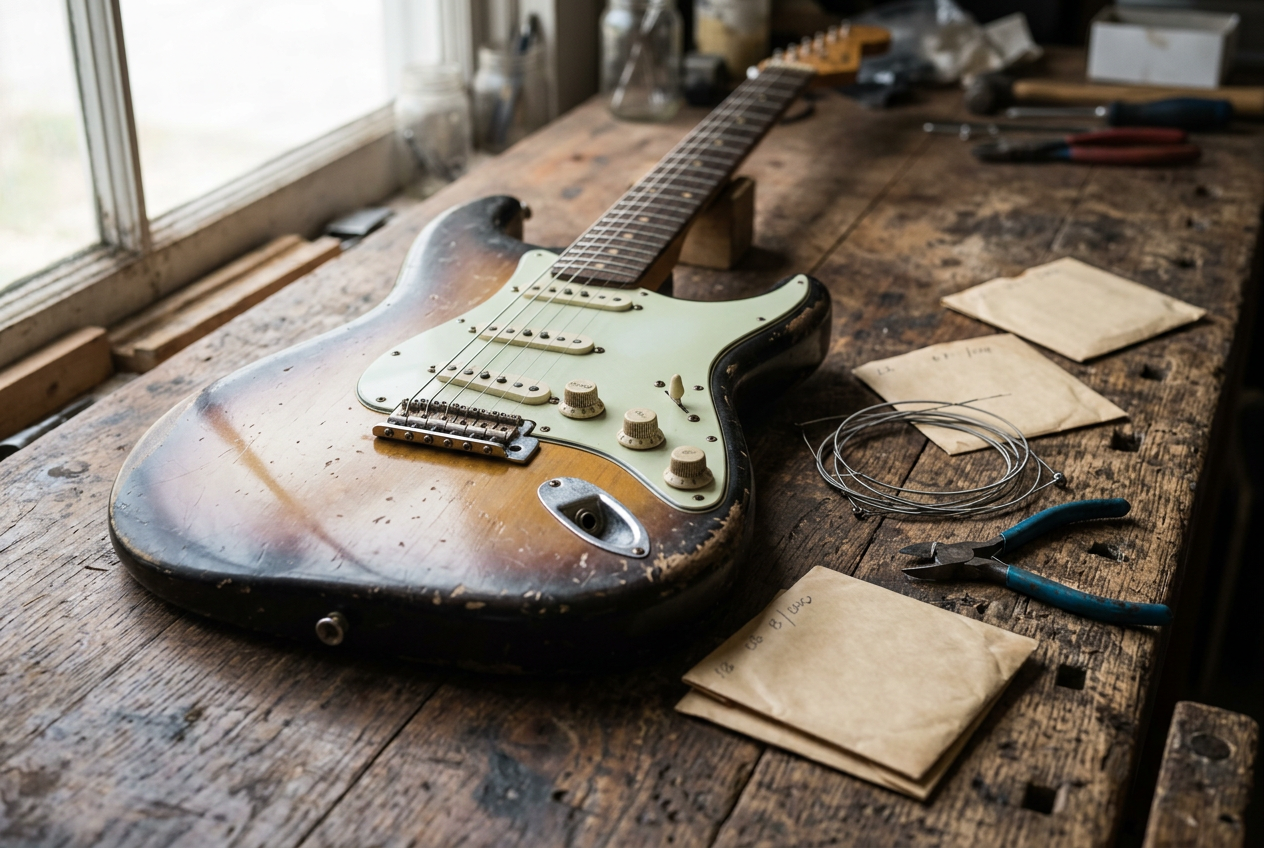
9s vs 10s vs 11s: What Really Happens When You Change Guitar String Gauge?
String gauge changes tension, feel, setup and tuning stability far more than it changes tone. Here's what really happens when you move between 9s, 10s and 11s — and how to pick the right set.
String gauge is the cheapest experiment in guitar and the one surrounded by the most nonsense. A set costs the price of a coffee and changes how the instrument feels under your hands more than most pedals change how it sounds. It also changes the setup, the intonation, the tremolo balance and — on some guitars — the tuning stability.
What it changes far less than the internet claims is tone.
This guide covers what actually happens, physically, when you move between 9s, 10s and 11s, and how to work out which set belongs on your guitar.
What the Numbers Mean
A set described as '9s' has a .009" plain high E string. '10s' start at .010", '11s' at .011". The rest of the set scales up from there, though not identically between brands — two different manufacturers' 10-46 sets can feel meaningfully different because the intermediate gauges and the core-to-wrap ratio in the wound strings differ.
The most common electric sets are 9-42, 10-46 and 11-49, along with hybrid sets that pair light plain strings with heavier wound strings for players who want easy bending and a solid low end.
Tension: The Thing That Actually Changes
Everything else in this article is downstream of tension. A thicker string at the same pitch and the same scale length requires more tension, because a heavier string vibrating at the same frequency over the same length must be pulled tighter.
The differences are not subtle. Across a full set, moving from 9s to 10s adds a meaningful amount of total pull on the neck; moving from 9s to 11s adds substantially more. Most string manufacturers publish per-string tension figures, and they are worth looking at once — the numbers make the trade-offs concrete in a way that adjectives do not.
That extra tension is why heavier strings feel stiffer, why they need more finger pressure, why they resist bending, and why the neck and tremolo need re-balancing when you switch.
Bending and Vibrato
This is where most players notice the change first. Bending a whole step on 11s takes appreciably more finger strength than on 9s, and that has real musical consequences. Fast, wide bends and multi-step overbends are simply easier on light strings — one reason many players in the shred and hard rock lineage settled on 9s.
Vibrato is the more interesting case. Light strings make vibrato easy but also make it easy to be sloppy: a light string responds so quickly that inconsistent hand movement becomes audible as pitch wobble. Heavier strings push back, and for some players that resistance produces a more controlled, more deliberate vibrato. Neither is better. They demand different techniques.
Picking Feel and Fretting Pressure
Heavier strings resist the pick. Players who dig in hard often prefer them for exactly that reason — a light string under an aggressive right hand goes sharp on the attack and flops around. Players with a light touch usually find heavy strings unresponsive, because they are not putting enough energy in to get the string moving properly.
Fretting pressure matters more than people admit. Playing 11s for four hours with barre chords is genuinely more physical work than playing 9s. If you have any history of hand or wrist trouble, that is a legitimate factor in the decision, not a weakness.
Try a hybrid set before assuming you need to go all the way up or down. A set with light plain strings and heavier wound strings gives you easy bending on the top three and a tighter, less floppy low end — which is exactly what most drop-tuned players actually want.
Tuning: Pitch Under the Fingers
Two separate effects here. First, heavier strings hold pitch better under aggressive picking, because it takes more force to displace them far enough to sharpen the note. Second, heavier strings are harder to accidentally bend sharp while fretting — a very common issue for players with a heavy grip on light strings, particularly on chords near the nut.
Working against that: heavier strings put more load on the nut and are more prone to binding in slots cut for a lighter set, which causes strings to stick and release unevenly during bends. That is a setup problem, not a string problem, and it is discussed in Why Does My Guitar Go Out of Tune?.
Intonation and Setup: You Cannot Skip This
Change gauge and you have changed the instrument's mechanical state. Three things need attention.
Intonation. Different string mass means different compensation at the saddle. A guitar intonated perfectly for 9s will be out with 11s. This is not optional — see How to Intonate Your Guitar.
Neck relief. More tension pulls more forward bow into the neck. Going up a gauge typically increases relief; going down decreases it. Measure before and after, and adjust only in tiny increments if adjustment is genuinely needed.
Action. Relief changes shift string height, so action needs re-checking after any relief change. The correct order is always relief, then action, then intonation. The full routine is in The 15-Minute Guitar Setup.
Nut slots. Going heavier can mean the string no longer fits its slot properly. Going lighter can mean the string sits loose and rattles. Both are tech-level fixes if they turn out to be a problem.
Tremolo Balance: The Hidden Cost
On a hardtail or Tune-o-matic guitar, a gauge change is an inconvenience. On a floating tremolo it is a project.
A floating trem is a balance between string tension pulling forward and spring tension pulling back. Change the strings' tension and that balance breaks: heavier strings tip the bridge forward, lighter strings let the springs pull it back. You have to re-balance at the spring claw, which changes the tuning, which changes the tension, which moves the bridge again. Expect several iterations.

X Concepts Strings • Made in USA
Never Run Out of Strings Again.
Join the X Concepts String Club and get fresh USA-made strings delivered every month—plus Premium membership options for the full Guitar Plugged experience.
On a Floyd Rose or other locking system, add fine-tuner range and locking nut clamping to the list of things to sort out. Our step-by-step on that: How to Restring a Floyd Rose Without Losing Your Mind.
Drop Tuning: The Best Argument for Heavier Strings
This is where gauge stops being preference and starts being function. Tune a set of 9s down to drop C and the low strings become floppy — they buzz, they intonate badly, they go sharp when you pick them and they lose definition under distortion.
Lower tunings need more mass to maintain workable tension. That is why players in drop tunings use 10-52, 11-52, 11-56 and heavier, and why extended-range and baritone instruments exist at all. It is not a tone argument; it is a physics one.
“Billy Gibbons plays some of the lightest strings in rock and has one of the biggest tones in rock. That single fact should end the argument permanently.”
The reverse is also true. A set chosen for drop C will feel like bridge cable in standard tuning.
Scale Length: Why the Same Set Feels Different
This trips up more players than anything else in this article. Take an identical set of 10s, put one on a Fender-style guitar with a 25.5-inch scale and another on a Gibson-style guitar with a 24.75-inch scale, tune both to standard pitch, and they will not feel the same.
The longer scale requires more tension to bring the same string to the same pitch. So 10s on a 25.5-inch Strat feel stiffer than 10s on a 24.75-inch Les Paul. This is why so many players use 9s on Fenders and 10s on Gibsons and report that they feel roughly equivalent — because in terms of tension, they roughly are.
The exceptions matter. PRS traditionally uses a 25-inch scale that sits between the two. Some Gibson models and many Gretsch guitars use different scale lengths again, baritones stretch to 27 inches and beyond, and short-scale instruments like a Jaguar sit shorter still at 24 inches. Check your instrument's actual scale rather than assuming its brand.
| Scale Length | Common Examples | Feel at the Same Gauge |
|---|---|---|
| 24.0" | Fender Jaguar, some short-scale models | Slinkiest; easiest bends |
| 24.75" (nominal) | Gibson Les Paul, SG, ES-335 | Softer, easier bending |
| 25.0" | PRS, some Gretsch models | Between the two standards |
| 25.5" | Fender Strat, Tele, most Ibanez | Tighter, more resistance |
| 26.5"–27"+ | Baritones, extended range | Stiff; designed for low tunings |
Perceived Tone and Sustain: Handle With Care
Here is the claim that will not die: heavier strings sound better. Bigger, fatter, more sustain, more tone.
The honest version is more nuanced. A heavier string has more mass and drives the pickup harder, which does produce slightly more output. Under identical conditions, that reads as fuller. But 'identical conditions' is doing enormous work in that sentence, because most players are not comparing gauges under identical conditions — they are comparing a fresh heavy set against a worn light set, or comparing two setups where one guitar was re-intonated and the other was not.
More significantly: a heavier string only sounds bigger if you can actually play it well. A player who can bend a whole step cleanly on 9s and struggles on 11s will produce worse-sounding music on 11s, because expression comes from control rather than mass. Vibrato that becomes tentative, bends that land flat and a fretting hand that fatigues after twenty minutes cost far more tone than a thousandth of an inch of string diameter provides.
Sustain is also mostly a function of the whole system — the setup, the neck joint, pickup height, the amp, the player's fretting-hand pressure — rather than the string alone.
Stevie Ray Vaughan, In Context
Every string gauge conversation eventually invokes Stevie Ray Vaughan, usually as proof that heavy strings equal big tone. The story is true and almost always told without the parts that matter.
Vaughan did use unusually heavy strings — accounts of his sets vary and he changed them over his career, with .013 sets frequently cited and heavier still in some periods. Crucially, he typically tuned down a half step, which reduces the tension of a given gauge considerably. He also had large, exceptionally strong hands, a technique built around striking the strings extremely hard, and — famously — recurring problems with his fingers splitting open, to the point that superglue was a routine part of his working life.
His guitars were also set up specifically for that approach, with high action and heavy frets, and he had techs maintaining them constantly.
So the honest lesson from Vaughan is not 'use 13s'. It is that his gear served an extraordinarily physical technique in a specific tuning. Copying the strings without the tuning, the hands, the setup and the attack does not get you his sound. It gets you a guitar you cannot bend. Our full breakdown of his rig is here: The Ultimate Guide to Stevie Ray Vaughan.
Billy Gibbons, and the End of the Argument
Now the counter-example. Billy Gibbons has one of the most instantly recognisable and physically enormous guitar tones in rock history, and he is famous for using extremely light strings — sets starting at .007 or .008 have been widely reported, a preference he has said in interviews was encouraged by a conversation with B.B. King about not working so hard.
Gibbons' tone is huge. It is also produced with strings that most players would consider unusably light.
Put those two examples side by side and the conclusion is unavoidable: there is no morally superior string gauge. Tone lives in the hands, the attack, the vibrato, the amp and the choices made in the room. Gauge determines how the instrument feels while you make those choices.
The right gauge is the one that suits the guitar, the tuning, the setup and your technique. That is the entire rule.
Should I Play 9s, 10s or 11s?
A practical framework rather than a verdict.
Play 9s if: you are on a 25.5-inch scale in standard tuning, you bend frequently and widely, you play lead-heavy music, you have a lighter picking attack, or you have any hand or wrist discomfort. 9s on a Strat is one of the most common and most successful combinations in electric guitar.
Play 10s if: you want a general-purpose set that handles rhythm and lead equally, you play a 24.75-inch scale guitar, you pick moderately hard, or you occasionally drop to D. 10-46 is the default recommendation for a reason — it is the middle of the road in the useful sense.
Play 11s if: you tune down a half step or a full step, you play mostly rhythm or chord-based music, you have a heavy right hand that pushes lighter strings sharp, you play jazz or blues where bending is less central, or you play slide and need the tension to keep the strings off the frets.
Consider a hybrid set if: you want light-string bending on the top three strings and a tighter low end for riffing — a very common preference among rock and metal players in drop tunings.
Whatever you choose: change one variable at a time, play the new set for at least two weeks before judging, and get the guitar properly re-set-up after the switch. A gauge change evaluated on a guitar that has not been re-intonated and re-balanced tells you nothing except that something feels off.
| Priority | Best Starting Point | Why |
|---|---|---|
| Wide bends and lead playing | 9-42 | Lowest tension; easiest expression |
| All-round rock and blues | 10-46 | Balanced feel, works on most scales |
| Heavy attack, rhythm focus | 11-49 | Resists picking; holds pitch |
| Half-step down tuning | 10-46 or 11-49 | Recovers tension lost to lower pitch |
| Drop D occasionally | 10-52 hybrid | Light top, tighter low string |
| Drop C or lower | 11-56 or heavier | Maintains usable low-string tension |
| Slide playing | 11s or heavier, higher action | Prevents the slide fretting out |
| Hand or wrist issues | 9s or lighter | Substantially less fretting effort |
The Practical Takeaway
Strings are the cheapest meaningful change you can make to a guitar and the easiest to reverse. Buy a set of each, spend a fortnight with them, and pay attention to how you play rather than how you think you should sound. The gauge that makes you play better is the correct one, and no one else's hands get a vote.
Experience-driven coverage, not algorithm bait.
- 20+ years of guitar playing experience
- Real-world retail experience at Guitar Center
- Thousands of hours testing guitars, amps, and pedals
- A community of 50,000+ guitar enthusiasts across platforms
- Partnerships with Fender, DistroKid, TrueFire, Card Chords, and Enya
- Editorial standards published openly — see how we test gear
More From the Guitar Garage
Practical setup, gear and maintenance guides written by working guitarists — straight to your inbox.
Ask GP
3 free questions a dayStill curious? Ask GP about this story.
Your personal classic-rock and guitar guide — ask anything about 9s vs 10s vs 11s.
Discussion (0)
Sign in to join the discussion.
Sign in to commentLoading comments…
Discover another guitar story
Swipe through our latest features, breaking news and iconic solos — one story at a time.
Open Swipe →More in Guitar Garage
10 Things Every Gigging Guitarist Needs (And the One Thing They Always Forget)
Every guitarist obsesses over amps and pedals, but smooth gigs come down to preparation. Here are 10 essentials every gigging guitarist needs — plus the one thing almost everyone forgets.
Why Does My Guitar Go Out of Tune? 11 Causes (And How to Fix Each One)
Discover the 11 most common reasons guitars go out of tune and learn practical fixes to keep your instrument stable and sounding its best.

How to Record Guitar at Home (And Actually Get a Professional Sound)
From your very first riff to a polished recording — everything you need to know without wasting money on gear you don't need.