
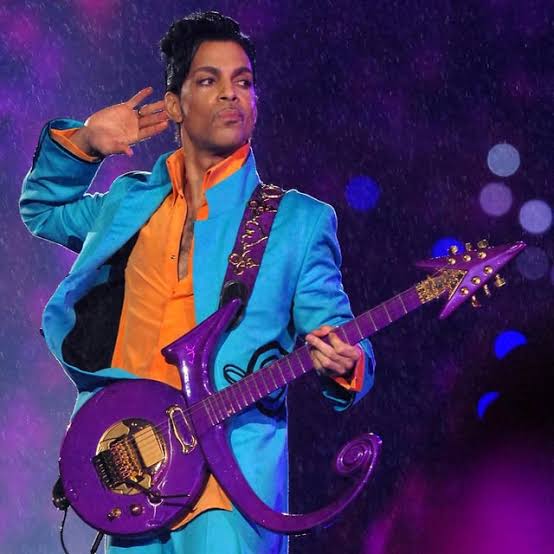
A song born onstage, a guitar part that barely needs distortion, and a solo built on emotion instead of excess — the full story of "Purple Rain" and its immortal guitar moment.
A song born onstage. A guitar part that barely needs distortion to command a room. A solo built on emotion instead of excess. And, more than two decades later, a rain-soaked Super Bowl performance that transformed an already legendary song into something almost mythological.
There are guitar solos that impress you. There are guitar solos that inspire you to pick up the instrument. And then there are a handful that seem to transcend the guitar entirely.
Prince's "Purple Rain" belongs to that last category.
It isn't the fastest solo ever recorded. It isn't the most technically complicated. The rhythm guitar underneath it doesn't rely on a monstrous riff in the traditional Zeppelin, Sabbath or Van Halen sense. Yet the moment those enormous opening chords appear, there is virtually no mistaking the song. And when Prince finally unleashes the guitar near the end, every bend feels as if the preceding minutes have been building toward it.
That is the genius of "Purple Rain." The guitar doesn't dominate the composition. It completes it.
More than four decades after the song was recorded, "Purple Rain" remains one of rock guitar's greatest lessons in restraint, dynamics, arrangement and emotional phrasing. And remarkably, the recording that became one of Prince's defining studio masterpieces began as something much more dangerous: a live performance.
Before the Purple Rain
By 1983, Prince was already far beyond being merely promising. 1999 had pushed him into mainstream America with "Little Red Corvette," "Delirious" and the album's title track, while his reputation as a musician was becoming almost as formidable as his reputation as a performer.
But Prince was preparing something considerably bigger. He wasn't simply making another record. He was building an entire world around Purple Rain: an album, a film, a visual identity and a band capable of helping him execute music that was growing increasingly ambitious.
That band was The Revolution. And one of its most important new members would leave an unmistakable fingerprint on "Purple Rain." Her name was Wendy Melvoin.
She was only 19 years old when she made her live debut with Prince and the Revolution at Minneapolis' First Avenue on August 3, 1983 — the very performance from which the foundation of "Purple Rain" would be taken. That fact alone makes the recording extraordinary. One of the most recognizable guitar arrangements of the 1980s was being performed in front of an audience while one of its guitarists was effectively playing her first official show with the band.
The Chords That Announce "Purple Rain"
Prince received sole songwriting credit for "Purple Rain," but the guitar arrangement became a collaborative piece of magic. Wendy Melvoin has explained that she helped arrange the opening chord progression into the form listeners recognize on the record.
And those chords matter. A lot. Because describing the opening of "Purple Rain" simply by writing down chord names misses most of what makes the part extraordinary. The magic is in the voicing. The strings are allowed to ring. Notes overlap. There is space between attacks. The guitar sounds enormous without becoming aggressive.
Instead of the tight, palm-muted rhythmic vocabulary that defined so much '80s rock guitar, "Purple Rain" breathes. The progression moves with almost hymn-like patience. Prince and the Revolution aren't rushing toward the chorus. They are creating an environment.
That is why the opening functions almost like a riff despite not behaving like a conventional riff. A riff doesn't necessarily have to be a repeating single-note figure. Sometimes a particular sequence of chord voicings becomes just as identifiable as "Smoke on the Water." Play those opening voicings with the right timing and texture and most listeners know the song almost immediately.
The Secret Is What You Don't Play
Young guitarists frequently learn an important lesson backward. We spend years learning how to play more. More notes. More gain. More speed. More effects. "Purple Rain" demonstrates the opposite skill: knowing when not to play.
Listen to how much room exists around the guitar. Those spaces allow the keyboards, vocals, bass, drums and eventually the strings to become part of one enormous sound. A guitarist trying to fill every opening would destroy the arrangement.
That restraint is essential to understanding Prince as a guitar player. He could absolutely explode when necessary. But he understood that the explosion mattered more if you had waited for it. And "Purple Rain" makes you wait.
The Wendy Melvoin Tone
The shimmering rhythm guitar is an enormous part of the song's identity. Melvoin has described the original setup as a modified Rickenbacker equipped with G&L pickups, running through a BOSS CE-1 Chorus Ensemble and a Mesa/Boogie Mark I amplifier.
That chorus is crucial. Not because the guitar needs to sound obviously "effected," but because modulation helps turn the chords into something wider and more dimensional. The notes seem to float rather than simply decay.
For modern players trying to enter the same general tonal territory, the current BOSS CE-2W Waza Craft is particularly interesting because it includes both a CE-2 mode and a CE-1 mode designed to reproduce the character of BOSS's original chorus sounds. The important point, however, is that buying a chorus pedal will not magically create "Purple Rain." Keep the modulation tasteful. The objective isn't seasickness. It is width.
The Night "Purple Rain" Was Captured
On August 3, 1983, Prince and the Revolution performed a benefit concert for the Minnesota Dance Theatre at First Avenue in Minneapolis. A mobile recording unit was brought in to capture the show. Prince had essentially turned a hometown concert into a recording session.
The set included future Purple Rain material including "I Would Die 4 U," "Baby I'm a Star" and the title track itself. Basic recordings from all three would eventually be used for the album.
Get Prince’s “Purple Rain” Tone
Tell ToneMD what guitar and gear you own and we’ll show you how to get as close as possible using the equipment you already have — full signal chain, real numbered settings, no guesswork.
Included with The Guitar Plugged Premium
That means when you hear "Purple Rain," you aren't simply hearing musicians attempting to manufacture the sensation of a huge live performance inside a recording studio. You're hearing the DNA of an actual performance. The room existed. The audience existed. The band was responding to one another in real time. That distinction helps explain something extraordinarily difficult to manufacture: the song feels as though it is happening.
From an 11-Minute Performance to the Masterpiece We Know
The First Avenue performance wasn't simply pressed onto vinyl untouched. Prince continued refining it. The original performance ran approximately 11 minutes. During subsequent work, material was removed, including an additional verse and guitar solo, bringing the song closer to the roughly eight-minute album version. Strings arranged by Lisa Coleman were also overdubbed.
Think about that editing decision from a guitarist's perspective. Prince had more guitar available. He removed some of it. The man had virtually unlimited technical ability and enough confidence to play guitar behind his head in front of stadiums. Yet when the song demanded editing, guitar wasn't sacred. The song was sacred.
That philosophy is exactly why the final solo works so brilliantly. Prince doesn't spend eight minutes constantly reminding you that he's a phenomenal guitarist. He waits. And waits. Then the guitar finally arrives as the emotional release.
• Prince reportedly contacted Journey keyboardist Jonathan Cain after recording "Purple Rain," worried it was too close to "Faithfully." Cain told him the overlap amounted largely to familiar four-chord territory — the songs were distinct.
• Wendy Melvoin was 19 years old at the First Avenue show that produced the master take.
Then Comes the Solo
This is where "Purple Rain" moves from great song to guitar landmark. For much of the recording, Prince refuses to give you the release you're expecting. The arrangement gradually expands. His vocal grows more desperate. The drums feel larger. The harmonic movement becomes increasingly hypnotic.
Then Prince's guitar begins to speak. Not shred. Not demonstrate. Speak.
The solo is built around one of the most important weapons available to any electric guitarist: the bend. Prince bends notes until they feel vocal. Some rise and hang. Others cry and fall away. He repeats ideas. He leaves enormous gaps. He allows sustained notes to become part of the arrangement rather than immediately replacing them with another lick.
Technically advanced players can sometimes struggle with solos like this for a strange reason. They're almost too capable. The instinct is to decorate. Prince refuses. The notes have weight because there aren't too many of them.
Why the "Purple Rain" Solo Works
1. Prince builds before he burns. The solo doesn't begin at maximum intensity. There is somewhere to go. If every bend is enormous, none of them feels enormous. 2. Repetition becomes a weapon. Certain melodic ideas return. That's not laziness — that's composition. The solo becomes memorable because it contains ideas rather than merely licks. 3. Sustained notes matter. A note held for four beats is still a musical event, and the silence around it can be every bit as important as the attack. 4. The guitar responds to the vocal. The solo feels like an extension of everything Prince has just sung, allowing the existing character to say things words no longer can. 5. Technique serves emotion. The goal isn't "look what I can play." The goal is "feel this."
Prince the Guitarist Was Always Hiding in Plain Sight
Prince's status as a pop icon occasionally obscured just how serious a guitarist he was. Mainstream audiences saw everything simultaneously: the singer, the songwriter, the dancer, the producer, the fashion icon, the multi-instrumentalist, the provocateur. The guitar was only one piece of an overwhelming artistic identity.
If Prince had done nothing except play guitar in somebody else's band, we'd probably discuss him very differently. His playing contains rock, blues, R&B, gospel and funk vocabulary, but the end product doesn't feel like a collage of influences. It sounds like Prince. Plenty of guitarists can learn the vocabulary. Very few develop a voice.
The Tone Behind the Emotion
Pinning down every piece of equipment heard on an early-'80s Prince recording can become complicated, particularly because the Purple Rain sessions mixed live recording and subsequent studio work. Period documentation and gear research point toward Prince and Wendy using Mesa/Boogie amplification, with Prince's famous Hohner-style Mad Cat Telecaster among the defining instruments of the era. Gear archives also identify Mesa/Boogie Mark II amplifiers and Bag End cabinets as part of the broader Purple Rain-era rig.
“Sometimes virtuosity is knowing exactly how long to wait before playing the next note.”
But chasing exact vintage hardware misses the larger lesson. The "Purple Rain" lead tone requires several ingredients more than it requires a museum-perfect rig.
• Guitar: Responsive Tele-style single-cut with strong midrange
• Overdrive: BOSS SD-1 for mid-focused push and sustain
• Modulation: CE-style chorus, tasteful — width, not seasickness
• Amplifier: Mesa/Boogie-style clean-to-edge-of-breakup
• Ambience: Generous reverb, controlled delay
• The real secret: expressive vibrato and bends that reach their destination
ToneMD Prescription: Build Your Own "Purple Rain" Tone
Trying to recreate Prince's tone becomes complicated because the correct settings depend heavily on what you're actually playing through. A Helix preset doesn't translate directly to a Boss Katana. A Fractal user doesn't need the same instructions as somebody using a Fender Mustang. A Les Paul doesn't react like a Tele-style guitar.
That's the reason we built ToneMD. Instead of handing every guitarist one generic list of settings, ToneMD builds a tone prescription around your rig. Select your platform, tell ToneMD what guitar and pickups you're using, enter Prince — "Purple Rain," and use the resulting prescription as the starting point for your own recreation.
For a general starting philosophy, aim for a clean-to-edge-of-breakup rhythm sound with lush but controlled modulation, then build the lead tone around increased sustain, midrange and gain without burying the pick attack. And remember: tone is only half the prescription. You still have to make the guitar cry.
2007: "Can You Make It Rain Harder?"
Twenty-three years after Purple Rain made Prince a global superstar, the song received perhaps its greatest encore. Super Bowl XLI. February 4, 2007. Dolphin Stadium, Miami Gardens, Florida.
Prince had approximately 12 minutes in front of one of the largest television audiences imaginable. Halftime shows are logistical monsters even when conditions are perfect. Conditions were not perfect. It was raining. Hard. There were understandable concerns about a wet stage, electrical equipment and performers moving around in high-heeled shoes. When Prince was informed about the weather, the response attributed to him became legendary: he reportedly wanted to know whether they could make it rain harder.
Of course he did.
The Greatest Possible Weather for "Purple Rain"
Prince's Super Bowl set was already wildly ambitious. He tore through material that included "Let's Go Crazy," "Baby I'm a Star," Creedence Clearwater Revival's "Proud Mary," Bob Dylan's "All Along the Watchtower" and even the Foo Fighters' "Best of You." Then came the inevitable finale.
And nature supplied production value no stadium crew could have manufactured convincingly. Actual rain poured down as Prince played "Purple Rain." The stage glowed. The crowd disappeared into the storm. Prince stood in the middle of it with his guitar. Suddenly a song released in 1984 seemed to have been waiting 23 years for exactly that moment.
The Super Bowl Solo
Watch Prince during that performance and something becomes immediately obvious. He isn't treating the guitar solo as an instrumental break. It is the climax of the entire show.
A lesser performer might have approached a Super Bowl guitar solo as an opportunity to demonstrate virtuosity. Prince understood television. He understood silhouette. He understood staging. He understood anticipation. And above everything, he understood drama. During the climactic section, a large fabric screen rose and Prince's silhouette was projected across it as he played. Producers had actually worried that the rain-soaked screen might fail to rise properly. It worked, and the image became one of the defining visuals of Super Bowl halftime history.
But remove the giant screen. Remove the stadium. Remove the rain. The guitar performance still works, because Prince plays the melody as though the instrument is connected directly to his nervous system. Notes stretch. Bends climb. The guitar screams without losing melody. And Prince allows notes to hang in the rain. That's the part guitarists should study — not merely which fret he plays, but how long he is willing to let one note survive.
Why the Super Bowl Performance Matters to Guitar Players
The performance is frequently discussed as one of the greatest Super Bowl halftime shows ever staged. That's deserved. But guitarists should look at it from another angle: when was the last time an electric guitar felt that important during one of America's biggest mainstream entertainment events?
There was Prince, standing alone against a gigantic illuminated sheet, playing an extended guitar solo to an audience that certainly wasn't composed entirely of guitar players. And nobody needed the solo explained to them. Nobody needed to understand scales. The emotion translated. That's the ultimate goal of instrumental playing. If somebody who knows absolutely nothing about guitar can understand what you're trying to say, you've won. Prince won.
The Difference Between Playing the Notes and Playing "Purple Rain"
You can learn the notes of the "Purple Rain" solo relatively quickly. Learning to play it convincingly is another matter. The bends have to reach their destination. The vibrato needs confidence. The spaces need discipline. The sustained notes have to remain alive.
That's why this is such an excellent song for intermediate and advanced players alike. For the intermediate guitarist, it teaches control. For the advanced guitarist, it teaches restraint.
Try this experiment. Learn the basic solo. Then record yourself. Listen without watching your hands and ask: am I making every bend say something? If the answer is no, don't add notes. Remove them. Slow down. Improve the vibrato. Improve the intonation. Change the dynamics. That's the Prince lesson.
A Solo Doesn't Need 100 Notes When Five Will Do
Guitar culture naturally celebrates athleticism. We admire Eddie Van Halen, Yngwie Malmsteen, Steve Vai, Joe Satriani, Paul Gilbert and John Petrucci — and rightly so. But guitar playing has another dimension that is much harder to quantify: emotional efficiency. How much can you communicate with one note?
David Gilmour understood it. B.B. King understood it. Jeff Beck understood it. And Prince absolutely understood it. The best moments in "Purple Rain" aren't memorable because of how many notes fit inside them. They're memorable because Prince makes individual notes feel inevitable. You wait for the bend. It arrives. You want it to keep climbing. It does. Then it hangs there. That's tension and release at its simplest — and its most effective.
Wendy Melvoin Deserves Her Flowers
Any guitar discussion of "Purple Rain" that focuses exclusively on Prince misses an important piece of the record. Wendy Melvoin's contribution to the guitar arrangement is fundamental. Her opening voicings establish the entire emotional landscape before Prince's lead guitar ever gets an opportunity to explode.
She was 19 when the First Avenue performance was captured. Her live debut with the Revolution became part of one of the most famous recordings of the decade. Prince may have been the unquestioned center of the universe, but Purple Rain benefited enormously from musicians capable of bringing their own personalities into his vision. The Revolution wasn't decoration. You can hear the chemistry.
"Purple Rain" Changed What a Prince Song Could Be
Prince had already proven that he could write hits. But "Purple Rain" occupied a different scale. It was rock without abandoning soul. A ballad without becoming passive. A guitar showcase without becoming a guitar song. A pop anthem that could stretch for eight minutes.
It borrowed the emotional architecture of gospel, the volume of arena rock, the vocabulary of blues guitar and the theatricality of a performer who understood that music could be visual even when you were listening with your eyes closed. That's why the song continues to work. Its emotional mechanics are timeless.
From First Avenue to the Super Bowl
There is something beautifully circular about the history of "Purple Rain." The song's defining recording began in a club. Not a sterile studio. Not assembled piece by piece until every imperfection disappeared. A club. First Avenue. Minneapolis. August 3, 1983.
Twenty-three and a half years later, Prince stood in the rain at the Super Bowl. The scale could hardly have been more different. But the essential mechanism remained exactly the same: a man, a guitar, a band, and a song powerful enough to make an audience stop thinking about anything else.
The Guitar Plugged Verdict
There are more technically difficult guitar solos. There are faster solos. There are solos containing more exotic harmony and considerably more notes. There may not be many that mean more.
"Purple Rain" represents Prince's greatest strength as a guitarist: his ability to make technique disappear behind personality. You don't hear a scale exercise. You hear Prince. You don't hear somebody trying to impress guitarists. You hear somebody trying to move everybody. And that might be the highest level a guitarist can reach.
The greatest players eventually stop sounding like people playing guitar. They simply sound like themselves. Prince reached that point long before "Purple Rain." But on one August night in Minneapolis, the tape happened to be rolling. And on one rainy February night in Miami more than two decades later, the entire world got to watch him prove it again.
Purple rain. Purple guitar. One absolutely immortal solo.
Recommended Listening
What to Remember
- ▸The album version of "Purple Rain" is built on a live recording from First Avenue, Minneapolis, on August 3, 1983.
- ▸Wendy Melvoin helped arrange the opening chord voicings at her live debut with the Revolution, aged 19.
- ▸The original performance ran about 11 minutes; Prince edited it down to roughly eight, cutting a verse and a guitar solo.
- ▸The solo's power comes from bends, sustain, repetition and space — not speed or density.
- ▸Prince's rain-soaked 2007 Super Bowl finale turned the song into one of the most iconic guitar moments in mainstream television history.
- BOSS SD-1 Super OverDrive$59·Check on Amazon →
- Prince & The Revolution — Purple Rain (Vinyl)$29·Check on Amazon →
Some links are affiliate links — we may earn a small commission at no cost to you.
Experience-driven coverage, not algorithm bait.
- 20+ years of guitar playing experience
- Real-world retail experience at Guitar Center
- Thousands of hours testing guitars, amps, and pedals
- A community of 50,000+ guitar enthusiasts across platforms
- Partnerships with Fender, DistroKid, TrueFire, Card Chords, and Enya
- Editorial standards published openly — see how we test gear
Love the stories behind legendary guitar moments?
Subscribe to The Guitar Plugged for more History of the Riff deep dives into the songs, sounds and players that changed music.
Ask GP
Questions about How Prince Turned "Purple Rain"?
Get a straight answer from The Guitar Plugged's knowledge engine.
Keep digging
Discussion (0)
Sign in to join the discussion.
Sign in to commentLoading comments…
Discover another guitar story
Swipe through our latest features, breaking news and iconic solos — one story at a time.
Open Swipe →More in Guitar Talk
The Devil Went Down to the Crossroads: Inside Steve Vai's Legendary Guitar Duel
There are guitar scenes in movies. And then there is Crossroads. Forty years on, the final duel remains part movie sequence, part guitar lesson, part urban legend — and the truth behind it is stranger than the film ever let on.
Jake Kiszka and the Great Greta Van Fleet Debate: Rip-Offs—or the Band Bringing Classic Rock Back?
Greta Van Fleet have spent nearly their entire career hearing the same accusation: they sound like Led Zeppelin. But dismissing Jake Kiszka and company as imitators misses the far more interesting story.
Jeff Beck: The Guitarist Who Never Stopped Reinventing the Electric Guitar
There are guitarists who become famous for a sound. There are guitarists who become famous for a song. And then there are the rare players who seem to spend their entire careers trying to discover sounds the electric guitar wasn't supposed to make. Jeff Beck belonged to that last category.