
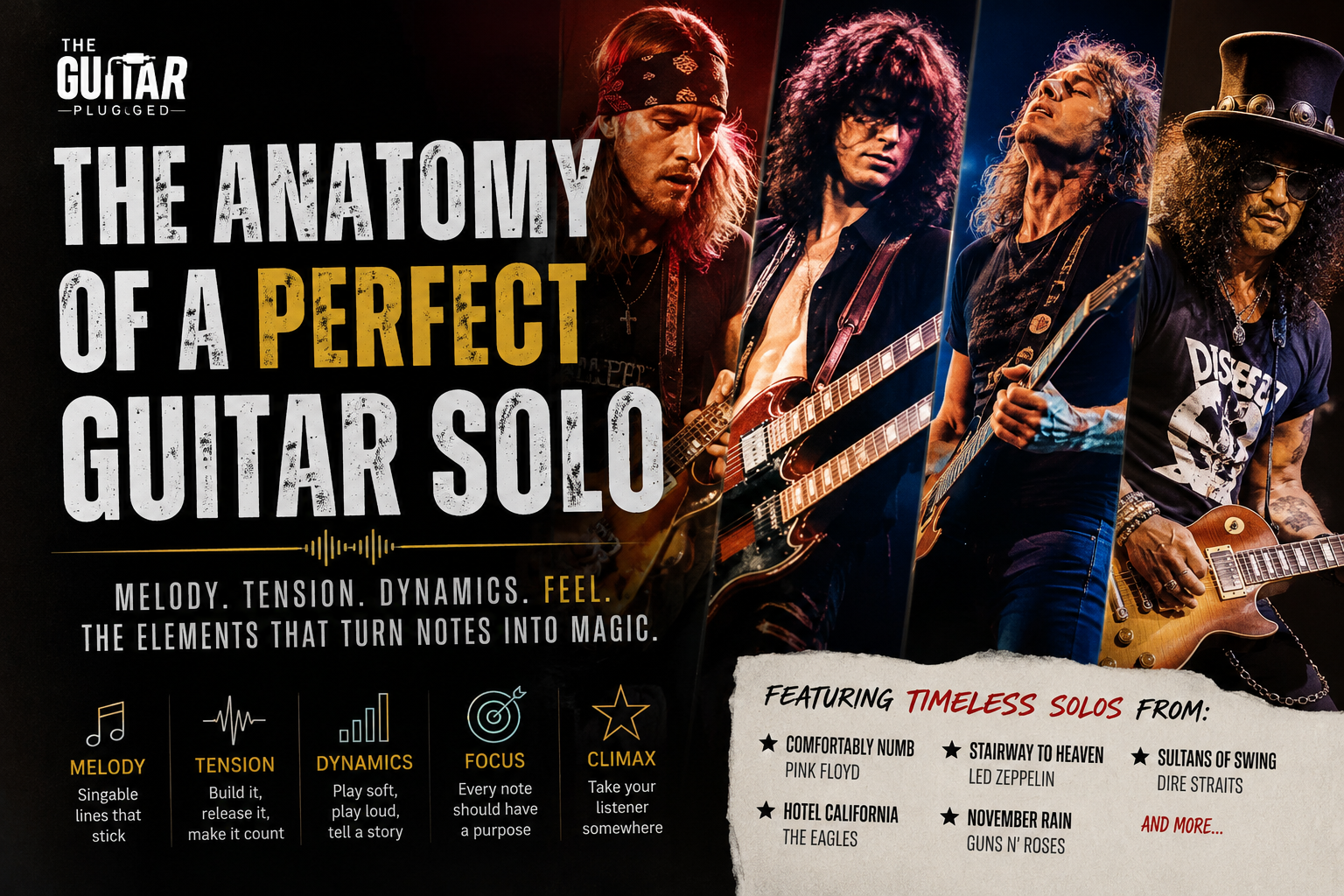
The Anatomy of a Perfect Guitar Solo: Why the Greatest Solos Never Get Old
Millions of guitarists can play more notes than David Gilmour plays in the opening phrases of Comfortably Numb. Almost none of them could have written it. A working guitarist's breakdown of melody, phrasing, tension, dynamics and tone — and how to use all of it when you write your own solo.
Millions of guitarists can play more notes than David Gilmour plays in the first thirty seconds of either Comfortably Numb solo. Thousands can play them cleaner, faster, and with better time. Almost none of them could have written those phrases.
That gap is the whole subject of this article.
What separates a collection of notes from a guitar solo people still want to hear thirty, forty or fifty years later? It isn't difficulty. Plenty of extremely difficult solos have vanished. It isn't originality alone, either — half the vocabulary in rock lead guitar was already sitting in Chicago blues records by 1960. Something else is going on, and it's learnable, which is the good news for the rest of us.
[TOC]
What to Remember
- ▸Memorable solos behave like vocal melodies — motifs you can hum, repeated and developed rather than abandoned.
- ▸Phrasing, not scale choice, is what makes two players sound different on the same five notes.
- ▸Tension comes from delaying resolution: bending toward a target note and arriving late, or not at all.
- ▸Great solos are shaped like stories — a low, quiet opening earns a high, loud peak.
- ▸Technique is vocabulary. Speed is only a problem when nothing musical is being said with it.
Melody: The Solo Needs Something to Say
Sing the second solo from Comfortably Numb. You can. Most people who have heard the song twice can. That's not an accident of familiarity — it's a property of the writing. The phrases move in singable intervals, they sit in a comfortable range, and they resolve where your ear expects them to resolve, right up until the moments Gilmour decides they shouldn't.
A solo that functions as a melody survives being separated from the guitar. Hum the Sultans of Swing outro. Whistle the top line of the November Rain solo. If it still works without distortion, without the amp, without the room, you have a piece of composition rather than a run of scale material.
Slash's November Rain solos are worth studying specifically because they're so unhurried. The famous outro solo is built out of long, held notes with enormous vibrato and a handful of climbing phrases — the sort of line a singer could actually perform. Compare it to the tapping-and-legato content he's perfectly capable of playing elsewhere and it becomes obvious that the restraint is a choice, not a limitation.
Mark Knopfler's Sultans of Swing works differently. The closing solo is fast, but it's fast the way speech is fast — bursts of notes clustered into phrases with clear beginnings and endings, delivered fingerstyle on a Strat so that every note has a slightly different attack. It's melodic in the way a good storyteller is melodic. There's punctuation.
The mechanism underneath all three is the same: motif. State a short idea. Repeat it, usually with one thing changed — a note moved, the rhythm shifted, the phrase transposed to sit over a new chord. Then develop it into something bigger. Listeners remember ideas they hear more than once. They don't remember material that never comes back.
• Can you sing the first four bars back after one listen?
• Does any idea appear more than once in the solo?
• When it comes back, has something changed?
• Does the last phrase relate to the first one?
If you answered no four times, you played a scale, not a solo.
Phrasing: The Notes You Don't Play Matter
Give two guitarists the same backing track, the same key, and the same five notes of a minor pentatonic box. One sounds like B.B. King. The other sounds like a practice session. Nothing about the note choice explains the difference. Everything about the phrasing does.
B.B. King is the cleanest demonstration in recorded music. He tended to play a short phrase and then stop — genuinely stop, sometimes for a full bar — while the band carried on. The silence isn't emptiness. It's framing. A phrase surrounded by space registers as a statement; the same phrase buried in continuous eighth notes registers as texture.
Vibrato is the other half of it. King's vibrato was wide, fast and applied deliberately to specific notes; Gilmour's is slower, wider still, and often arrives late in a held note so that the note blooms rather than shakes. Gary Moore attacked his vibrato with something close to violence. Stevie Ray Vaughan played heavy strings tuned down a half step and dug in hard enough that his attack alone functioned as an expressive device — you can hear the pick fighting the string.
None of those four players is doing anything the others couldn't. They're making different decisions about four variables:
Rhythmic placement. Landing slightly behind the beat feels relaxed and bluesy. Landing on top feels urgent. Neither is correct; both are tools.
Note length. How long you hold the top note of a phrase changes its weight more than anything else in your control.
Bend speed. A fast bend is an exclamation. A slow one is a question. A bend that arrives a fraction under pitch and stays there is the single most identifiable sound in blues guitar.
Silence. Where the phrase stops determines where the next one starts, and a listener's attention resets in the gap.
The practical upshot: if your solos sound generic, the problem is rarely your scale knowledge. Record yourself, listen back, and count how many bars contain no notes at all. If the answer is zero, you've found the issue.
Tension and Release
Music is anticipation management. You set up an expectation, then decide when — and whether — to satisfy it.
The most direct tool on guitar is the bend toward a target note. Bend up to the root and arrive on the downbeat and you've resolved cleanly. Bend up and arrive a beat late, over a chord change, and the same note suddenly means something different. Stop the bend short of pitch and hold it there and the listener leans forward.
Chord tones are the other half. A solo that only acknowledges the key sounds flat over a moving progression. A solo that lands on the third of whatever chord is currently underneath it sounds like it belongs to the song. This is what people mean when they say a player "follows the changes," and it's the difference between a lead line and a lead line that sounds composed.
Want This Tone?
Tell ToneMD what guitar and gear you own and we’ll show you how to get as close as possible using the equipment you already have — full signal chain, real numbered settings, no guesswork.
Included with The Guitar Plugged Premium
Hotel California is the textbook case. Don Felder and Joe Walsh trade phrases over a descending progression that never fully settles, and the harmonized figure at the end resolves the whole thing — which is precisely why the outro feels like a destination rather than a fade.
Stairway to Heaven does it with pacing. Jimmy Page opens with a simple, almost tentative idea and spends the solo climbing away from it. And Gary Moore's Still Got the Blues does it harmonically — the progression itself keeps circling back before it lets go, and Moore plays right into that ache instead of trying to resolve it early.
Dynamics feed the same system. Getting quieter before the peak is a form of tension. So is thinning out the note density for two bars right before you double it.
Building the Solo Like a Story
A great solo almost never opens at full intensity. If bar one is the loudest, highest, fastest thing in the section, there's nowhere left to go, and eight bars later the listener has stopped caring.
Think in three parts.
1. The Statement
Low on the neck, sparse, melodic. You're establishing an idea and letting the listener adjust to a new voice entering the song. Two or three phrases is plenty.
2. The Development
The idea comes back, but changed. Note density creeps up. You move up a position. Maybe you add a technique you haven't used yet — a wider bend, a faster run, a chromatic approach note. Nothing here should feel like a peak; it should feel like pressure building.
3. The Climax
The highest register, the longest held note, the biggest bend, the moment everything has been pointing at. Then a landing — a resolved phrase, a held root, or a handoff back to the vocal.

X Concepts Strings • Made in USA
Never Run Out of Strings Again.
Join the X Concepts String Club and get fresh USA-made strings delivered every month—plus Premium membership options for the full Guitar Plugged experience.
Stairway is the standard-issue example because the architecture is so exposed: the solo starts modestly and climbs, phrase by phrase, until the last section is running at a completely different intensity than the opening. Comfortably Numb does the same thing across a much longer span, and the second solo works partly because the first one already established the melodic language it's escalating.
Register is your cheapest structural tool. Start around the 5th fret. Finish above the 12th. The listener will feel the arc even if they can't name what changed.
Dynamics
This is the most neglected item on the list, largely because so much modern recording flattens it automatically.
Pick attack alone gives you an enormous range. Play a phrase lightly near the neck and it's round and vocal; play the identical phrase hard near the bridge and it snarls. Add the guitar's volume knob — roll it back to 6 for the opening statement, roll it up for the climax — and you've got dynamics that survive even a heavily overdriven amp, because you're changing how hard the front end is being driven, not just how loud it is.
“Two players can use the same five notes in the same position and sound nothing alike. Everything that separates them happens in the spaces between the notes.”
The contrast case is worth being honest about: a heavily compressed, mechanically even performance is easier to mix and easier to play, and there are contexts where that's exactly right. But even dynamics mean every note carries the same weight, and when every note is important, none of them are.
Try this. Play a phrase three times: once soft, once medium, once as hard as you can without the notes falling apart. It's the same phrase. It's three different musical statements.
Tone Serves the Solo
Tone isn't decoration applied after the fact — it's part of the composition, because it determines what kind of phrases are even possible.
Brian May's sound — the Red Special through treble boosters into Vox AC30s — sustains and layers in a way that made his stacked harmony lines viable. Those parts are written for that tone. Gilmour's soaring, compressed lead voice, thick with delay, lets a single held note stay interesting for four bars; without that sustain, the same phrase would sound empty. Eddie Van Halen's aggressive, slightly loose Brown Sound had enough compression and gain to make legato lines speak evenly, which is exactly what his vocabulary required.
Knopfler's fingerstyle attack on a Strat gives him a different note envelope entirely — softer transient, more midrange complexity, and the ability to sound multiple strings at once with different intensities. Slash's Les Paul-into-Marshall voice is thick in the low mids, which is why his long held notes sit so comfortably on top of a dense band.
There is no single perfect guitar tone. There's the tone that makes your phrases work in the song you're playing. A scooped, saturated modern high-gain sound will bury a subtle blues bend; a clean Fender amp will expose a legato line that relies on gain to sustain. Choose the sound first, then write to it — or write the line first and dial the amp until the line speaks.
Technique Is a Tool, Not the Goal
It has become fashionable to treat technical playing as the enemy of feel. That's lazy, and it's wrong.
Eddie Van Halen's Eruption is one of the most emotionally charged pieces of guitar recording in the catalog, and it is almost entirely technique. Joe Satriani has built a forty-year career on instrumental music that people hum. Steve Vai uses the whammy bar as a genuinely expressive device, not a stunt. Yngwie Malmsteen's neoclassical phrasing is rigorous, structured composition — you may not enjoy the idiom, but it is not random.
Speed is not the problem. Technique without musical purpose is the problem, and you can hear the difference instantly: purposeful technique goes somewhere, and demonstrative technique just stops when the player runs out of pattern.
Van Halen is the clearest example of the good version. He used tapping the way a horn player uses arpeggios — as a way to cover intervals a hand can't reach, in service of a line. His legato runs have shape and direction. His dive bombs land on musical events, not random beats. The techniques were vocabulary, and he had something to say with them.
The test is simple: does the fast passage lead somewhere the slow passages set up? If yes, play it. If it exists to prove you can, cut it.
The Climax
Certain moments in recorded guitar carry an anticipation that survives complete familiarity. You know the note is coming. You've heard it four hundred times. It still works.
The second Comfortably Numb solo has several of them. The November Rain outro has one the moment the last section lifts. Hotel California has the harmonized figure everyone in the room air-guitars at the same time.
What makes these moments land isn't the notes themselves — most of them are simple. It's everything before them. The peak of a solo is a payoff, and a payoff requires a debt. If you spend the first eight bars in the highest register at maximum gain and maximum note density, the last eight bars can't be a climax, because nothing has been withheld.
That's the practical implication: your climax is designed backwards. Decide what the biggest moment will be, then deliberately avoid using its ingredients — that register, that intensity, that technique — until you get there.
Why Imperfection Can Make a Solo Better
There's an important distinction here, so let's be precise: sloppy is not expressive. Missing the pitch on a bend because your fingers aren't strong enough is not soul. It's a bend that's out of tune.
But human variation is real and it's audible. A phrase that pushes slightly ahead of the beat sounds urgent. A bend that overshoots deliberately sounds aggressive. Pick noise, fret buzz on a hard attack, the scrape of a hand moving position — these are artifacts of a person physically playing an instrument, and they're part of why the record sounds like a performance rather than a file.
Vibrato is where this matters most. Machine-perfect vibrato at a fixed rate and depth sounds synthetic, because no human hand does that. The slight irregularity in a great player's vibrato is the fingerprint.
Quantized, pitch-corrected, endlessly comped guitar can be technically flawless and still feel like nothing happened. The goal isn't to introduce mistakes — it's to stop editing out the evidence that a person played it.
Can the Perfect Solo Be Taught?
The instinct can't. The framework absolutely can, and most players who "can't write solos" have simply never been given one.
Here it is, in order:
1. Establish a melodic idea. Two bars. Something singable. Write it before you plug in if that helps.
2. Leave space. Deliberately. Rests are part of the composition, not gaps in it.
3. Repeat and develop the motif. Bring the idea back with one element changed.
4. Target chord tones. Know where the thirds are for each chord in the progression and land on them.
5. Increase intensity gradually. Note density, dynamics and gain should all trend upward.
6. Change register. Start low. End high. Let the arc do the work.
7. Use technique where the music demands it. Not before.
8. Build toward one memorable peak. One. Not four.
9. End with purpose. Resolve, or hand off cleanly. Don't just stop playing.
Loop a simple 16-bar progression and improvise over it with a hard rule: you may only play five notes per four-bar phrase. Twenty notes total.
Record it. You'll immediately start choosing which notes matter, holding them longer, bending them further, and putting them in more interesting rhythmic places — because you can't hide behind volume of material.
Run it three or four times, then remove the limit. Most players find that the solo they play afterward is dramatically better than the one they would have played before.
If you want more raw material to draw on while you do this, the Practice Hub scale library and chord library cover the shapes and the chord tones you'll be targeting.
What Actually Makes a Solo Last
The best guitar solos aren't remembered because of how many notes they contain. They're remembered because of how those notes make us feel — and feeling, in music, is manufactured through the specific, teachable choices we've been through here. Melody. Space. Tension. Shape. Dynamics. Tone that suits the song. Technique deployed with intent.
Decades after Comfortably Numb, Hotel California, Stairway to Heaven and Sultans of Swing were recorded, guitarists are still sitting down and learning them note for note. Nobody is making them. There's no exam. They do it because reverse-engineering a great solo is the fastest way to understand why it works — and because once you know why it works, you can start making the same decisions in your own playing.
That's the real reason these solos never get old. They're not museum pieces. They're the syllabus.
Experience-driven coverage, not algorithm bait.
- 20+ years of guitar playing experience
- Real-world retail experience at Guitar Center
- Thousands of hours testing guitars, amps, and pedals
- A community of 50,000+ guitar enthusiasts across platforms
- Partnerships with Fender, DistroKid, TrueFire, Card Chords, and Enya
- Editorial standards published openly — see how we test gear
The Modern Guitar Magazine. Delivered to your inbox.
No spam. No gimmicks. Just great guitar content — stories, tones, iconic solos, and honest gear takes. Every week.
Ask GP
3 free questions a dayStill curious? Ask GP about this story.
Your personal classic-rock and guitar guide — ask anything about The Anatomy of a Perfect.
Discussion (0)
Sign in to join the discussion.
Sign in to commentLoading comments…
Discover another guitar story
Swipe through our latest features, breaking news and iconic solos — one story at a time.
Open Swipe →More in Guitar Talk
The 10 Greatest Guitar Renditions of “The Star-Spangled Banner”
From Jimi Hendrix's controlled chaos at Woodstock to modern performances by H.E.R., Gary Clark Jr. and Jack White, these guitarists turned America's national anthem into something deeply personal.

Happy Birthday, Joe Perry: The Riff Machine Who Gave Aerosmith Its Swagger
Joe Perry turns 76 today. From the swampy grind of “Sweet Emotion” to the reunion that saved a band, this is the career of the guitarist who taught American hard rock how to strut.
History of the Riff: How Joe Satriani Made “Flying in a Blue Dream” Feel Weightless
An acoustic guitar in an unusual tuning, a stray broadcast and a melody that seems to hang in the air: inside the construction of Satriani’s 1989 masterpiece.