Marcus King: The Blues Prodigy Carrying Southern Guitar Into a New Generation
Vocal bends, elite vibrato and a semi-hollow tone the size of a room. A guitarist's deep dive into Marcus King's technique, phrasing vocabulary, gear and why he may be the most complete young blues musician working today.
There are guitar players who impress you with speed. Others leave you speechless with tone. Some write unforgettable songs. Marcus King somehow manages to do all three.
Long before his name became familiar to mainstream audiences, serious guitar players knew something special was happening. Word moved the way it always does in guitar circles — a phone-recorded club clip, a festival side-stage set someone couldn't stop talking about, a name dropped by an older player who does not hand out compliments cheaply.
The first thing you notice isn't how fast he plays. It's how effortlessly emotional every phrase feels. His bends sound vocal. His vibrato seems alive. Even when he tears through blazing pentatonic runs, nothing sounds rehearsed. Everything feels honest.
That honesty has become Marcus King's greatest strength. In an era where social media often rewards technical gymnastics over musical storytelling, King reminds listeners that feeling still wins. Every note has purpose. Every solo tells a story. And that's exactly why so many guitar players believe he's one of the finest blues musicians of his generation.
[TOC]
What to Remember
- ▸Marcus King grew up in a three-generation Greenville, South Carolina guitar family — music was the family business, not a hobby.
- ▸His core tone comes from a 1962 Gibson ES-345 semi-hollow, played largely on the neck pickup into loud, barely-breaking-up tube amps.
- ▸His vibrato is elite because it is wide, even, correctly timed and always returns to true pitch — the hardest thing on the instrument to fake.
- ▸His vocabulary blends minor and major pentatonic, Mixolydian, Dorian, chromatic passing tones, double stops and gospel phrasing.
- ▸He is a genuine soul singer and songwriter, which is why he is likely to outlast pure technicians.
- ▸The gear list is short on purpose: guitar, tube amp, one overdrive. Tone starts in the hands.
Growing Up in a Musical Family
Marcus King was born in Greenville, South Carolina in 1996 — upstate, closer to the Blue Ridge foothills than to the coast, in a part of the South where blues, country, gospel and soul have been sharing the same bar stages for a very long time. That geography matters. Greenville isn't Chicago and it isn't Clarksdale. It's a place where a working band has to be able to play a shuffle, a country two-step, a gospel-flavored ballad and a Southern rock encore in the same night without flinching.
His father, Marvin King, is a respected blues guitarist in his own right, a regional player who spent decades on those stages doing exactly that. His grandfather, Bill King, played too. Three generations of guitar players in the same family line is not a marketing story — it's a training environment.
The distinction is worth sitting with. Plenty of guitarists grow up loving music. Fewer grow up inside it. In the King household, music wasn't simply a hobby. It was the family business — the thing that paid bills, the thing that filled the truck with gear on a Friday afternoon, the thing that got talked about at the kitchen table on Sunday morning with the specificity most families reserve for work.
• How a set is paced, not just how a solo is played
• How to read a room that isn't listening yet
• How to play a rhythm part for three hours without getting bored
• How to hear a band as an arrangement rather than a backdrop
• How to keep your dynamics in reserve until the moment they matter
He started playing extremely young — guitar in his hands before most kids have picked a favorite band — and was sitting in with his father's group as a pre-teen. By his mid-teens he was gigging for real, and by 2015 he had released his first record under the Marcus King Band name while still a teenager.
That upbringing shows in the least glamorous places. Listen to how he comps behind a horn line. Listen to how he leaves room for a Hammond organ. Listen to how he plays fewer notes in the first chorus than the third, because he already knows where the song is going. That's not a technique you learn from tab. It's what happens when your musical education is a bandstand rather than a bedroom.
Just as importantly, the influences arriving through the house weren't filtered through a genre. B.B. King and Otis Redding and the Allman Brothers Band and Ray Charles and gospel radio all sat in the same pile. Nobody told him blues and soul and Southern rock were separate categories, so he never learned to treat them that way. That single fact explains more about his playing than any gear list ever will.
The Tone
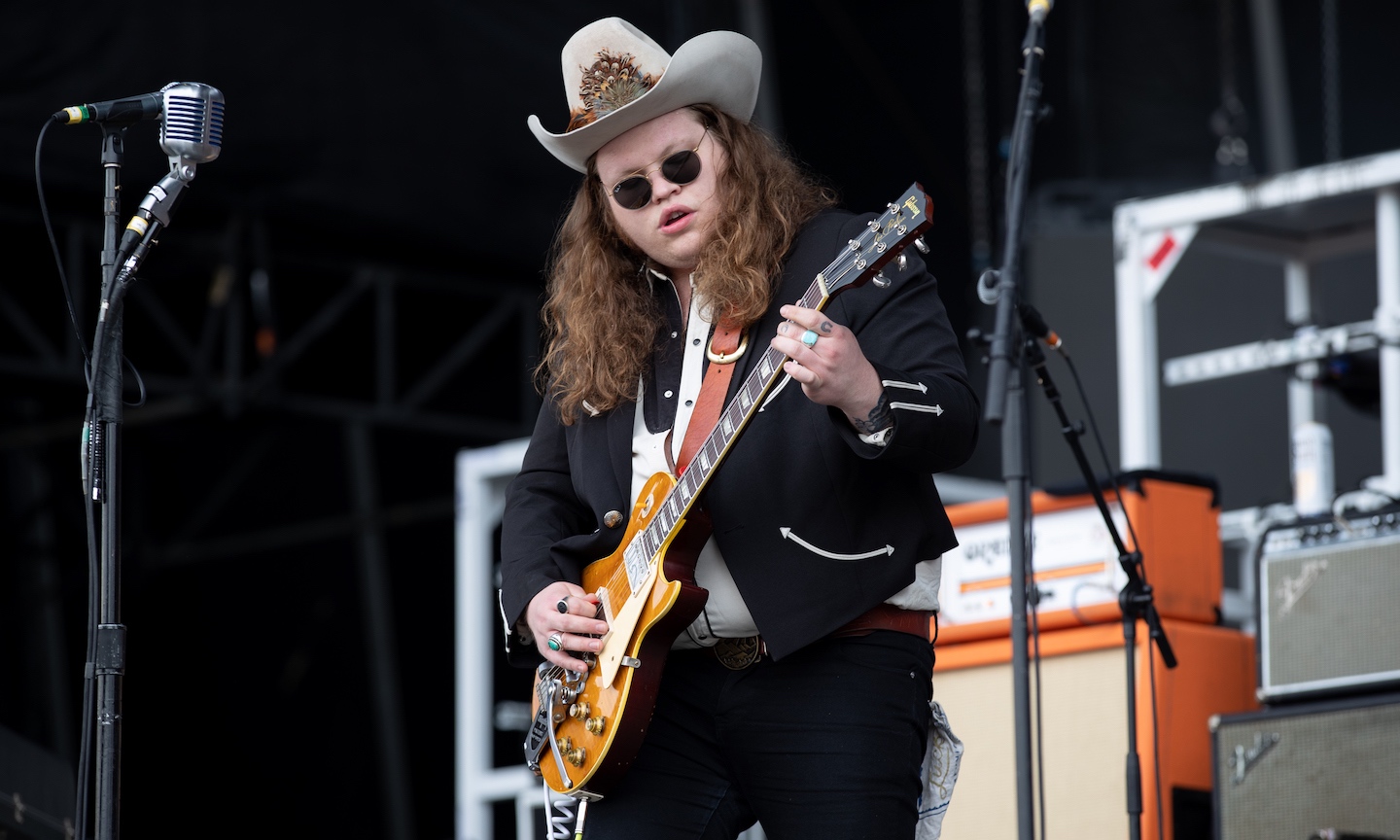
Start with the guitar, because with Marcus King the guitar and the tone are almost inseparable. His long-standing main instrument is a Gibson ES-345 — a 1962 model nicknamed "Big Red" that belonged to his grandfather and passed down through the family. A semi-hollow, center-block 335-family guitar with humbuckers, a Varitone circuit and enough air inside it to change how the notes decay.
That body style is doing real work. A solidbody Les Paul pushes air in a straight line: pick attack, sustain, done. A semi-hollow blooms. The note arrives slightly rounder, the low mids swell for a fraction of a second after the pick leaves the string, and feedback becomes a color rather than a problem. When King leans into a sustained bend at volume and the note starts to sing back at him, that's the box working with the amp instead of just sitting in front of it.
Then there's the neck pickup. Most of King's most identifiable lead tones live there — thick, dark, woody, with the top end rolled off just enough that the attack stops sounding like a pick and starts sounding like a voice. It's the same territory Duane Allman lived in on his Les Paul, and B.B. King on the ES-355, and Larry Carlton on the 335. It is also the hardest tone to play well, because a dark neck pickup hides nothing. There's no fizz to blur sloppy fretting and no compression to even out your dynamics. You are naked in there.
A bright bridge pickup with gain flatters you — it adds attack you didn't play and sustain you didn't earn. A dark neck humbucker on a semi-hollow does the opposite. It reproduces exactly how hard you hit the string, exactly how clean your fret-hand mutes are, and exactly how even your vibrato is. Players who sound great there are usually players with great hands.
The influence map underneath the sound is easy to name and hard to hear separately, which is the point:
- B.B. King — the economy, the space between phrases, the idea that one note held correctly outranks eight notes played nervously.
- Albert King — the enormous over-bends, the left-hand strength, the sense that the string is being physically wrestled rather than politely pushed.
- Duane Allman — the Southern melodic sensibility, the harmonized thinking, the slide-informed legato even when no slide is on his finger.
- Freddie King — the aggressive attack and the instrumental-shuffle drive, the way a solo can be a riff rather than a run.
- Stevie Ray Vaughan — the raw physicality and the refusal to play quietly when the song wants everything.
What keeps King from sounding like a tribute act is that he never imports a lick wholesale. He imports behavior. He plays B.B.'s patience with Albert's grip, in Duane's harmonic language, at SRV's intensity level, through a guitar none of them played. The result is recognizable within four bars and impossible to attribute to any single source.
Underneath all of it sits the oldest truth in electric guitar: tone starts in the hands. Give King a borrowed guitar through a rented amp and he still sounds like Marcus King within a phrase or two. That's not mysticism — it's measurable. Pick attack angle, pick depth, how much of the pick's edge contacts the string, where along the string length he picks, how much fret-hand pressure he uses, how quickly he releases a bend, how much palm contact sits on the bridge. Those variables shape a note far more than a $300 overdrive does.
[MEMBERS_CTA]
Why Marcus King's Vibrato Is Elite
If you want to understand why other guitar players talk about him, stop listening to the fast parts and listen to the held notes.
Vibrato is the single hardest thing on the instrument to fake. Everything else can be practiced into place with a metronome. Vibrato is a physical signature — a combination of speed, width, evenness and timing that reveals exactly how much control a player actually has. It is the guitar equivalent of a singer's voice, and like a voice, it is instantly identifiable to anyone paying attention.
Want Marcus King’s Tone?
Tell ToneMD what guitar and gear you own and we’ll show you how to get as close as possible using the equipment you already have — full signal chain, real numbered settings, no guesswork.
Included with The Guitar Plugged Premium
King's vibrato is wide, slow enough to breathe, and metronomically even. That last part is the rare one. Most players' vibrato accelerates as it goes — it starts hesitant and speeds up as nerves take over. His stays locked, pulse after pulse, which is why a held note of his sounds intentional rather than anxious.
• Consistency — every oscillation is the same width and the same speed
• Pitch return — the note comes back to true pitch, not sharp of it
• Timing — the vibrato starts where the phrase wants it, not immediately by reflex
• Variability — narrow and fast for tension, wide and slow for release
The pitch-return point is the one most players fail. If your vibrato oscillates above the target note and never settles back down, the whole phrase drifts sharp and the listener hears "out of tune" without knowing why. King's finger anchors the target pitch and the vibrato happens around it, the way a singer's does.
String control feeds directly into this. On a wound third string a full bend takes real hand strength; on a plain third it takes real restraint. King is comfortable in both directions, and he uses that comfort to access microtonal bends — quarter-tones that sit deliberately between the blue note and the major third. That's the sound people describe as "vocal." Human voices don't move in twelve equal steps, and neither does great blues phrasing.
Compare him with the players who own this territory and the picture sharpens:
- Gary Moore had perhaps the most violent vibrato in blues-rock — enormous width, hair-trigger onset, everything at maximum emotional pressure. King is more patient with the onset, holding the straight tone longer before the vibrato arrives.
- B.B. King used the famous "butterfly" wrist vibrato, narrower and faster, generated by shaking the hand off the neck. Marcus leans more toward the wrist-rotation, whole-arm bend-vibrato school.
- Stevie Ray Vaughan used vibrato as force — an extension of how hard he was attacking everything else. King uses it as dynamics, dialing it up and down to shape a phrase rather than running it wide open.
- Joe Bonamassa is a useful modern comparison because he's technically immaculate; his vibrato is exact and controlled. King's is looser and more Southern, closer to a gospel singer's melisma than to a precision instrument.
The takeaway for players: vibrato is what separates good guitarists from great ones because it's the only technique that cannot be improved by playing slower. You either have control of the string or you don't, and every listener can hear which.
The Guitar Vocabulary
Plenty of blues guitarists are fluent. Fewer sound fresh. The difference comes down to vocabulary — how many musical sentences you can construct, and how many of them the listener hasn't already heard a thousand times.
King's foundation is the minor pentatonic, as it is for almost everybody in this lineage. But he treats it as a starting position rather than a destination, and the moves he makes out of it are what give his solos their forward motion.
Major pentatonic over dominant chords. This is the single most Southern thing in his playing. Sliding from the minor pentatonic into the major pentatonic on the same root — the Allman Brothers move, the Dickey Betts move, the B.B. box move — instantly brightens a phrase and pulls it toward country and gospel. Players who only know the minor box sound like they're playing over the changes. Players who can flip between the two sound like they're playing with them.
Mixolydian. Add the major second and the major sixth to that major pentatonic and you have Mixolydian, which is what a dominant seventh chord actually wants. It's the sound of Southern rock jams, of horn-section soul, of gospel turnarounds. King moves in and out of it constantly, often within a single four-bar phrase.
Dorian. On minor grooves he reaches for Dorian rather than natural minor — that raised sixth gives a minor vamp a lift instead of a slump. It's the difference between mournful and soulful, and it's a large part of why his slow songs never feel maudlin.
X Concepts Strings • Made in USA
Never Run Out of Strings Again.
Join the X Concepts String Club and get fresh USA-made strings delivered every month—plus Premium membership options for the full Guitar Plugged experience.
Chromatic passing notes. The connective tissue. He'll walk chromatically into a target note from a half step below, which does two things: it delays the resolution by a fraction of a beat, and it makes the arrival feel earned. This is jazz vocabulary functioning as blues punctuation.
Double stops. Thirds and sixths, bent slightly and shaken, are the fastest way to make one guitar sound like two. It's a device that runs from Chuck Berry through Steve Cropper's Stax rhythm work into the Allmans' harmonized lines. King uses double stops the way a horn arranger would — as a harmonic thickening at exactly the point the song needs to swell.
Slide influence without a slide. Even when he's playing with fingers alone, the phrasing is slide-informed. Notes are approached from below and slid into rather than picked cleanly on. That's a Duane Allman inheritance and it's a large part of the vocal quality.
Southern gospel phrasing. This is the least technical and most important item on the list. Gospel singers phrase behind the beat, land on unexpected extensions, repeat a motif three times and change it on the fourth. King's solos are structured like that — call, response, escalate, resolve — instead of being a continuous stream of licks. It's why you can hum his solos back afterward.
“The first thing you notice isn't how fast he plays. It's how effortlessly emotional every phrase feels.”
Most blues solos fail in the same way: they present the same information at the same intensity for sixteen bars. King's solos have architecture. They start below the ceiling, leave silence early, develop a motif rather than abandoning it, and save the highest register and widest vibrato for the last four bars. That's arrangement thinking applied to improvisation.
Marcus King Isn't Just a Guitar Player
Here's the part guitar-forum debates tend to skip: Marcus King is a genuinely great singer.
Not a guitarist-who-also-sings. A soul singer with real grit, real range, and the phrasing instincts of somebody raised on Otis Redding and Ray Charles rather than on rock frontmen. That voice does something to his guitar playing that no amount of practice could replicate — it gives him a permanent internal reference for what a melodic line should feel like. When people say a guitarist "sings" through the instrument, they usually mean it as a metaphor. With King it's closer to a literal transfer of technique.
The soul influence runs deeper than the vocals. Early Marcus King Band records were built around horns, a genuinely unusual choice for a young blues-rock act, and horns force a guitarist to think differently. You cannot play continuously when there's a horn section — you have to place your parts inside an arrangement. That discipline is audible everywhere in his work now.
Then there's the songwriting. Carolina Confessions (2018) was the record where the songs started matching the playing — narrative, specific, structurally confident. El Dorado (2020), produced by Dan Auerbach in Nashville, stripped the band back and made his voice the center. Young Blood (2022) went the other direction: loud, raw, power-trio energy, the guitar back at the front. Mood Swings (2024), produced by Rick Rubin, was the most exposed record of his career — a genuinely uncomfortable, honest set of songs about mental health that happened to have guitar on it, rather than a guitar record with lyrics attached.
That range is why the phrase "complete musician" keeps attaching itself to him. And it's why the career is likely to last. Pure technicians hit a ceiling — there is a finite audience for velocity, and it does not grow. Musicians who write, sing, arrange and lead a band have somewhere to go when the novelty of their technique wears off. Every long career in this instrument's history follows that pattern.
Gear
The gear conversation around Marcus King is refreshingly short, which is itself the lesson.
The guitar. The 1962 Gibson ES-345 — "Big Red" — is the anchor. Semi-hollow, center block, dual humbuckers, Varitone. He has also played a Gibson signature model built around that instrument, plus various 335-family guitars and, more recently, a broader range including solidbodies and acoustics as the material has demanded. But the semi-hollow is the sound in most people's heads when they picture him.
Why semi-hollow matters. The center block gives you enough solidbody sustain to hold a note at volume; the hollow wings give you air, bloom and a slightly compressed low-mid response. It's a guitar that rewards touch dynamics because the note keeps evolving after you play it. It's also a guitar that will feed back if you're careless — which is exactly why players who use them well tend to have excellent volume-knob discipline.
Amps. Tube amps, loud, mostly clean-to-edge-of-breakup. King has been associated with Orange amplification in recent years — the orange cabinets are visible at most shows — and has used Fender-style and other classic tube circuits along the way. The philosophy is consistent regardless of badge: get a real amp moving air, set it where it's just about to break up, and control the rest with your hands and the guitar's volume control.
Overdrive. A dirt pedal in front of a cooking tube amp, used to push the front end rather than to generate the distortion outright. This is the whole trick of blues-rock gain staging: the amp makes the tone, the pedal makes the amp work harder. Tube Screamer–style mid-hump circuits and transparent Blues Driver–style boxes both work; they just push different frequencies.
Minimal pedals. No sprawling switching system, no elaborate ambient rig. A little dirt, a little wah at times, a touch of reverb or delay. The signal path is short enough that what comes out of the speaker is still recognizably the guitar and the hands that played it.
You can buy the ES-345. You can buy the amp. You can buy every pedal on his board. You will not sound like Marcus King, and he'd tell you the same thing. Tone comes from the hands first — attack, dynamics, vibrato, note choice, and the willingness to leave silence. The gear only decides how loudly your hands get broadcast.
Build a Marcus King Inspired Rig
A practical, no-nonsense route to the semi-hollow blues-rock sound. You do not need a 1962 ES-345 to get most of the way there — you need a center-block semi-hollow, a real tube amp, one dirt pedal and better hands.
*Affiliate disclosure: The Guitar Plugged may earn a small commission from qualifying purchases made through Amazon or Reverb links in this article, at no additional cost to you. See our affiliate disclosure for details.*
Five Things Guitarists Can Learn From Marcus King
1. Play fewer notes. Not as an aesthetic pose — as an arrangement decision. Every note you don't play makes the next one louder. Record yourself soloing over a slow blues, then play the same solo again with half the notes removed. The second version will almost always be better.
2. Master vibrato. Spend real, boring, isolated practice time on it. Bend to pitch, hold it, and oscillate evenly against a metronome — eighth notes, then triplets, then sixteenths, checking that you return to true pitch every time. This is the single highest-return technical investment a blues player can make.
3. Serve the song. Ask what the track needs before you ask what you can play. Sometimes the answer is a double stop and silence. King's solos work partly because they are sized correctly for the songs they live in.
4. Dynamics beat speed. Learn to play the same phrase at three volumes with your hands alone, no pedal, no knob. A solo that goes from a whisper to a roar is more exciting than a solo that starts at ten, because contrast is what listeners actually hear.
5. Learn to sing through your guitar. Literally sing a phrase, then find it on the neck. It will be shorter than what you'd normally play, it will breathe, and it will have a shape. Do that enough times and your playing starts sounding like a voice instead of a scale.
Essential Listening
- *El Dorado* (2020) — the Dan Auerbach–produced Nashville record. Restrained, warm, song-first, and the clearest showcase of his voice.
- *Young Blood* (2022) — loud, raw and guitar-forward. If you want the fire, start here.
- *Mood Swings* (2024) — the Rick Rubin record. Emotionally exposed, sonically adventurous, and the strongest evidence that he isn't going to stay in one lane.
- *Carolina Confessions* (2018) — the Marcus King Band album where the songwriting caught up to the playing. Horns, soul, Southern narrative.
- Live performances — non-negotiable. The studio records are excellent; the live playing is where the extended soloing, the dynamics and the band interplay actually live. Find full-set festival footage rather than clips.
The Future
Every generation of guitar music needs ambassadors — players who are good enough to command respect from the people already inside the tent, and compelling enough to bring in the people standing outside it. The blues has always depended on this. B.B. King did it for decades. Stevie Ray Vaughan did it in the eighties, at a moment when blues was supposedly commercially finished. Joe Bonamassa did it through relentless touring and a self-built audience.
Marcus King is doing it now, alongside players like Christone "Kingfish" Ingram and Eric Gales, and the effect is visible. Teenagers who found him through a festival clip end up at Duane Allman. Listeners who came for the voice end up at Otis Redding. That chain — modern player to their influences to their influences — is the actual mechanism by which this music survives. It has never survived through preservation societies. It survives because somebody young and undeniable makes it feel current again.
There's a second reason his rise matters. A generation of players is being trained by short-form video, where the incentive structure rewards the most notes in the fewest seconds. That's not evil — it's just a format with a bias. King's success is evidence that the other thing still works: that a wide vibrato and a well-placed silence can build a career and fill a room, and that audiences have not actually stopped responding to feel.
He's also still young. The catalog he'll build over the next twenty years is likely to be far larger than what exists now, and the Mood Swings record suggests he has no interest in making the same album twice. That restlessness is what separates players who have a decade from players who have a career.
Conclusion
Marcus King isn't trying to become Stevie Ray Vaughan. He isn't trying to become Duane Allman. He isn't trying to become B.B. King.
He's becoming Marcus King.
That may ultimately be why he's one of the most exciting guitarists alive today. He understands the history of the instrument — you can hear every bit of it in his phrasing, his tone and his choice of guitar. But he's writing the next chapter instead of repeating the last one.
And for anyone who has spent years worrying that this music was slowly becoming a museum exhibit, that's the most encouraging sound in the world: a young player with a vintage semi-hollow, a loud amp and almost no pedals, making it all feel brand new.
Related reading on The Guitar Plugged
Where does Marcus King rank among modern blues guitarists for you? Tell us in the comments.
- Boss BD-2 Blues Driver Overdrive PedalCheck price·Check on Amazon →
- Ibanez Tube Screamer Overdrive PedalCheck price·Check on Amazon →
- Ernie Ball Regular Slinky Nickel Wound Electric Guitar StringsCheck price·Check on Amazon →
- Dunlop Tortex Guitar Picks Variety PackCheck price·Check on Amazon →
Some links are affiliate links — we may earn a small commission at no cost to you.
Build a Marcus King Inspired Rig
Some links may be affiliate links. We may earn a small commission at no cost to you.
Experience-driven coverage, not algorithm bait.
- 20+ years of guitar playing experience
- Real-world retail experience at Guitar Center
- Thousands of hours testing guitars, amps, and pedals
- A community of 50,000+ guitar enthusiasts across platforms
- Partnerships with Fender, DistroKid, TrueFire, Card Chords, and Enya
- Editorial standards published openly — see how we test gear
Keep Guitar Loud
Join The Guitar Plugged newsletter for weekly guitar stories, gear, Tone Decoded features and exclusive classic rock content.
Ask GP
3 free questions a dayStill curious? Ask GP about this story.
Your personal classic-rock and guitar guide — ask anything about Marcus King.
Discussion (0)
Sign in to join the discussion.
Sign in to commentLoading comments…
Discover another guitar story
Swipe through our latest features, breaking news and iconic solos — one story at a time.
Open Swipe →More in Guitar Talk
Happy Birthday, Joe Perry: The Riff Machine Who Gave Aerosmith Its Swagger
Joe Perry turns 76 today. From the swampy grind of “Sweet Emotion” to the reunion that saved a band, this is the career of the guitarist who taught American hard rock how to strut.
History of the Riff: How Joe Satriani Made “Flying in a Blue Dream” Feel Weightless
An acoustic guitar in an unusual tuning, a stray broadcast and a melody that seems to hang in the air: inside the construction of Satriani’s 1989 masterpiece.
Tony Iommi Opens Up About His Final Conversation With Ozzy Osbourne: “I Still Can't Get It in My Head”
The Black Sabbath guitarist says Ozzy was exhausted after the band's emotional farewell — but determined to give fans one final show.