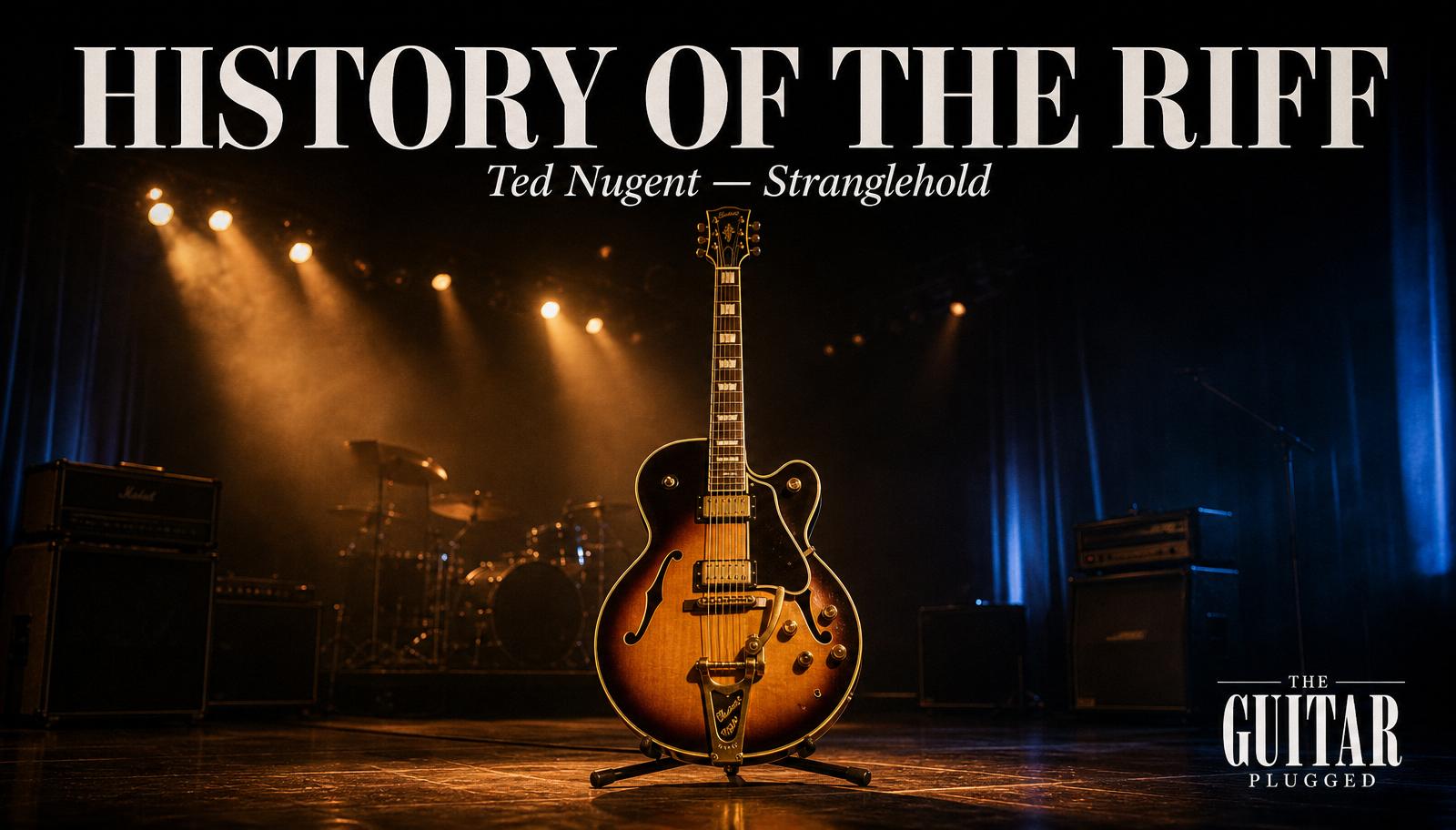
History of the Riff: How Ted Nugent's "Stranglehold" Created One of Rock's Most Hypnotic Guitar Grooves
A slow-burning, blues-drenched blueprint for how confidence, space and tone can outlast speed. Inside the story, gear and enduring influence of Ted Nugent's most iconic riff.
Before Derek St. Holmes ever opens his mouth, the song has already told you everything you need to know.
A few slow, deliberate notes rise out of the speakers — thick, saturated, patient — and within seconds every guitar player in the room knows exactly what they're hearing. It doesn't matter if it's coming through a bar's blown-out PA, a car radio at midnight, or a pristine set of studio monitors. Those first bars of "Stranglehold" arrive with the confidence of a song that has spent nearly fifty years quietly reminding rock guitar what it's actually supposed to sound like.
In an era that was obsessed with speed, complexity and technical firepower, Ted Nugent opened his debut solo album with one of the slowest, heaviest, most hypnotic riffs classic rock has ever produced. There's no flashy tapping. No neoclassical run. No layered stack of overdubbed harmonies. Just a hollow-body guitar, a wall of tube amplifiers, and a groove so patient it dares you to sit still.
That is the strange miracle of "Stranglehold." It is one of the most powerful riffs in rock history precisely because it refuses to hurry. It succeeds on feel, on space and on confidence. And nearly half a century after it was tracked in 1975, it still sounds enormous.
The Birth of Ted Nugent's Solo Career
To understand why "Stranglehold" hit the way it did, you have to understand where Nugent was coming from — and what he was walking away from.
By the early '70s, Ted Nugent had already spent years fronting The Amboy Dukes, the Detroit garage-psych band best known for their 1968 hit "Journey to the Center of the Mind." But by 1975, Nugent was hungry for something bigger, louder and more explicitly his own. He dissolved the last version of the Dukes and built a proper solo band around musicians who could deliver the ferocity he was chasing.
The lineup was lean and dangerous. Derek St. Holmes stepped in on lead vocals and rhythm guitar, bringing a bluesy, soulful voice that could ride effortlessly over Nugent's guitar. Rob Grange handled bass with a low-end swing that gave the band its Motor City muscle. Cliff Davies — a British drummer with a jazz background — locked everything into a hypnotic, in-the-pocket pulse that made even the loudest moments feel controlled.
That band tracked Ted Nugent, the 1975 self-titled debut, and everything about the record telegraphed a new phase. It was raw, unapologetic and completely uninterested in fitting into any polite corner of mid-'70s rock. It sold in the millions, went multi-platinum, and helped establish Nugent as one of the most commercially dominant hard rock guitarists of the decade.
Right at the very top of side one sat "Stranglehold." All eight-plus minutes of it.
Building the Riff
Look at "Stranglehold" on paper and it's almost embarrassingly simple. A slow tempo. A bluesy foundation rooted in the minor pentatonic. A handful of notes stretched across a huge, unhurried groove. There is nothing on the page that a first-year guitar student couldn't decipher.
But that's the trick. The notes aren't the song. The space between them is.
Nugent leans hard on open-string resonance, letting the low end ring while the upper register punches with heavy vibrato. Every phrase breathes. Every bend has time to speak. There are almost no unnecessary notes anywhere in the main figure — no filler, no showing off, no rushing to the next idea. The riff feels less written than carved, like Nugent chipped away everything that wasn't essential and dared the band to fill the rest with attitude.
This is the same philosophy that powers the greatest riffs from AC/DC, ZZ Top, Mountain and Cream. Angus Young leaves room between every chord. Billy Gibbons plays fewer notes than almost any Texas bluesman alive and hits harder than most of them. Leslie West and Eric Clapton both understood that a single sustained bend, played with the right touch, can carry more weight than a full 32-note run.
Restraint is a form of power. "Stranglehold" is one of its purest studies.
Tone Breakdown
The other secret weapon of "Stranglehold" is the sound of the guitar itself. This isn't a modern high-gain tone. It isn't a scooped, tight, chugging metal voice. It's warm, hollow, alive — a tone that could only have come from a big-bodied electric guitar pushed into a loud tube amp with almost nothing in between.
Get Ted Nugent’s “Stranglehold” Tone
Tell ToneMD what guitar and gear you own and we’ll show you how to get as close as possible using the equipment you already have — full signal chain, real numbered settings, no guesswork.
Included with The Guitar Plugged Premium
Nugent's weapon of choice has long been the Gibson Byrdland, a fully hollow archtop originally designed for jazz players. On paper, it's the last guitar you'd expect anyone to use for loud, aggressive hard rock. It feeds back easily. It's physically large. It has a shorter scale length. It fights you if you don't respect it. Nugent turned all of those "problems" into features. That controlled feedback becomes the sustaining voice of "Stranglehold." That hollow body gives every note a woody, three-dimensional character that no solid-body can quite replicate.
Behind the guitar sits a wall of loud tube amplification — the kind of clean-but-cranked Fender-style headroom that lets natural tube compression, not a distortion pedal, do the dirty work. Minimal effects. No modern noise-gating. Just pick attack, finger vibrato and a room full of moving air.
That is why so many players trying to recreate "Stranglehold" through a modern high-gain rig walk away disappointed. The organic quality of the recording lives in the interaction between a resonant hollow guitar, a loud tube amp on the edge of breakup and a human being playing with dynamics. Pile on too much preamp saturation and everything collapses into a modern buzz.
• Guitar: Gibson Byrdland or a full-body hollow archtop (ES-175/ES-330-style)
• Amp: Loud clean-platform tube amp (Fender Twin, Bassman, or high-headroom equivalent) pushed into natural breakup
• Pickup selection: Bridge humbucker for grit; neck for the fatter sustained bends
• Gain: Low-to-medium — let the amp compress, not a pedal
• EQ: Slight mid-forward; keep the bass controlled to prevent hollow-body mud
• Reverb: Just a touch of amp spring or a small plate — the room does most of the work
• Playing tips: Heavy pick attack, patient vibrato, and don't crowd the space between phrases
Derek St. Holmes' Contribution
It's worth stopping here to give Derek St. Holmes the credit he's often denied. Ask a casual listener who sings "Stranglehold" and there's a strong chance they'll say Ted Nugent. They'd be wrong.
St. Holmes' vocal is a masterclass in blues-rock phrasing. He rides on top of the groove with a smooth, soulful delivery that provides the essential emotional counterweight to Nugent's guitar. Where the riff is heavy and confrontational, the vocal is loose, expressive and human. That dynamic contrast is what turns "Stranglehold" from a great riff into a great song.
The relationship between vocal and riff is where the arrangement really breathes. St. Holmes never fights the guitar. He weaves around it, letting the guitar dominate the intro and then filling the middle sections with just enough melodic presence to remind you there's a story being told. If "Stranglehold" had been an instrumental, it would still be a great piece of music. With St. Holmes' voice on top, it becomes iconic.
The Legendary Extended Solo
X Concepts Strings • Made in USA
Never Run Out of Strings Again.
Join the X Concepts String Club and get fresh USA-made strings delivered every month—plus Premium membership options for the full Guitar Plugged experience.
Then, of course, there's the solo.
"Stranglehold" doesn't have a solo so much as it has a guitar performance — a long, improvisational, slow-cooked ride through blues phrasing, sustained bends and controlled feedback. It's one of the more famously extended lead sections in classic rock, and it moves with the same confidence as the riff that spawned it.
There's no rush. No obligation to prove anything. Nugent lets notes ring out for beats at a time. He bends into pitches from underneath, holds them, and then lets them decay naturally into the next phrase. He builds tension not through speed, but through phrasing — melodic ideas that develop the way a great blues solo should, with each phrase answering the last.
“Some riffs demand your attention through speed. "Stranglehold" earns it through authority.”
In an era where guitar solos were increasingly becoming showcases for technique, "Stranglehold" made a different argument. It suggested that a guitar solo could be a piece of storytelling. Its lineage runs much closer to David Gilmour's patient, vocal-like leads or Gary Moore's "Still Got the Blues" than to the shred era that would follow just a few years later.
That is why guitarists still respect the "Stranglehold" solo even in an age of hyper-technical instrumental playing. It refuses to compete on those terms. It wins on completely different ground.
Why Guitar Players Love This Song
Ask any working guitar teacher and they'll tell you: beginners learn the "Stranglehold" riff in an afternoon. The notes are simple. The pattern is repetitive. The tab isn't intimidating.
Ask any experienced player and they'll tell you the opposite: "Stranglehold" is deceptively difficult to actually play well.
The reason is that everything the song is really made of — timing, groove, dynamics, vibrato, touch, feel — cannot be captured in a tablature file. You can memorize every note perfectly and still miss the song entirely. The riff demands that you sit on the beat with authority, that your bends land with the right pitch and speed, that your palm stays relaxed enough to let the amp do the work.
It is one of those pieces of music that quietly separates players who understand feel from players who only understand notes. And it does so without any of the technical fireworks that usually get associated with "advanced" playing.
Influence on Rock Music
The DNA of "Stranglehold" runs directly through the next fifty years of rock guitar.
You can hear its patient, hollow-body swagger in Billy Gibbons' slow-cooked ZZ Top blues shuffles. You can hear its bend-and-sustain vocabulary in Slash's willingness to hold a single note across an entire bar of "Sweet Child O' Mine." You can hear its heavy vibrato in Zakk Wylde's massive one-note statements, in Jerry Cantrell's molasses-thick Alice in Chains grooves, and in the way Dimebag Darrell could make a single bend feel like a threat.
More broadly, "Stranglehold" is part of the reason that slow, heavy riffs are considered as powerful as fast ones in modern rock. Long before doom metal codified the idea, before stoner rock made worship of the low end an entire subgenre, before Alice in Chains dragged grunge into darker tempos, "Stranglehold" was quietly demonstrating that a riff moving at half speed could hit twice as hard.
Recording Legacy
The song was a commercial and cultural success from the moment it landed. Ted Nugent moved millions of copies, and "Stranglehold" became the album's calling card. It dominated FM album-oriented rock radio through the late '70s and '80s, and it never really left. Classic rock stations still play it in heavy rotation half a century later. Streaming has kept it in constant circulation for a new generation of listeners. It regularly appears on lists of the greatest guitar riffs and greatest guitar solos of all time.
There are songs that were bigger hits than "Stranglehold." There are songs that were more commercially dominant in their moment. But very few classic rock recordings have shown this kind of staying power without ever feeling dated. "Stranglehold" doesn't sound like 1975. It sounds like the timeless idea of a rock band walking into a room and playing loudly. That never goes out of fashion.
• Released in 1975 on Nugent's self-titled solo debut
• Opening track on the album — the first thing listeners ever heard from Ted Nugent's solo band
• Derek St. Holmes performed lead vocals, not Nugent
• Famous for its long, jam-like instrumental section
• Still widely covered by bar bands and classic rock tribute acts around the world
• A permanent fixture on "greatest guitar riffs" and "greatest guitar solos" lists
Why the Riff Still Matters
Modern guitar culture is dominated by information. Tablature is a click away. Backing tracks stream instantly. Every technique imaginable has been demonstrated at slow speed on YouTube. It has never been easier to learn notes.
And yet, decade after decade, players keep finding their way back to "Stranglehold" — and coming away humbled.
The reason is exactly what it has always been. In a landscape flooded with fast, technical, hyper-produced playing, "Stranglehold" quietly proves that groove, confidence and tone leave a bigger impression than speed. It's a song that rewards restraint, punishes rushing, and forces you to actually listen to what the drums and bass are doing underneath you.
For any serious student of classic rock guitar, it remains essential listening. Not as a trophy solo. Not as a party trick. But as a working model of how much can be said with very little — if you say it with authority.
Explore more of that philosophy in our Tone Decoded series, across the wider History of the Riff archive, in our roundups of the best classic rock albums, and in our list of the greatest guitarists of all time.
Conclusion
Great riffs don't always demand attention through speed. Some of them earn it through authority.
Every time those opening notes of "Stranglehold" push out of a speaker, something changes in the room. The tempo of the world drops a little. The conversation stops mid-sentence. Time seems to slow down just enough for you to remember what a great rock guitar tone actually sounds like when it isn't asking permission.
Few riffs demonstrate the power of space, tone and feel more effectively than "Stranglehold." It is not just one of Ted Nugent's greatest moments. It is one of the defining guitar riffs in the entire history of rock — a permanent reminder that sometimes the heaviest thing a guitar can do is take its time.
What to Remember
- ▸"Stranglehold" opened Ted Nugent's 1975 self-titled solo debut and helped define his career — a slow, hypnotic, blues-rooted riff in an era obsessed with speed.
- ▸The riff's power comes from restraint: pentatonic simplicity, open-string resonance, heavy vibrato and space between phrases — a philosophy shared with AC/DC, ZZ Top, Mountain and Cream.
- ▸Nugent's tone is built on a Gibson Byrdland hollow-body pushed into loud, clean-headroom tube amps with minimal effects — natural tube compression and pick attack, not modern high-gain.
- ▸Derek St. Holmes sang lead vocals — not Nugent. His smooth, blues-inflected delivery is what turns the riff into a complete song.
- ▸The famously extended solo works because it prioritizes phrasing, bends and sustain over speed, closer in spirit to Gilmour and Gary Moore than to the shred era that followed.
- ▸Beginners learn "Stranglehold" quickly, but experienced players know it's difficult to master — because timing, groove, dynamics and feel can't be captured in tablature.
Keep Exploring History of the Riff
- Ted Nugent — Self-Titled Debut (Vinyl)$29·Check on Amazon →
- Fender Tube Amplifier$899·Check on Amazon →
Some links are affiliate links — we may earn a small commission at no cost to you.
Shop "Stranglehold"–Inspired Gear
Some links may be affiliate links. We may earn a small commission at no cost to you.
Experience-driven coverage, not algorithm bait.
- 20+ years of guitar playing experience
- Real-world retail experience at Guitar Center
- Thousands of hours testing guitars, amps, and pedals
- A community of 50,000+ guitar enthusiasts across platforms
- Partnerships with Fender, DistroKid, TrueFire, Card Chords, and Enya
- Editorial standards published openly — see how we test gear
The Modern Guitar Magazine. Delivered to your inbox.
No spam. No gimmicks. Just great guitar content — stories, tones, iconic solos, and honest gear takes. Every week.
Ask GP
3 free questions a dayStill curious? Ask GP about this story.
Your personal classic-rock and guitar guide — ask anything about How Ted Nugent's "Stranglehold" Created.
Discussion (0)
Sign in to join the discussion.
Sign in to commentLoading comments…
Discover another guitar story
Swipe through our latest features, breaking news and iconic solos — one story at a time.
Open Swipe →More in Guitar Talk
Happy Birthday, Joe Perry: The Riff Machine Who Gave Aerosmith Its Swagger
Joe Perry turns 76 today. From the swampy grind of “Sweet Emotion” to the reunion that saved a band, this is the career of the guitarist who taught American hard rock how to strut.
History of the Riff: How Joe Satriani Made “Flying in a Blue Dream” Feel Weightless
An acoustic guitar in an unusual tuning, a stray broadcast and a melody that seems to hang in the air: inside the construction of Satriani’s 1989 masterpiece.
Tony Iommi Opens Up About His Final Conversation With Ozzy Osbourne: “I Still Can't Get It in My Head”
The Black Sabbath guitarist says Ozzy was exhausted after the band's emotional farewell — but determined to give fans one final show.