
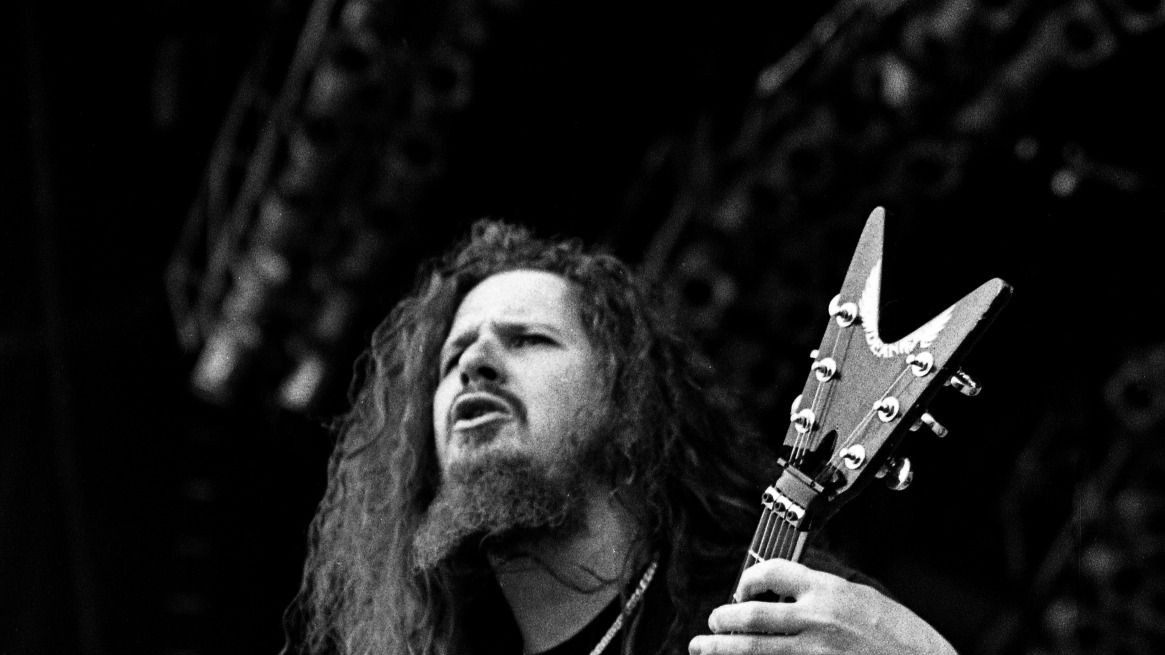
Dimebag Darrell performing with Pantera at Monsters of Rock, 1994. Photo: Martyn Goodacre, via Wikimedia Commons (CC BY 4.0).
Inside the fearless Texas guitar language, brutal-but-musical tone, and melodic instinct that made Dimebag Darrell impossible to imitate — and impossible to replace.
You always know within a bar and a half.
A Pantera riff does not fade in. It does not build politely from an ambient wash. It lands — dry, clipped, mean and weirdly bouncy — like something heavy being dropped on a concrete floor by somebody who is enjoying himself enormously. Before the vocal, before the chorus, before you can even name the song, the guitar has already told you exactly who is holding it.
That is the strange thing about Dimebag Darrell. Extreme metal guitar is a crowded room full of players with monstrous distortion and monstrous chops, and almost all of them blur together at a distance. He never did. Not once. Turn on classic rock radio and you can identify Angus Young in four notes. Turn on a metal station and you can identify Dimebag in two.
The easy explanation is gear: the Dean ML, the dive bombs, the squeals. The easy explanation is wrong, or at least badly incomplete. Plenty of players bought the same guitar, the same pickup, the same amps. Nobody sounded like him.
What made Dimebag Darrell one of the defining electric guitar voices of the last forty years is something harder to buy: he made extreme metal feel loose. Dangerous. Melodic. Funny, occasionally. Joyful, almost always. He took a genre that was busy proving how serious and technical it could be, and he made it swing.
The Guitarist Who Put a Smile Back Into Heavy Music
By the end of the 1980s, guitar had gotten very good at being impressive and very bad at being fun. The shred era produced a generation of extraordinary technicians, and it also produced an aesthetic where every solo sounded like a job application. Metal rhythm playing, meanwhile, was hardening into a formal discipline: faster, tighter, more mechanical, less human.
Dimebag had the entire shred vocabulary. He could play the sweeps, the tapped arpeggios, the whammy-bar theatrics, the whole conservatory of late-eighties technique. What separated him is that he almost never deployed those tools the way shredders did. He put them inside riffs. He used virtuoso material as texture and punctuation rather than as the point of the exercise.
That instinct is why Pantera riffs hit like a band rather than a click track. And that instinct has a name attached to it: Vinnie Paul.
The relationship between Dimebag and his brother behind the kit is the single most underrated technical fact about Pantera. Vinnie Paul did not play metal drums the way most metal drummers of that era played them. He played them like a groove drummer who happened to hit extremely hard — with a heavy backbeat, a lot of ghost-note information and a bass drum pattern that left holes rather than filling every subdivision.
Dimebag wrote guitar parts into those holes. Listen to what he does not play. The riffs stop. They stutter. They hang back a fraction and then snap forward. Most metal guitarists play at the beat. Dimebag played with it, around it and occasionally against it — on purpose — because he trusted the drummer he had grown up next to in Arlington, Texas to keep the floor from moving.
That is why the word groove attached itself to what Pantera were doing. Groove metal is not a marketing term for slower thrash. It describes a specific rhythmic relationship: riffs as percussion, silence as an instrument, and a band that behaves like a rhythm section with a lead guitarist inside it rather than a lead guitarist with a backing band.
The band's transformation is well documented and frequently condescended to. Pantera spent the mid-eighties as a Texas glam-metal outfit with hairspray and high notes, and the received wisdom is that they threw all of it away when Phil Anselmo arrived and Cowboys From Hell reintroduced them in 1990. That is half true. What they actually kept was the part that mattered: musicianship, showmanship, and a complete lack of embarrassment about entertaining a room.
What followed is one of the most focused runs in metal. Cowboys From Hell established the language. Vulgar Display of Power in 1992 sharpened it into something violent and physically compressed. Far Beyond Driven in 1994 pushed it into genuine ugliness and still debuted at number one. The Great Southern Trendkill in 1996 got stranger, bleaker and more experimental. Reinventing the Steel in 2000 planted a flag on the whole approach as the world moved on to something else.
Across all five records the constant is not tempo, or aggression, or even tuning. It is personality. Every one of those albums sounds like a specific human being with a specific right hand deciding, riff by riff, where the notes go.
“Cowboys From Hell”: The Moment the Rules Changed
The title track is a masterclass in restraint disguised as an assault.
Play the main riff slowly on a clean amp and you will notice something almost disappointing: there is not much to it. The complexity is low. A guitar student can learn the notes in an afternoon. What that student cannot learn in an afternoon — and what most never learn at all — is the placement.
The riff's identity lives entirely in attack and space. Each figure is chopped off before it can ring. The palm mute is not a mood, it is a rhythmic device, used to shorten notes to precise lengths so that the gaps between them become audible events. The result is a guitar part that behaves like a snare pattern with pitch information attached.
Want Dimebag Darrell’s Tone?
Tell ToneMD what guitar and gear you own and we’ll show you how to get as close as possible using the equipment you already have — full signal chain, real numbered settings, no guesswork.
Included with The Guitar Plugged Premium
Then there is the sound itself: open, bright, aggressive and unusually dry for 1990. Most metal guitar tones of that period were drowning in reverb or smeared by chorus. Dimebag's is right up against your face with nothing between you and the pick. There is nowhere to hide. If the picking hand is even slightly late, the whole thing collapses.
It never does, because his right hand is locked to Vinnie's kick drum with a precision that has nothing to do with a metronome and everything to do with two brothers who had been playing together since they were kids. Darrell Lance Abbott, born in Arlington in 1966, co-founded Pantera with his older brother. Whatever else the band changed over two decades, that engine was original equipment.
The riff does not rely on excessive complexity. It relies on conviction, placement, and a right hand that treats a distorted guitar as a percussion instrument that can also sing.
His Secret Weapon Wasn't Gain
Here is the sentence that has misled two generations of guitar players: “Dimebag's tone was scooped mids and tons of distortion.”
It is repeated constantly, it is easy to test, and it produces a sound nothing like his. Try it. Max the gain, drop the mids to zero, boost the bass and treble, and play the “Cowboys From Hell” riff. You will get a fizzy, formless mess that vanishes the moment a bass guitar enters the room. Whatever that is, it is not what is on the record.
What is actually happening is more interesting and much more useful.
Dimebag's sound is built on definition. The core ingredients are attack, upper-midrange articulation, ferocious muting discipline, deliberate harmonic control, aggressive noise management, and an EQ and gain chain assembled specifically to stop high gain from turning into mush. The broad EQ contour of his live rig could certainly look scooped on a faceplate. The functional result was a tone with an enormous amount of information in the 1.5–4 kHz region, which is precisely where pick attack lives.
The building blocks most associated with that sound:
• Dean ML-style guitars — most famously the heavily modified 1981 Dean ML known as the “Dean From Hell.” The ML's long, resonant body and offset mass are part of the attack, not just a logo
• High-output bridge pickups, above all the Bill Lawrence L-500XL — a blade-style, high-output design with an unusually forward upper-midrange character
• Floyd Rose tremolo systems — not an accessory but a compositional tool; the whammy bar is part of his phrasing vocabulary
• Randall solid-state amplification — stiff, fast, unforgiving transient response. Solid-state is the reason the mutes sound like hits rather than thumps
• Furman PQ-3/PQ-4 parametric EQ — the least-discussed and most important item in the rack, used as an active tone-shaping and gain-staging device rather than a corrective utility
• Graphic EQ, noise gate, delay and tightly controlled effects — the gate in particular is what makes the silences silent
• His harmonic vocabulary and whammy-bar control — the part that cannot be bought
The Furman deserves its own paragraph, because it is where most tone-chasers go wrong. A parametric EQ placed in front of and around a high-gain amp does not merely correct problems. It decides what the distortion is being fed, and therefore what the distortion sounds like. Push a narrow band of upper mids into a stiff solid-state front end and you get bite and clarity at high gain. Cut the wrong low frequencies before the preamp and the low end tightens without losing weight. That is gain staging as composition, and it is a large part of why nobody replicates this tone by turning knobs on a modeler's amp block alone.
One honest caveat, because accuracy matters more than mythology: there was never one permanent Dimebag rig. Amps, cabinets, rack contents, guitars and even pickup choices shifted across albums, tours and eras, and the studio signal chains differed from the live ones. Treat the list above as the load-bearing walls of his most associated sound, not as a wiring diagram for a specific song.
“Most metal guitarists play at the beat. Dimebag played with it, around it, and occasionally against it — on purpose.”
The Harmonics Had a Voice
Anybody can produce a pinch harmonic. Catch the string with the edge of the thumb as the pick passes, land in the right node, and a squeal comes out. It takes an afternoon to learn and about a decade to make musical.
Dimebag made them speak. The difference is not the harmonic — it is everything wrapped around it.
Start with pick angle. He attacked with the pick tilted, so the thumb was already in contact position and the harmonic could be summoned on demand rather than hunted for. That meant he could place a squeal on a specific note in a specific bar, every time, instead of hoping one appeared. A technique you can only produce by accident is a trick. A technique you can aim is a vocabulary.
Then there is what happens after the note exists. He did not let harmonics sit still. The whammy bar goes in immediately — a shake, a dip, a scoop up into pitch — and the left hand adds vibrato that is wide, deliberate and slightly unruly. Blues players do exactly this with bent notes. Dimebag was doing it with harmonics, at metal volume, over a groove.
That is the actual insight: he treated the harmonic as a vocal inflection. Not decoration, punctuation. A shout at the end of a phrase. A sarcastic aside. A note that answers the vocal instead of competing with it.
The evidence is spread across the catalogue, and it is worth hearing how different the applications are. In “Walk,” the guitar is almost entirely rhythmic, a swaggering half-time strut where every accent is placed like a boot heel. “Mouth for War” is all forward propulsion, the picking hand driving the band rather than following it. “Becoming” leans on the whammy as a compositional device, the pitch bending under the riff itself. “I'm Broken” is groove and syncopation, riff writing with an almost funk sense of where the hole should be. “5 Minutes Alone” is space and menace, a riff that waits. “This Love” shows the dynamic range in a single song: near-clean, restrained verses and a chorus that arrives like a door being kicked in.
Six songs, six different jobs for the same pair of hands.
“Floods” and the Melodic Side of Dimebag
And then there is “Floods.”
If you only know Pantera as the loudest band on the shelf, the closing solo of “Floods” is the argument that ends that conversation. It is regularly named among the greatest guitar solos in metal, and unlike most entries on that kind of list, it does not earn its place through difficulty.
It earns it through narrative.
The solo begins almost tentatively, with clean, exposed phrasing and enormous amounts of air around each note. Nothing is rushed. Notes are allowed to arrive, sit, bend and decay. The vibrato is slow and vocal, closer to a blues player than a metal one. Space is doing as much work as sound, and the listener is leaning in rather than being pushed back.
Then it builds — not by getting faster, but by getting more certain. The phrases lengthen. The bends reach further. The tone thickens underneath as the band swells around it. By the time the final section arrives, the solo has traveled somewhere, and the emotional payoff feels earned rather than announced.
Contrast that with the way virtuosity is usually deployed in heavy music: a burst of information at high speed, technically flawless, emotionally sealed. Sterile shred tells you the player practiced. “Floods” tells you the player felt something. Dimebag could be genuinely violent in one bar and unashamedly lyrical in the next, and he never seemed to regard those as different jobs.
“Cemetery Gates” makes the same case from a different angle. The clean arpeggios, the harmonized lead lines, the melodic patience of the solo section — it is the work of a guitarist with a full command of melody who simply chose, most of the time, to spend it on riffs.
Which points at the thing that really separates him. Dimebag did not divide himself into a rhythm guitarist and a lead guitarist. His leads carried rhythmic authority — you can hear the groove inside the phrasing even when the band drops out. His riffs carried melodic identity — you can hum most of them. In a genre that had largely split those two roles into different personalities, he refused to pick one.
The Texas in His Hands
The lazy comparison is Eddie Van Halen. The lazy comparison is also unavoidable, because Dimebag never hid it: the flash, the whammy abuse, the harmonics, the sheer physical joy of playing loud all trace back to that door being kicked open in 1978.
But Eddie is one ingredient in a very Texan recipe.
From Van Halen he took freedom — permission to treat the electric guitar as a device for making noises nobody had made yet, and permission to sound like he was having a great time doing it. From Ace Frehley he took personality over precision: the idea that a solo's job is to be memorable, that a guitar player is a character, and that showmanship is not a compromise of musicianship. From classic heavy metal — Sabbath, Priest, Maiden — he took weight, riff architecture and the discipline of a riff that can hold an entire song up by itself.
Then come the parts that are harder to import if you did not grow up where he grew up. Southern boogie swagger, which is the actual source of the swing in his rhythm playing — that pushed-and-pulled, slightly behind-the-beat strut that no amount of thrash technique will teach you. Blues vocabulary, which is where the bends, the vibrato and the phrasing on “Floods” come from. And the ambient music education of Texas, where blues, country, southern rock and metal all shared the same bar circuit and the same audience expectations about entertaining a room.
Put those together and you do not get “Eddie Van Halen but heavier.” You get a different language, built from familiar words. Dimebag absorbed his influences so completely that they stopped being references. Nobody hears “Walk” and thinks about Ace Frehley. They hear Dimebag, which is exactly what happens when a player finishes digesting the things that made him.
What Modern Players Still Get Wrong About Dimebag's Tone
The practical section, for anyone who has spent a weekend chasing this sound and come away frustrated.
• Don't start by maxing out gain. Set the amp where the notes stay separate, then add distortion only until you lose definition — and back off one notch
• Tighten your picking before reaching for another pedal. Ninety percent of a “mushy” high-gain tone is muting and attack, not equipment
• Use EQ to create focus, not just a giant mid scoop. Boost a narrow band of upper mids and hear how much more the guitar cuts. Scoops sound huge alone and vanish in a band
• Practice pinch harmonics as phrasing, not party tricks. Aim them at a specific note in a specific bar, then add vibrato and the bar. If you cannot place one on command, you do not have the technique yet
• Let riffs breathe. Silence is part of the groove. Record yourself and count how many notes you could remove without losing the riff
• Build a tone that responds to your hands and your own rig. His sound worked because it suited his attack, his guitar and his room. A copied EQ curve in a different context is just somebody else's homework
Hear it. Chase it. Build it.
Enter the tone you want, tell ToneMD the gear and pickups you actually own, and get a recipe built for your rig — full signal chain, real numbered settings and step-by-step instructions for your exact amp or modeler.
Open ToneMDFree lookups every month · Unlimited with The Guitar Plugged Premium
Dimebag Darrell belongs in the conversation with the defining voices of the electric guitar era, and not as a genre specialist admitted on a technicality. His sound was immediate — identifiable in two notes, from across a room, on a bad car stereo. His feel was personal in a way that technique alone cannot manufacture. And his influence was earned the hard way, one riff at a time, on records that people are still trying to reverse-engineer three decades later.
What he really did was make technical ability feel human. The chops never floated free of the song, the band or the party. The playing was always attached to something.
Long after the gear has been cloned and the licks have been slowed to half speed on YouTube, the hardest thing to recreate is the spirit — Dimebag made metal feel alive.
The Guitar Plugged may earn a commission from qualifying purchases, at no added cost to you.
Gear to Explore
Some links may be affiliate links. We may earn a small commission at no cost to you.
Sources & further reading
- 1.Pantera — Cowboys From Hell (Atco, 1990)
- 2.Pantera — Vulgar Display of Power (Atco, 1992)
- 3.Pantera — Far Beyond Driven (EastWest, 1994)
- 4.Pantera — The Great Southern Trendkill (EastWest, 1996)
- 5.Pantera — Reinventing the Steel (EastWest, 2000)
Experience-driven coverage, not algorithm bait.
- 20+ years of guitar playing experience
- Real-world retail experience at Guitar Center
- Thousands of hours testing guitars, amps, and pedals
- A community of 50,000+ guitar enthusiasts across platforms
- Partnerships with Fender, DistroKid, TrueFire, Card Chords, and Enya
- Editorial standards published openly — see how we test gear
The Modern Guitar Magazine. Delivered to your inbox.
No spam. No gimmicks. Just great guitar content — stories, tones, iconic solos, and honest gear takes. Every week.
Ask GP
3 free questionsQuestions about Dimebag Darrell Didn't Just Make?
Get a straight answer from The Guitar Plugged's knowledge engine.
Discussion (0)
Sign in to join the discussion.
Sign in to commentLoading comments…
Discover another guitar story
Swipe through our latest features, breaking news and iconic solos — one story at a time.
Open Swipe →More in Tone Decoded
The Infamous Stevie Ray Vaughan Soundcheck
No crowd. No spectacle. Just Stevie Ray Vaughan checking levels at the Syria Mosque in 1986 — and sounding absolutely monstrous. What the footage reveals about tone, touch and the myth of the rig.

The Last 10%: Why You Can Copy a Famous Guitarist’s Entire Rig and Still Miss the Tone
You bought the guitar, the amp, and the pedals — so why doesn’t it sound right? The last 10 percent of guitar tone is the most important part, and it’s almost never about the gear list.
Why John Frusciante's Tone Is Harder to Copy Than You Think
Everyone chases the Strat, the Tube Screamer, the CE-1 chorus. But the real Frusciante sound lives in his hands, his dynamics, and the way he treats pedals like colors — not crutches.